Why AEO Is Hard to Measure: The Reporting Gap in AI Search
Prerequisites: What you need before measuring AEO
Before any prompt panel or GA4 work, assemble five things. Skip this and you will spend a cycle collecting numbers that answer nothing.
- GSC access on the property, with page-level impressions and clicks export.
- GA4 Edit or Explore access, plus permission to create custom channel groups in Admin > Attribution Settings > Manage Channel Groups.
- 15-20 high-intent buyer questions in your niche. Pull these from actual customer language: sales call transcripts, support tickets, site search logs, community discussions. Constraint-heavy phrasing works best (“best X under $100 for Mac with offline sync”), not one-word keywords.
- Current merchant program terms: cookie window, commission rate, approval rules. Log a dated copy so you can spot term changes later.
- A blank evidence log – a spreadsheet with columns for prompt, engine, run, mention (yes/no), citation (yes/no), link present, competitor names, wrong facts, date.
GA4’s native AI Assistant channel went live May 13, 2026, but many ChatGPT, Gemini, and Claude sessions never pass a referrer header. So even the official channel is a floor. Merchant terms drift; the verify program details before ChatGPT guide covers that audit separately.
Checkpoint: You have a named prompt set and an evidence log with columns ready before touching a single AI interface.
Step 1: The reporting gap - no Search Console for LLMs
A common failure mode is treating AEO ranks as if an LLM ledger existed. It does not. Search Console tracks blue links. A synthesized answer is not a link. When someone asks, “What is your ChatGPT rank?”, the honest answer is a range across runs, not a position.
Google is piloting Search Generative AI performance reports, but those blend AI Overview impressions into overall performance. A citation impression is not a click. There is no stable, standardized KPI that tells you AI visibility the way GSC tells you click-through.
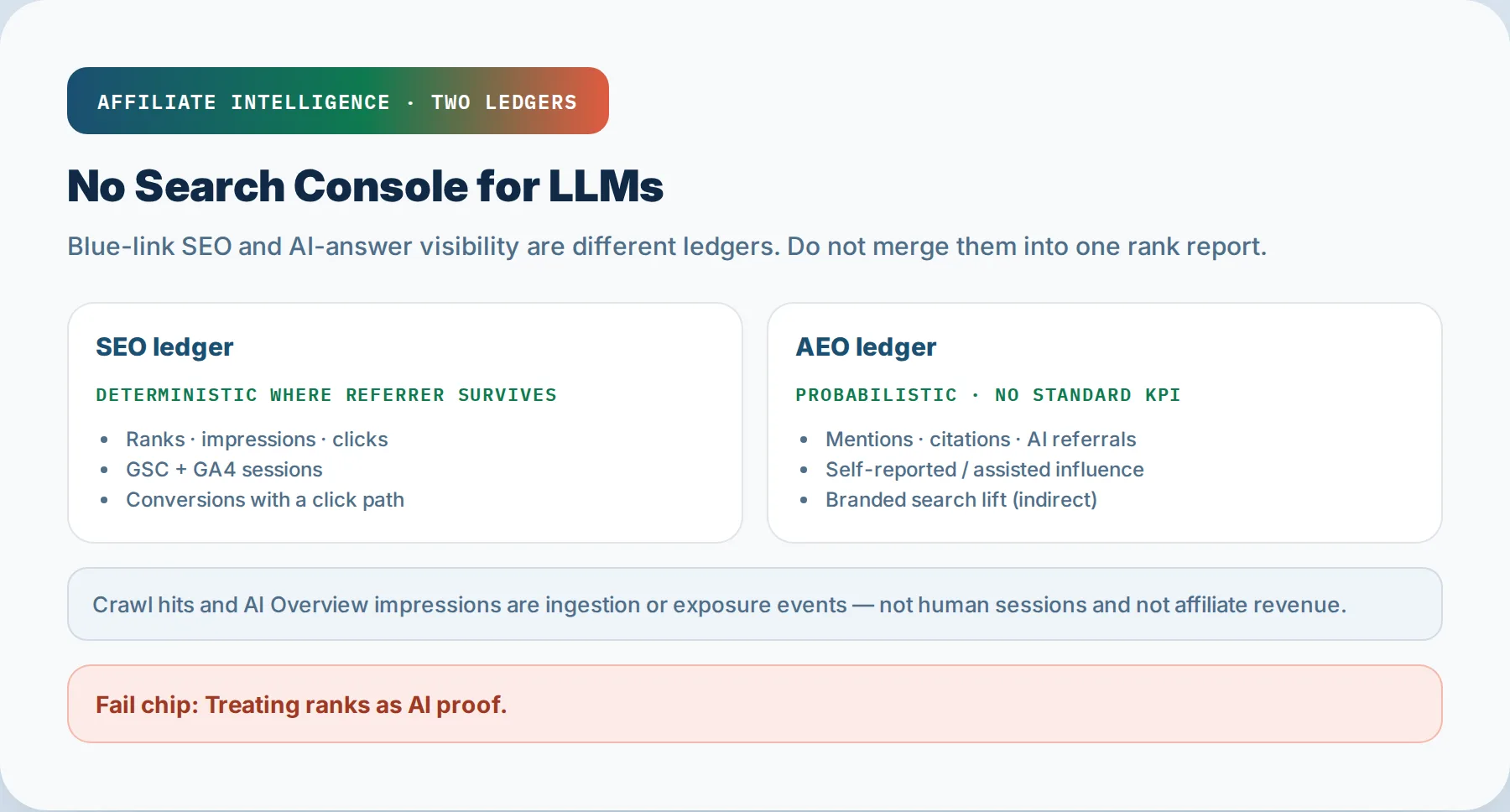
The two ledgers: SEO vs AEO
Publishers often expect Search Console to extend naturally. It does not. Two separate ledgers exist:
- SEO ledger: ranks, impressions, clicks, sessions, conversions. GSC plus GA4. Deterministic where a referrer survives.
- AEO ledger: mentions, citations, AI referrals, self-reported influence, branded search lift. None standardized. All probabilistic.
The overlap is shrinking. Ahrefs found only 38% of Google AI Overview-cited pages rank in the organic top 10, down from 76% a year earlier. Moz’s 2026 analysis of 40,000 queries put 88% of Google AI Mode citations outside the organic top 10. The two ledgers are not interchangeable.
Checkpoint: You can now name the two ledgers and their units - blue-link rank/click versus citation/mention/assisted.
What crawl hits do not prove
Server logs show GPTBot or ClaudeBot fetching a page. That is an ingestion event. It is not a human visitor, not a session, and it generates no affiliate revenue. Operators who report crawl hits as “AI demand” are measuring a delivery truck, not a sale.
Same problem with impressions inside AI Overview reports. An impression means the URL appeared in a generative feature. It does not mean anyone read it, clicked, or remembered the brand. Stop using crawl requests and AI impressions as proof of buyer interest.
Step 2: Why SEO scoreboards fail here
A common failure mode is reporting rank as proof of AI demand. Rankings can hold while clicks fall. Ahrefs measured position-one organic CTR on AI Overview queries dropping 58% as of December 2025. Seer Interactive found 49.4% to 65.2% declines on impacted queries, and a randomized field experiment reported 39.8% click loss. The narrow claim stands: blue-link scoreboards mislead as AEO proof. Do not present one universal click-loss percentage.
Checkpoint: You can state whether a traffic decline is click loss, ranking loss, or both.
Rank does not equal citation
SEO ranking and AI citation are different surfaces. A Chatoptic study of 15 brands found only 62% overlap between Google first-page rankings and ChatGPT mentions, with a correlation of 0.034. That is noise-level. Do not fake ChatGPT rank certainty.
Audit your existing rank report. Flag any row that assumes page one position transfers to AI visibility. It does not.
Diagnose click loss separately from ranking loss
Seer Interactive’s Q3 2025 YoY data splits the pattern. When AI Overviews were present but a brand was not cited, organic CTR sat at 0.52%, down 65.2%. Cited brands fared better: 0.70%, down 49.4%. No AI Overview at all: 1.45%, down 46.2%. Being cited recovers some click loss, but both decline.
The diagnostic question for stakeholders: did we lose the rank, or did we lose the click? If rank holds but clicks fall, AI Overview interception is the likely cause, not a rankings failure. That distinction changes the fix: you optimize for citation or extractability, not for more backlinks.
Answer-shaped extractability is not rank
A page can hold rank one and still lose the citation because the extractable answer block is buried. What I measure instead is whether the manual prompt panel pulls a clean passage, table, or definition from the page. Structural changes such as clear answer blocks, comparison tables, and entity consistency matter more than adding word count or low-quality links. In one tactic review, structural changes showed a +115% AI visibility lift, comparison tables +40%, statistics +41%, while word count alone produced +0.4% and low-quality backlinks roughly zero (FancyAI research on AI visibility lift by tactic).
Track extraction frequency in the prompt panel, not organic position. See content formats defensible against AI shopping for the format playbook.
Step 3: Proxies: useful, easy to oversell
Proxies are the only honest material here, and they are dangerously easy to oversell. Label every proxy with a proof ceiling: what it proves, what it does not. No single number should carry an AEO report.
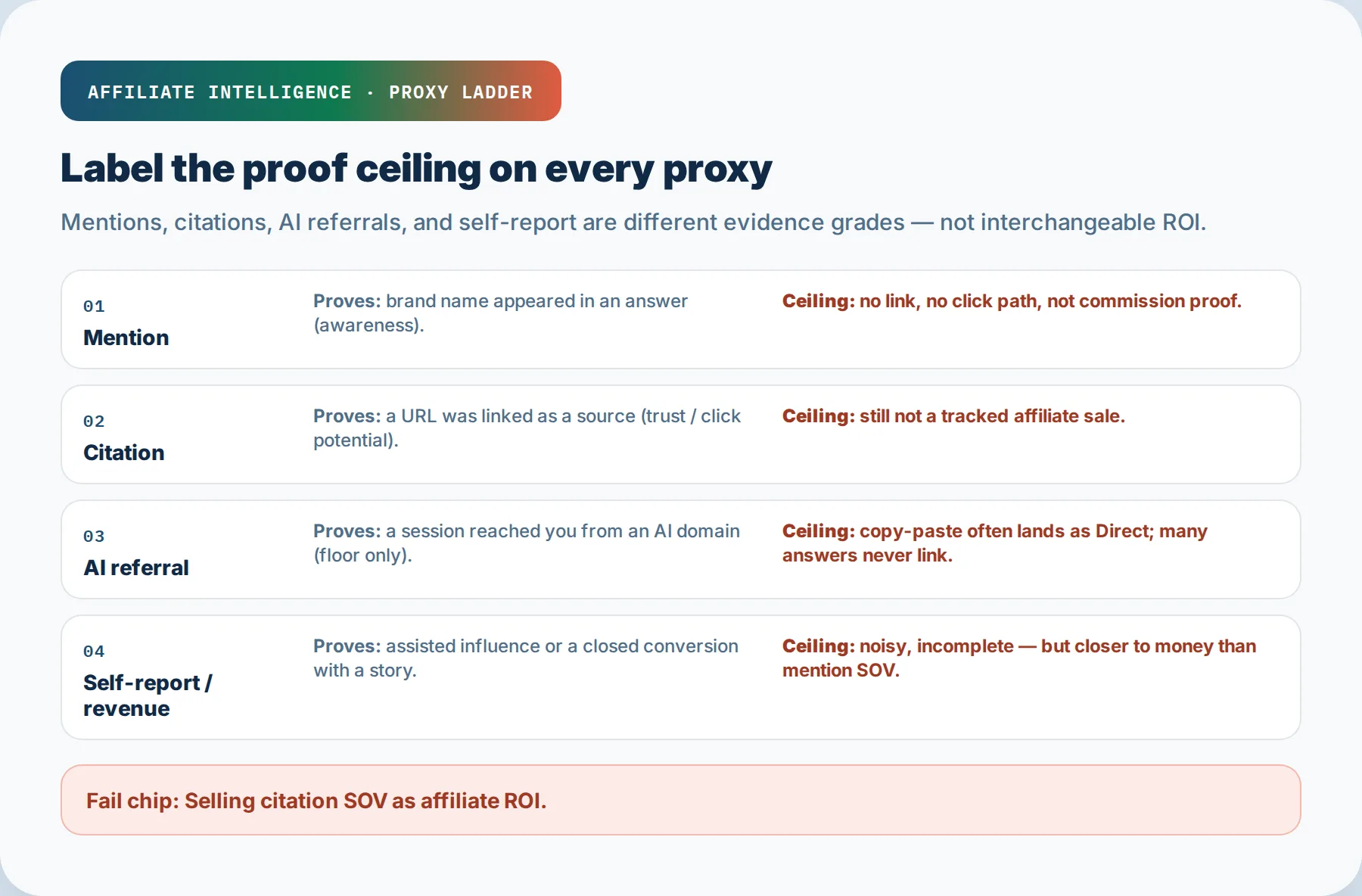
Mention vs citation vs purchase-adjacent prompt
Three structurally different signals hide inside “AI visibility”:
- Mention – the brand name appears with no link. Awareness only.
- Citation – a specific URL is linked as a source. Trust signal, click potential.
- Purchase-adjacent prompt – the query asks for a recommendation or comparison. Highest commercial weight.
ChatGPT has 99.3% brand inclusion in eCommerce responses but 3.2x more mentions than citations. Google AI Overview sits near the opposite end: 6.2% brand inclusion, but 2.4x more citations than mentions. A mention in ChatGPT is a low-signal event because almost every brand shows up. A citation in Google AI Overview is a high-signal event because almost no brand does.
Create a three-column log: mention, citation, purchase-adjacent. They carry different proof ceilings, and conflating them inflates your report.
Checkpoint: Your evidence log separates mentions, citations, and purchase-adjacent prompts.
Third-party citations and proof ceilings
82 to 95% of AI citations come from third-party earned sources. A brand’s own site contributes only 5 to 10%. So when your URL gets cited, often a third-party page is doing the carrying. The GEO for affiliate content / get cited playbook covers how to earn those. When readers face a high-stakes decision, they still favor publisher judgment over a generated answer, which is why trust work matters: why readers trust publishers over AI recommendations.
Assign each proxy a proof ceiling before reporting:
- Mention proves reach, not trust.
- Citation proves trust and potential click, not revenue.
- AI referral session proves a click happened, not who influenced the sale.
- Self-reported AI source proves direction and approximate magnitude, not exact attribution.
No citation-to-revenue conversion rate exists that you should present as universal. Stop before you invent one.
Step 4: A bounded measurement stack
The stack is three instruments, run in parallel, none oversold: a manual fixed-prompt panel, GA4 partial referrals, and self-reported attribution. Before I trust a single AI referral row, I check the pattern across runs and instruments.
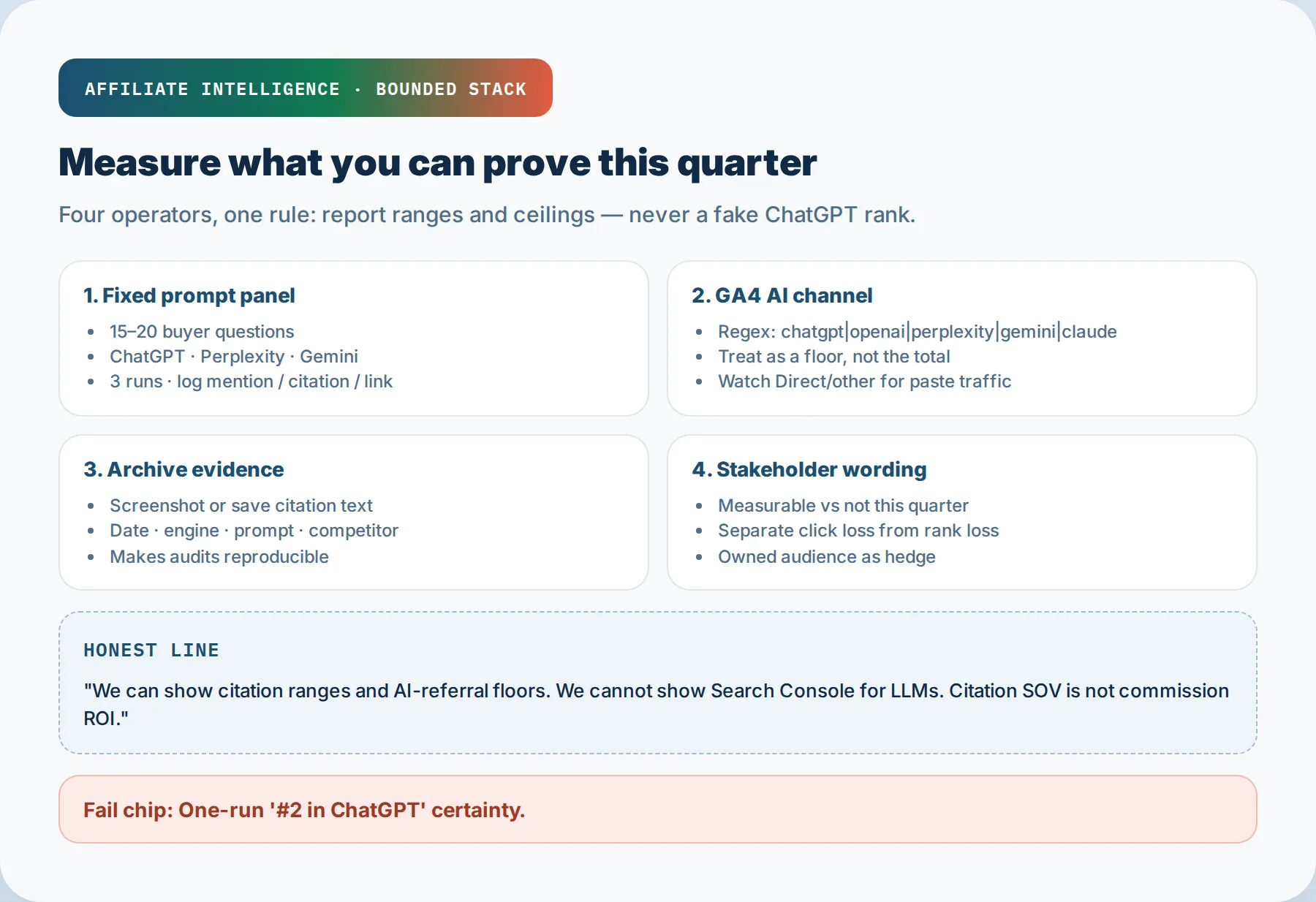
Manual fixed-prompt panel: report ranges, not ranks
Goal: establish an honest visibility baseline across engines.
Run your 15-20 prompts through 3 engines: ChatGPT, Perplexity, and Google AI Overview or AI Mode. Run each prompt 3-5 times. Log every run. Report visibility as a frequency, not a rank: “cited in 4 of 5 runs”, not “#1 in ChatGPT”.
Why ranges matter: SparkToro’s research had 600 volunteers run 12 prompts through 3 tools 2,961 times. The chance of getting the same brand list twice from ChatGPT or Google AI is under 1 in 100. Same ordering is closer to 1 in 1,000 runs. A single run is an anecdote. Visibility percentage across repeated runs is the only stable metric.
PROMPT: best CRM under $40/month for a solo consultant with EU data residency

RUN 1: You absent, Competitor A cited, Competitor B mentioned
RUN 2: You mentioned (no link), Competitor A cited
RUN 3: You cited as third source, Competitor A cited first
RUN 4: You mentioned (no link), Competitor C cited
RUN 5: You cited as second source, Competitor A cited first

RESULT: cited in 2/5, mentioned in 4/5, competitor A cited in 5/5
REPORT LINE: "Cited in 2 of 5 runs. Visibility 40% for this prompt."
That is the honest baseline. Log wrong facts too: a hallucinated cookie window or pricing claim is a page-level entity problem you can fix.
Checkpoint: You have a 15-20 prompt x 3 engines x 3-5 runs protocol with frequency reporting, not fake ranks.
GA4 partial referrals and the Direct paste problem
Goal: capture the visible slice of AI click-through traffic.
Create a custom channel group in GA4. The native AI Assistant channel exists since May 13, 2026, but misses sessions where referrer headers are stripped. Build a regex channel for full coverage:
chatgpt.com|chat.openai.com|perplexity.ai|claude.ai|gemini.google.com|copilot.microsoft.com
Place this channel above Referral so AI sources match before the generic catch-all. Use it in Explore reports for historical data; custom groups work retroactively.
The catch: this channel is the floor, not the total. Roughly 70% of AI-adjacent visits arrive with no referrer and land in Direct. Perplexity may pass referrer on web; ChatGPT mobile often does not. Label visible AI referral rows as the visible minimum. For conversational funnels, the chatbot affiliate funnels attribution traps guide covers where tracking breaks inside chat.
Then build a second signal: new-user Direct sessions landing on AI-indexed content pages. New visitors arriving at a blog post directly with no campaign are plausibly AI-influenced. Correlate that segment with your prompt panel visibility. When both rise together, the signal is meaningful.
Checkpoint: You have a regex AI channel, a Direct-paste caveat, and a new-user Direct segment to cross-reference.
Self-reported attribution and assisted paths
Goal: capture the zero-click influence GA4 structurally cannot see.
Add one optional open-field to your checkout or demo form: “How did you hear about us?” Free text beats a dropdown – “I asked ChatGPT for the best X and it recommended you” reveals what a taxonomy pick hides.
Then review GA4 Conversion Paths with a 90-day window to find AI referral sessions appearing as earlier touchpoints in multi-step paths. The Graphite/n8n study found 90% of AI-driven conversions never clicked a citation link; GA4 attributed about 1% of conversions to AI while surveys attributed about 9%. That is a 9x gap. Refine Labs found a 90% gap between software and self-report for dark social, with podcasts at 53% self-reported and 0% software-reported. That is the same no-referrer problem discussed in the dark social attribution private shares guide.
Trend the self-report share quarter over quarter. Direction and magnitude, not exact truth.
Checkpoint: You have a survey field, a 90-day assisted conversion view, and a trend line started.
Zero-click nuance: not a universal death percentage
Zero-click is context-dependent and should not be reported as a universal death percentage. Some datasets put zero-click share around 60%, while others report higher or lower depending on query mix, device, and whether the panel includes AI Overviews. Instead of one headline number, measure the three signals that hold up better: assisted conversion paths, self-reported source, and branded search lift.
A query with a complete AI answer behaves differently from a purchase-stage query where searchers still cross-check sources. Seer Interactive found cited brands earn more organic and paid clicks than uncited brands on the same AI Overview query, so the citation gap is often the actionable part, not the zero-click total (Seer Interactive AIO CTR study).
Honest stakeholder report: label every proof ceiling
For each metric, report visibility ranges across runs, visible AI referrals as a floor, and self-reported influence as directional. Do not present a single citation-to-revenue conversion rate or a combined AEO ROI score.
Use three columns: measurable, estimated, unknown.
- Measurable: visible AI referral sessions, citation frequency in your prompt panel, branded search lift, self-reported AI share.
- Estimated: zero-click influence, assisted AI revenue, the revenue multiple on an AI referral cohort.
- Unknown: casual AI recommendations that leave no trackable signal.
Branded search lift from AI citations typically shows a 60 to 90 day lag. Do not promise a clean ROI curve in month one. Label each proof ceiling next to the number. A report that says “unknown” in one column builds more trust than a fabricated exact number.
Owned-audience hedge: email and owned channels
If AI search stays zero-click, residual demand needs an owned path. A newsletter or owned email list reduces dependence on AI visibility and gives you a measurable non-AI baseline. Track owned-channel signups and revenue separately so AI influence is not the only lever in the report. See publishers surviving AI search with newsletters for setup direction.
Checkpoint: You have one owned-audience metric tracked separately from AI proxies.
Troubleshooting Common Issues
1. GA4 shows AI visits as Direct.
Fix: Accept it as structural, not a bug. Add the regex channel for visible rows. Layer the new-user Direct segment to AI-indexed pages over it. Do not force attribution GA4 cannot recover.
2. Citation present, but no commissions.
Fix: Separate awareness from commission. A mention proves reach only. Add a decision job and a direct link path to the page. Check merchant terms for cookie-window or approval changes that kill conversion after the click.
3. Scoreboard shows rank, but no clicks.
Fix: Diagnose click loss versus ranking loss. If rank holds, an AI Overview or synthesis layer is intercepting. Optimize for extractability and citation, not more backlinks.
4. Stakeholder asks for a universal zero-click percentage.
Fix: Refuse the single number. Offer ranges: Ahrefs 58% position-one CTR loss, Seer 49.4% to 65.2% on cited versus not-cited, randomized experiment 39.8%. The honest answer is a band, not a point estimate.
5. Merchant terms changed after a rewrite.
Fix: Re-verify against the live program terms before republishing. A page citing stale commission terms teaches ChatGPT the wrong number.