Affiliate Content Gaps: Using Community Discussions to Find Unanswered Questions
The SERP-first habit isn’t a strategy – it’s a trap
Starting with keyword tools leads to generic, interchangeable content. Real gaps hide in the constraints that real buyers voice in communities – specific scenarios no dashboard flags. The difference is the difference between another “best X” list and a page that answers the actual question.
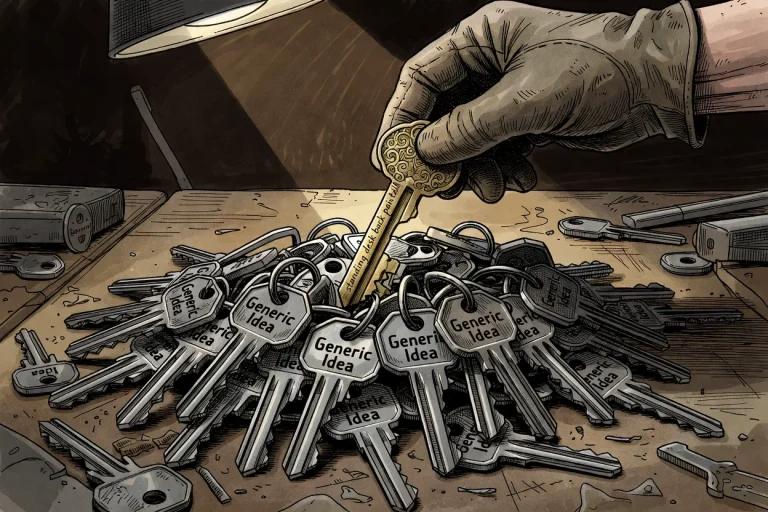
Affiliates often open Ahrefs or Semrush, sort by volume, and pick their next topic. Then they ask ChatGPT for “20 blog post ideas about running shoes” and get 20 titles that are already on page one, worded slightly worse. The operating assumption is that a keyword row – especially one with high monthly searches – is the best next article. It’s often the most contested average angle instead.
That habit is expensive. Not because the tool is wrong – volume data is volume data – but because volume doesn’t tell you whether the page-one results already answer the constraint your reader actually walked in with. If every competitor ranks a generic “best backpacking tent” list, the real gap is almost never another list. It’s the constraint they keep mentioning in community discussions but no one has written a dedicated page for: ultralight tent for a wet-climate first trip, tent I can set up alone with shoulder pain, tent that doesn’t sound like a sail in the wind when I’m in a relationship. The volume number for those queries might be tiny, ugly, zero in most dashboards. But they capture a person stuck at a decision point – and that’s exactly the kind of query that converts, earns information gain, and becomes the page someone actually bookmarks.
The job of this piece is simple: show how conversation signals – the questions, complaints, and comparison asks that real people post in communities – surface unmet constraints earlier than any keyword tool. Then I’ll walk through how to filter them, brief them, and turn one validated gap into a set of angles that aren’t interchangeable with your competitors’. Toward the end I’ll mention a tool we built to structure that signal into a useable brief, but roughly 80% of the method works without it. The bottleneck isn’t more ideas. It’s capturing the sentence, checking the SERP, and giving yourself a brief that isn’t just a working title.
What a “gap” actually is for affiliates
A content gap isn’t a keyword with a difficulty score under 10. It’s an audience constraint or question the SERP answers thinly, generically, or not at all. That’s what operators who chase “low KD” often miss: the SERP can be full of weak pages and still not actually resolve the thing keeping someone from a purchase.
The gap lives in the texture. Comparison asks: “A vs B for my case – I’m a beginner with a $150 budget, and I need it to work in a dusty workshop.” Objections: “I keep hearing that product X is great, but does it still hold up if you’re using it outdoors every weekend?” Onboarding stuck points: “I bought the tool and can’t get past the setup.” Tutorial gaps around tools people already chose: “How do I actually use this thing for a podcast workflow, not just the generic dashboard tour?” The honest version of “I can’t test this category” when you’re building an affiliate page for a product you cannot personally use – that gap deserves a researched recommendation that discloses the basis of the claim, not a fake first-hand review.
Information gain, as a concept, makes this concrete. The March 2026 core update made it clear that pages with proprietary data, first-hand evidence, and original frameworks saw gains, while templated content and generic AI farms were severely punished (Digital Applied). If your draft could swap brands and still read the same, you’re in the recycled pile. The SERP is full of those pages. The gap is the constraint nobody’s answering yet, and the reward is a piece that earns the kind of trust that doesn’t vanish the next time an update rolls through.

Failure-mode map

Before I get to the capture-and-brief loop, let’s name the patterns I see operators trip over. These are the buckets. Skip any of them and you’ll suspect you’re doing research while actually publishing into a pile.
Lurk without capture. You read community discussions, nod at the interesting questions, and keep no record. A week later you can’t recall the exact phrasing – so you write from memory and miss the constraint entirely. The sentence you needed is gone. Capture is the fix.
Keyword-tool theater. More dashboards, same SERP pile. You sort by difficulty and volume, pull long-tail variations that tools suggest, and still end up with the same “best x for y” titles everyone else has. The tool confirms language; it doesn’t invent the seed.
AI list substitution. Blank-prompt “20 blog ideas about gardening tools” produces a list of plausible, inert titles. They regress to the mean – the model picks the most probable sequences from its training data, which are, by definition, already well-covered angles. If you publish from that list, you’re betting on volume over distinctiveness. I wrote about why that fails in more detail why AI idea generators give useless lists, but the short version: the model isn’t an idea generator; it’s a pattern completer that defaults to safety. Handing it your editorial calendar is a type of quiet abdication.
Clone theater. You copy a competitor’s table of contents, or worse, an ad page’s feature list, and write a page that doesn’t actually do a reader job. It exists to rank, but it doesn’t help someone decide, learn, or solve a specific problem. That’s the page AI Overviews can summarize into oblivion – because it’s just spec rearrangements.
Honesty dodge. You promote a product you wouldn’t stand behind, with no disclosure of limits, no mention of what the product doesn’t solve, and no clarity on whether you’ve actually used it. This erodes the only moat an affiliate has: trust. A purchase made on a dishonest recommendation isn’t revenue; it’s a pending reversal, a chargeback, or a reader who never comes back.
None of these are scraping problems. They’re discipline problems. Fix them by switching from dashboards to conversation signals, then running a filter.

Capture – gap filter – brief (the loop)
The workflow that actually surfaces usable affiliate content ideas is three steps. No scraping, no bulk harvesting – just the kind of methodical signal capture that keeps your calendar honest.
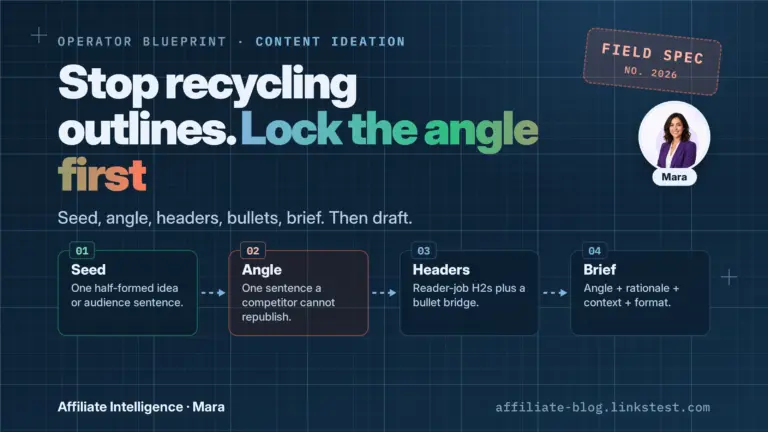
Capture. Open a text file or a spreadsheet. When you read a community discussion (any forum, blog comment section, social thread), write down the exact sentence someone used. Not a summarised idea – the quote. “I bought a standing desk but my lower back still hurts after two hours – am I setting it up wrong or is the desk just not right for a tall person?” That’s a constraint. Another: “I want to try cold brew concentrate but every recipe I find uses a scale I don’t own and a 24-hour steep I don’t have patience for.” That’s an objection plus a specific limitation. These are source-list entries, not keywords.
The point is to capture the language people actually use, not the language a keyword tool guesses they might use. Often-cited research suggests long-tail, natural-language queries drive a significant share of traffic and convert better than head terms because they mirror the exact words a searcher types. But that traffic only materializes when your page echoes the phraseology the searcher typed. If you write “best budget cold brew maker” but your real reader typed “cold brew concentrate without a scale,” you miss.
Gap filter. For each captured sentence, skim the SERP. Does a page answer this exact constraint? Not just relate to the topic – does one of the top five results address this specific person’s situation? If the answer is a generic roundup that compares five products by price and feature-list, without mentioning setup posture for tall users, you have a gap. If the answer is a thin forum thread with conflicting opinions and no conclusion, you have an opportunity. The filter is: is this constraint actually resolved, or is it only gestured at? You’re not looking for zero KD. You’re looking for a SERP that’s failing the reader.
Brief. Once you’ve validated the gap, write a short structured brief – not a full outline, just enough to know what you’re making and why it’s different. Include:
- Angle: The specific framing that answers the constraint. (e.g., “Standing desk setup guide for people over 6 feet, with posture adjustments and chair pairing.”)
- Rationale: Why this matters – the community signal, the unanswered SERP, and why your take is credible (first-hand trial, expert interview, or honest researched comparison).
- Context sentence: The original captured wording that started this (anonymized). This keeps the writer anchored to real demand.
- Format: Explainer, comparison table, mistake post, tutorial, pain-point-first review.
From one validated gap, you can expand into multiple angles. The tall-user desk setup gap could yield: a comparison of three height-adjustable desks tested by someone 6’3″, a “common setup mistakes tall people make” post, a review of aftermarket monitor arms that raise screen height 2 inches extra, and a budget trick for adding foam blocks under desk legs. That’s four useful pages from one seed, not 20 semi-related titles you brainstormed cold. Depth beats breadth.
Optional corroboration: autocomplete and “people also ask” can confirm language, but they confirm – they don’t pick your thesis. Tools are corroboration; the seed comes from the conversation.
For reviews, open with the pain point first. Don’t lead with the product. If the reader’s stuck point is “my lower back hurts after two hours at a standing desk despite buying a recommended one,” your intro paragraph should restate that frustration before you mention the desk. That signals “I read your problem” and earns the right to recommend something. A pain-point-first opening converts better than a feature list because it answers the emotional need before the logical one.

Soft bridge: the tool that doesn’t pretend to write your review (IdeaForge)
When the bottleneck is turning messy, long-form community discussion into usable briefs – with angle, rationale, and context already pulled – the manual loop can feel slow. That’s why we built IdeaForge, a public beta tool that scans thousands of community discussions and delivers structured idea briefs in under 30 seconds. Each brief includes an angle, a rationale, and an actual quote (anonymized) from the source thread. For example, a brief for the standing desk niche might surface: angle: “Setup guide for tall users with posture adjustments,” rationale: “Forum thread shows multiple tall users still feeling back pain despite buying recommended desks,” context sentence: “I bought a standing desk but my lower back still hurts after two hours – am I setting it up wrong or is the desk just not right for a tall person?” That kind of structured seed doesn’t come from a keyword tool.
It’s not a magic originality machine, and it doesn’t invent lived experience. It surfaces and structures signals that already exist in public conversation. The output isn’t a naked title list. It’s a set of seed briefs grounded in what real people are saying. You still decide what’s worth writing. You still run the gap filter and the honesty check. The tool just shortens the capture-to-brief step – especially useful if you’re researching a niche you don’t personally inhabit, or you want to supplement your own source list with external signal.
I should be clear: IdeaForge is something we built, so I have a relationship with it. No promised rankings, no “secret niches,” no commission claims. It’s a structuring tool. If your bottleneck is capture rather than structuring, you may not need it – just keep that source file open. But if you’ve accumulated a notebook full of half-phrases and want them turned into briefs that remind you why you’re writing, it’s a helpful second step.

A one-sitting checklist before the next affiliate post
Stop letting tools invent your calendar. Before you write another affiliate article, run these seven checks:
- Do I have a real audience sentence (not a keyword row or AI-generated title)?
- What constraint makes this piece specifically different from the page-one best-of?
- Could a competitor republish my angle tomorrow with zero change and equal credibility?
- Did I gap-check the SERP for that constraint, or only for the head term’s difficulty score?
- Is my brief built from angle + rationale + context – or is it just a working title?
- Am I substituting an AI idea list for actual conversation research? (If yes, stop – see the why AI idea generators give useless lists.)
- If I used a conversation-structuring tool, did I still apply the human filter and honesty check?
If you can answer all seven, you’re not guessing. You’re writing from demand. That’s the difference between a page that survives the next algorithm nudge and one that quietly evaporates when Google stops tolerating interchangeable content.
Capture the stuck sentence first; then write.