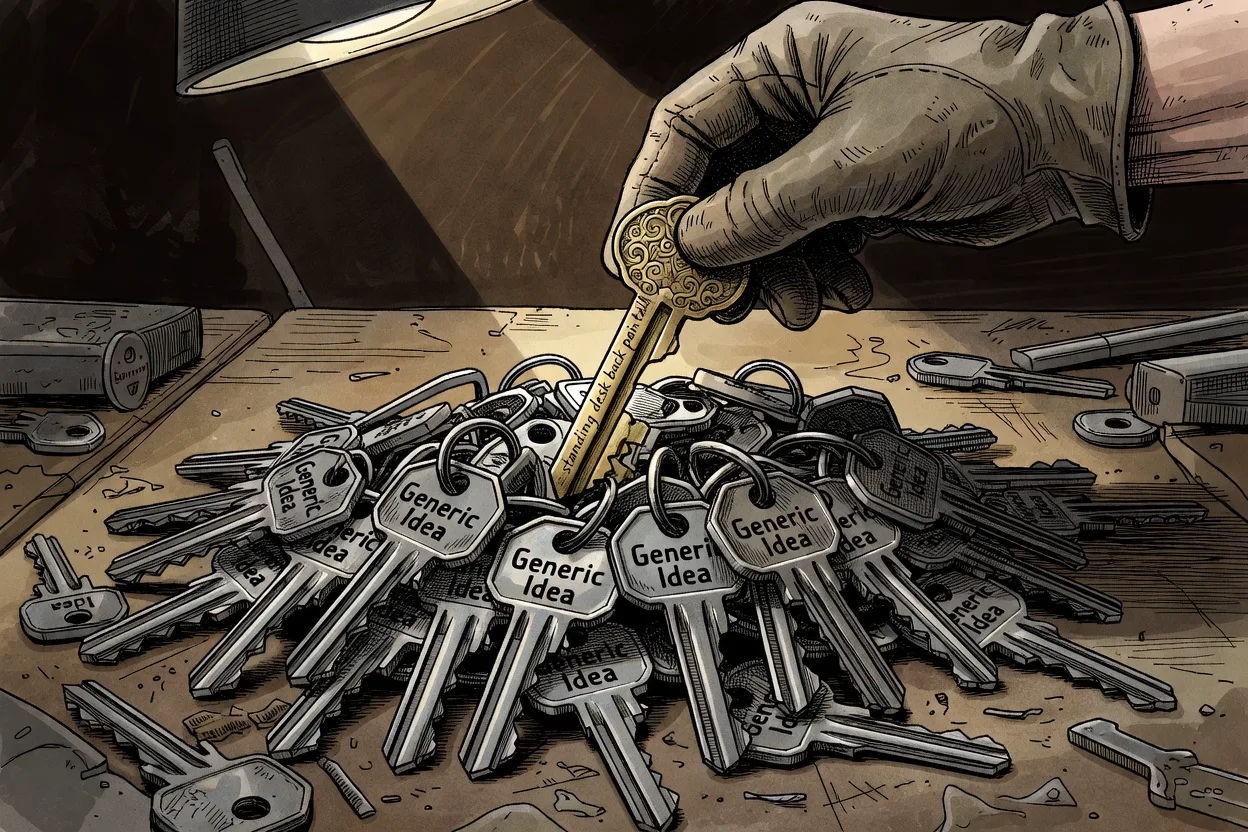
How to Generate Content Ideas That Aren’t Generic (A Process That Actually Works)
If you fill next month with “best X for Y” titles from a blank AI prompt, you scheduled the SERP’s average angle. Not a strategy – a mirror.
Brainstorms, keyword sorts, and AI lists all run on the same broken assumption: more ideas equals a better calendar. Volume drowns editorial judgment until your pipeline swaps brands and reads the same as a dozen competitors who used the same tools.
The fix is a system. One that starts with audience language, not a prompt bar.
This pillar walks you through the whole loop – seed sources, angle lock, a light validation filter, and a handoff to an outline that isn’t just a reworded page-one table of contents.
Along the way I’ll point you to deeper dives for conversation-gap research and the outline-building mechanics, plus a tool I built that structures messy community signals. If a title could be reposted by your competitor tomorrow and still make sense, it’s not ready.
The failed assumption: more ideas = a better calendar
The calendar looks full. “10 Best X for Y,” “How to Z,” “Why A Is the Future of B.” The problem isn’t that these topics are wrong – it’s that they’re interchangeable. Drop any of them into a rival site and the reader wouldn’t blink.
The same mistake repeats across the industry: treat idea generation as a volume game, then wonder why most pages earn no meaningful search traffic – a reality Ahrefs has documented and one that hasn’t meaningfully reversed.
A blank AI prompt “give me 20 blog ideas about [topic]” delivers titles that regress to the mean: the most common, most predictable sequences in the training data. That’s not ideation – it’s statistical autocomplete. I wrote more about why AI blog idea generators give useless lists, but the short version: a prediction engine doesn’t invent originality; it minimizes surprise.
Without a half-formed seed, you get the SERP’s average angle. If your entire month is built that way, you’ve scheduled a collection of content the world already owns.
This pillar replaces the volume mirage with a single habit: process one non-interchangeable idea from a real audience sentence before you ever open a keyword tool. That requires a different starting point – and it’s not a better brainstorm.

Where non-generic ideas come from
A non-generic idea starts with friction. Not novelty for its own sake, but a specific, unresolved tension in the language your audience uses. The operators who consistently publish pages that earn clicks (not just impressions) keep a source list: a messy, growing collection of exact sentences from communities, support tickets, DMs, blog comments, and customer calls.
These are raw demand signals:
- “I bought a standing desk but my lower back still hurts after two hours – am I setting it up wrong or is the desk just not right for a tall person?”
- “I want to try cold brew concentrate but every recipe I find uses a scale I don’t own and a 24-hour steep I don’t have patience for.”
That’s not a keyword. It’s a constraint plus specific, scannable detail. Clarity and specificity beat novelty every time. A “best cold brew maker” list is generic; a guide for concentrate recipes without a scale is irreplaceable. The same logic applies to comparison asks (“A vs B for my dusty workshop, sub-$150”) and objection patterns sprouting in comment sections.
Corroboration tools – Google autocomplete, People Also Ask, Search Console – confirm the language after the seed exists. They don’t invent the thesis. If you search for “standing desk back pain tall” and see a People Also Ask result that mirrors your captured sentence, that’s corroboration. If you start from the autocomplete suggestions, you’re guessing at language the seed should have given you.
I wrote a deep dive on finding content gaps from community discussions. The short version: lurk-without-capture is a failure mode (more on that below), and blank AI lists are not a starting point. Your source list is.

The system: capture → angle → outline → light validate
Here’s the loop I recommend. It’s built to process one seed into something that can’t be substituted.
Capture. Keep a running document or spreadsheet. When you encounter a real sentence – from a community, support ticket, or comment – copy it verbatim. No summarizing. The exact phrasing matters.
Pick one seed. Don’t brainstorm a dozen. Grab the sentence that contains the most concrete constraint or the clearest “I tried X and it didn’t work because Y.”
Angle lock. Boil that seed down to one sentence a competitor cannot republish unchanged. For the tall-person desk seed, the angle might be: “Setup guide for people over six feet – posture adjustments, chair pairing, and how to check if the desk actually goes high enough.” That’s not a “best standing desk” post with a different headline. It’s an answer to a constraint the roundups ignore.
Light SERP skim. Search the angle, not the generic topic. If a top-five result already delivers a dedicated guide for tall users with back pain, your angle isn’t sharp enough – sharpen it or pick a new seed. You’re checking whether the angle is already exhausted, not whether the keyword difficulty is low. If the top pages only gesture at the problem, you have a gap.
Headers-first + bullet bridge. Now build an outline that answers that angle. I’ve written out the full headers-first method in from topic to outline: a content ideation process you can repeat.
The core is this: every H2 does a reader job tied to the angle, and under each H2 you drop 2-4 bullets (evidence, objections, steps, examples) before writing a single paragraph. That bullet bridge prevents the outline from becoming a thin clone of page one.
Light validate. Before you commit the idea to the calendar, run these fast checks:
- Competitor-swap test: could a rival publish this exact outline and retain credibility? If yes, the angle is weak.
- Audience-sentence test: does the brief contain the language of the original seed?
- SERP-for-angle: did I actually search the specific angle, or just the keyword?
- Brief fields present: angle + rationale + context + format? If it’s just a working title, it’s not a brief.
- Human filter: if a tool (AI, conversation scraper) was involved, did I still verify the angle and outline manually?
This light-validate step replaces a full-blown satellite I originally planned; in practice, these five checks catch the vast majority of calendar candidates that should be sent back to the source list.

Failure-mode map
Operators drift into one of six traps that trade signal for convenience. These patterns repeat across teams.
AI list substitution. Blank prompt → list of titles → calendar. The model hands you the most probable sequences, which are already covered. You skip the audience sentence entirely.
Keyword-tool theater. More dashboards, more long-tail variations, but every title still sounds like “best X for Y.” The tool corroborates language that isn’t original because the seed never came from a real constraint.
Lurk without capture. You read community discussions, nod at interesting questions, and keep no record. A week later the exact phrasing is gone, and you write from memory – missing the constraint.
Clone theater. You copy a competitor’s table of contents or the SERP’s H2s and call it an outline. It ranks a version of what’s already there, often earning zero additional clicks after the AI Overview answers the same generic points.
Tool theater. Swapping from one AI idea generator to another, testing prompt templates, joining prompt-library communities – all while ignoring the messy source list sitting in your inbox. Tool-swapping is displacement, not strategy.
Calendar fill / over-plan stall. You’ve stacked the month with “working titles” that have no angle, no audience sentence, and no brief. The slots look productive, but the pipeline is hollow. Worse, the fear of re-opening a half-baked title keeps you from unpublishing it.
Each of these replaces signal with convenience. The antidote is the same: return to the source list and process one seed.

Soft bridge: when the mess needs structure (IdeaForge)
Sometimes the bottleneck isn’t the capture or the angle lock – it’s turning a pile of messy community threads and scattered notes into a usable brief. That’s where a structuring layer helps. Not an idea generator. A signal organizer.
I built IdeaForge as a public-beta tool for exactly that gap. It scans thousands of community discussions, forums, and blogs and delivers structured briefs – each with an angle, a rationale, and a real, anonymized quote from the source.
For the standing desk seed, it might deliver: angle: “Setup guide for tall users with posture adjustments,” rationale: “Multiple tall users report persistent back pain despite using recommended desks,” context quote: “I bought a standing desk but my lower back still hurts after two hours…”
The tool doesn’t claim originality. It doesn’t invent lived experience. It surfaces and organizes language that already exists in public conversation, so you can skip the manual scanning and spend your time locking the angle. The first two ideas per search are free; if you need more, it’s a one-time $9 unlock. No subscription.
How to use: Paste messy community notes or a half-formed topic into IdeaForge to get an angle, rationale, and a real user quote; then run it through the angle lock, SERP skim, and light-validate checklist. The tool removes the “lurk without capture” risk. It doesn’t replace editorial judgment.
Once you have a structured seed from IdeaForge – or your own source list – you still run the same filter: lock the angle, skim the SERP, build headers and bullets, and light-validate.
A one-sitting filter before the idea hits the calendar
Before you place even one idea on the calendar, run this checklist. It ties the whole system together. If a single check fails, the idea goes back to the source list – not into a slot.
- Is there a real audience sentence behind this? Not a keyword phrase – a verbatim sentence from a person stuck on a constraint or asking a specification-rich question.
- Is the angle locked in one sentence a competitor can’t republish unchanged? If you swap your brand out, would the outline still read as a distinct, useful piece? If not, sharpen.
- Did I SERP-check this angle – not just match the page-one H2s? Confirm the top results don’t answer this exact constraint. If they do, the gap isn’t real.
- Does every H2 do a reader job tied to the angle? No filler headers. No “Introduction.” No “What is X.” Each header advances the specific answer.
- Are there bullets under each header before I start drafting? At least two, no more than four. This prevents blank-page drift.
- Is my brief a real brief? It must include the angle, the rationale, the original context sentence, and the intended format. A working title isn’t a brief.
- If I used a conversation-structuring tool or AI, did I still apply a human filter? Did I verify the quote exists? Did I check the SERP myself? Did I decide what’s worth writing?
If the idea passes all seven, it’s ready for the calendar – and it won’t be interchangeable with the next publisher’s next AI-generated list. If you want to shortcut the community scanning step, the signal-organizing tool IdeaForge (public beta, two free briefs per search) can surface the raw sentence and angle, but you still own checks 1 through 7.
Stop generating volume. Generate one non-interchangeable seed and process it.