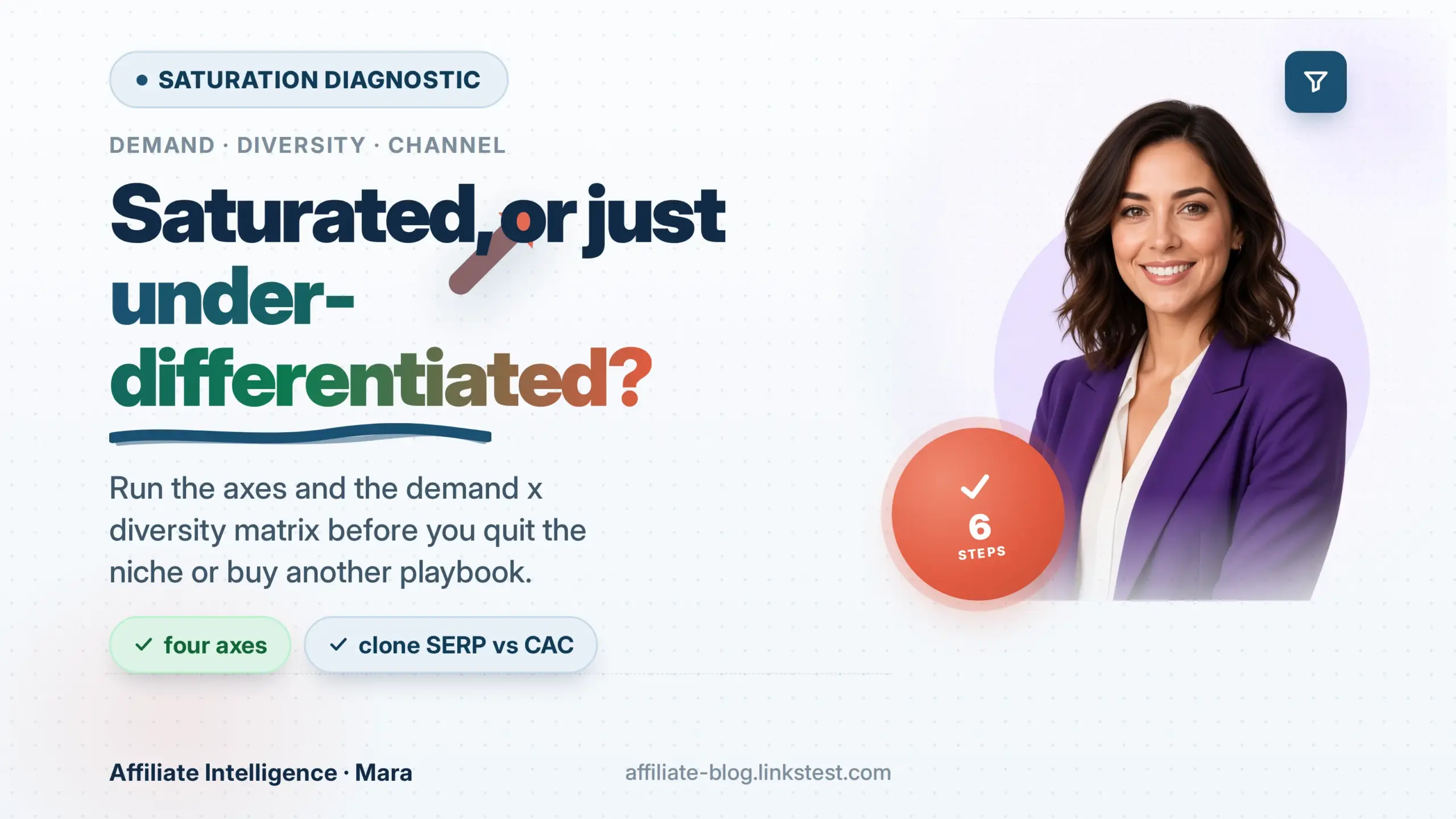
Affiliate Saturation or Under-Differentiation? A Diagnostic Guide
Operators often declare a niche “saturated” the moment they see the same offer, same landing page, and same traffic source as six other affiliates. That is a failed assumption. Before I trust any saturation claim, I want the evidence ledger open. This tutorial walks the diagnostic: six steps, checkpoints at the end of each. The payoff is a go/no-go label instead of a feeling.
Prerequisites: Assemble the Ledger Before Any Verdict
Before I trust any saturation claim, I need six raw inputs on the table. Not the “is affiliate marketing dead?” essay. Just the ledger.
- Current offer inventory. Same offers, same landing pages, same traffic source map. List what you promote and where you point the clicks.
- Demand trend. Search Console or analytics - impressions and clicks, period over period.
- Paid signals, if you run paid. CPA or CAC, CTR, and conversion rate by source.
- A list of 20-30 long-tail commercial phrases you have not yet targeted.
- Top-10 SERP screenshots, or top-ad screenshots, for your head term.
- Current merchant terms: commission, cookie window, payout.
No tool shopping. Google Trends and Keyword Planner are screening tools, not magic. The ledger is the diagnostic’s fuel. If you cannot produce the offer map in ten minutes, your tracking discipline is the first problem.
Checkpoint: You can open all six inputs and see, at a glance, where each test will pull from.
Two Problems, One Word: Saturation vs Under-Differentiation
Operators see identical offers, identical landing pages, and identical traffic sources and conclude the niche is dead. A common failure mode: they rebuild on vibes, hop courses, or chase “unsaturated” lists. That is a category error.
Two separate problems hide inside the word “saturated.”
First, real saturation: demand is flat or falling on at least two axes, and no residual angle remains. That is an exit signal.
Second, under-differentiation: the niche has demand, but every operator copied the same playbook - same offer, same page structure, same traffic source. The niche is not dead. The work is undifferentiated. Playbook and MMO-course sameness creates the false feeling that the whole industry is saturated.
I will say it again, because most operators collapse these. Same offer plus same LP plus same traffic source is an under-differentiation smell, not proof demand is dead. Treat the second as the first and you quit a viable niche, then buy another playbook that clones the same problem.
Checkpoint: You can name both problems without collapsing them, and you know which one this article is testing.
Step 1: Define Saturation on Four Axes
Goal: refuse single-axis saturation claims before you run a single test.

Action: score the niche on four axes.
- Supply: promoter density in your exact slice.
- Demand: search or buying interest trend, not vibes.
- Channel: which surface - SEO, paid Meta, email, owned, YouTube.
- Geography: which market - a niche closed in US paid can be open in a second GEO.
Fail chip: “Too many affiliates” as the only score. That is one axis, supply, measured badly. It ignores demand direction and channel. A niche can be closed on one paid channel and open on owned traffic or another geography. Headcount of promoters tells you almost nothing.
Saturation is a vector across supply, demand, channel, and geography. You need at least two axes pointing down before the word earns its place. A crowded SEO SERP with growing demand means hard fight - not dead.
Structural example: a supplement offer has crowded Meta auctions and flat US search trend. Same offer, same LP, same traffic source. On Meta, the CPA math might be closed. On an owned email list in a second English-speaking geography, nothing says the offer is dead. Same offer, different channel, different geography - different verdict.
Checkpoint: You can state which axes are flat, which are rising, and which channel carries the saturation claim.
Step 2: Run the Demand x Diversity Matrix
Goal: get an action label, not a mood. The matrix is the core diagnostic - demand trend on one side, content diversity on the other.

Action: pull demand direction from Search Console and compare it to what the top results actually look like.
Top-10 interchangeability audit
Action: take the top 10 SERP results, or the top ads, for your head term. Strip the branding - remove logos, color, site chrome. Now ask: are these interchangeable? Same feature tables, same VSL architecture, same stock angles, same lazy pros-and-cons.
If yes, that is clone architecture. Clone architecture is room for substance, not an automatic exit. Somebody can come in with evidence and a sharper verdict - using formats that still earn a click under AI answers – and take the click.
Why it works: interchangeability measures differentiation, not demand. A wall of identical pages proves the market has not found its best answer yet. The residual room is a proof pack, not another generic list.
Checkpoint: You can mark the top 10 as “clone” or “distinct” in under two minutes each.
Head-term probe
Action: check the “Best [category]” and “[category] reviews” phrases directly. If every winning page is a clone listicle, crowding is real - but it is format crowding.
Why it works: head terms are the loudest room in the niche. They are not the whole niche. Residual room lives one layer down: audience, evidence, a decision job the clones refuse to do. A comparison without a verdict is just a table, and tables are what AI does best. If every win is the same generic top-10, the opportunity is not another generic top-10. The same-ASIN triage in same-ASIN content triage after merchant rules change is the reset for merchants whose wins look identical.
Checkpoint: You know whether your head term is a clone war or a diverse fight.
Place the niche in the matrix
Action: put your niche in one of four boxes.
- Growing demand plus clone-heavy content: differentiate. The room exists; the work is substance.
- Flat demand plus entrenched moats: exit or pivot. No angle left to compensate.
- Growing demand plus diverse content: hard fight. You are competing with real operators, not templates.
- Flat demand plus clones: careful. May be a channel problem, not a niche problem - test a second surface first.
Growing plus clone-heavy means differentiate. Flat plus entrenched moats means exit or pivot. The box tells you what to do next.
Checkpoint: You have one action label - differentiate, hard fight, test channel, or exit.
Step 3: Do Not Confuse Paid and Content Signals
Goal: stop mixing two separate failure signals into one bucket called “saturated.”

Action: split the diagnosis by surface. Clone SERP means one thing. Rising CPA with flat CTR and CR means another. Keep the content signal and paid signal separate as follows.
Content signal: clone SERP / same LP
If the SERP is clones and your page is a clone of the clones, you sit in the under-differentiation path. Same offer, same LP, same traffic source. The fix is work quality and angle, not quitting the niche.
Why it works: SEO sameness is a content problem with a content fix. Treating it as saturation sends you shopping for a niche you will clone the same way.
Checkpoint: You can name whether your content signal is clone architecture or demand loss.
Paid signal: CAC/CPA up while CTR and CR flat
If cost per acquisition climbs while click-through rate and conversion rate stay flat, demand is not the problem - auction competition or offer fatigue is. That is offer/channel saturation on paid, distinct from SEO sameness.
Action: pull the numbers per source. Clicks steady but conversions cratering is a funnel problem, not a niche problem - check the path after the click.
Why it works: flat CTR and CR mean the user still clicks and still buys at the same rate. Only the auction got more expensive. That is a capital problem, not a demand funeral.
Checkpoint: You have your paid trend separated from your content trend.
Capital tier trap
Underfunded CPA auctions feel like saturation. The operator is outbid, not out of demand.
Action: compute target CPA from payout and desired margin. If your payout is $50 and you want a 30% margin, target CPA is $35. If the auction clears above that, the offer is closed for you at your capital tier - not closed everywhere.
Why it works: the niche may simply be priced above what you can fund. That is a mismatch, not a verdict on the niche. Name it, then decide whether to raise capital, shift channel, or exit that specific auction.
Checkpoint: You can say “I am outbid” without saying “the niche is dead.”
Step 4: Run Residual Room Tests
Goal: before you exit or rebuild, verify there is no remaining commercial room.
Action: run three quick probes.
Long-tail 20-30 test
Action: spot-check 20-30 untargeted commercial long-tails for volume, difficulty, and intent before quitting. Use Search Console gaps plus Keyword Planner as a screener - not a magic oracle.
Add two named screens, not vibes. First, keyword CPC as a barrier signal: if the commercial tails you can actually win still clear at CPC levels that break your target CPA math, the residual room is expensive, not free. Second, SERP authority density: open the top results for those tails and score how many are entrenched media or multi-year affiliate domains versus thin clones. Low CPC plus thin authority density is a green residual-room signal. High CPC plus dense authority is a hard fight even on the tail.
Why it works: head-term crowding hides tail demand. A niche can look walled off at the top and still have dozens of “best X for narrow feet” style queries nobody answers well. Volume and intent alone overstate opportunity if CPC and authority density say you cannot fund or outrank the fight.
Do not lean on a universal long-tail sales-share number. Check the tail, confirm intent, then decide.
Checkpoint: You have 20-30 phrases scored for volume, difficulty, intent, CPC barrier, and authority density - and you know if one cluster is winnable.
Trend-lag trap
Viral product lists usually mean late entry. By the time a product appears on a “top viral products” roundup, the early operators have moved on. Late entry looks like saturation - it is timing failure, not a closed niche.
Action: check Google Trends for your product or category. Flat or declining after a spike is a red flag that you are chasing the wave’s tail.
Why it works: separating timing from structure saves you from quitting a viable category because you entered a dead one.
Checkpoint: You have checked whether your “saturated” niche was actually a timed-out trend.
Audience / lifestyle sub-niche
Action: own a use-case or lifestyle audience instead of chasing product keywords. Product-keyword chasing is where the clone war lives. Audience ownership lives one layer up: “overlanding families” instead of “best rooftop tents,” “home baristas on a budget” instead of “best espresso machines.”
Why it works: audience ownership gives you a defensible angle templates cannot copy. Mining unanswered community questions gives you the gaps; a real ideation process for non-generic angles keeps you off the template; and knowing why AI idea lists feel saturated stops you feeding the machine the same inputs everyone else does.
Micro-niche scale check. If the use-case is so narrow that one orphan page cannot support a site, plan a hub of related problems for that audience before you declare “room.” Differentiation without a publishable cluster is a hobby page, not residual commercial room.
Lead-gen escape (light). When product-review clone wars are the only surface left, some operators pivot the same audience expertise into lead demand for real-world businesses - local services, B2B software demos, agency intros - instead of another “best X” listicle. One beat, not a lead-gen course: ask whether the audience already buys advice or introductions more readily than another SKU.
Checkpoint: You have named a use-case audience a generic top-10 cannot serve, plus either a hub structure or an explicit decision that lead-gen is not the path.
Step 5: Build Hands-on Evidence and Trust Traffic
Differentiation is not a personality tweak. It is original proof: test results, structured data, screenshots, or first-party observation. It is also owned traffic - email subscribers, returning visitors, buyers who come back because the answer was useful. Clone pages rank; trusted pages convert. AI Overviews can summarize specs and surface-level comparisons, but they cannot fabricate first-hand evidence.
Trust traffic over vanity traffic
A thousand high-intent, trusting visitors beat anonymous volume. Differentiation shows up in conversion and list quality, not raw pageviews.
Action: replace “traffic up” as the goal with “qualified clicks and downstream conversion.” Vanity metrics are easy to gather but they fall short when bringing in sales.
Why it works: the clone war is optimized for vanity - pageviews, impressions, sessions. Trust is the opposite signal and it compounds.
Checkpoint: Your primary metric is trust-weighted, not volume-weighted.
Hands-on evidence AI cannot fake
Usage data, walkthroughs, verified friction, dated pricing. AI clone listicles raised the undifferentiated bar - they can paraphrase a spec sheet in seconds. What they cannot fake is the proof pack: your own screenshots, constraint tests, real pros and cons. Pages with original testing evidence hold traffic and conversion better than clone pages because clones cannot follow.
Action: add one original-evidence element to your top money page before touching anything else. Formats that resist AI summarization all share this: a dated price check, a failed setup note, a who-it-is-not-for verdict.
Why it works: effort compounds. AI can remix opinions, but it cannot invent your test log.
Checkpoint: Your top page now carries at least one piece of evidence a clone cannot reproduce.
Step 6: Diversify Traffic Sources and Exit/Pivot Without Shame
Saturation is per channel, offer class, or head-term clone war, not industry-wide. Before you exit, test one paid surface against one owned surface. If the pure affiliate clone war is stuck, add a community, consulting, or own-product layer as a light hybrid; if the economics or conversion path is the real issue, triage the content under current merchant rules in same-ASIN content triage after merchant rules change before layering new revenue.
Traffic-source diversity
Exit the zero-sum SEO or Meta clone war with a second surface. Structural, not a channel scoreboard.
Action: name one second surface you control - an email list, a YouTube description, a community post - and ship the same verdict there.
When paid CAC is hostile but the offer still converts, owned email is margin defense, not a vanity list. A list you already paid to build lets you re-sell or upsell without re-entering the auction that just priced you out. Treat backend sends as risk management for offer-side saturation, not as a soft “also post somewhere else.”
Why it works: clone wars are zero-sum because everyone fights for the same click. A second surface resets the competition. Concentration in a single traffic source creates fragility.
Checkpoint: Your flagship verdict lives on at least two surfaces, and if you run paid, you can name how owned email protects margin when CPA climbs.
Exit or pivot without shame
If demand is flat, CPA is rising beyond your margin, and no residual angle passed the tests - the long-tail was dry, the audience was already owned, the head term was moated - then exit or pivot. Pivot options: same skill, new geography or new product. An operator whose English-language CPA auction priced them out moved the same offers to an under-served second-market audience and reset the math.
Why it works: exit is a decision, not a confession. Naming the exit criteria ahead of time - flat demand plus rising CPA plus no residual angle - makes it a call, not a collapse.
Stop unsaturated-niche shopping. The list you buy next week will have the same clone war by the time you arrive.
Checkpoint: You can write the go/no-go sentence for your niche in one line.
Troubleshooting
CAC climbs but CTR and CR are flat. That is auction competition, not demand death. Compute target CPA and refuse auctions above it.
The SERP looks walled off but demand is growing. Check the long tail before calling the niche dead; head-term moats are normal.
The whole industry feels oversaturated. That is often playbook sameness and course-hopping, not demand exhaustion. Anything looks oversaturated if execution stays at the template skill threshold. Stay on one niche long enough to run the matrix twice before you buy the next “unsaturated” list.
Need a first dollar while you diagnose? Amazon Associates can still be a viable entry lane in some categories - program basics live in Amazon Associates for operators - but that is not a substitute for finishing this diagnostic on the niche you already work.
Count the axes and run the matrix before you quit the niche or buy another playbook. Same-LP clone wars are usually under-differentiation. Flat demand plus rising CPA with no angle left is the real exit signal. “Saturated” is a lazy label until the tests run.