SaaS vs Physical Products: An Affiliate’s Honest Comparison
Operators often frame the SaaS vs physical products affiliate decision as a percentage war. A 30 percent digital program beats a 7 percent ecommerce program, the logic goes. That framing collapses the moment you hold it against cashflow shape, returns load, and whether the payout can actually survive. This tutorial runs through five checkpoints, in order, so you can rebalance without chasing a brochure number.
Prerequisites
Before you touch a dashboard, collect four things.
First, a current offer list or candidate shortlist, physical and digital, capped around ten offers. Second, the actual program terms and payout screens for each. Not the marketing page, the terms document. Third, a content-job map: what each page or video is actually designed to do for a reader. Fourth, an audit sheet with columns for sticker rate, keep rate, lock or hold window, payout timing, validation window, and geo fit.
I recommend building the sheet now rather than mid-tutorial. Everything after this is column arithmetic. A common failure mode is deciding from memory. Write the numbers down. If you cannot answer the four clocks for a program - lock date, return window, chargeback lookback, partial-return eligibility - mark it unknown and treat any pending dollar from that program as soft.
Checkpoint: Your audit sheet has one row per candidate and every column filled or explicitly marked unknown.
Step 1 - Name the income shape: recurring vs one-time
The headline percentage is a teaser. What you are actually choosing is the shape of your income, and the two shapes behave differently.
Physical products overwhelmingly pay once. A 10 percent cut on a $100 item is $10, once. To earn the same next month you need new clicks, new buyers, new traffic. That is a treadmill.

SaaS and subscription offers pay on renewal. A 20 percent recurring commission on a $99 per month tool pays $19.80 per month per active customer. One comparison post that refers ten customers, with half still subscribed after twelve months, is roughly $118 per month before churn - not a one-time $79.
But recurring is not infinite. Model the churn-adjusted window, not the dream. If subscribers churn at 60 percent monthly retention, the average lifetime payout is about three months, not forever. A capped 12-month recurring deal compounds for a year, then stops. Lifetime recurring is a liability the merchant must fund indefinitely. Read the duration as carefully as the rate.
Benchmarks give the shape some scale. Median ecommerce commissions sit near 8.4 percent of order value, while median SaaS runs about 22.5 percent of first-year revenue, per the program economics / commission sustainability guide. That gap reflects category margins, not a judgment.
Attribution windows shape the flow too. Physical programs in impulse categories often run 24-hour to 7-day cookies. SaaS buying cycles run 30 to 90 days, and serious programs match that with longer windows. Amazon Associates uses a 24-hour session cookie, but an item added to cart during that session can still credit the affiliate if the order completes within 89 days, and on digital products within 180 days, according to the Amazon Associates Program Policies. Cash timing sits on top of it all. A physical payout that lands in 30 days can still be soft if the return window runs 60. SaaS net-30 or net-60 payouts stretch the same way.
Draw two curves. One-time physical: a flat reset each month. Churn-adjusted recurring: a staircase that climbs, then bends under cancellations. The failure chip is “chasing the bigger percentage.” A clean 25 percent program beats a fragile 60 percent launch stunt once you compare the area under those curves.
Label each candidate as one-time, capped recurring, or lifetime recurring before you move on. Record the attribution window and the typical cash timing from click to paid.
Checkpoint: Every row has an income-shape label, the attribution window, and the typical cash timing from click to paid.
Step 2 - Price the ops load: returns, clawbacks, geo, reputation
Physical products carry operational weight digital offers mostly skip. Returns, refunds, clawbacks, shipping problems, geo fit, and a reputation hit when a defect lands in your inbox.
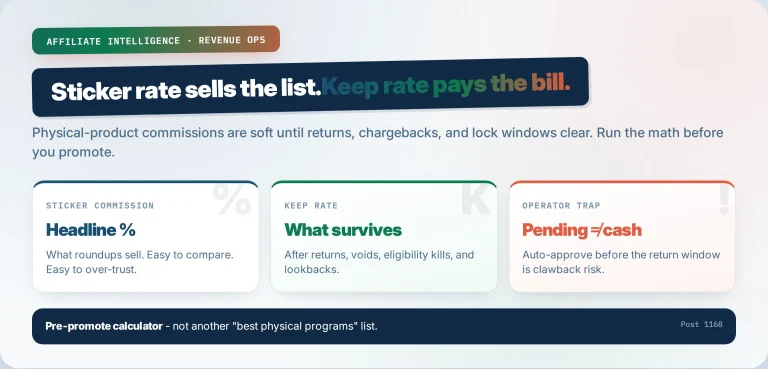
The metric that matters is keep rate. Kept commission equals sticker rate multiplied by keep rate. A 20 percent sticker with a 25 percent return burden is really a 15 percent kept rate, before chargebacks. The physical keep-rate vs sticker rate guide works through the formula in full.

US ecommerce return rates averaged 20.4 percent in 2024, with projections near 24.5 percent for 2025, according to the Red Stag Fulfillment return rate benchmarks. The NRF’s 2025 Retail Returns Landscape puts the overall ecommerce rate at roughly 19 to 20 percent, with apparel running 20 to 40 percent and electronics 8 to 15 percent, per Richpanel’s category benchmarks. If your traffic skews incentive-heavy, assume returns run higher.
Chargebacks are a separate clock. Lookback windows can run 120 to 540 days. Cardholders generally have 120 days from the relevant start date to file, with future-delivery and travel transactions extending up to 540 days from the original transaction, according to Stripe and ClearSale. Common reversal windows run 14 to 60 days. A payout that lands before the return window closes is not paid; it is advanced. A clawback is the moment the forecast corrects. The commission clawbacks tracking prevention guide lays out the full taxonomy.
Amazon makes this concrete. A 4 percent commission on a $200 electronics purchase that returns at 10 percent nets $7.20, not $8. A retail network paying 12 percent on a $40 beauty item with a 5 percent return rate nets $4.56. The percentage is not the story.
Then geo. Slow shipping and dishonest cross-border fulfillment feed returns. A three-week delivery inflates cancellations and “item not as described” complaints. Audience geography matters as much as the offer itself.
Reputation is the invisible weight. When a physical item breaks, the reader blames the recommendation, not just the merchant. Digital downtime gets aimed at the vendor. Physical failure gets aimed at you.
Before I trust a physical program, I record four clocks: lock date, return window, chargeback lookback, and partial-return eligibility. Partial returns are sneaky. A customer returns one item from a multi-SKU order, the merchant keeps the rest, and the terms may void the entire commission. If you cannot answer the lock date, do not send the traffic.
Checkpoint: Every physical candidate has a kept-commission calculation and the four clocks written down.
Step 3 - Test margin sustainability and term verification
A generous rate in a thin-margin category is a warning, not a feature, because program economics set the ceiling. Shopify’s affiliate commission guide puts physical goods at 5 to 15 percent, digital products at 20 to 50 percent, subscription services at 15 to 30 percent recurring, and B2B software at 10 to 30 percent of first contract value.
Compare every candidate to its category norm, not to your wish list. The full underwriting frame lives in the program economics / commission sustainability guide. The short version: a 100 percent first-month payout can be a rational launch subsidy. It is rarely a durable revenue model. Treat any rate with no public history beyond six months as promotional by default.
Before I trust a rate, I verify it from the source. Not from a brochure. Not from a ChatGPT answer. A real failure mode is confirming a “90-day cookie” through an AI summary, then discovering the actual terms say 7 days with a 30-day first-party exception. The verify program details before ChatGPT guide lists the checks.
Answer five questions in writing. Does the rate time-box into a lower steady state? Is lifetime capped or open? What SKUs and categories are excluded? When does a commission lock, if it locks at all? What is the chargeback lookback?
Cap versus lifetime is a reading signal, not a tiebreaker. A 12-month cap shrinks the compounding window. Lifetime stretches it, but depends entirely on the merchant’s churn and margin. If the product’s real retention cannot fund a lifetime payout, the lifetime label is theater.
Checkpoint: Every rate is marked durable or promotional. Locks, returns, validation windows, and exclusions are confirmed from the program’s own terms.
Step 4 - Check SaaS fit traps: recurring fantasy, link rot, job clarity
Recurring is not set-and-forget. The quiet killer is link rot from platform migrations. When a SaaS moves from one affiliate platform to another - Impact, PartnerStack, FirstPromoter are common - old links sometimes 404, and sometimes worse: they resolve to the homepage but drop the tracking parameter.
Migration can look clean while the mapping breaks. FirstPromoter’s own migration process promises completion in 24 to 48 hours without affiliates changing links, but that is only as good as the redirect configuration, according to FirstPromoter’s comparison page. Say the affiliate link carries the token abc123 and redirects to the pricing page. The URL resolves 200, so a naive check passes. The token is gone. The merchant got the click; you did not get the credit.
The fix is a top-earner link audit. Pull your top ten revenue articles, click every affiliate link, and follow the redirect chain to confirm your affiliate ID survives to the final URL. Quarterly at minimum. Passive income is only passive if something watches the plumbing.
Then check job clarity. A SaaS recommendation works only when the content job matches a software-buying intent. Ranking “best AI chatbot tools” is a job. Stretching a generic AI product into a gift guide is not. Product-audience fit beats the recurring fantasy every time. A 30 percent recurring payout means nothing if your audience came for a kitchen gadget.
A related trap is promoting SaaS to an audience that churns fast. If referrals cancel in month one and two, the recurring curve bends to near zero. Check retention signals: do existing publishers report sustainable renewals, or a launch spike followed by reversals?
Checkpoint: Your existing and new SaaS links have passed a redirect parameter check. Each SaaS offer has a clear content-job fit with a software-buying audience, not a forced one.
Step 5 - Keep physical where it still fits and build a mixed portfolio
Physical is not dead. It wins in four situations: trust and tactile demonstration, high AOV with a clean keep rate, content jobs built around tangibility, and geo checkout fit.
Unboxing videos, gift guides, hands-on reviews are physical-native jobs. A newsletter showing a specific pair of socks can pull 800-plus clicks from one link because the recommendation is tactile. SaaS cannot fill that hole.

The AOV plus keep rate case is underrated. In one documented offer test, the physical version carried a 44 percent higher average order value and a 2.3 percent return rate against 8.7 percent for the digital twin. A physical version can sometimes convert better, return less, and make the sticker rate beside the point.
Amazon is the default physical program for most publishers, not because it pays well - it does not - but because it is reliable, broad, and handles fulfillment. The Amazon Associates for operators guide covers what the program actually is. The item-level reporting / Tracking ID workarounds guide documents where tracking breaks and the workarounds. Treat Amazon as a default role in the physical half of your portfolio, then layer higher-margin retail programs where the keep rate holds.
Do not force monogamy. The right mix is by content job. A site can run SaaS tutorials, Amazon gift guides, and a few direct retail partnerships at once, each earning through a different shape. The portfolio itself becomes the asset.
After you have run the math, negotiation is on the table. The when to negotiate better commission rates guide covers when to ask for a better rate: after EPC and keep-rate math, not before. Honey-style last-click pressure also changed what physical offers earn at the margin; the attribution after Honey program changes guide tracks the actual program shifts.
I’ll say it again: physical is not dead, Amazon is not dead, SaaS is not automatically superior. The mix has to fit the jobs you actually publish.
Checkpoint: Every content job has an assigned offer type. Amazon has a deliberate default role, not a dead label. Any negotiation ask is backed by keep-rate and EPC numbers.
Verification - Decision checklist and short FAQ
Score every candidate across four dimensions: cashflow shape, ops load, margin durability, and content-job fit. Then commit to the mix you can actually run.
Higher percentage versus higher AOV has no absolute winner. A 4 percent on a $200 item yields $8 gross; a 20 percent on a $20 item yields $4. Run the kept-commission math, factor conversion, and decide per offer. The sticker never settles the question alone.
Q: Should I negotiate after this math?
Yes, after. You now have kept rate, EPC, and churn-adjusted values. That is the packet you bring, not a vague request.
Q: Do Honey and last-click changes matter for physical offers?
They compress last-click attribution. Physical impulse offers are the most exposed because short cookies plus aggressive last-click pressure can erase credit. Monitor your reports.
Q: Which is safer: capped 12-month recurring or lifetime?
Neither is automatically safer. A capped deal is predictable. Lifetime compounds only if the merchant’s churn and margin can fund it. Read the economics, not the label.
A bigger brochure percentage with a broken keep rate or an unfundable SaaS payout is not progress. Progress is an offer mix whose cashflow shape and ops weight you can actually operate.
Checkpoint: Final scores are written down. The rebalanced mix is committed, and the winning criteria are cashflow shape, ops load, margin durability, and content-job fit - not the sticker rate.
Troubleshooting Common Issues
1. All SaaS candidates fail the link-rot audit.
Exact fix: Prioritize programs with clean redirect chains and platform-stable history. If an audit fails, drop the offer rather than trying to repair infrastructure you do not control. Re-audit quarterly.
2. All physical candidates have high return risk.
Exact fix: Apply a hard keep-rate discount. Start at 20 percent for most physical, heavier for apparel and electronics. Choose categories with lower return burdens or high AOV that survives the discount. Walk if the kept rate sits below your effort threshold.
3. A program changes terms after you publish.
Exact fix: Maintain a change log per program with screenshots. Re-verify terms quarterly. If the new rate fails the effort threshold, pull the offer or demote it below better candidates. Content may survive; the payout does not.
4. Pending dollars stay soft beyond the expected window.
Exact fix: Re-check the four clocks - lock, return, chargeback lookback, validation. If post-payout lookbacks are open-ended, treat all pending as soft and do not forecast cash from it. Escalate with the affiliate manager first, then network support, citing the terms.
5. You cannot find the lock date in the terms.
Exact fix: Email the affiliate manager and ask directly: what is the lock date, after which a commission cannot reverse? No answer means no traffic. Record the response in your change log.
6. A top-earning article quietly stopped earning.
Exact fix: Click through every affiliate link and follow the redirect chain to the final URL. Confirm your tracking ID survives. Check for migrated platforms and dropped parameters. Fix the links or replace the offer.