Affiliate Commission Clawbacks: When Earned Money Gets Taken Back
The Adjustment Email: When a Negative Payout Lands
Operators often open a payout statement and find a negative line item. No email announcing it. No reason code visible at first glance. Just a subtraction where last month used to show a balance.
The thesis is simple: pending is a forecast with a discount rate, not a bank balance. A clawback is the moment the forecast corrects. Some programs catch the refund before payout and call it a reversal. Some take the money back after it lands and call it a clawback. Either way, the operator who treats the dashboard number as spendable is underwriting a risk they have not read.
A clawback is a documented reversal of a specific commission for a stated reason (Altery). That is different from shaving, where conversions quietly never appear. A clawback you can see, trace, and dispute. Shaving you detect only by watching the gap between your own tracking and the program report over time. Both matter. But the clawback arrives as a line item, and the line item arrives because the program’s rules already said it could.
Most programs hold commissions first, then retain the right to reverse them for a defined period. Approval is not the same as finality. The reversal window often extends well past the day money lands. Programs point to the terms. The operator who reads those terms before scaling is the one who stops being surprised.
Trigger Taxonomy: Why the Money Moves Backward
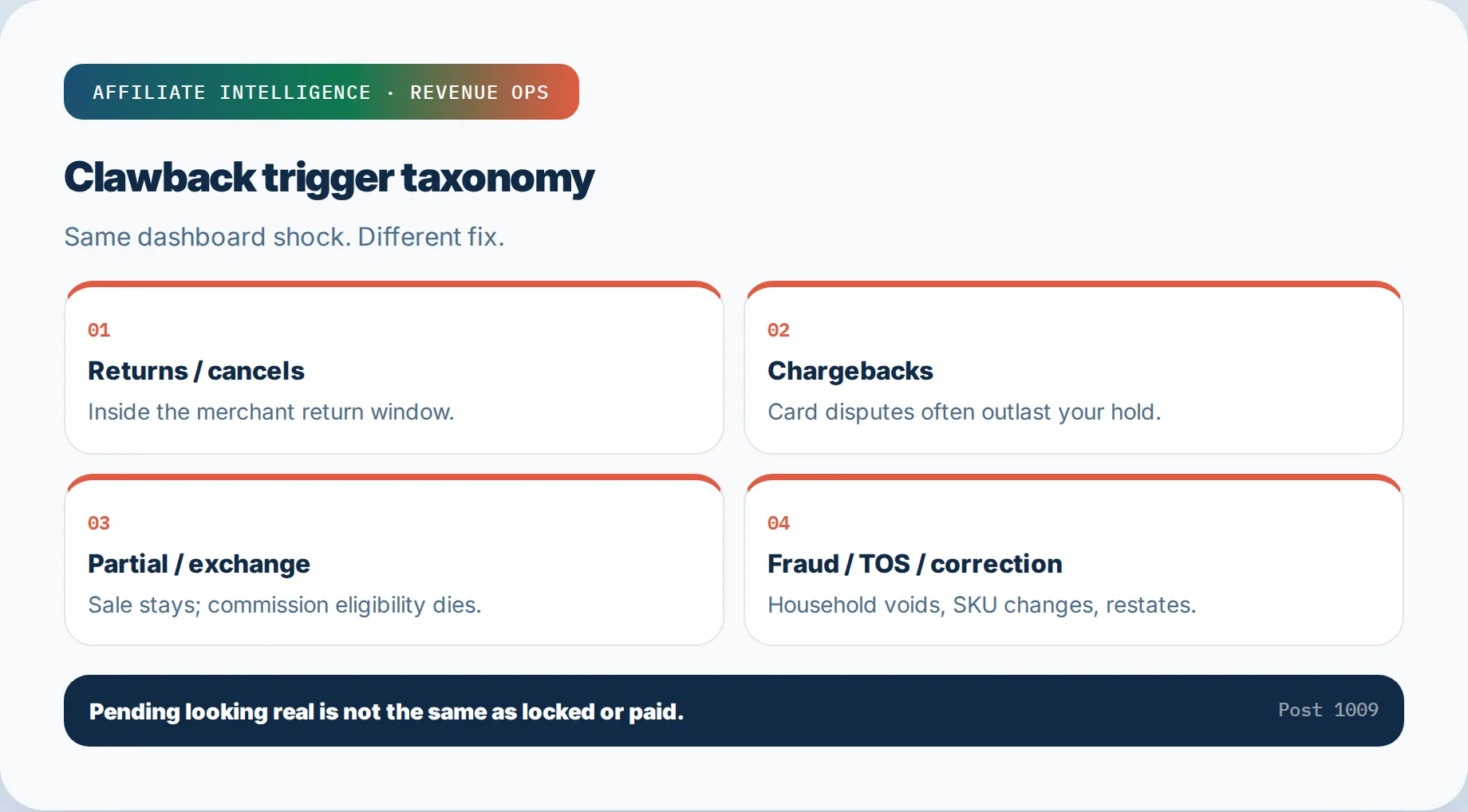
Before reacting to a negative line, classify it. The trigger set is wider than the five-bucket shorthand. These are the named ways a commission moves backward.
First: refund or return. The customer sends the product back or cancels inside the guarantee period. The sale unwinds, and the commission on it unwinds with it.
Second: partial return, exchange, or order modification. The sale can still show as a sale while commission eligibility dies. A line-item refund, a swap, or a later order edit can reduce the commissionable amount to zero even though the transaction still displays as a completed order. This is one of the least obvious triggers because nothing looks reversed on the surface. SamCart’s affiliate guide is direct: any refunded item deducts the corresponding commission from the affiliate’s ledger (SamCart).
Third: chargebacks. The cardholder disputes the charge with the bank. The merchant loses the payment, then reverses the commission tied to it. A chargeback generally takes about 30 days to resolve, and chargeback fees can run from $15 to $100 per transaction depending on the processor and industry risk (PostAffiliatePro). The fee is not the affiliate’s problem. The reversal is.
Fourth: fraud or quality flags. A lead or sale gets marked fake, self-referred, or failing validation rules. False positives happen too: legitimate traffic can look fraudulent when the program’s scoring tools are not tuned. In the same bucket, same-IP, household, and friend-on-same-Wi-Fi voids are usually treated as self-referral or household hygiene. A spouse ordering from the same connection, or a test purchase from your own device, can look just like a manufactured conversion to an automated rule. That is not a riot to fight; it is an exposure variable to catch before the program catches it first (fraud and quality flags).
Fifth: duplicate or mis-tracked events. The same conversion counted twice, or attribution corrected after the fact. The original order remains; the duplicate credit disappears.
Sixth: order never completed. Marketplace “complete order” or delivery-confirmation gates can void a commission after the click looked like a win. The order exists, but the platform’s completion condition is not satisfied, so the payout is removed before or after approval.
Seventh: merchant changes commission on the SKU after the click. A rate drop, offer change, or catalog restatement re-prices the item between click and payout. The click was valid, but the commissionable value no longer matches what the affiliate calculated.
Eighth: attribution denial. Extension, last-click conflict, or another partner being credited can remove a commission that belonged to the same order. That includes cashback-style denials. This is not fraud; it is a competing claim on the conversion.
Ninth: expired unpaid commissions. Some marketplaces age out unpaid balances. The commission is not clawed back in a single dispute, but it is removed if it sits past the platform’s claim window.
Tenth: negative carryover or offset. In RevShare programs, a negative revenue month can create a deficit that future earnings must clear before the affiliate is paid again. That is not a reversal of one sale. It is a structural offset rule, and it behaves differently from a one-line clawback.
Why does this matter? Because classification determines response. A refund-driven reversal is usually routine and mostly predictable. A fraud-driven reversal usually arrives with account suspension and a more aggressive tone. Offer design matters too: free trials, lead-gen payouts, and anything with a long return window carry structurally higher reversal risk than a simple final-sale product (Altery). Classify first, then decide how hard to push.
Read the Lock, Return, Lookback, and Offset Windows Before You Scale
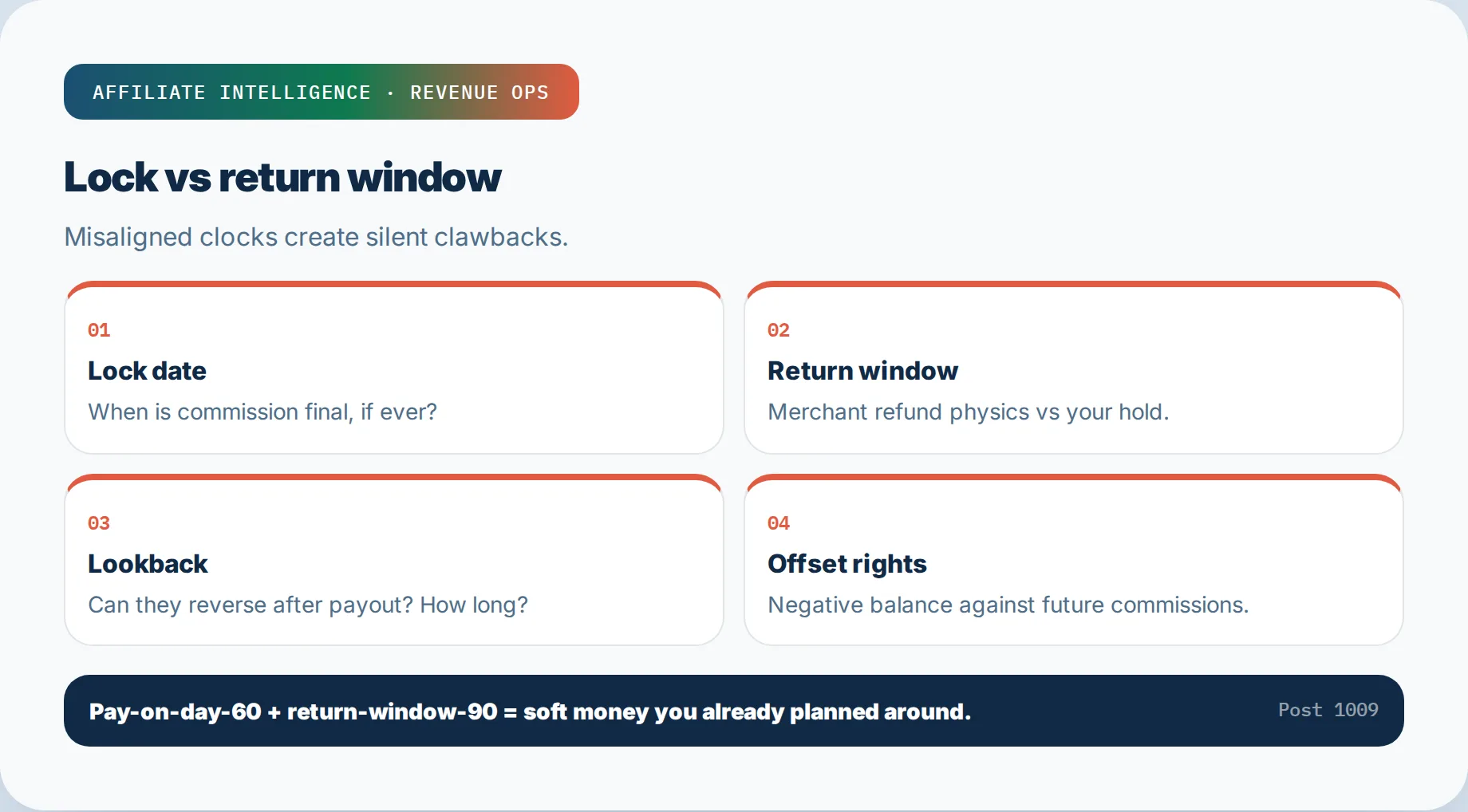
Here is where most operators lose money before a single dispute starts. They compare commission rates, cookie windows, maybe EPC. Then they skip the four clocks that actually decide whether the money sticks.
The reserve hold is the first clock. Somewhere around 7 to 30 days, this is the period before a recorded commission becomes payable at all. The return window is the merchant’s refund policy on the product. The lookback or reversal window is the period during which an approved or even paid commission can still be taken back. Common reversal windows run 14 to 60 days, sometimes longer. The offset rule governs how the program recovers value after payment, usually by deducting from future payouts rather than demanding repayment.
The mismatch is the problem. If a program pays you on day 30 but the refund policy runs 90 days, you are carrying 60 days of unprotected exposure. Rewardful’s guidance is blunt: match the pending period to the refund policy, for example 90 days for a 90-day refund policy (Rewardful). Mihir K. puts the practical range clearly: “Put a hold period before payout. 30 days covers most monthly plans, 60 if your refund policy is generous” (Mihir K., Referralful). A well-designed hold period eliminates 60 to 80 percent of situations that would otherwise require a clawback (Track360). When a program has a short hold and a long return window, the program is structurally guaranteed to claw back. It is not bad luck. It is arithmetic.
Payment timing is part of the same exposure calculation, not just a cash-flow preference. When a network lets you choose payout frequency or filter programs by merchant payout timing, favor a schedule that sits after the lock and outside the lookback window rather than one that pays fast but leaves you exposed on money already received. A payout date inside a longer reversal window is not paid; it is advanced. Treat payout timing as a risk lever, the same way you treat the lock date.
Terms are operational levers, not fine print. Before you send serious traffic, read the payment terms the way an underwriter reads a balance sheet. Withheld commissions after review covers the holdback and review side. Program economics covers the sustainability side. Both live under the same principle: the rate is the teaser. The hold, lock, and reversal windows are the actual deal.
Build the Exposure Ledger: Pending vs Locked/Paid
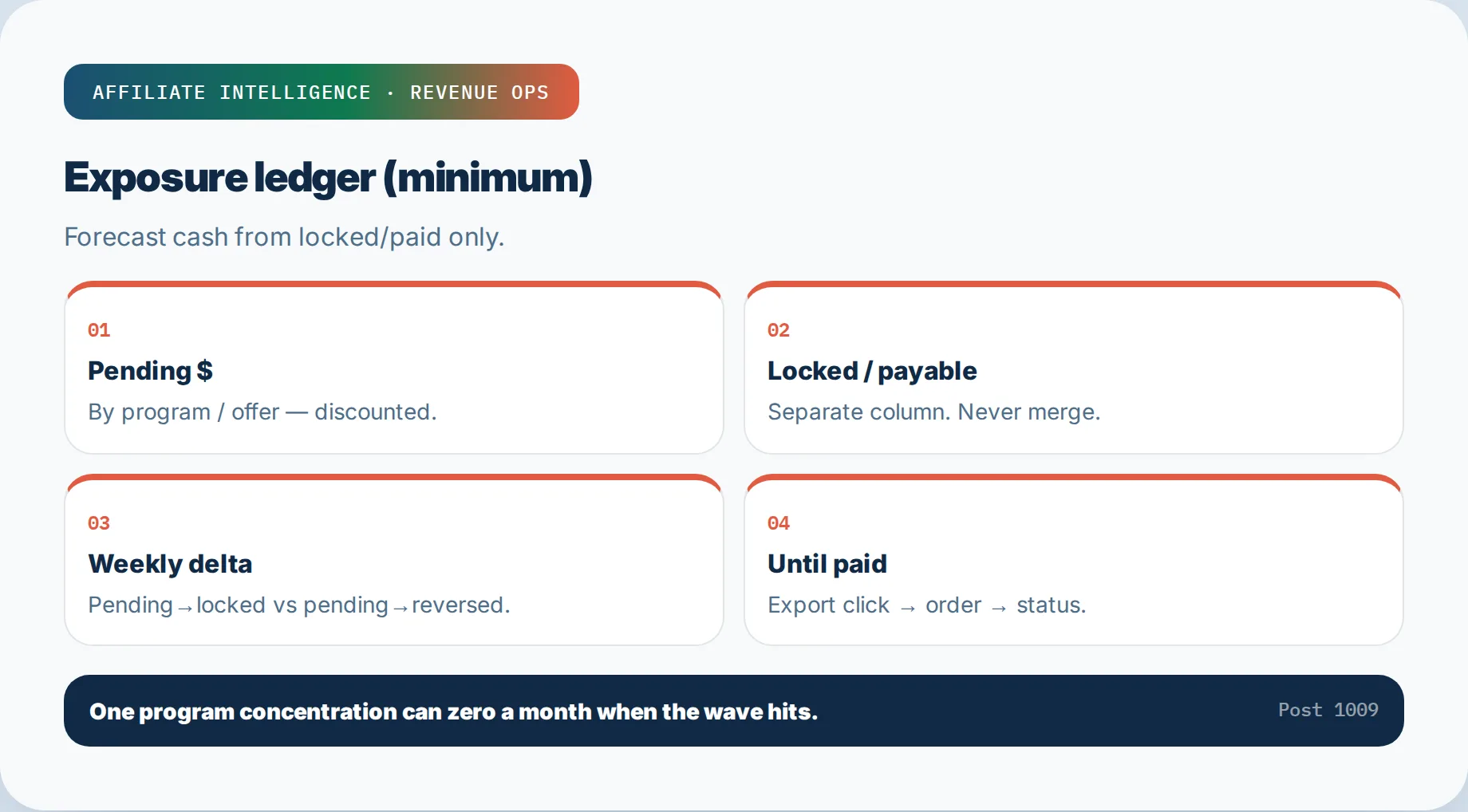
If you run more than one program, stop reading dashboards as scoreboards. Read them as a ledger. When one program dominates the book, the clawback policy in that program is effectively your cash-flow policy. Concentration risk management is the related check, not a separate exercise.
The status chain is the same everywhere: click, order, pending, locked, paid. A click shows up instantly. The commission does not. Reversals can occur until the commission locks. After the lock, the program should treat the order as final. Before the lock, every line is provisional.
SamCart’s default is a clean example. Payable commissions are older than 30 days. Pending commissions are younger than 30 days (SamCart). That 30-day line is the exposure boundary. A refund or chargeback inside the window reverses the commission without touching paid money. A refund after the window, if the program has already paid, becomes a negative line item against future earnings. The dashboard shows the same number. The risk profile is completely different.
For each commission, keep the full chain visible from click to paid. Screenshot or export the click ID, order ID, commission status, and status timestamps. Do not stop at “approved.” Approved can still sit inside the reversal window. Paid is the finish line, and the export should show the line until it reaches paid.
Same-network hygiene is an exposure control, not only a fraud essay topic. A test click, a household purchase on the same Wi-Fi, or a friend’s order from your connection can look like a self-referral to automated rules. Catch those early and keep them out of the pending column before they become a clawback with a fraud label. This is the same discipline as checking duplicate traffic before it becomes a quality flag.
The ledger is not about what you earned. It is about what can still be taken back. For each top program, track three buckets: pending, locked, paid. Then ask the question nobody asks until it is too late: how much of this month’s recognized total can still be reversed? If you cannot answer that number in one sitting, you are flying blind through the exact period where clawbacks happen.
During network migrations, this gets worse because the ledger itself can break. A pending balance in a closing program may never become payable. Same underlying risk: you have to know where each line sits in the status chain before you can price the exposure.
Dispute Without Theater
When a reversal lands and the reason is vague, the instinct is to reply hot. Resist it.
Public rage-posting is emotionally satisfying for about ten minutes. Operationally, it is rarely the best first move. What works is slower and less cinematic: a concise case file. Not a rant. A file.
Before the file, do two quiet checks. First, match the network line item to the merchant order status. If the network shows a chargeback but the merchant status still shows completed, or the merchant shows a refund while the network line still reads approved, that status gap is your opening question, not an accusation of theft. Second, separate fights that sometimes arrive together: a withheld balance and a clawback are different problems. If both are present, do not argue them as one. Withheld commissions after review covers the freeze side; this piece covers the takeback side.
Include the affected amount, date range, traffic source, click IDs, timestamps, status history, and the exact question you need answered. Ask for the reason code, the specific evidence behind the reversal, and the expected review completion date. The card networks alone maintain 151 distinct reason codes, so “chargeback” is not a reason; it is a category (Verifi). Force the program to be just as specific. If the program runs through a network, learn the network’s dispute path before you need it.
Escalate in a straight line: affiliate manager first, then network support, then a written terms citation. Do not skip steps, and do not turn the final step into legal theater. The point is not to threaten; it is to make the program’s own published rules carry the conversation. If the terms say one thing and the support ticket says another, the gap is the evidence.
There is a structural reason this works. Affiliates accept reversals when they can see exactly why the commission was clawed back and verify that the policy was applied consistently (Track360). The moment a program looks selective or arbitrary, trust collapses and the best partners leave first. A professional dispute is not weakness. It is the mechanism that reveals whether the program can produce a reason code or is improvising one.
If they can define the evidence only after the dispute starts, they control the goalposts. The case file is what keeps the goalposts visible. Withheld commissions after review walks through the escalation path in more detail. The short version: documented specificity beats public noise, almost every time.
Prevention and Program Selection: Pick Lock Rules Before You Send Traffic
The best clawback defense is not a faster dispute. It is choosing programs where the reversal risk is priced before you send the first click.
This is underwriting, not rate chasing. I look for four things. A hold period matched to the refund window. A lock date stated in writing, not implied. A reversal window with a stated maximum, common guidance is 90 days from commission approval (Track360). And a recovery mechanism that stops at deduction from future payouts, not an open-ended claim on cash.
The compliance audit checklist is a useful adjacent filter, but the clawback-specific test stays narrow: can the program state the trigger, the window, and the appeal path in writing?
The benchmark is useful here. Hold periods in SaaS affiliate programs commonly run 30 to 60 days, while refund windows typically span 14 to 30 days (Reditus). A 30-day hold against a 14-day refund window is healthy. A 14-day hold against a 60-day refund window is a trap wearing a fast-payout costume.
Program economics makes the same argument from the durability side: the rate is the teaser, the structure is the yield. The same applies to clawbacks. Two programs can offer 25 percent recurring. One locks commissions at 30 days against a 14-day refund window. The other locks at 90 days against a 60-day refund window. Same headline. Completely different exposure. And if you have enough volume to negotiate, that conversation should cover hold and lock terms, not just the rate. A better lock date is often worth more than a point of commission.
When network float becomes unbearable, direct or escrow brand deals are a light structural alternative. They replace the platform’s reversal clock with a two-party agreement, which is not risk-free and not a pitch; it is simply another underwriting option for the same four clocks.
The One-Sitting Clawback Pass
Enough theory. Six actions, one sitting, boring and effective.
Download monthly statements with transaction IDs for every program doing real volume. List each program’s reversal window in a column next to it. Mark every recent commission as pending or locked. Note which programs use negative carryover offsets and which do not. Flag concentration: if one program is more than 40 percent of revenue, its clawback policy is now your cash-flow policy. Then schedule the recheck.
That is the entire pass. No fancy tooling. A spreadsheet and thirty minutes once a month. The operator who knows their concentration level is the one who notices when one program’s reversal exposure has quietly become half their monthly cash.
Concentration risk management goes deeper on the dependency math. For clawback purposes, the rule is shorter: a reversal you can absorb is an accounting event. A reversal that breaks your month is a portfolio failure. The pass tells you which one you have before the email lands.
Questions for Top Programs
Send these to your five highest-revenue programs. Directly, in writing, operator to operator.
What is the lock date? What is the lookback window? Which triggers can reverse a paid commission, not just a pending one? How are offsets applied: deduction from the next payout, or negative balance carried forward? Is there a recovery cap or an escalation path above a certain amount?
Map every answer to the four clocks: hold, return, lookback or reversal, and offset. You are not asking for a rate sheet. You are asking when the forecast becomes final. Also get the dispute path in writing: the reason codes the program uses, the evidence it needs for each one, and the expected review window.
One concrete benchmark to anchor the answers: on FastSpring and Impact, January actions lock in February and are paid on March 15 (FastSpring). That is a clean, knowable structure. If a top program cannot answer the same questions in two sentences, that silence is itself information.
Ask for the written source for each answer. Dashboard settings are not terms. You want the reusable answer, not the support ticket interpretation. If the terms need adjustment, the negotiation piece is the natural next read. But send the questions first. You negotiate from what you know. Most operators negotiate from what they hope.
Counterargument: A Reversal Can Be Legitimate
This is not an anti-merchant argument. Clawbacks exist for a reason, and sometimes the reason is sound.
Without clawbacks, organizations risk paying out commissions for deals that ultimately do not generate revenue (CaptivateIQ). A refunded sale should not produce a paid commission. A fraudulent order should not produce a paid commission. The merchant is not wrong to protect the program from paying on revenue that did not stick.
The problem is not the reversal itself. It is opacity. Fair clawbacks are clear, limited in scope, and enforced consistently. As Gary M. noted, progressive programs may refuse reversals on ordinary returns while still reversing fraud and canceled orders (AM Navigator). The same trigger should produce the same reason code for every affiliate, every time. When it does, even a painful clawback is survivable. When it does not, even a small one corrodes the program.
So do not read a negative line as theft by default. Read it as a signal. The question is whether the program can explain it. The operators who run the pass and ask the questions are the ones who can tell the difference.
Close: Lock Rules and Exposure Tracking Beat Rage Email
Here is the whole argument in one paragraph. Pending is a forecast with a discount rate, not a bank balance. The discount rate is the program’s reversal window, and it is higher than most operators assume. Lock rules tell you when the forecast becomes final. Exposure tracking tells you how much of this month’s number is still at risk. Neither is exciting. Both beat the rage email.
So run the pass this week. Download the statements. List the reversal windows. Mark pending versus locked. Note the offset rules. Flag the concentration. Schedule the recheck.
The operators who lose the least are not the ones with the best agreements. They are the ones who noticed the exposure before the negative line arrived. Withheld commissions after review covers what happens when the program decides to sit on your money. This piece covers what happens when they take it back. Read them together. Then go audit your top five programs.
The clawback is coming. It is in the terms already. The only question is whether you priced it before it priced you.