Affiliate Commissions During Merchant Network Migration: Where They Disappear
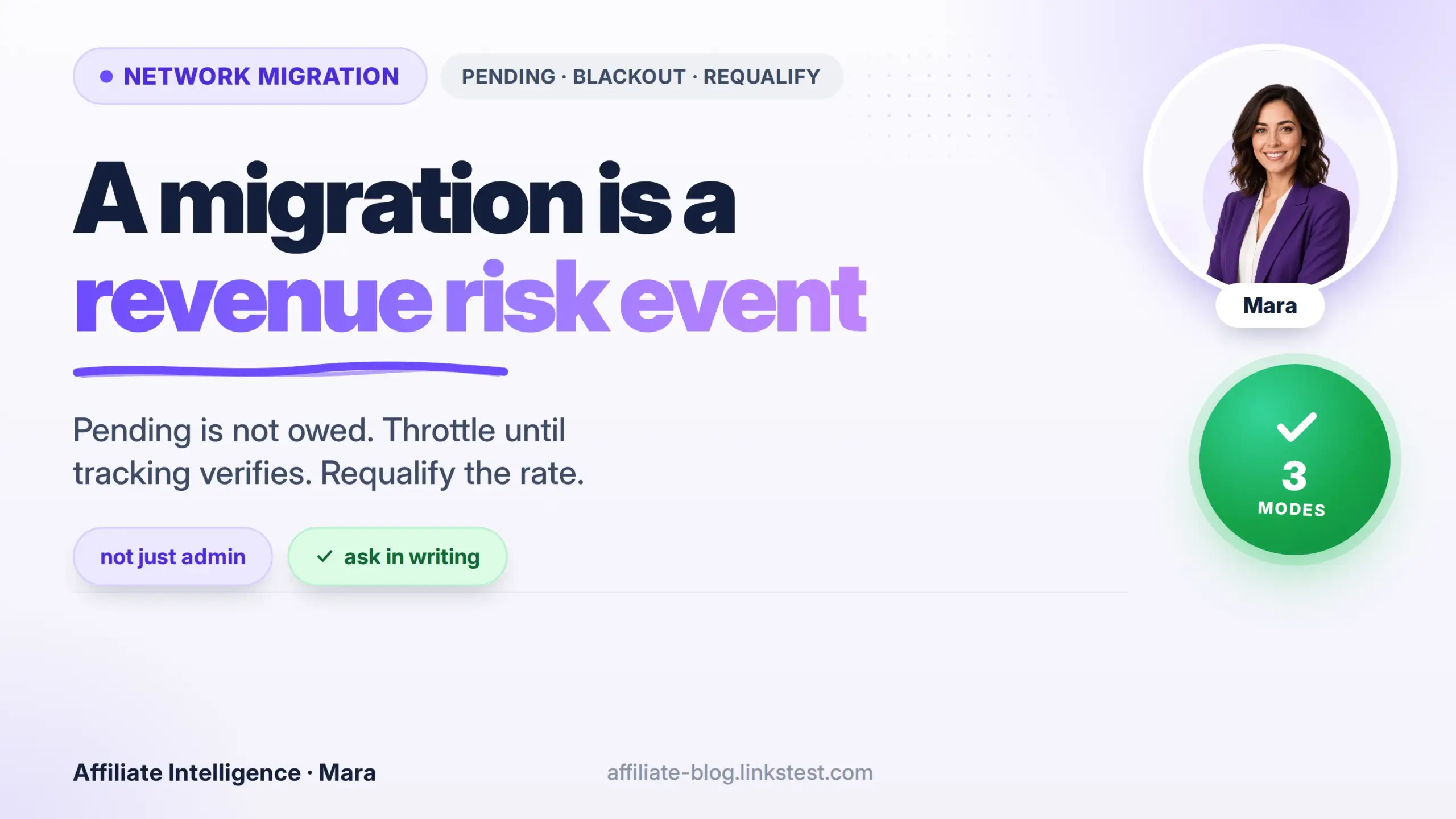
Merchant network migrations are not technical events. They are revenue risk events wearing a migration checklist. This is a publisher playbook, not a merchant onboarding guide. When a merchant moves networks or brings a program in-house, merchant-side material frames data transfer and partner communication. Publishers lose money in three places: the pending validation window, the tracking blackout, and the requalification spectrum. None of them announce themselves cleanly. All of them cost money if you keep sending volume on autopilot.
Sudden network cuts to a publisher (for example Honey in January 2026) are a different event than a merchant program move, but they share one lesson: payments can freeze while balances still look "pending." Most merchant migrations are quieter. Treat any announced or suspected migration as a revenue event first. The operators who lose the least noticed early, documented before the close, and reduced exposure only where tracking failed.

Anatomy of where commissions disappear (three modes)
A tracked sale is not a paid commission once migration interrupts validation or tracking. Three modes do most of the damage. They often overlap.
Mode 1: The pending commission window
Most programs run a validation period. Thirty to ninety days is common; longer appears in refund-heavy categories. If the old program closes while sales are still validating, the dashboard may show a pending balance that never becomes payable. Pending is not owed in most agreement language. Payment usually needs validation to finish and the merchant to approve the sale.
Weglot’s FirstPromoter to Kiflo postponement note is useful because it made continuity explicit: migration moved to phases, FirstPromoter access cut shifted later, commissions generated in FirstPromoter would still be paid through FirstPromoter, final payout dates moved with the schedule, and referral links stayed unchanged for the stated cohorts. That is what clarity looks like. Silence is not proof of bad faith. It is the absence of a promise. Weglot’s table also models what to ask: the date the last pending commissions are generated on the old rail, and the date of final payouts. Merchant-side playbooks give the same shape - Refersion tells brands to pay out owed commissions on the legacy platform before cutover, and SaaS migration checklists tell them to reconcile every open balance (pending, approved, held, paid, reversed) instead of moving a net total. Ask for that in writing.
Mode 2: The tracking blackout
During the handoff, tracking often gets strange before it fails. Old links stop resolving. New links are not live everywhere. Deep links break. Redirect flows get messy. Tags fire inconsistently. Etsy Help names Rakuten Advertising as the Affiliates partner, and craft publishers who already lived an Awin-to-Rakuten swap (for example CraftGossip’s 10,000+ link cleanup) learn that bulk replace is the real tax - not the login screen. Replace highest-revenue URLs first, then the long tail.
Moonpull estimates that around 5 percent of advertisers’ tracking implementations change each month. Treat that as attributed implementation churn on ordinary sites, not as a migration rate. Before you trust volume on a new stack, require a test click, a tracked conversion, and visible reporting. Prefer a centralized hop so one destination swap beats editing every old post. Until end-to-end proof passes, keep risky paths at maintenance level.
Mode 3: The requalification spectrum
Sometimes a new network is a blank-slate program: new approval, new default rates, new payout logic. Sometimes continuity is engineered. Split the public sources. Rakuten Advertising’s advertiser-facing partnership post emphasizes carrying relationships and extended redirects for years so partners do not need a full rejoin. Rakuten’s Publisher Help Center is where publishers get the claim-or-create impact.com account path and the wave timing (programs moving this year and next). Treat those as network promises - confirm dates, redirect duration, and rate survival with this merchant in writing.
DMi Partners (merchant-side) notes that typically only 50-70 percent of partners migrate their links in the first four weeks. That is partial link adoption under a parallel-run window, not a blank-slate filter. The same guidance: run both programs in parallel and do not remove the old pixel until the majority confirm. Your written ask: Until when does the old tracking stay live?

Early warning signals
Migrations rarely arrive as a clean memo. Watch hiring for a new affiliate or partnerships lead, payment-term edits in T&C mail, dashboard metadata swaps, and click-to-commission drift against your baseline. Flat clicks with weaker economics often mean merchant-side tracking change, not worse content. When your own trend breaks without a seasonal story, email the manager with the dated gap - compare to your baseline, not to a universal percentage.

Publisher protection playbook
First, download monthly statements with dates, amounts, and transaction IDs for every merchant doing real volume. Screenshots are not payment records. Inventory proof before the failure - the same discipline as link rot audits.
While you still have access, audit tools that inject or rewrite those URLs: link managers, shorteners, cloakers, coupon widgets, email tools, postbacks keyed to the old network ID. Migrations break at the edges.
When a migration is confirmed, use the window the merchant announces - or act immediately if none is published. Do not blanket-pause if the merchant documents long redirect continuity and old plus new still track. Prefer parallel tests: compare old-network versus new-network clicks on the same URLs and date window, then limit volume only on paths that fail end-to-end proof. That discrepancy mindset matches the click-to-commission diagnosis tree. For hop design that survives redirects, see UTM, SubID, and server-side proof.
Ask in writing about pending handling (amount, IDs, dates), the date the last pending commissions are generated on the old rail, the final payout date, and the old pixel’s end date. Treat the new program as a qualification check on rates and terms even when claim/auto-join messaging sounds continuous. Recheck top deep links while you wait - highest-revenue first.
What the agreement usually means (not legal advice)
Most agreements make commissions payable only after validation ends and the merchant approves the sale. If the old program closes earlier, the merchant may satisfy the contract while you still lose the money. Some merchants honor pending through the old rail anyway - Weglot said so in writing. Intention is not obligation. Withheld commissions after review and clawback prevention show the same pattern: tracked is not paid until the payout run says so. Build the paper trail that makes honoring the balance easy. That does not remove exposure.
One-sitting checklist
- Download statements for the top revenue programs (IDs, dates, pending).
- Inventory third-party tools that rewrite those affiliate URLs.
- Read recent payment-term T&C edits.
- Email each merchant with meaningful pending: amount, IDs, dates; last pending-generation date on the old rail; final payout date; pending handling; and old-pixel end date.
- On the merchant’s announced window (or immediately if none): parallel-test old vs new clicks; replace highest-revenue failing links first (then bulk/centralized replace); limit only dead paths.
- Confirm claim/join path and rates in writing before assuming the old deal transferred.
Operators who wait for the announcement lose the cleanest evidence window. Operators who document, ask in writing, and test in parallel may still lose some pending - but they know what failed and when.