Affiliate Link Rot Revenue Loss: Find Silent Failures Costing Commissions
Most affiliate link rot never throws a 404. It degrades quietly: a deep link lands on a category page, a SubID vanishes mid-chain, a geo-blocked page loads fine from a US office IP. Commissions decay while traffic holds steady. Operators notice only after EPC has already dropped. The thesis here is simple: the most expensive link rot is silent, and scheduled health checks beat reactive cleanup because they catch decay before the payout report does.
Link rot is not only 404s
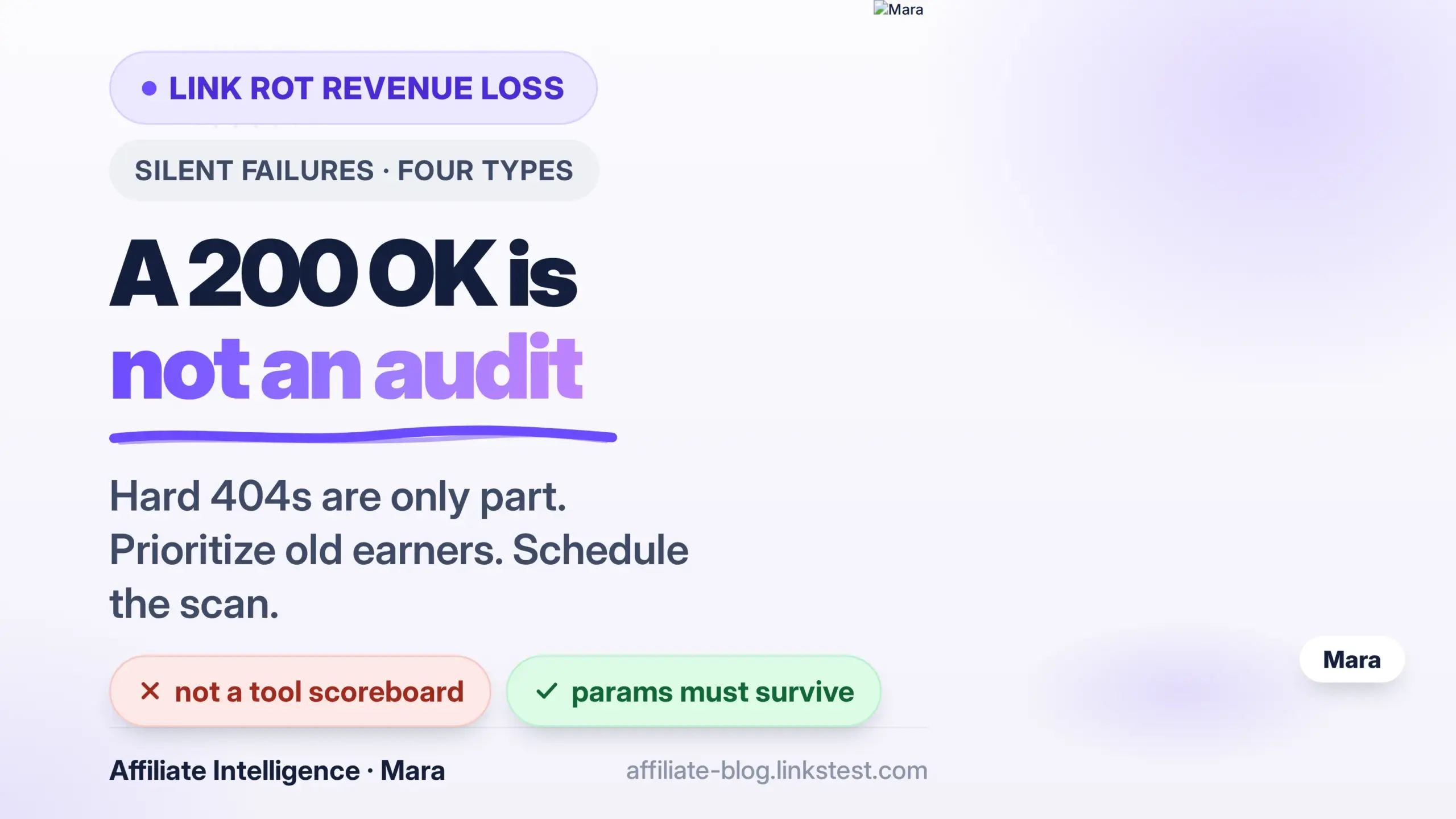
A green 200 is not an audit. Most link rot is invisible because the page returns successfully. Trackonomics by impact.com scanned more than 7,000 pages across 25 publishing sites and estimated the industry loses at least $160 million annually to link rot. I treat that as an attributed estimate, not a precise ledger. In the same study, more than 40 percent of affiliate URLs contained some rot issue, and 404 errors were only 27 percent of the failures. That means nearly three quarters of the damage was silent: wrong page, dead product, stripped tag.
I care less about the exact dollar figure than the shape of the problem. Clicks keep moving. Pages keep loading. The merchant gets the sale. The publisher does not get credited, because the tracking signal died somewhere in the middle. If you want a separate treatment of what to do when EPC drops without an obvious click drop, the conversion drop piece is the next stop. For this article, the starting point is diagnostic: link rot is a health condition, not an event.
The structural scenario matters more than a percentage. An evergreen guide that ranks for “best backpacks” can receive steady organic clicks for years. If three of its ten deep product links now resolve to a category page, the click count looks normal. The commission per click does not. That gap is the leak. Link rot does not need a crash to cost money. It only needs a mismatch between what the content promises and where the URL lands.

Four failure types lumped as “link rot”
Four failure types get lumped under link rot, and only the first announces itself.
Hard 404. The page is gone. The server returns 404 or 5xx. This is the satisfying failure because it is visible, and also the minority. In the Trackonomics data, 404s were 27 percent of issues; useful, but it leaves the rest invisible.
Silent redirect to wrong destination. The URL returns 200, but the final page is a homepage, a category wall, or an offer wall. A retailer restructures a product slug, and the deep link now walks to a generic landing page. The visitor still sees a valid page, so no one reports a problem. Conversion collapses anyway.
Tracking parameter loss mid-chain. The page is correct. The product is correct. But the SubID, clickref, or affiliate ID was stripped two hops earlier. The network never attaches the click to the publisher. This is the most expensive single class because nothing looks broken. One LinkPulse analysis, which I treat as an attributed estimate, put roughly 20 percent of broken-link revenue loss in this category.
Geo-blocking that only fails outside your test IP. The page is live in the US, but a German or Australian visitor hits a fallback page without the affiliate handoff. If you only test from one office, you will never see it. This is a systemic blind spot, not a rare edge case.
Soft 404s and out-of-stock variants are the cousin of silent redirects. The URL returns 200, but the page is an empty product shell or a “no longer available” notice. The link looks healthy to a status checker and dead to a shopper. Amazon ASIN fragility is the cleanest example class: a product gets unlisted, the ASIN dies, and the affiliate link decays while the content around it keeps ranking. I deliberately avoid naming a tool scoreboard here; the point is the failure type, not the logo. For hop-level forensics, the redirect chain tooling piece covers curl protocol and tool tiers, and the leakage forensic piece maps the parameter strip taxonomy in detail.
Across four failure types (hard 404, silent redirect, tag loss, geo-blocking), three of the four are invisible from a click log. That is the whole problem in one sentence. Hard 404 sits on one side, the only failure that triggers an alert. The other three sit on the revenue-killer side: the 200 that hides a category page, the 200 that hides a stripped ID, the 200 that hides a geo fallback. If a monitoring tool only classifies the first, it is checking reachability, not revenue. Reachability is the floor. The floor is not the job.

Where revenue leaks first (prioritize)
Prioritization is not a feeling. Revenue leaks first where traffic is oldest and intent is most specific.
Older high-organic pages decay before low-traffic pages. A three-year-old gift guide still ranking for a seasonal term is a liability if no one has rechecked its links. The content has search equity, so clicks continue. The products may not.
Deep product URLs are more fragile than homepage links. A homepage link survives a restructure; a deep link to a SKU or ASIN does not. As an attributed estimate, about 15 percent of Amazon affiliate links break within six months, and retailer URL restructures can wipe deep links overnight. The same logic applies to any merchant with per-product URLs.
Seasonal content that ranks year-round is a specific trap. A “best winter boots” guide earns nothing for six months, then spikes in October. If the links rotted in March, the damage is invisible until the first snow.
The strongest early signal is hard to see in aggregate: high click-through rate with a declining commission rate. If the same page sends the same traffic but EPC decays, something is silently redirecting or stripping tags. That pattern is the structural scenario I use instead of a fabricated audit diary. An evergreen backpack guide still ranks. Three deep product links now land on category pages. Clicks continue. EPC decays. The merchant gets the traffic. The publisher gets less credit. No crash. No alert. Just a slow leak.
The fix is to sort by revenue, not by recency. Pull your highest-earning pages first, and within them, the oldest pages that still rank. I recommend starting with the top 25 revenue URLs and working back through the long tail only after those are clean. The oldest highest-earning evergreen pages are where the aggregate loss concentrates, because they have both the traffic and the time to rot. A new post has not had time to decay. A three-year-old post has. Seasonal content deserves its own peak-season pass: if a guide ranks for back-to-school terms, check it in July, not in September when the traffic already arrived.

Three-step audit workflow
The audit is three steps, and I recommend running them in order. Skip the first and you will optimize a broken spreadsheet.
Step one: inventory affiliate URLs and status. Export every affiliate link from your site, link management plugin, or CMS. For each, record the source page, the destination, the network or program, and the last verified date. If you need a bulk pre-launch version of this step, the bulk validation checklist covers scale QA. The inventory is the audit trail. Without it, you are guessing which links exist. Most operators do not actually know their current URL inventory; they know the links they pasted six months ago. Those are different sets.
Step two: inspect the full redirect chain beyond the first 200. A status checker that reports 200 only proves the final URL resolved. It does not prove the query string survived every intermediate hop. Before I trust a 200 OK, I trace the chain manually with curl, one hop at a time, because a 200 HTML intermediate can rewrite the destination and drop the identifier without ever emitting a redirect. Owned-domain hop honesty belongs in the cloaking compliance piece. The redirect chain tooling piece covers curl protocol and tool tiers for this step. The practical rule is boring: follow every hop, log status and Location, stop at the first mismatch.
Step three: verify tracking parameters survive. This is the step most generic monitors skip. Your affiliate ID, SubID, clickref, or click ID must be present on the final landing URL, or the network must have captured it at an intermediate hop via cookie. I treat the query string as the money column. If the parameter is gone by hop two, that is the breakpoint. If SubIDs arrive blank after a hop that looks fine, the SubID blank diagnosis is the adjacent runbook. Do not keep tracing past the first mismatch. For parameter design and survival rules, the UTM and SubID tracking spine piece is the reference. The leakage forensic piece tells you what to do after you find a break; this article stays focused on finding and classifying the failure first.
Discrepancy ranges matter when you are tempted to wave off small deltas. As an attributed estimate, Media Intercept-style discrepancy ranges of five to twenty percent are common depending on redirect chains and privacy restrictions. Moonpull’s attributed estimate warns that around five percent of advertisers’ tracking implementations change monthly, a half-life decay pattern. I would not treat either number as gospel, but both point the same direction: point-in-time audits go stale, and small losses compound.
The three-step workflow is diagnosis, not tool shopping. One step is inventory. One is chain tracing. One is parameter survival. If a platform only does step one, it is a bulk checker, not a health monitor. If it only does step two, it is a tracer, not a revenue guard. I am skeptical of any dashboard that collapses all three into a green dot. The audit itself is cheap. The expensive part is not running it.
Why scheduled health beats reactive cleanup
The strongest objection to scheduled monitoring is that reactive cleanup feels sufficient. A publisher sees EPC drop, traces the dead link, replaces it, and moves on. The problem with that rebuttal is timing. By the time EPC drops, the loss has already happened. Silent failures do not announce themselves in the payout report; they accumulate in the days or weeks before the report exists. Reactive cleanup is a post-mortem. Scheduled health checks are prevention.
A point-in-time audit goes stale almost immediately. Merchant restructures happen overnight. A retailer changes a URL scheme, a product feed expires, a network updates a parameter name. The link that passed on Tuesday can fail on Thursday. As an attributed estimate, Trackonomics placed UK publisher losses on Black Friday 2018 alone at 575,000 GBP. I use that attributed estimate only to show the peak-season stakes. Waiting for a revenue dip to investigate would have booked that loss before anyone looked.
I recommend weekly scans on top revenue URLs and immediate alerts on high-revenue links when a check flips from healthy to broken. The full catalog can run monthly, with a complete deep-link pass before any known peak: back-to-school, gift-giving season, Prime Day if you are Amazon-heavy, Black Friday. Seasonal full audits are not optional. A link that dies in February and is caught in July has already wasted five months of organic clicks.
The operational discipline is the point, not the tool. Weekly scans plus high-revenue alerts turn link health into a living process instead of a fire drill. I prefer cadence over perfection. A scheduled check that catches 80 percent of failures early beats a heroic manual sweep that catches 100 percent once a year. The counterargument deserves a fair hearing: some operators say large merchants rarely break links, so monitoring is overhead. That is true until it is not. The failure is low probability per link and high certainty across a portfolio. With a hundred deep links, the question is not whether some will rot, but which one will rot next.
There is one safety rule I will not soften: do not fully auto-replace dead links when editorial intent named a specific SKU. If the content says “the Osprey Daylite 26,” replacing the dead URL with a generic category page or a competitor’s product violates the promise of the article. The fix is to preserve intent. Find the same SKU at another retailer, or update the recommendation explicitly, or remove the link with a note. Blind auto-replace trades a technical failure for an editorial one. That is a worse problem because it erodes the one asset an affiliate publisher has: trust.
Scheduled health beats reactive cleanup for the same reason a budget beats overdraft fees. The cost of monitoring is small and predictable. The cost of silent decay is large and invisible. I would rather know my links are healthy weekly than discover they were not, after the quarter closes.
One-sitting checklist + short FAQ
The one-sitting version is deliberately short. Pull your top revenue URLs. Classify each failure type. Fix or replace with intent preserved. Schedule the next scan. That is the whole checklist, and it fits on an index card. If the question is inbound toxic-link risk rather than outbound rot, use the Moz Link Explorer for affiliate audits scout - it is a different lane from this revenue leak checklist.
Pull your top revenue URLs. Not all links. Not a random sample. The top 25 or 50 pages by affiliate revenue, because those carry the bulk of the exposure. If you do not have per-page revenue, use traffic multiplied by average order value as a proxy. The goal is to find the pages where a silent failure costs the most.
Classify each failure type. A hard 404 is an obvious fix. A silent redirect needs a destination check. A stripped tag needs a chain trace. A geo failure needs a test from outside your home country. One finding from a Trackonomics scan, which I cite as an attributed example, was 21 link rot issues in a single article, including seven links to 404 pages and 19 pricing issues in another high-traffic piece. The point is not the exact 21. The point is that one article can hide weeks of losses.
Fix or replace with intent preserved. For a dead SKU, find the same product at another merchant or update the recommendation. For a silent redirect, point the link at the canonical final destination. For a stripped tag, fix the hop that dropped the parameter. Do not blindly auto-replace a specific product with a category page. That changes the contract with the reader.
Schedule the next scan immediately. Weekly for top revenue URLs. Monthly for the long tail. Full audit before every peak season. The scan that catches a break today is only as good as the one scheduled for next week. I recommend a recurring calendar entry, not a mental note.
Two questions come up enough to answer directly. Is a 200 OK enough? No. A 200 only proves the last page loaded. It says nothing about whether the right page loaded, whether the affiliate tag survived, or whether a visitor in another country saw the same thing. Does geo-blocking show in US-only tests? No. You must test from the geographies you actually monetize, because the page can be healthy in one country and dead in another.
Run the first scan this week. Not when the next payout report looks soft. By then the leak has already been priced.