How AI Content Silently Breaks Affiliate Links (And How to Audit for It)
Operators often ship a page that ranks, returns a clean HTTP 200, and still pays nothing. The failure is not the content score. It is the link. AI-assisted publishing makes one failure more common: the model rewrites the URL while the product name still matches. This tutorial teaches the audit, not another think piece.
Prerequisites
Before you start, drop the assumption that a visible page and a green status mean tracking works. A click is logged at the redirect; a sale is matched later. Between them sits a handoff chain, and any hop can break while the click still logs cleanly.
Gather five things first.
- A CMS href inventory: every affiliate URL in rendered HTML, not just the raw post content.
- The tagged deep links from your brief: your source of truth for what the link should have been.
- One clean click path in an incognito browser, free of old cookies.
- Terminal access with curl 7.68 or newer, plus a server-side redirect checker if your chain is long. You need read access to your CMS export and view access to the network dashboard click rows.
- Network access to see whether your click arrived with the correct SubID.
I recommend a plain spreadsheet with Link URL, Source Page, Brief URL, Network, and Priority. Priority comes from analytics, not recency.
Checkpoint: You can pull every affiliate href from a rendered page and list the tagged URLs your brief specified. If those two columns do not match, you already found the first leak.
Failed Assumption: Green Rank Plus 200 Means Monetizing
Operators often treat rankings and reachability as proof of monetization. A common failure mode is a page that ranks in the top three, loads perfectly, and earns nothing because the affiliate identifier never survived.
There are two silent families and one audit gate that catches both. Family one is AI URL substitution: the model swaps the tagged deep link for a clean product URL. Family two is post-publish parameter strip: browsers, share paths, shorteners, or redirect hosts remove the parameter after the page is live.
Content grading scores are the wrong lens here. A high AI quality score can sit on a page where every commission link is dead. I care less about grammar grades than click truth at the landing page.
Many link failures are silent, not hard 404s. Trackonomics scanned more than 7,000 pages across 25 publishing sites and found that 404 errors were only 27 percent of failures; the rest were wrong-page redirects, stripped tags, and dead product pages that still returned 200 (bulk affiliate link validation checklist pre-launch). Treat that as an attributed estimate, not a universal law. The shape is what matters: healthy-looking pages can leak revenue.
Checkpoint: You can classify an AI page by failure family, not content score. If you catch yourself saying “the product name matches, so it is fine,” stop. That is the exact failure mode.
Failure Family 1: AI Swaps the Clean URL
Step 1: Detect substitution before you trust rendered HTML.
The model receives a brief with a tagged deep link. Something like:
https://merchant.example/product?aff_id=12345&subid=best-vpn
The model outputs a page with a clean product URL:
https://merchant.example/product
The page looks right. The product name matches. The anchor text is correct. But there is no affiliate redirect, no click ID, no cookie handoff. The sale goes through; you do not get paid.
This is the post-redirect URL mistake scaled through automation. The clean URL is not the affiliate link. Never copy the final URL from the browser address bar and use it as your affiliate link.
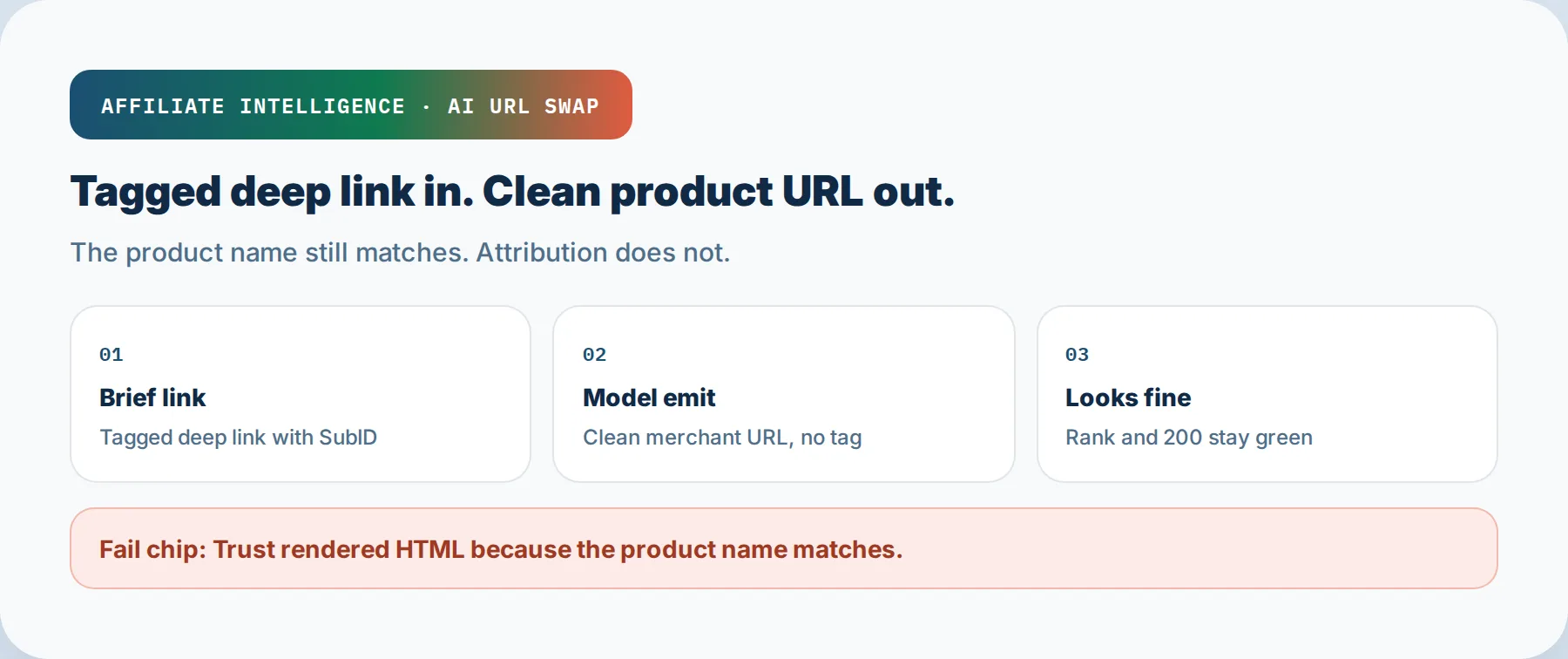
Diagram 1 - AI URL swap:
The fail state is trusting rendered HTML because the product name matches. The fix is a substitution sweep:
grep -o 'href="[^"]*"' rendered.html | sort -u
Compare every href against your brief URLs. A link that starts with a merchant domain but lacks your aff_id, tag, SubID, or network click parameter is a substitution. I recommend flagging it before publish, not after.
A structural scenario makes this concrete. A publisher generates 300 product pages from one template. The brief for page 217 contains a tagged deep link. The model omits the query string on 40 of those pages because the template clipped the parameter. The product images and titles all match. No status checker fires. The first sign is a thin payout report. The sweep catches it in one pass because the diff between rendered href and brief URL is mechanical.
Why this works: grep extracts the actual href values from the final HTML, the same HTML a browser clicks. The brief URL is your control group. A diff between the two catches replacement even when the visible text is perfect.
Checkpoint: You have a list of rendered hrefs and a diff against the brief. Every clean product URL is marked as a substitution before the page ships.
Failure Family 2: Params Die After Publish
Step 2: Catch the strip path after the page is live.
A page can publish with a correctly tagged href, then lose the parameter later. Browser privacy features strip known tracking query parameters in private browsing, Messages, Mail, and copy-on-share paths. URL shorteners and cloaking wrappers can drop the query string if they forward a bare destination instead of the full URL. Social platforms re-wrap links in their own redirects.
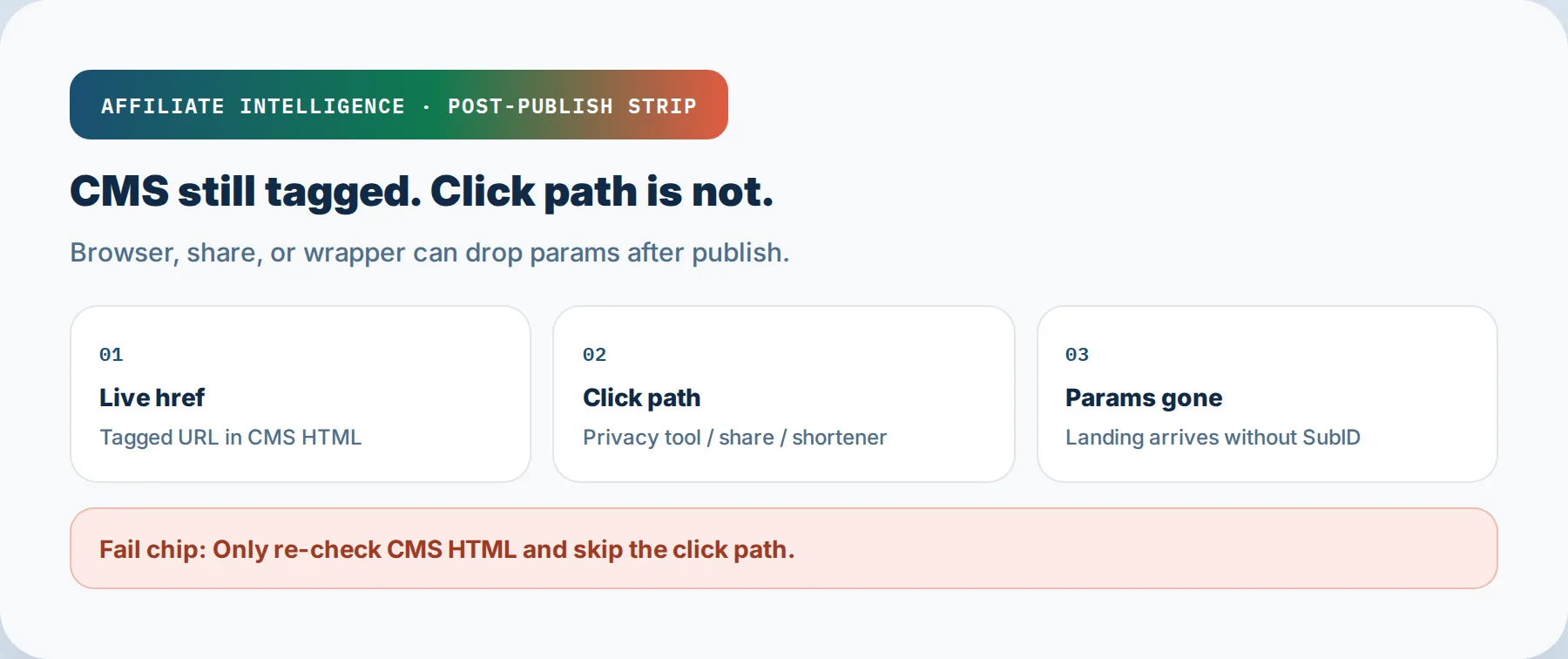
Do not strip everything after the question mark. Too aggressive cleaning removes the affiliate identifier along with the utm noise. The rule is: preserve payout parameters and test wrapper survival.
Diagram 2 - Post-publish strip path:
The fail state is only re-checking CMS HTML and skipping the click path. The CMS still holds a tagged URL, so the page looks healthy. A real click from Safari private browsing or a shared link arrives stripped.
Test survival with a server-side trace:
curl -sIL "https://go.example.com/offer?subid=test-aug30-01"
Watch each Location header. If the query string disappears before the final landing, the strip is happening inside the chain. Then test the same link in an incognito browser from your target country and watch the URL bar across redirects. I recommend seeding one known SubID so you can read it back precisely. If SubIDs arrive blank after a hop that looks fine, the blank SubID diagnostic is the adjacent runbook (SubID tracking not showing up diagnose).
Shorteners and cloaking wrappers deserve special attention. A wrapper that points to a bare destination forwards the path and throws away the query string. The original tagged link lives in your CMS; the wrapper lives in the click path. I recommend testing the wrapper itself, not just the CMS href, because the wrapper is where the parameter dies. A sharing-friendly persistence test means copying the live URL from the address bar and pasting it into a private window, then confirming your affiliate key still appears at the landing page.
Why this works: the curl -sIL trace follows redirects server-side and shows each hop as it is, without any browser privacy layer. It proves whether the parameter survives the entire chain, not just the first redirect.
Checkpoint: You have a click-path parameter survival result for one seeded SubID. If it is blank at the landing page, you know the strip family, not a mystery.
Audit Beyond Status Codes
Step 3: Verify tag survival and destination content, not just a green 200.
A final HTTP 200 only proves the last URL resolved. It does not prove your tracking key survived the chain, the product is in stock, or the visitor reached the correct region. This step catches what generic monitor dashboards miss.
First, trace the full redirect chain. A 200 HTML intermediate can rewrite the destination and drop the SubID without ever emitting a 3xx. That is why the chain, not the final code, is the evidence. For hop forensics, the redirect chain detection piece is the sibling reference (redirect chain detection tools).
curl -sIL "https://go.example.com/offer?subid=test-aug30-01"
# log each status code and Location; stop at first missing query string
Second, check the destination content. A soft 404 is a page that returns 200 but is an empty product shell or a “no longer available” notice. An out-of-stock variant loads for a US IP but dead-ends for German traffic. These are business-logic failures, not HTTP failures. The link rot sibling covers soft 404s and silent wrong pages in depth (affiliate link rot silent failures). When a break survives the hop trace and shows up in the payout report, the affiliate tracking failures diagnose silent attribution runbook is the next stop. For AI pages, the rule is straightforward: every recommended product link must land on a page that still sells the promised product in the target region.
A status checker calls a soft 404 healthy. A shopper calls it dead. I recommend checking final HTML for phrases like “out of stock,” “currently unavailable,” or a missing buy button, and testing one link from a second region if your audience crosses borders.
A realistic before/after makes the point. An AI-built gift guide links ten product pages. Six resolve with 200s. Two are discontinued-products-serve-category pages and one is a geo fallback that works only from a US IP. The server-side trace shows the tag survives, so a tag-presence check would pass all six. The content check catches the three dead recommendations. That is the difference between the floor and the job: reachability is the floor; the destination state is the job.
Why this works: status codes are transport telemetry. They say nothing about the commercial state of the destination. Content-level checks connect the link to the promise you made in the article.
Checkpoint: You have a beyond-200 checklist: tag present at final URL, chain under a sane hop count, destination sells the promised product, and at least one regional spot check.
Pre-Live Gate for Bulk AI Pages
Step 4: Run a pre-live gate before shipping AI pages at scale.
Bulk AI pages amplify both failure families. If you generate 500 pages from one brief, one wrong URL template can ripple across every page before anyone reads a word. The fix is an inventory gate with pass/fail, not “audit later.”
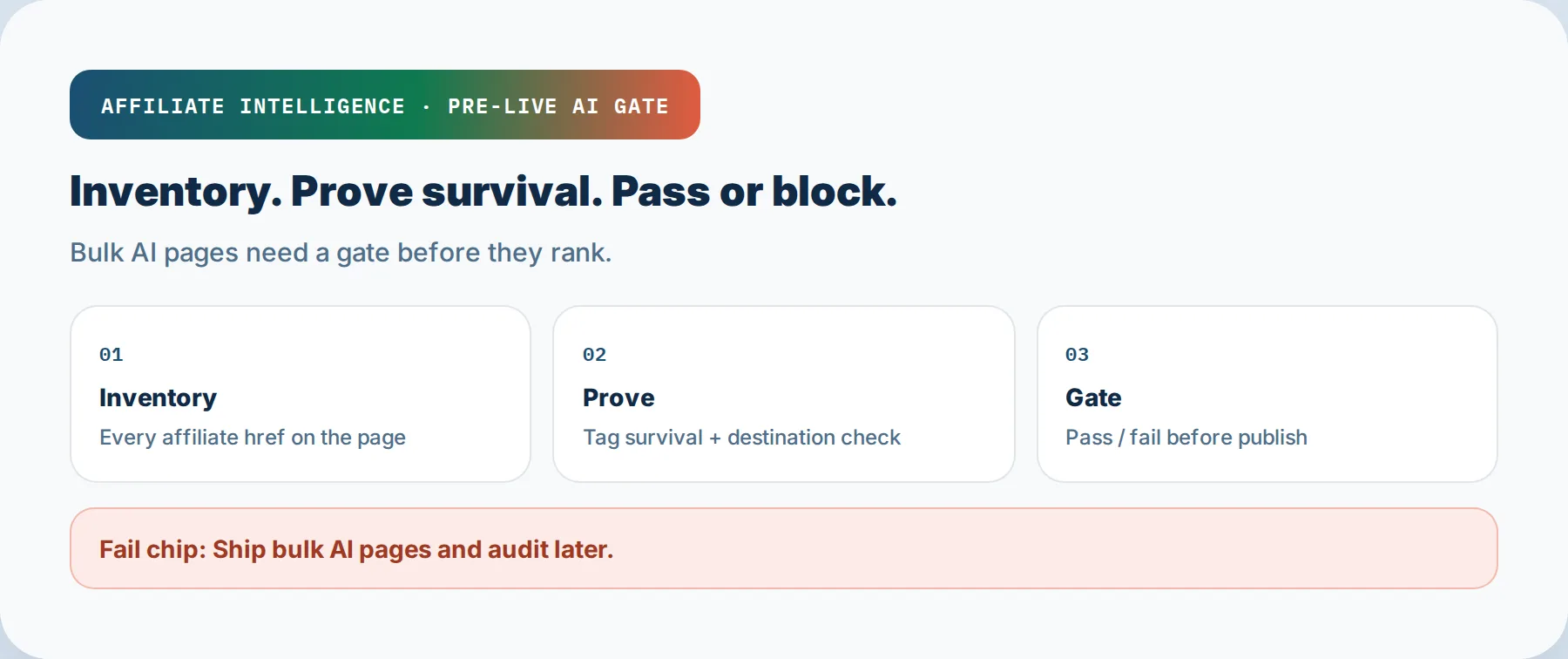
Diagram 3 - Pre-live AI gate:
The gate has three passes.
First, inventory every affiliate href in the generated pages. Extract them the same way as Step 1.
Second, test each URL for tag survival and destination content. Run a server-side trace and confirm your affiliate key appears on the final landing URL or is captured by the network before the last hop. Since a 200 HTML intermediate can consume the query string without a redirect code, do not trust a blind follow.
Third, record pass/fail per URL before publish. A failing link is fixed or replaced before it enters your link management system. This is the same logic as the bulk pre-launch checklist, which covers scale QA in detail.
Central link management turns a destination swap into a one-scoped fix. If AI pages point to go.example.com/headphones and the merchant changes the deep link, you update the central redirect once instead of editing every generated page. This is not a content-grade trick; it is the one-swap destination fix. I recommend testing that your wrapper preserves tracking when you change the destination.
A small shell loop works for the first pass on a single batch:
for url in $(grep -o 'href="[^"]*"' batch.html | sed 's/href="//;s/"$//'); do
  echo "$url"
  curl -sIL "$url" | grep -iE '^(HTTP|Location:)'
done
If the page includes AI-personalized content blocks, keep the tracking layer separate from the content layer; the AI content personalization runbook is the sibling reference.
Why this works: a pre-live gate catches substitution and strip failures before they scale, while the fix is cheap. A central redirect manager gives you one control point when the audit finds a broken destination.
Checkpoint: You have a pass/fail result for every affiliate href in a batch of AI pages before those pages publish.
Ongoing State-Transition Scan
Links change state after launch independently of content edits. Stock flips from available to out of stock, region availability shifts, redirect hops multiply after a merchant migration, a wrapper stops forwarding your query string, or a network updates its parameter name. None of those events touch the article body. A content-only re-audit misses all of them.
Run the rendered href sweep plus chain trace on state-change triggers, not just content updates. Trigger a re-check when a merchant announces a URL structure change, when a high-revenue page starts slipping EPC, when a central redirect destination is edited, when a network posts a parameter update, or when a product goes out of stock in your primary region. The same logic from the pre-live gate applies, but the trigger is state, not publish date.
Cadence still matters. Moonpull’s attributed estimate warns that around five percent of advertisers’ tracking implementations change monthly. That is a half-life pattern, not an event. Scan top revenue URLs weekly. Run the full catalog monthly. Add a complete deep-link pass before a known peak: gift season, Black Friday, Prime Day if you are Amazon-heavy.
Prioritize by revenue and age, not by spreadsheet order. Old high-earning evergreen pages decay before new low-traffic pages. A three-year-old gift guide still ranking is a liability if no one rechecks its links.
Keep the tagged URL in one central location, and point AI pages at that central key instead of a raw merchant URL. Fix the central record once, and every published page inherits the fix. Reconcile the rendered inventory against that central source monthly; any page carrying a raw or stale URL is a state break, not a content problem.
Independent monitoring matters because network dashboards lag the break. Some networks do not flag a stripped SubID until after the payout report. Set an alert when a tagged link flips from healthy to broken on a high-revenue page.
Why this works: state-transition scanning catches the breaks that happen between content deploys. The content can stay green while the link rots underneath it.
Checkpoint: You have a recurring scan plan with weekly top-revenue checks, a monthly catalog pass, pre-peak deep-link audits, and a central redirect that propagates fixes to every published page.
Troubleshooting Common Issues
Here are the common failure states and where they route.
-
Rendered href lacks the affiliate parameter. This is AI URL substitution. Re-run the Step 1 diff against the brief. Fix the source link, not the visible text.
-
CMS HTML is tagged but the click arrives clean. This is post-publish strip. Test wrapper survival with
curl -sILand a private-browser click. If SubIDs are blank after a hop that looks fine, route to the blank SubID diagnosis runbook. -
Final URL returns 200 but the destination is an empty product shell. This is a soft 404. Route to the link rot sibling for the full silent-failure treatment.
-
The chain resolves but your tag died mid-chain. This is a redirect hop failure. Route to the redirect chain detection piece.
-
Clicks fire but conversions never appear. This is an attribution break. Route to the tracking failure families runbook.
-
Bulk AI pages shipped before an audit. Run the pre-live gate retroactively, starting with top revenue pages. Route to the bulk validation checklist for the full four-pass QA method.
Do not rebuild those sibling posts here. This page owns the AI substitution and strip paths plus the audit gate that catches both.
The closing point is mechanical. Two silent families break commissions while vanity metrics stay green: AI URL substitution and post-publish parameter strip. Audit substitution and strip paths before you scale; soft-link the siblings for bulk QA, rot, hop forensics, and blank SubIDs. I will say it again: a green 200 is not an audit. Click truth at the landing page is.