Affiliate PPC Commissions Flat Despite Better Ad Metrics? What to Check
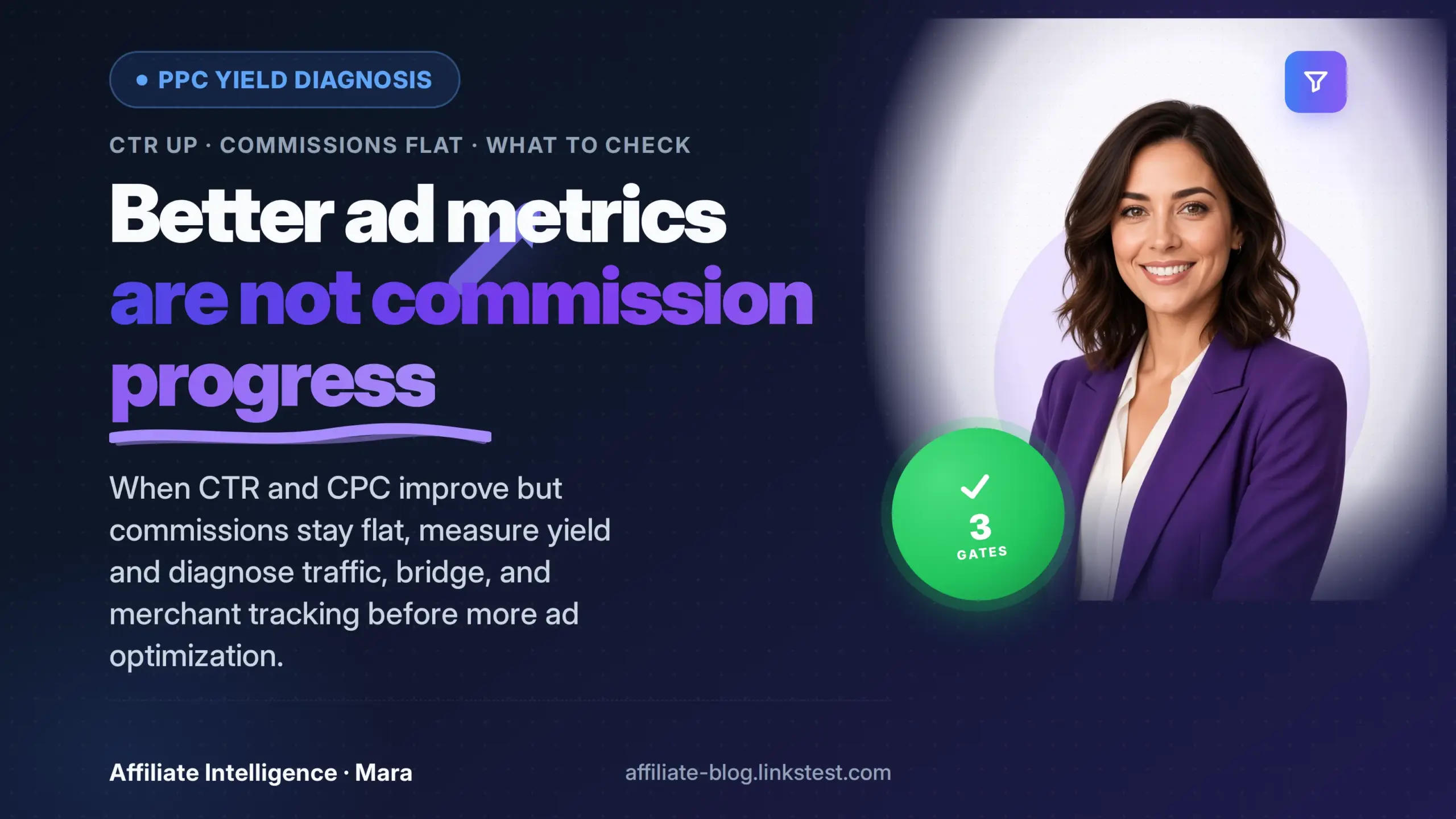
Operators often read a prettier ad account as progress. CTR climbs, CPC falls, quality score settles, and the commission line refuses to move. Then two wrong conclusions compete: keep optimizing the only dashboard you control, or demand a better rate from the merchant. Both skip the actual break.
The break sits between the click event and the money line. Better ad metrics stop at the click. Flat commissions happen after it. This tutorial walks the diagnostic in order: measure yield, split the failure into branches, test the bridge and the merchant, then decide whether to change ads, swap offers, or negotiate. No audience blame. No rate demand until the ID trail is proven.
Related diagnostics referenced throughout: the click-to-commission funnel diagnosis checklist, the redirect-chain commission leakage audit, the silent attribution taxonomy, the registration-wall tracking break, the when to negotiate better commission rates, the affiliate program economics and commission sustainability, the stop affiliate commission clawbacks with tracking prevention, the affiliate PPC attribution collision audit, and the affiliate paid-traffic tracking platforms setup pitfalls. Each sibling gets one link in this paragraph.
Prerequisites: What You Need Before You Diagnose
Before starting, assemble five things. Do not skip the raw link.
First, open the ad platform dashboard. You need CTR, CPC, quality score, match type, and impression share for the campaigns in question.
Second, open the merchant or network commission ledger. You need clicks logged, conversions logged, commissions, pending, and reversed rows by date. Read the two dashboards separately; one reports platform-facing metrics, the other reports money movements. They are not the same system and will not reconcile by design.
Third, open your own analytics. You need outbound clicks, landing page engagement, session duration, and device split.
Fourth, pull a raw affiliate link with the SubID parameter your network expects. Impact uses subId1, CJ uses SID, Awin uses clickref, ShareASale uses afftrack, and Rakuten uses u1 (dynamic SubID tracking guide). Using the wrong name means the network silently drops the value before the test even starts.
Fifth, open a clean browser profile. No cookies, no saved sessions, no extensions that rewrite requests or strip parameters.
You now have two dashboards, one linker, and a test click path ready. The rest of this tutorial measures the gap between the first dashboard and the commission ledger.
Checkpoint: You can name your network’s payout parameter and paste a seeded test value into a live link. The ad dashboard is open next to the commission ledger, not merged with it.
Step 1: Ad Metrics Stop at the Click
The ad platform has one job: report what happens inside the auction and at the click. CTR is clicks divided by impressions times 100, and CPC is total campaign cost divided by total clicks (Post Affiliate Pro CPC vs CTR guide). CTR measures the ad’s pull. CPC measures what you paid. Quality score estimates relevance. None of these touch the bridge page, the merchant site, the checkout, the inventory, or the attribution event.
A common failure mode: an operator sees CTR up and CPC down, reads that as a healthier campaign, and keeps bidding. But the ad platform’s metrics all terminate at the moment of the click. After that moment, you are on someone else’s infrastructure — a bridge page you may own, a merchant page you do not, a checkout you absolutely do not, an attribution chain you cannot see from the ad dashboard.

Clicks and conversions are separate events. A click can log cleanly while every downstream hop fails. That is the principle the click-to-commission funnel diagnosis checklist opens with. One thousand clean clicks and zero sales does not mean the audience is wrong. It means the break is downstream, and the ad account will never show it.
The ad dashboard line can rise while the commission line stays flat because the two lines measure different systems. A prettier ad account is a visibility result, not a revenue result. Once you name that, you stop optimizing the only dashboard you control and start measuring the number that actually pays.
The honest next move is not another ad test. It is computing the yield and splitting the post-click chain.
Checkpoint: You have written one sentence naming the failed assumption, and it does not contain the words “audience problem” or “rate cut.”
Step 2: Commission Yield Is the Honest KPI
Commission yield, sometimes labeled EPC on merchant dashboards, is commissions divided by paid clicks. The formula from the Post Affiliate Pro EPC guide is total earnings divided by total clicks. Compute it for the last 7 days and the last 30 days, then set those two numbers next to CTR and CPC.

commission_yield = total_commissions / total_paid_clicks
A higher CTR with a flat yield means the campaign did not improve. A lower CPC with a flat yield means you are buying cheaper clicks that still earn nothing. The yield number is the only one that pays you. CTR and CPC are intermediaries.
What matters is the trend, not a magical threshold. A directional benchmark from WeCanTrack is that an EPC above $0.50 is considered solid for most niches, and high-ticket niches like finance, insurance, and SaaS can see EPCs of $2 to $10 or more. Treat that as a range, not a pass or fail. Treat universal benchmark numbers as noise unless they match your niche and your paid cost structure.
Here is the tighter version for paid traffic: Net Profit Per Click, or NPPC, equals yield minus CPC. If yield is $0.50 and CPC is $0.30, you keep $0.20 per click. If CPC falls to $0.15 and yield stays $0.50, you keep more per click — that is a real CPC win, but only because yield held. If CPC falls because you are buying junk clicks and yield drops to $0.10, the cheaper traffic is a losing trade. The only way to know which case you have is the yield number.
After this step, you have written two numbers side by side and marked the gap. Do not touch an ad setting yet.
Checkpoint: You have a dated line in your notes that looks like “CTR +14%, CPC -12%, yield flat” and you know which number matters.
Step 3: Traffic Problem or Post-Click Problem?
Flat yield with rising CTR splits into two branches, and the branch names the next test. The split is upstream traffic and intent on one side; bridge, message match, merchant, and tracking on the other.
The upstream branch is traffic quality. If the ads pulled more clicks from the wrong intent — research queries, broad match junk, lookalike audiences with no buying pulse — then more clicks can dilute the yield without any downstream break. The ads got easier to click, not more likely to buy.

The downstream branch is everything after the click: the bridge page leaking, the message not matching from ad to page, the merchant page overpromising or understocked, or the attribution chain dropping the ID. Post-click variables you do not own include the merchant’s site, price, checkout flow, inventory state, and attribution rules. These failures happen while the ad metrics look great because the ad platform cannot see them.
The first fork is message match. Same traffic, same offer, two different landing pages can produce wildly different downstream conversion. If the ad says “Fully Free for Life” and the bridge page buries that promise, continuity breaks and the click dies at the page. The page’s job is to pre-qualify the user for the offer flow — not to dump cheap traffic into the merchant funnel and hope the tracker saves you (Remoby affiliate landing page strategy framework).
The second fork is traffic source. Same offer, different traffic segments behave like different campaigns. Research visitors browse and compare. Buyer-intent visitors are ready. Broad match can rise in CTR by surfacing cheap informational queries that will never convert. A keyword with ten thousand monthly searches and zero commercial intent is noise; a five-hundred-search phrase with clear buying intent pays bills.
Tag the flat outcome as upstream traffic or downstream post-click before touching any lever. Guessing wrong wastes the next three steps.
Checkpoint: You have written “traffic” or “post-click” next to the flat yield line, and you can name the evidence that supports the tag.
Step 4: Same Traffic, Different Merchants (and the Reverse)
Once you have tagged the branch, run controlled comparisons. Two comparisons do most of the work.
First, same traffic, different merchants. Point the same paid traffic source at two different merchant offers for two weeks. Keep the bridge and the ad angle identical. If one merchant logs commissions and the other does not, the merchant is the variable, not your traffic. The offer’s price, checkout length, inventory state, cookie window, or conversion path is the lever. If both merchants drive flat yield, the traffic branch was the right tag, or the bridge is the shared leak.
Second, same offer, different traffic. Point one offer at two traffic segments — research intent versus buyer intent, or broad match versus exact and phrase with negatives. If the buyer-intent segment produces yield and the research segment produces vanity CTR, the traffic branch is the answer. Match types and negatives become the next change order in Step 6.
The point of these comparisons is not to gather more metrics. It is to isolate a variable. A merchant is a variable, not a constant. A traffic segment is a variable, not an audience identity. Until you run one of these comparisons, you are arguing with averages.
Structural case: a publisher fires paid search at two SaaS offers with identical bridge pages. Offer A uses a registration wall mid-funnel; Offer B does not. Offer A’s new-user conversions show a material tracking discrepancy against logged-in users because the signup gate resets the tracking session and breaks attribution before checkout. Offer B converts and attributes. Same traffic, same publisher, same bridge. The merchant side is the difference. No traffic quality argument survives that comparison.
For the second comparison, match type is the cheapest isolation. Exact match with negatives tightens intent. Broad match with rising CTR often pulls in informational queries that inflate the click count and dilute yield. The fix is not better creative. The fix is match type and negatives — Step 6.
Checkpoint: You have written one controlled comparison result: “same traffic, two merchants” or “same offer, two segments” with the yield difference and the variable named.
Step 5: Bridge Leak and the Micro-Conversion Outbound Click
The bridge page is where clicks become money or disappear. Before you scale spend, inspect the bridge for leaks before the affiliate offer.
A green 200 is not an audit of ID survival. The final page loading does not prove the SubID that pays you survived every intermediate hop. That is the core warning from the redirect-chain commission leakage audit, and it matters here because the bridge is often the hop where the ID dies.
Two checks matter. First, does the bridge page leak the ID or drop the query string before the merchant click? Run the click with your seeded SubID and watch the query parameter through every hop. If the parameter is gone before the merchant sees it, the bridge is eating the attribution, not the merchant. The click-to-commission funnel diagnosis checklist covers the full six-hop map.
Second, treat the outbound affiliate click as a micro-conversion. The micro-conversion is the signal that your page did its job: a pre-qualified visitor advanced from your page to the merchant. Then compare your logged outbound click count with the merchant or network click log. A gap between those two counts can reveal clicks that leave your page but never register in the merchant’s tracker. If outbound clicks climb but micro-conversions do not, the bridge is adding noise. If micro-conversions climb but commission yield stays flat, the break is downstream — the merchant, checkout, or tracking.
Message match lives on the bridge. The ad’s promise must survive verbatim into the page headline and the CTA. The page’s job is to continue the story, not start a new one. A bridge page that teases but does not pre-qualify gets high outbound CTR and weak yield because it passes unready users to the merchant.
The bridge is also the place to record session quality. Scroll depth, time on page, and outbound click position per traffic source tell you whether the ad or the page is pulling the wrong people.
Before you rewrite bridge copy, check page speed and mobile render. A slow mobile bridge can kill outbound clicks and look like a traffic-quality problem when the real break is load time, layout shift, or a CTA that never reaches the thumb. Fix performance and mobile layout first. Only then rewrite headlines or CTAs. If CTR is high and purchases are absent, use session recordings or heatmaps as a structural method: watch where the scroll dies, where rage clicks cluster, and whether the affiliate CTA is even in the viewport on the devices that drove the ad clicks. The recording is evidence for a named page failure, not a tool-shopping exercise.
Checkpoint: You have watched one seeded SubID cross the bridge and either survive to the merchant click or die at a named hop. You have a micro-conversion number next to the outbound click count. You have either cleared speed/mobile or named the recording evidence that blocks a copy rewrite.
Step 6: Pre-Scale Leak Fix, Match Types, and Pre-Qualifying Traffic
Do not scale spend against a flat yield. That is the single discipline that prevents a losing campaign from becoming an expensive one.
Here is the change order before more budget goes into an ad account that has not earned it.
First, fix the bridge or chain leak identified in Step 5. A broken hop is a leak that scales with spend; more budget only pumps more clicks through the same hole. Pause the campaign, record the timestamp, the failed URL, the failed hop, and the seeded value. Timestamped evidence is what converts “my EPC is soft” into “your hop four strips the SubID.”
Second, adjust match types and negatives when CTR rises on junk. If broad match is pulling informational queries, swap to exact and phrase, add negative keywords, and let CTR fall. A lower CTR with emerging yield is progress. Broad match works when you have enough conversion history for Smart Bidding — typically 30 to 50 conversions per month per campaign (Stackmatix Google Ads keyword match types guide). If you do not have that volume, exact and phrase match with negatives are the safer pre-scale default. The stop affiliate commission clawbacks with tracking prevention covers pause and promotion rules; the affiliate PPC attribution collision audit covers overlap between your paid traffic and merchant-side PPC; the affiliate paid-traffic tracking platforms setup pitfalls covers setup issues. Each applies lightly here, but the core change is the match type and negative list.
Third, pre-qualify in the ads. Pre-qualifying in ads may lower CTR and raise yield. If the ad copy promises the real offer’s constraints, fewer wrong people click, and the ones who do arrive ready. Pre-qualifying is not about reducing volume; it is about raising the percentage of clicks that can become commissions. Watch the yield move before calling the CTR drop a loss.
Treat assisted conversions with caution before you kill “non-converting” awareness keywords in a long funnel. A keyword that rarely takes last-click credit can still warm the session that another keyword closes. Cutting every zero-last-click term because the ad dashboard shows no direct sales can shrink the yield of the converting set. Review assisted paths before the pause list.
Also set a data floor before you pause. Impatience is not diagnosis. Low-AOV offers usually need more click volume before a flat yield reads as a structural break; high-AOV offers can justify an earlier freeze because each click costs more and the commission trail is thinner. Write the click floor next to the pause criterion so you do not freeze a campaign that has not yet earned a verdict.
Fourth, if the yield trail is broken, the data floor is met, and you cannot fix it in one sitting, pause or cap spend with timestamped evidence. A flat yield with a broken chain is not a campaign to scale. It is a campaign to freeze until you know which hop failed.
The pre-spend change order forces you to acknowledge a structural truth: more clicks are not more commissions. Stop optimizing the only dashboard you control until the yield moves. The yield number is the boss, not the CTR chart.
Checkpoint: You have written a three-line change order, an assisted-path review note, a click/AOV data floor, and a pause criterion with a timestamped trail, and none of the lines include “increase budget.”
Step 7: Diagnose Before Negotiate, Prove Tracking, and Pause with Evidence
After the traffic, bridge, and offer checks, if the yield is still flat, the failure mode is tracking or economics. Each requires different evidence.
Diagnose before you negotiate. If the ID survives every hop and the commission still does not land, escalate the economics conversation. If the ID dies mid-chain, the merchant is not the first stop. That is the routing rule in one sentence. The redirect-chain commission leakage audit gives the full hop forensic. The silent attribution taxonomy gives the classification for breaks that do not look like breaks. The registration-wall tracking break covers the signup-gate reset case.
Build an independent tracking proof package. Your own analytics, a tracker, and the network dashboard are three ledgers with three jobs. Reconcile them by date and order ID. If the network shows a conversion but your bank ledger does not, the break is post-payout: holds, payment thresholds, clawbacks, or reversals. The stop affiliate commission clawbacks with tracking prevention covers those rules. Date-level comparison is the escalation evidence.
Watch pending and clawback lag. A commission can land in the network ledger as pending, then disappear later under merchant rules — voided order, fraud flag, refund, program policy. If you only read the approved column, you miss the lag. Read pending and reversed rows alongside approved ones.
Check for PPC attribution collision. The affiliate PPC attribution collision audit explains the overlap between your paid campaign and merchant-side paid search. If the merchant runs PPC on the same keywords, your affiliate click may lose the last-click race or be credited to the merchant’s own spend.
Check for paid-traffic tracking pitfalls. Paid platforms report conversions in their own windows — Facebook 7 days click, GA4 90 days, affiliate networks typically 30 days. Those windows will not reconcile. The affiliate paid-traffic tracking platforms setup pitfalls covers the setup issues. For server-side postback tracking, a postback URL sends conversion data directly between servers and is often more reliable than browser-based pixels (Cometly conversion tracking guide).
Only after the ID trail is proven and the yield gap is explained by economics do you negotiate rates. The when to negotiate better commission rates and the affiliate program economics and commission sustainability cover the ask. Bring the evidence package: the survived ID, the date-reconciled ledger, the pending rows, and the merchant-vs-bank gap. A flat yield with no evidence-based ask is a rate complaint, not a negotiation.
Checkpoint: You have an evidence folder with a survived ID trace, a date-level ledger comparison, pending and reversed rows, and a written sentence naming whether the break is economics or tracking.
Troubleshooting Common Issues
Route symptoms to fixes without re-reading the whole article.
CTR up, yield flat. Split the branch: traffic quality or post-click. Check message match and match types first if the ad copy changed recently.
High outbound clicks, flat micro-conversions. The bridge page is the leak. Re-run the seeded SubID trace and read the hop log.
Network shows conversions, commissions missing. The issue is pending, clawback, or payout hold. Export by date and compare to bank.
No commission row exists at all. The chain broke before attribution. Trace the hop, find the dead ID, and fix before any economics conversation.
Tempted to negotiate the rate. Stop and complete the ID trail first. A rate ask on a broken chain is a voice complaint, not an evidence-backed negotiation.
Closing: A prettier CTR with a flat commission line is not progress. Progress is a yield that moves after you name the broken stage.