Affiliate Tracking Failures: Diagnose and Fix Silent Attribution Breaks
Flat clicks with falling commissions look like a traffic-quality problem. They are usually a named break in the attribution chain, and the fix is a full-path diagnostic, not another tracking plugin.
Prerequisites: Tools, Access, and the Failed Assumption to Drop
Drop the assumption first: clicks fine means tracking fine. A network dashboard logs clicks at the redirect. A sale is a separate event hours or days later. Between them sits a chain of handoffs, and any one can break while the click still logs cleanly. Blaming traffic quality before you name the break is the most expensive mistake in this job. The canonical foundation for this diagnostic is affiliate link tracking best practices UTMs SubIDs server-side.
Before you start, gather five things.
- Network or merchant dashboard access, with both click rows and conversion rows visible.
- A clean incognito browser so old cookies do not make you feel smarter than you are.
- Raw link or redirect log access, or a terminal with
curlto trace hops yourself. - One known SubID slot for the network you are testing. Impact uses
subId1, CJ usesSID, Awin usesclickref. For the full parameter map, see the SubIDs advanced tracking and attribution. - The discipline to name two ledgers that disagree before opening any tool.
The network ledger owns payout truth. GA4 owns behavioral truth. Do not expect them to reconcile.
Before I trust a green number, I name which ledger owns payout.
Checkpoint: You can write down two ledgers and one known SubID value before touching any dashboard.
Step 1: Silent Breaks Are a Family, Not One Bug
A common failure mode is treating clicks and conversions as one pipeline. They are not. A click is logged at the redirect. A conversion is matched later by whatever survived the handoff. When that handoff snaps, the click still looks healthy and the commission simply never appears.
The break is never one mysterious bug. It is a family of named failures.

Start with the most embarrassing one because it is common: the post-redirect URL mistake. A publisher opens the merchant checkout, copies the final landing URL after the redirect, and pastes that as the affiliate link. The page loads. The user buys. But the affiliate redirect never fired, so no click ID was ever created. The destination loads, which is why nobody notices. It is not the affiliate link. That failure is silent in every dashboard you own.
The second trap is the green tick. TUNE is explicit: you receive a 200 OK HTTP response if the platform attempts to process a postback, even when the conversion is unsuccessful (S2S postback failures behind a green tick). A dashboard tile turning green means the endpoint answered. It does not mean tokens matched, SubIDs returned, or payouts will reconcile.
That is why the click event itself has to be your single source of truth at redirect time. Capture the raw referrer, the UTM block, and the network click ID the moment the redirect fires. Later, you match against that event. If you only trust the dashboard, you are auditing a delivery receipt instead of attribution.
I’ll say it again: flat clicks are a family of named breaks, not a traffic-quality death.
Checkpoint: You can name the likely failure family - URL, cookie, hop, wall, or postback - before touching a tool.
Step 2: Full-Path Test Before You Scale or Panic
The dashboard saying tracking works is not proof. The only proof is one known identifier surviving the entire path: click, land, convert, report match.
Here is the protocol. It is the highest-value hour you can spend.

Step 2a: Fire a known SubID from a clean browser. Use an incognito window so old cookies cannot fake a success. Put a unique value in the SubID slot, something like test-aug22-01.
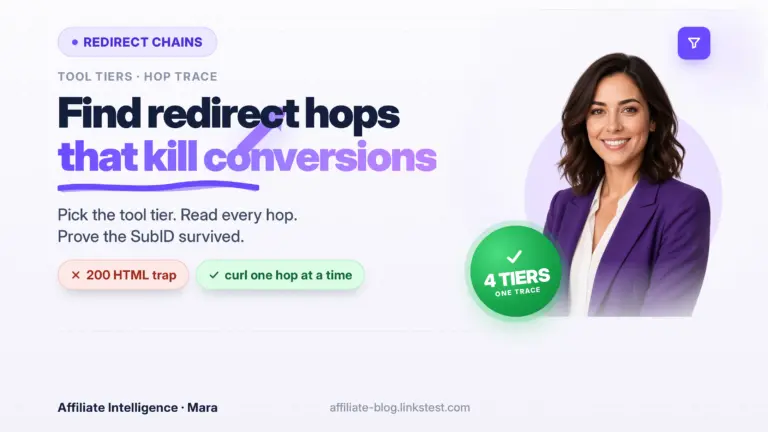
Step 2b: Trace the redirect chain. Run it through curl or a redirect-chain tool. You are looking for silent 200 HTML hops that strip query strings. A 302 rewrite can drop the SubID even when the landing page still loads.
curl -sIL "https://your-redirect.example/offer?subid=test-aug22-01"
Watch each hop. If the query string is gone before the final landing, the break is between hop one and hop three. Do not keep going downstream.
Step 2c: Check the landing page and cookie jar. Open DevTools, Application tab, Cookies. Inspect path, domain, and expiry. A cookie set with Path=/store will not be sent on /thankyou. A checkout on secure.store.example.com may not see a cookie set narrowly for example.com.
Step 2d: Confirm the network click row. Log into the network and verify the click arrived with your known SubID. If the network shows the click but no SubID, the break is tag mapping. If the SubID is blank, that is a structured problem, not a mystery.
Step 2e: Validate the postback before you spend. If your postback success rate during testing is below 98 percent, do not proceed to launch. A 95 percent success rate means one in twenty conversions goes untracked, enough to start partner disputes inside the first month (Track360’s tracking setup validation). This is the full click-to-commission checklist in miniature; the complete version lives in the conversion drop funnel diagnosis checklist.
The raw debug log is your red flag detector. Missing written logs - meaning no request line, response code, and transaction ID recorded - is itself a red flag. If you cannot see all three, you are guessing.
Do not trust the dashboard. Fire one known SubID and stop at the first mismatch.
Checkpoint: You have a documented full-path proof or a named broken handoff.
Step 3: Cookies, ITP, and Late Capture
The cookie is a handoff, not a receipt. It tells the merchant which click preceded the sale. When it dies early, the sale still exists; the proof of origin does not.
Three loss patterns matter most.
ITP and third-party blocking. Safari’s Intelligent Tracking Prevention caps third-party cookies at zero and trims first-party cookies set via JavaScript to seven days. Cookies set server-side with a Set-Cookie header survive longer because the server, not the document, owns them. Before I trust a cookie, I check whether JavaScript set it.
In-app browser wipes. When a user taps your link inside Instagram or TikTok, the app opens a sandboxed webview with its own cookie jar. The network sets its tracking cookie in that disposable jar. The buyer later completes the purchase in their real Safari or Chrome, where the cookie never existed. The click was real; the attribution chain broke at the sandbox. Awin built an in-app browser breakout feature precisely because this failure is common enough to warrant a product-level fix (Awin’s In-App Browser Breakout documentation). The in-app browser is a cookie graveyard, not a handoff.
Late capture. Capture the parameters at first landing, not at signup. If you wait until the registration form, you lose every click that died or bounced before that point. Store the click ID, UTM block, and referrer on the initial page load, server-side if possible, then forward them into the signup flow. This is the design layer; the full argument lives in the UTM, SubID, and server-side proof foundation above.
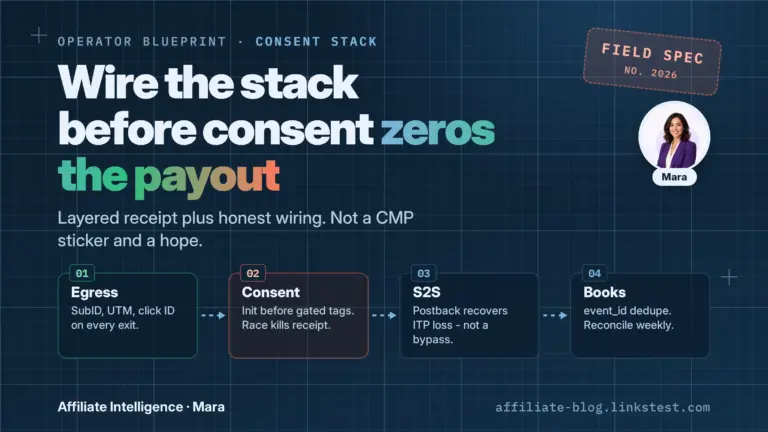
The consent banner is usually not the killer. Operators often blame the cookie banner when the real break is earlier. The question is not “did the banner appear?” It is “which cookie controls conversion, and how was it set?” A server-set cookie or a postback survives what the banner blocks.
Checkpoint: You can list which cookie controls conversion, how it was set, and whether the in-app browser is in your traffic path.
Step 4: Rot, Redirects, Walls, and Filter Traps
One generic audit is the failure mode. These breaks do not share a root cause, so one checklist will miss three of them.
Registration walls. A merchant forces account creation between click and checkout. The cookie often still exists; the handoff does not. Domain scope collapse, session reset on authentication, or parameter stripping across signup redirects all kill attribution downstream. Segment new versus returning click-to-commission and walk the cold path in a clean browser. The full diagnosis is in the tracking broken by merchant registration wall.

Link-rot clusters. URL restructures, soft 404s, out-of-stock products, missing tags on old money pages, and ASIN volatility are rot. A soft 404 is especially nasty: the server returns an HTTP 200 with an empty page, so every link checker reports green while the commission is already gone. The systematic way to find these clusters before they cost you is the link rot revenue loss silent failures.
Redirect hops. Each hop is a chance to strip the SubID. Shorteners, aggregators, and merchant CDNs normalize query strings. A green check on the final page is not proof the ID survived the chain. For hop forensics, route to the redirect chain commission leakage audit, and for merchant-side flow changes, the silent commission drops merchant redirect flows.
Filter traps. A bad SubID or subsource filter can block good traffic that passes empty or missing subsource values. A rule built to exclude known-bad subsources can swallow legitimate rows with blank values before the postback ever matches. Check the filter before blaming the network.
Link-editing hygiene. Shorteners, stripped params, copy-paste share loss, and UTM stripping by LinkedIn or email are all hand-editing failures. Publish the canonical link once and reuse it. Every manual edit is a chance to lose a parameter.
Click tracking discrepancies of five to twenty percent are common in multi-step flows, as an attributed estimate only (tracking broken by merchant registration wall). The point is not the exact number. The point is that a green check is a floor, not a permanent state.
Checkpoint: You have a triage map and the correct sibling route for each named break.
Step 5: Questions, Audits, and What to Monitor Weekly
Ask the affiliate manager tracking questions before you promote, not after a commission mystery. Four questions cover most of it: What cookie type does the program set? What is the cookie lifetime? Does the program support S2S postbacks? What browser limits should I plan around? If the AM cannot answer, that is a signal about the program, not a reason to panic.
Then run a ten-minute weekly audit instead of a quarterly panic.
- Check your top ten revenue links for health. Did any destination change? Any soft 404 or missing tag?
- Compare GA versus network conversion counts as a shape signal. A widening gap is a named break, not a rounding error.
- Keep one named AM contact per network. Escalate with a date-level export, not a screenshot of a soft EPC.
- Run a dual check: 404 on the page and missing tag on the confirmation. A page that loads and a tag that never fires are two different failures.
- Use coupon fallback as parallel proof. When a 100-percent-coupon test conversion still triggers the network’s rules, you have an independent read on the tracking path.
Broken or duplicate UTM tagging accounts for 15 to 30 percent of “missing” traffic in account audits, treated here as a shape rather than a universal number (Coinis tracking-link audit). The traffic is not missing. It is bucketed wrong because someone capitalized the source.
I recommend a weekly ten-minute audit instead of a quarterly panic.
Checkpoint: You have a repeatable weekly check that catches a break inside seven days, not ninety.
Verification: One Clean Readback After a Fix
A fix is not proven until the readback matches the original known SubID. After you change a link, redirect, postback, or filter, fire one clean click and read back three things: the raw log request, the network click row, and the postback payload. Verify the raw request contains the SubID, the response code is what you expect, and the transaction ID round-trips.
Missing written logs at this point is the red flag that tells you the fix is not verifiable. If you cannot see the request and the response, you have replaced one guess with another.
The sequence is the whole closing doctrine: name the mode, test, fix, monitor. Verification is the “test” half of the loop, and it is the step operators skip because the dashboard already turned green. A green tile after a change is not a readback. It is a delivery receipt.
Checkpoint: Readback matches the known SubID in the raw log, the network row, and the postback.
Troubleshooting Common Issues
Run the triage by branch. Do not start with a tool. Start with the symptom you can already see.
Five common errors and their exact fixes.
-
Destination URL is the final landing page, not the affiliate redirect. The page loads but no click ID is created. Fix: paste the actual network redirect link into the correct field; if you are using Google Ads, the tracking template holds the affiliate link while the final URL holds the landing page.
-
Postback green but no matched click ID. The endpoint answered, the token did not match. Fix: inspect the raw postback request and confirm the
click_idparameter is not blank; fix the macro mapping (cid={click_id}, notcid={gclid}). -
Cookie expires in seven days or less. JavaScript set it. Fix: switch to server-side
Set-Cookieor move the attribution to an S2S postback. -
SubID column blank after conversion. Bad parameter name or a filter blocked empty values. Fix: confirm the network’s exact parameter name and check the subsource filter before touching postback mapping.
-
In-app browser clicks never attribute. The cookie died in the webview. Fix: prompt open-in-default-browser or route the tap to the native app; keep S2S as the backstop.
Flat clicks with falling commissions are usually a named break in the attribution chain, not a mysterious audience death. Find the break that still looks green, then fix that one. Name the mode, test, fix, monitor.