Redirect Chain Detection Tools: Find & Fix Redirect Hops That Kill Affiliate Conversions
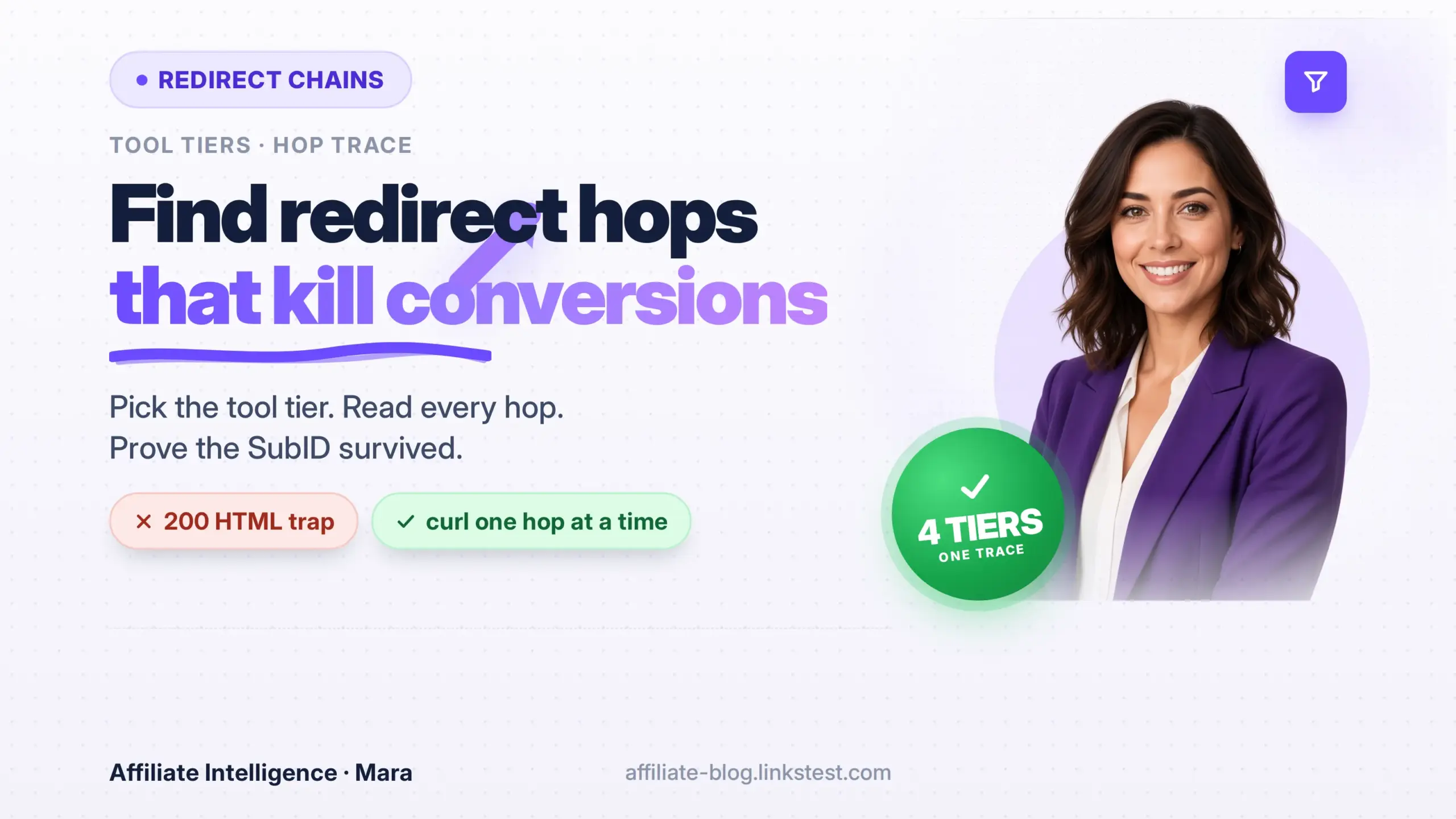
A green 200 is not an audit. A final page can load perfectly while the SubID that pays you was stripped three hops earlier. The problem: most redirect chain detection tools answer the wrong question. This is the hop-tracing tooling spine, not the leakage forensic taxonomy. It covers how to pick the right tool tier, how to read every hop, and how to run a curl redirect test that proves a known SubID survived.
If you already know a tag is being stripped and need to find the exact breakpoint, the redirect chain leakage audit is the next forensic step. If clicks are fine but conversions fall after the trace, the conversion drop spine is the next stop.
Failed assumption: a green 200 means the link is healthy
Operators often paste an affiliate URL into a checker, see the final 200 OK, and ship the link. The problem is structural. A checker that reports success only proves the last URL resolved. It does not prove the query string survived every intermediate hop. A 302 rewrite can drop the SubID while the landing page still loads.
Worse is the 200 HTML intermediate. A page can return 200, hold a meta refresh in its head, and rewrite the destination without ever emitting a 3xx. The checker sees a healthy page and says nothing. The SubID disappears on that hop. If hop two returns 200 HTML and the SubID vanishes, the network click row may still look fine because the click fires, just without your identifier.
The affiliate click path is longer than people admit: short link to tracker, tracker to network, network to geo router, geo router to merchant. Each hop is a chance to normalize query strings, reorder parameters, or drop unknown keys. Read every hop, not the summary line. The leakage audit covers the full forensic taxonomy when you need to classify which break you found. The silent attribution breaks taxonomy is the cluster home when you are not sure which hop class failed.
Pick the tool tier for the question, not the logo
Listicle “best redirect tools” posts get this wrong because they rank logos instead of jobs. I am skeptical of any list that does not classify the work first. Three questions choose the tier: one URL or many? Discovering debt or debugging one handoff? Proving a fix or just wondering where a link goes?
Four tiers cover the real work.
- Single-link trace. When you need to see where a short link, tracker URL, or cloaked link actually goes, a full path trace follows the redirect, including meta refreshes and JavaScript redirects. This is the affiliate link checker answer to “where does this go.” WhereGoes is the simplest read.
- Bulk validation. When you have a pre-publish list, httpstatus.io checks up to ten redirects per URL and reports headers, bodies, and round-trip times. This is the pre-send QA tier, not a diagnosis layer.
- Site-wide discovery. Screaming Frog crawls a site and exports redirect chains, loops, and source inlinks. It is a discovery tool for redirect debt, not a daily driver for one link. Use it when you inherit a site or survive a migration.
- Post-fix re-trace. curl is the operator default because it records status code, Location header, and query string per hop without a browser. This is the tier that proves a SubID survived.
No vendor grid needed. Pick the tier, then pick one tool from it.

How to read a hop log, affiliate-specific
A hop log is not a pass/fail signal. It is a read sheet. At each hop, record five things: the status code, the Location header, the final URL after the hop, the query string as it stands, and any meta refresh or JavaScript flags.
Status codes matter as behavior, not philosophy. A 301 signals a permanent move; a 302 or 307 signals temporary. For owned affiliate redirects, operators often default to 302 or 307 so the destination can change without implying a permanent handoff - that is a cloaking/ops default (DeepClick’s cloaking guide frames it that way), not a Google equity law. Do not treat “302 keeps authority” as a ranking guarantee. But a 200 HTML page is the trap: no redirect instruction, just a page that rewrites and forwards behind the scenes. Some affiliate networks specifically do not credit meta refresh redirects, per Pretty Links.
The query string is the money column. Impact expects subId1, CJ expects SID, Awin expects clickref. If the wrong parameter name is used, the network silently drops the SubID and you get a blank column. The tracking spine piece maps parameter names and survival rules in detail.
A compact hop read sheet looks like this:
If the SubID is gone by hop two, that is the breakpoint. Do not keep tracing past the first mismatch.

curl trace protocol, operator default
Before I trust a hop, I run curl by hand. The point is not to follow blindly. The point is to log each server answer and stop when parameters die.
- Put a known SubID in the URL, like
test-aug22-01. Use the exact parameter your network expects. - Fetch headers only with
curl -Ion the first URL. Do not add-Lyet. By default curl does not follow redirects; adding-Lmakes it follow up to 30 sequential redirects automatically, which hides the chain, per Everything curl. When geo or app routers may branch, re-run the same hop with a mobile User-Agent and a desktop User-Agent and compare Location plus query string - different agents can land on different hops. - Read the status and Location for the first hop. Write them down.
- Repeat the request against the Location target, one hop at a time.
- After each hop, check whether the known SubID still appears in the URL or Location. The moment it is missing, stop.
- Log status code, Location, and query string per hop.
A verbose trace can be curl -IL for headers only, or curl -iv for the full exchange. One-hop-at-a-time matters because an intermediate 200 HTML page will not show as a redirect in a blind follow. It shows as a body you were not looking at.
If you do use -L, set --max-redirs 5 as a circuit breaker. Curl follows up to 30 sequential redirects by default, but a poorly configured server can still loop (Warp).

The SubID survival rule is the same idea from the tracking spine piece: one known ID, every hop, first mismatch names the branch. If you see a blank parameter at the network, the SubID blank column diagnostic is next. The tracking spine covers what has to survive in the first place. If the tag is missing but the click still fires, the leakage audit separates technical loss from merchant policy.
When chains become revenue leaks
Extra hops are not free. Each one adds latency and a new chance to fail. A geo router adds a hop for every country. Migration redirect debt stacks over time: HTTP to HTTPS, then www to non-www, then an old slug rewrite to a new slug. A loop is not a chain; it is a chain eating its own tail.
The operator question is whether the hop earns its keep. One hop to the merchant is ideal. Two hops are defensible when you own a redirect domain and need to mask and log the click. Three hops, where one is a geo router and two are legacy rewrites, is debt.
A common failure mode: a merchant migrates a product slug. The old slug 301s to an intermediate category, which 301s to the new slug. The affiliate link still points at the old slug. Now every click walks three hops and one manual rewrite. That is latency and a silent parameter strip waiting to happen.
If clicks arrive but conversions drop after the trace, the conversion drop symptom tree is the right next stop. If the chain ends in a stale or dead hop instead of a redirect, the link rot piece covers that failure.
I deliberately avoid universal percentage PageRank loss claims. They are not actionable at the hop level and they distract from the things you can actually test: latency, parameter survival, and final destination.
Fix workflow without breaking tracking
Fixing is not deleting hops at random. The workflow is four steps.
- Point the start URL at the final target directly whenever you control the start. The original link should resolve in one hop to the canonical merchant URL, with every required parameter intact.
- Update internal links to reference the final target, not the redirected path. Redirects are a safety net, not primary navigation.
- Re-trace with the same known SubID after the change. Do not declare victory on a fresh glance. The same SubID must survive the new path, or you have traded one break for another.
- Log the change: which URL changed, why, when, and who owns it. Silent link edits are how redirect debt becomes an archaeology project.
When your own domain sits in the chain, honesty matters. A 200 HTML hop that obscures origin or hides the commercial relationship is a compliance question, not just a tracking one. The cloaking compliance piece covers owned-domain hop honesty and safe redirect methods.
- ☐ Seed a known SubID in the exact network parameter.
- ☐
curl -Ithe first URL without-L. - ☐ Log status, Location, and query string per hop.
- ☐ Stop at the first mismatch.
- ☐ Verify the final URL is canonical and the parameter survives.
- ☐ Fix the start URL to the final target when possible.
- ☐ Re-run the same trace before publishing.
Short FAQ
How many hops is too many? One is ideal. Two is defensible when you own a redirect layer. Three or more is a debt signal unless every extra hop serves a purpose you can name.
301 vs 302 for affiliate links? 302 or 307 is usually the safer ops default for link-level redirects because it signals the destination can change. Use 301 only when the move is permanent and you intend that permanent handoff. Treat equity talk as a heuristic, not a ranking guarantee.
Bulk or single trace? Bulk for a list before send, single for one broken handoff. Do not diagnose a single failure with a bulk tool’s summary line; trace the one URL by hand. Moz Link Explorer is not a hop tool either; for backlink scout limits vs a full audit, see Moz Link Explorer for affiliate audits.
SubID gone on hop two? Stop there. That is the breakpoint. Fix or change hop two, then re-trace with the same SubID. The bulk validation checklist covers scale QA workflow if you must fix many links at once.
The next time a checker says green, read the hop log before you ship the link. If the SubID survives every hop, ship it. If not, you now know exactly where to cut.