Best Affiliate Programs: Fit Tests, Not a Logo List
The phrase “best affiliate programs” is a trap. It asks for a winner, but no global winner exists. The best affiliate program is the one that fits your traffic and survives payout reality. Listicles sell logos. Operators need fit tests. Start with the skeptic’s is affiliate marketing a scam: a skeptic’s scam-legit checklist and the operator’s start affiliate marketing: skip the course, ship your link guide before you collect another dashboard.
The Failed Assumption: Best Is a Listicle Reflex
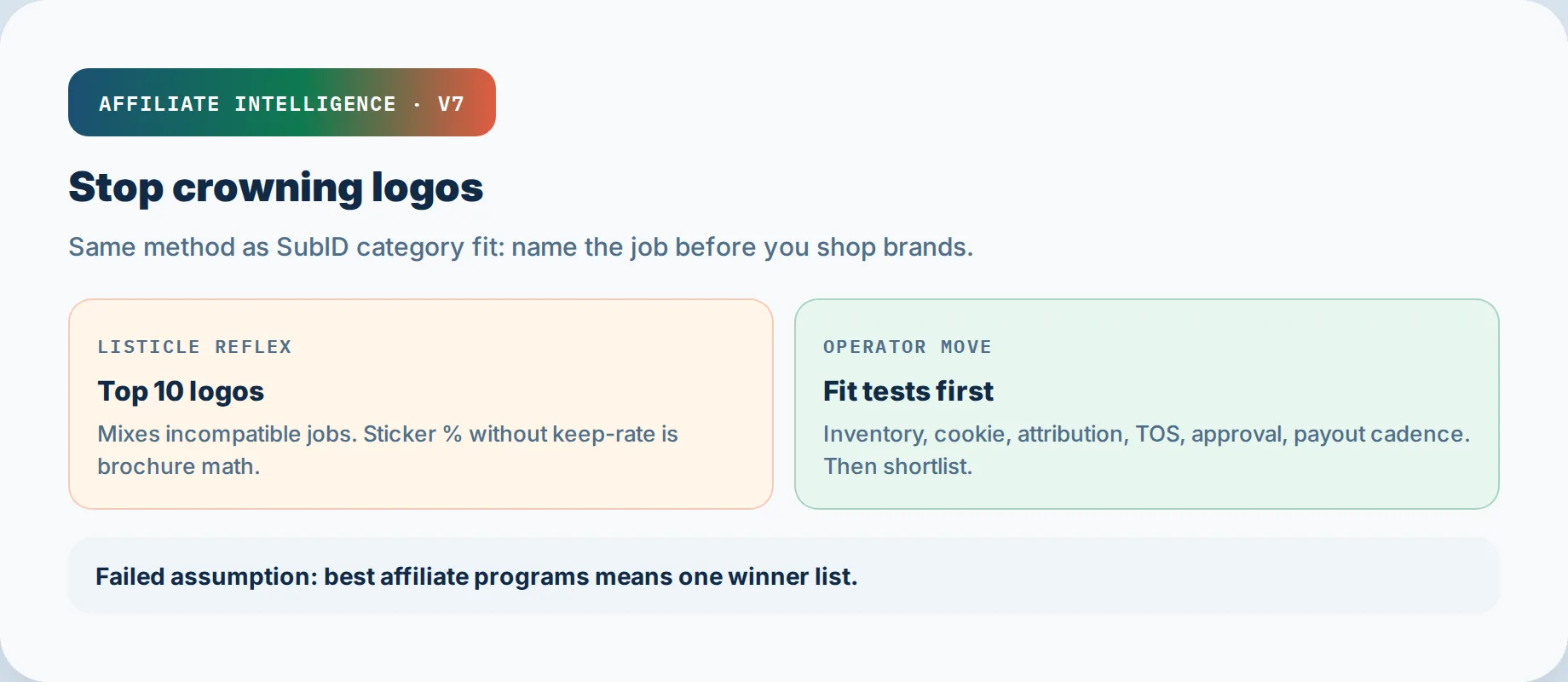
The failed assumption behind most “top affiliate programs” searches is that somebody else’s winner list describes your workload. It does not. Active campaigns rarely stop at one SubID slot. Real publishers track source, creative, placement, and offer in parallel, so multi-slot support is a fit test (SubID tracking fit test), not a nice-to-have. A program that fits one placement beautifully and mangles the second is not a fit. It is a slow leak.
The listicle reflex has a cost. You collect logos. You collect dashboards. You do not collect a channel that pays this week. The question is not which program has the highest rate on a comparison page. The question is whether the offer, the terms, and the checkout match what your audience already clicks. That is the entire decision.
Kill Three Confusions: Network vs Program vs Merchant-Side Tools
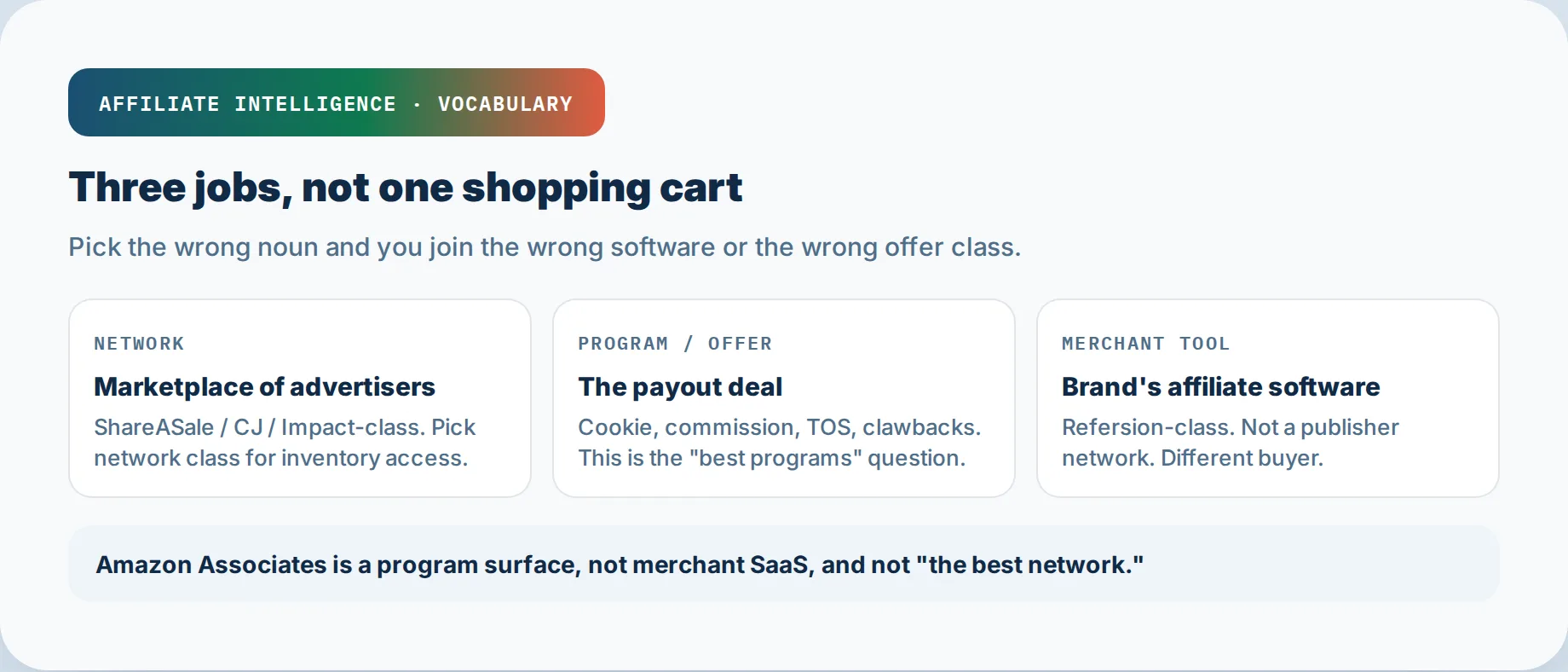
Before any fit test, kill three confusions. A network is terrain. A program is one specific offer inside that terrain. Merchant-side tools are the brand’s stack: they sell to the brand, and you inherit the friction of a platform built for the other side of the table.
Awin at acquisition reported 4,500 advertisers and over 100,000 active publishers, per the network class essay: ShareASale vs CJ vs Impact. That scale does not mean you are approved for any program. It means the catalog is large. CJ and Impact are different classes, not different logos. The class is the job: browse many mid-size merchants, chase specific brand programs, or plug into a brand’s partnership stack. If you cannot write your traffic surface, reporting need, and target program in one sentence, you are collecting dashboards, not building a channel.
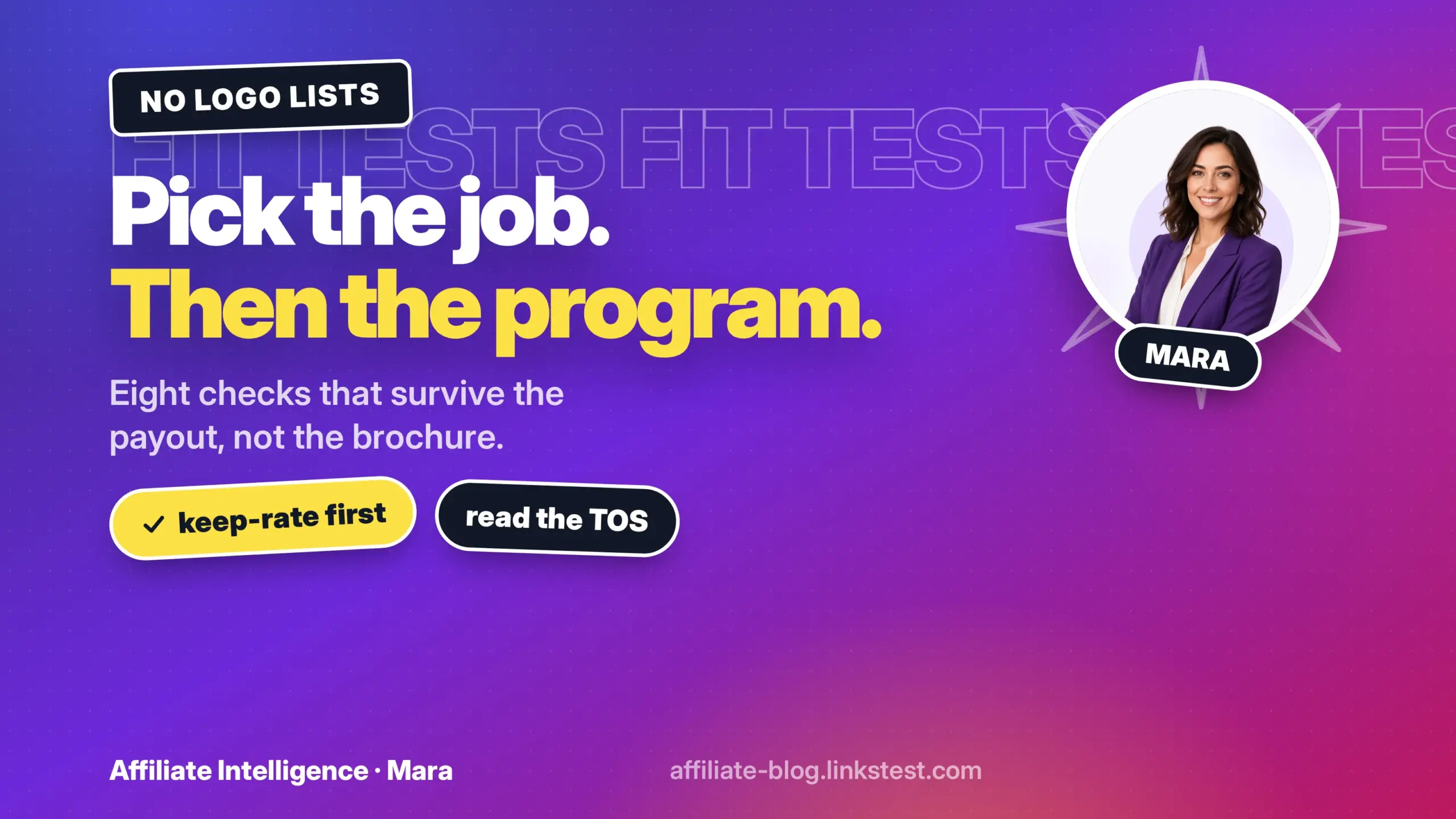
The Fit-Test Pack: Eight Checks That Survive the Week
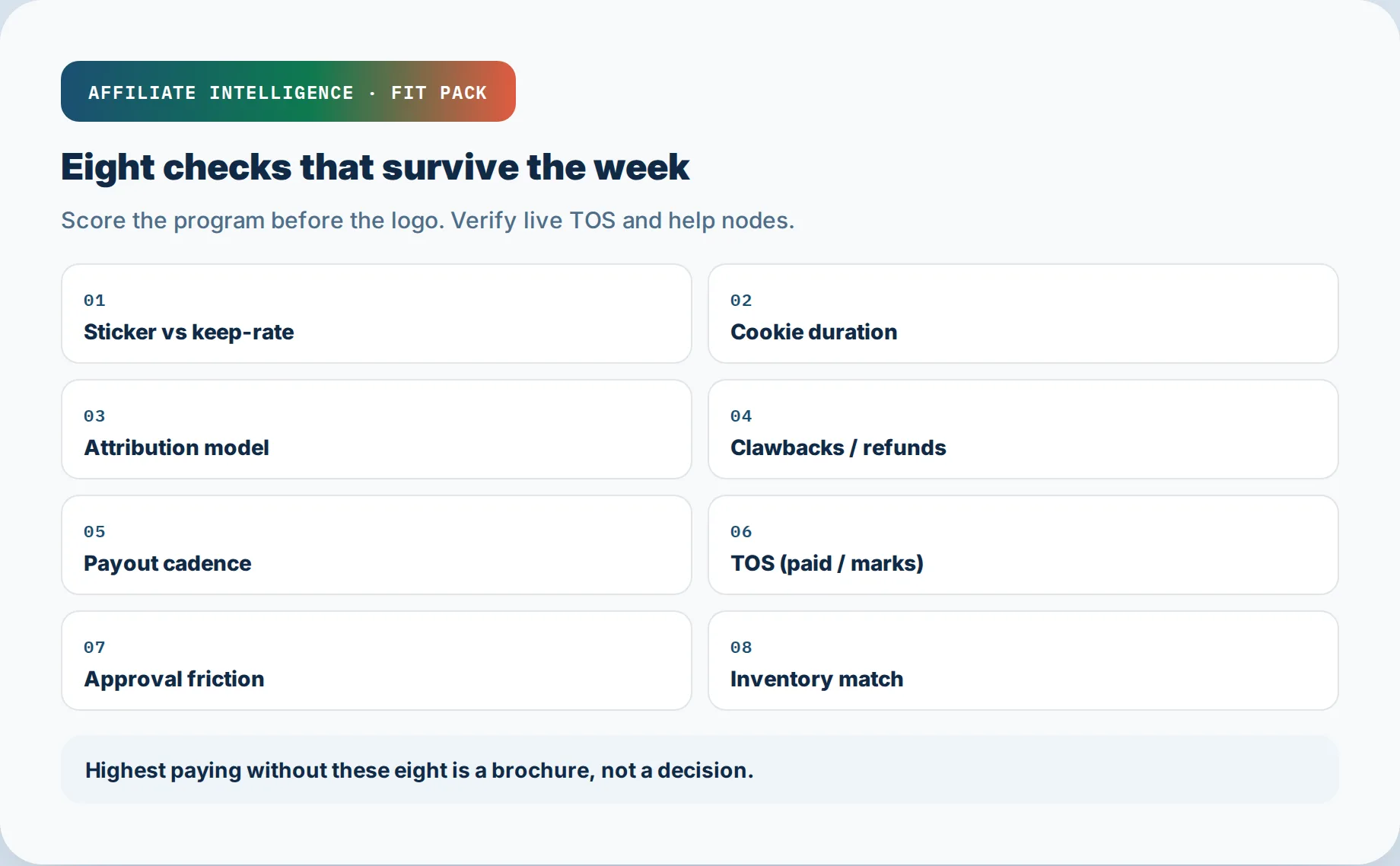
These eight checks are not a vague vet-carefully essay. Each one answers a single operational question: will this program pay me in a way I can model, or am I shopping a brochure? Use the checklist below before you apply, then run each H3 as a working test.
| Check | Operational question | Acceptable signal / red flag |
|---|---|---|
| ☐ Sticker vs keep-rate | What do I keep after returns or cancellations per 100 clicks? | Keep-rate beats sticker rate; red flag is a rate card with no return model. |
| ☐ Cookie duration | Does the window match my sales cycle? | 30 days fits impulse, 60 fits mid-consideration, 90-180 fits high-consideration software. |
| ☐ Attribution model | Where do failed postbacks surface and how are payable actions counted? | Ledger shows payable actions, not just sessions; last-click versus multi-touch is explicit. |
| ☐ Clawbacks and refunds | What reversal rights survive after I am paid? | Reverse terms are read before traffic; red flag is a 120-540 day silent clawback window. |
| ☐ Payout cadence | When does pending become payable and funded? | Approval, hold, and payment windows are separate; red flag is automatic approval shorter than returns. |
| ☐ TOS and approval | Is my placement allowed and will the queue move? | Strict networks approve 28-45 percent in some verticals; silent queue is a management signal. |
| ☐ Inventory match | Does the product match why the reader came? | One-sentence traffic-to-product match exists; red flag is a confusing checkout for your audience. |
| ☐ Concentration fit | Can one program kill my pending book if it changes? | Cut simulation still justifies content budget; red flag is one-logo livelihood. |
Sticker vs Keep-Rate
Expected yield beats sticker rate. Run the keep-rate formula before reading any rate card: average order value x (1 – return/cancel rate) x commission rate = kept commission. Then model it per 100 clicks: if 100 clicks produce C conversions, kept commission per click = (C / 100) x kept commission. A 4 percent Amazon Associates commission on a $200 electronics purchase with a 10 percent return rate nets $7.20, not $8, as the Amazon Associates for operators: what the program actually is walkthrough shows. Retail is harsher: an $85 order at 15 percent one-time commission and 45 percent margin pays $12.75 before returns, but a 12 percent return rate cuts the merchant’s kept amount to $22.44 after commission reversal, according to the Referly commission calculator. The bigger sticker pays less. Model the kept amount per 100 clicks, not the brochure number.
Cookie Duration as Hidden Lever
Cookie duration is a hidden lever. Do not rank cookie hours. Judge duration against your sales cycle. Track360’s 2026 benchmark shows median time-to-first-conversion from link click: eCommerce 1-4 days, iGaming 3-8 days, prop trading 7-21 days, Forex 14-45 days, and B2B SaaS 21-60 days. Use that as your sales-cycle reference. Decision rule: 30 days is acceptable for impulse physical goods, 60 days for mid-consideration purchases, and 90-180 days for high-consideration software. A 180-day window on a high-consideration software product is useful; a 30-day window on an impulse physical product is not a dealbreaker. Fit, not feature. The network class essay notes CJ retail cookie windows commonly run 7-30 days while many ShareASale merchants use 30-90 days, so read each merchant’s rule separately.
Attribution Model
Attribution model matters because last-click vs multi-touch changes whose conversion gets paid. A program might show a conversion you cannot see in your own analytics because the network ledger counts payable actions, not sessions. Before scaling, ask three pre-scale questions: where do failed postbacks surface, does the ledger show payable actions rather than sessions, and is the model last-click or multi-touch? Networks and GA4 rarely agree on the same conversion count, because one measures commission-eligible actions and the other measures behavioral events. The same gap appears in affiliate network versus GA4 comparisons: the network can correctly attribute a conversion that GA4 only records as a later visit’s source/medium, per Dognet’s attribution explainer. Compare the program’s attribution rule to the attribution you need to trust your own cut decisions.
Clawbacks and Refunds
Read reverse and withhold terms before traffic. A card chargeback lookback can run 120 to 540 days, and merchants may reserve the right to reverse paid commissions on that timeline. Cardholders generally have 120 days after transaction or expected delivery, extendable to 540 days for future-delivery or travel purchases, while merchants often have only 20-45 days to respond, according to Chargebacks911’s chargeback time limits guide. Before you send a click, estimate the tail: conversions x estimated dispute rate x commission = exposure. If a program’s terms allow clawbacks on a 120-day lookback and your content drives high-consideration purchases, price that tail risk before it finds you. Use the stop affiliate commission clawbacks: tracking prevention checklist to build your defense.
Payout Cadence
Payout cadence is cash-flow reality, not preference. Separate three windows: approval, hold, and payment. Awin’s auto-validation period can run up to 67 days on its Access tier, per Awin’s auto-validation documentation. Awin then processes payments twice a month, on the 1st and 15th, per Awin’s payment schedule. Model the flow: day 0 tracked sale, up to 67 days to auto-approve, then the next 1st or 15th to become payable, then bank transfer time. If the merchant’s return window is 60 days and commissions auto-approve in 7, the dashboard balance is soft. Payout maturity is a contract term, not a dashboard badge. The affiliate program economics guide walks through the same pending-to-payable mechanics.
TOS and Approval
Rejection is data, not insult. Approval rates vary sharply by vertical: eCommerce approval runs 55-78 percent, B2B SaaS 38-62 percent, iGaming 32-58 percent, and Forex 28-45 percent, according to Track360’s 2026 vertical benchmarks. If your placement is prohibited by default, no affiliate manager override will save you. Read the terms before you apply, and treat a silent queue as a signal about program management. The network due diligence checklist for beginners includes the same approval expectation and queue-escalation questions. For retail programs, read Target Affiliate Program due diligence before you scale before assuming approval equals payout.
Inventory Match
A program can be legitimate and wrong for your traffic. Before applying, write a one-sentence traffic-to-product match: “This page’s reader is evaluating [specific need], and this merchant sells [specific product] that solves it.” Then add a checkout-fit check: does the merchant’s checkout confuse your audience or match the promise of the page? If the product does not fit the page, the best rate card is irrelevant. Walmart Affiliate Program: what the brochure leaves out shows how even a large catalog can mismatch specific traffic. Fit over logo.
Attribution Quality Is a Payout-Risk Signal
Attribution quality is not a tracking department concern. Bad attribution predicts payout pain. Networks and GA4 rarely agree on the same conversion count, because one measures commission-eligible actions and the other measures behavioral events. That gap is not a bug. The network counts payable actions; GA4 counts sessions.
Before you scale, ask where failed postbacks surface. If the answer is “they do not,” the program’s attribution quality is a liability. A green tick means the endpoint answered, not that the tokens matched. I will say it again: green ticks do not prove joins.
Payout-Model Fit: CPC vs CPA/CPL vs CPS
The counterargument is easy to understand: pay-daily and pay-per-click programs look like the best affiliate programs because cash lands fast. A CPC program pays per click, so you get paid even if the visitor never buys. That feels safer. It is not safer. Use the comparison table below to match the model to your traffic intent.
| Payout model | What action pays | Best-fit traffic intent | Hidden risk | Keep-rate implication |
|---|---|---|---|---|
| CPC | Click, no purchase or lead required | Display-heavy, low-intent placements with little downstream value | Traffic quality can be gamed; merchant buys exposure without conversion obligation | Zero downstream value unless click rate compensates |
| CPA/CPL | Lead, trial, or defined action | Audiences evaluating a service or B2B offer before purchase | Strict lead validation windows and trial quality checks | Payout rewards a signal, not a closed sale |
| CPS | Completed sale | High-intent comparison and review pages | Returns and cancellations reverse commission | Payout quality matches completed purchase, but returns reduce kept amount |
Ignore the “highest paying affiliate programs” banners. Vertical EPC ranges differ sharply: forex runs $1.20-$4.60 per click while eCommerce runs $0.08-$0.35 per click, according to Track360’s 2026 benchmarks. Those shared numbers tell you what the crowd earns, not what your traffic will keep. Pay-daily is a payout schedule, not an affiliate model. Treat it as a cash-flow feature, then ask what action actually pays. For CPA-heavy marketplaces, read ClickBank without the hype: vet offers before you promote before trusting a high CPA number.
CPC Is a Model, Not a Crown; Pay-Daily Is a Schedule, Not a Fit Test
Do not crown a program because it pays daily or pays per click. CPC is a traffic sale model. The merchant buys exposure, not conversions, and you carry zero obligation to produce a customer. That can be a legitimate trade only when your placement is low-intent display inventory and the effective click rate compensates for the absence of downstream value.
Contrast two scenarios. A high-intent comparison content site should choose CPS or CPA because the payout tracks completed sales or qualified leads, matching why the reader arrived. A low-intent display property can justify CPC only if the click rate and reduced opportunity cost make the traffic sale worthwhile. If you are not sure which side you are on, ask one operational question: what action actually pays, and does that action match what your audience already does? Pay-daily changes only when cash arrives, not what triggers it.
High-Ticket Lane: When It Fits, When It Is Fool’s Gold
High-ticket affiliate programs get marketed as the fast path. The median SaaS commission runs about 22.5 percent of first-year revenue compared with 8.4 percent for ecommerce, per the affiliate program economics guide. That gap looks like an answer. It is not automatic profit.
High AOV hides low conversion and long consideration. A $2,000 course at 50 percent pays $1,000 per sale, but if your traffic has 0.2 percent conversion and a 30-day consideration cycle, the cash arrives late and brittle. Mid-ticket and recurring programs are training wheels: smaller absolute payouts, faster learning loops, less exposure to a single refund.
Use high ticket only when your content already demonstrates high-trust, deep-comparison behavior and your audience has a long decision cycle. If you are new, high ticket is fool’s gold: the sticker is enormous and the keep rate is often worse than it looks.
Recurring and Lifetime Claims: Vet the Contract Meaning
Recurring and lifetime claims need contract meaning. A common structure pays 15 to 30 percent on first purchase. Subscription apps often pay 20 to 40 percent of the first billing period, then 5 to 15 percent on renewals, per the affiliate program economics guide. The marketing page says “lifetime recurring.” The terms may mean first-year recurring, or recurring until cancellation, or only on the same plan.
Ask what happens on downgrades, refunds, and merchant changes. Does the recurring commission survive a customer moving to a lower tier? If the terms are silent, treat the lifetime claim as promotional. Uncapped recurring can compound: a $49/month subscription at 20 percent for 36 months costs $352.80 in total commission for one customer, according to the Referly commission calculator. A single recurring program that covers your fixed costs is concentration risk wearing a passive-income costume, see the concentration risk guide for affiliates.
Direct Merchant vs Network: Multi-Network When Jobs Differ
Direct merchant programs and networks are different jobs. Direct often means fewer approval gates and faster communication, but you inherit the merchant’s tracking stack and payout risk without a network’s guardrails. A network may offer dispute mediation and standardized terms, but the catalog class may not fit your specific brand needs. The decision is inventory, not prestige.
Do not open a second same-class account before the first produces readable data. Publishers running several networks often juggle many distinct SubID parameter names across platforms (SubID tracking fit test). That is admin debt. Only add a network when a new job requires a new class. If your first network handles catalog browsing and your second is a partnership platform for one premium brand, that is a decision, not a reflex. For CPA-heavy marketplace vetting, use ClickBank without the hype: vet offers before you promote as a worked example.
Concentration Anti-Pattern and Monitoring Program Changes
One-logo livelihood is a fragile point. If a single program is most of your pending book, a rate cut or shutdown hits you before you can rebalance. Awin limits rate reductions to a maximum 20 percent per change, once every 30 days, with seven-day notice, per the affiliate program economics guide. Many programs have no such guardrail. Figma (2024), BigCommerce (2025), and Booking.com (2025) have all shut down affiliate programs in recent years - proof that platform permanence is a marketing claim, not an operating guarantee. That pattern is background risk in the same economics guide, not an edge case. That is background risk, not an edge case. Read platform risk is not abstract: price it into your affiliate forecast before you assume a platform is permanent.
Build a cut simulation before the adjustment email. Name your concentration. Cut the top program’s rate by 20 percent and recompute yield. Replace it with zero for two payout cycles. If the cluster still justifies the content budget, you are robust. If not, fix the fragile point before it finds you. Monitor program changes: rate cards, TOS updates, payout threshold shifts, and platform migrations are all operating data. The migration of ShareASale into Awin is proof that permanence is a brand sticker, not an operating reality, per the network class essay: ShareASale vs CJ vs Impact.
Close: Use Aff DD Siblings as Worked Examples
Use the Affiliate Due Diligence siblings as worked examples, not a second encyclopedia. We already built Amazon Associates, Walmart, Target, and ClickBank as program-level fit tests. The Amazon page answers what the program actually is, not the brochure. Walmart and Target show what retail due diligence leaves out. ClickBank without the hype vets offers before you promote. The affiliate program economics guide deepens sticker vs keep-rate math. The network class essay: ShareASale vs CJ vs Impact covers terrain without ranking logos. The SubID tracking fit test covers the tool fit. Do not rebuild those pages. Read one, apply the fit test to your next candidate, and decide by job.
Pick one live campaign. Write down which program actually fits its traffic and payout reality this week. That is the only sentence you need to keep.