How to Get Approved for Amazon Associates (and Stay Eligible)
Amazon Associates approval is a gated process, not a signup trophy. You sign up, you get a conditional account, then Amazon reviews your application only after you drive qualifying sales: at least three within the first 180 days on the US help page as of 2026-09-12. Personal orders do not qualify. I’ll say it again: signup is not final approval. Operators win by preparing a real property, surviving the qualifying-sales window without fake orders, and triaging reject vs closed vs missed-window with the right next move. This tutorial walks each gate in order - not the "join in five minutes and print money" theater. Run the skeptic’s scam-legit checklist if any shortcut promise sounds too easy.
Prerequisites: Sign-Up Is Not Final Approval
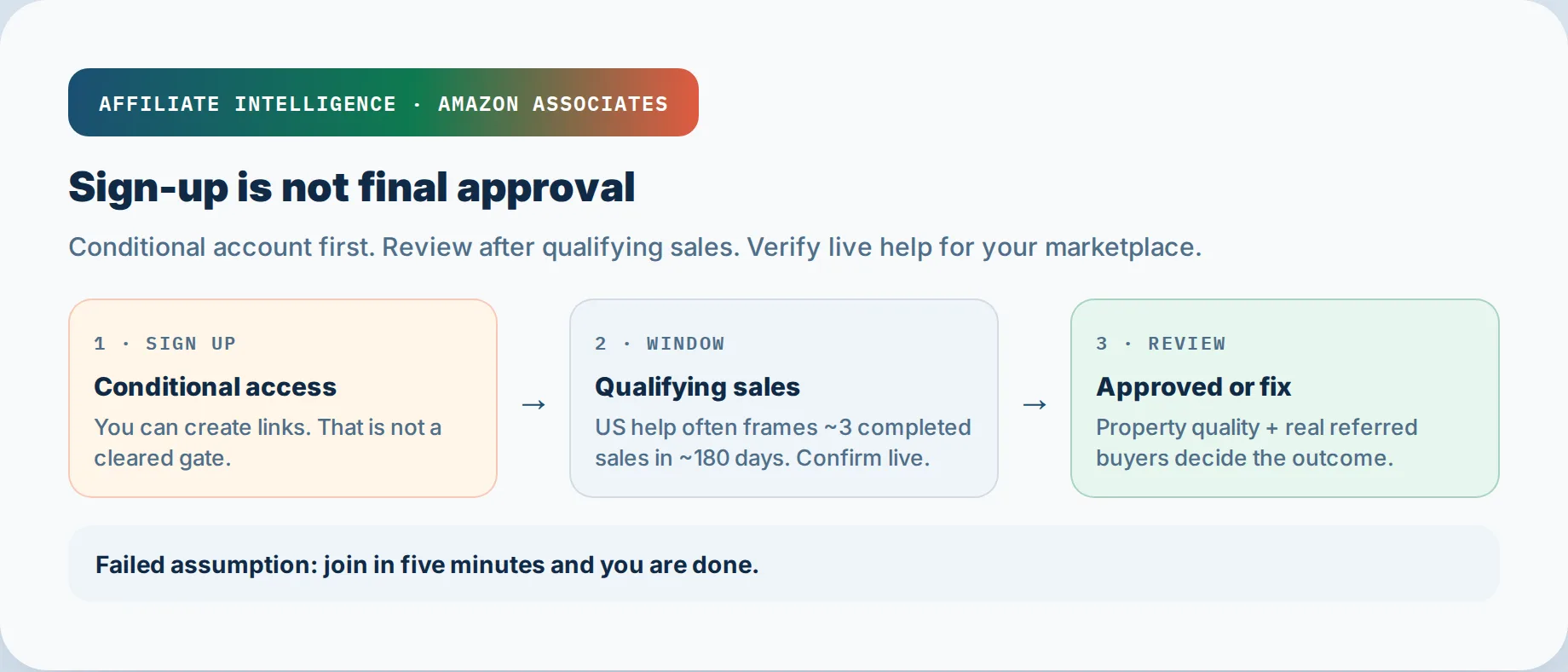
The premise matters more than the checklist. A publisher signs up, writes twenty product posts, and waits. No qualifying sales arrive inside the review window. The account stays gated or gets rejected for not crossing the threshold. That is not a broken pipeline. It is an unfinished application.
Before you apply or reapply, have these starting materials ready:
- One durable property: a website you own, a mobile app, or an accepted social network page with exact URL.
- Original content that stays useful even when every ad and affiliate link is stripped.
- A clear affiliate disclosure you can place near links, not buried in a footer.
- Tax or identity information for the marketplace where you applied.
- A plan to get real, non-fake buyer clicks through tagged links.
The Amazon Associates for operators: what the program actually is covers program DD, rate-move framing, and the Influencer vs Associates split. I am not rebuilding that here. Before I trust any threshold, verify your own marketplace help because day windows and accepted platforms can differ by locale. The current US Application Review Process help says at least three qualifying sales within the first 180 days. Policies can change. Check live.
Checkpoint: You can state the difference between a conditional signup account and full approval, and you know which property and marketplace you are applying under.
Step 1: Run the Property Readiness Checklist
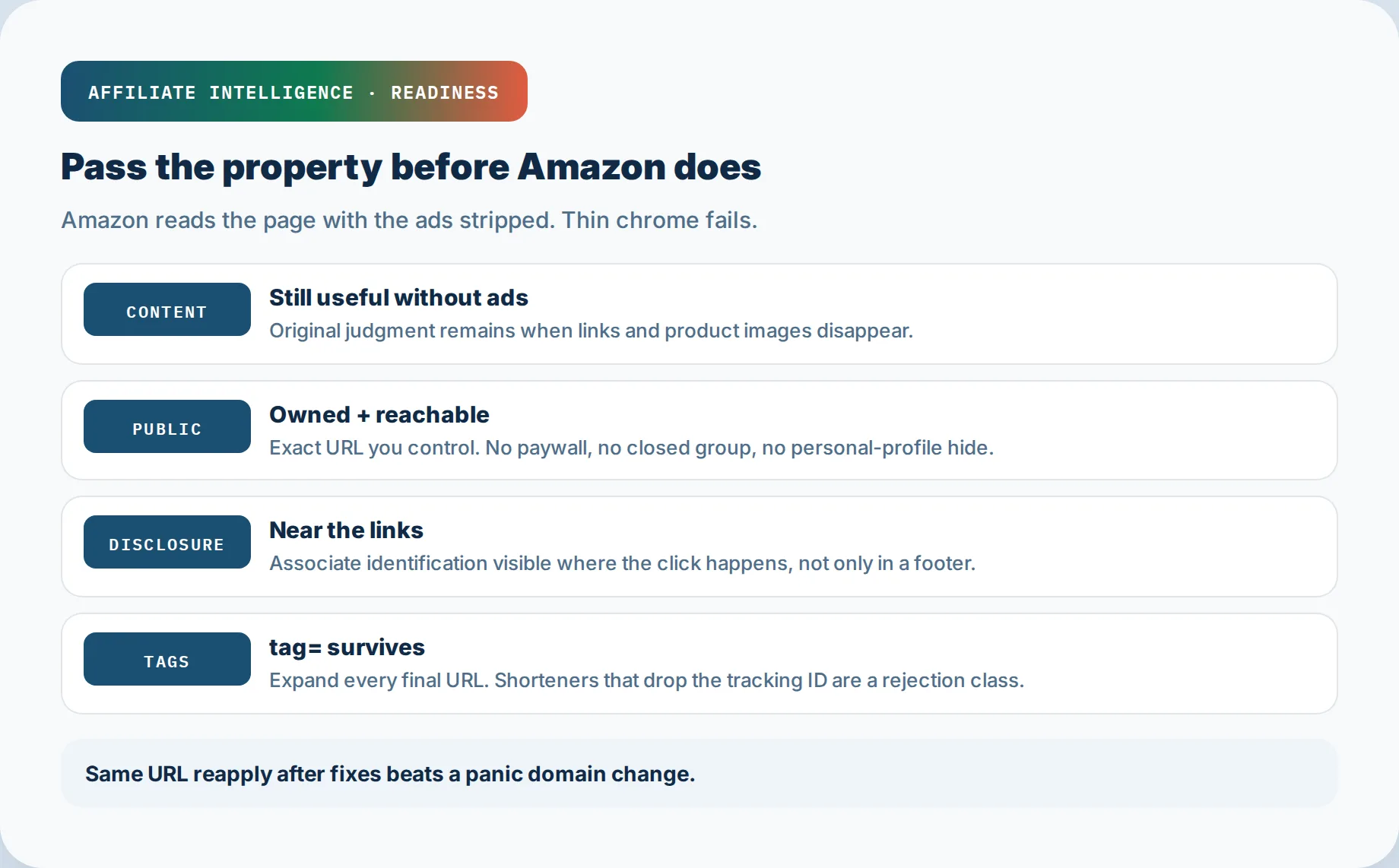
Goal: find every gate failure before Amazon does.
Run this pass against your website, app, or social page. Do not skip the "ads removed" lens.
- Content test: if every affiliate link, product image, and CTA disappeared, is the page still worth reading for a visitor? Amazon’s Application Review Process says all sites must have original content even when advertising is removed. The current US help has used a rough floor around ten posts, and web content generally needs to be recent - some versions cite within the last 60 days. But content-volume, recency, and social-establishment thresholds change by locale and update; check the live help node instead of treating any single figure as permanent policy.
- Ownership test: you must own the website. A subdomain on someone else’s blog or a free host you do not control can fail review.
- Public access test: no paywalls, no closed groups, no hidden follower counts. A site behind a password or a Facebook personal page does not count.
- Social proof test: if you are social-only, the page must be established with substantive organic followers or likes. Current US help has used at least 500 in most cases, and public visibility is still required. Personal profiles are excluded. Verify the exact social-establishment and follower criteria on the live Application Review Process node for your marketplace because these figures can change.
- Disclosure test: a visible statement identifying you as an Amazon Associate sits on the page, near links. Amazon’s Operating Agreement requires this. A footer-only disclosure is weak.
- Privacy test: a privacy policy explaining data collection, use, and sharing exists on the property.
- Tag test: every Amazon link on the property must carry your current tracking ID. A short link that drops the tag is a rejection class. Expand the final URL and confirm the
tag=parameter is present. When tags break or disappear, use the item-level reporting and tracking ID workarounds to trace the failure.
Amazon reads content without the ads. A thin page that is mostly product images plus affiliate chrome fails the readiness test.
Checkpoint: You have a completed readiness pass or a prioritized gap list with documented fixes for every failed item.
Step 2: Earn the First Qualifying Sales Without Faking Them
Goal: drive three real, completed, non-returned buyer purchases through tagged links before the window closes.
Do not fake the first three sales. Self-purchase, friends-and-family theater, and "support my link" pushes are not a qualifying-sales plan. Amazon’s Application Review Process states personal orders do not qualify, and the goal is to refer buyers outside your immediate circle. A related Australian Operating Agreement do’s and don’ts says commissions from you, friends, or family are not eligible. If you stage three orders from people who know you, you are testing Amazon’s enforcement, not building a pipe.
What works instead:
- Start with one distribution surface. The skip the course and ship your link method keeps the first move simple. A website post, a public YouTube video with a tracked link in the description, or a public social profile with a link can each work. Do not scatter across five channels; if one source later dominates, price in revenue concentration risk management instead of pretending Amazon income is permanent.
- Create the tagged link in Associates Central or SiteStripe before you publish. Expand the full URL and confirm the
tag=parameter. - Write or record content that solves a specific purchase decision. Comparison posts, honest reviews, and gift guides are conversion surfaces. Thin "best X" lists with no original judgment underperform.
- Do not start the clock with zero distribution. If you sign up, generate links, and then do nothing, the 180-day window burns quietly. Put the link in front of real viewers before review.
- Qualifying sale hygiene: a purchase must be completed, shipped, and paid. A return, cancellation, or refund initiated disqualifies the order under Amazon’s Program Policies. Do not count a sale that is still pending or gets reversed.
Structural scenario, not a war story: a YouTuber with a small but real audience posts a product comparison and puts one disclosed tagged link at the top of the description. Three viewers buy within two weeks. That is the qualified path. A second creator sends the same link to ten friends in DMs. Amazon sees private-message link pushes as a closure smell, and the friends’ orders do not qualify anyway.
Do not treat a magic traffic floor as a requirement. Amazon does not publish a minimum visitor count in the Application Review help. The relevant question is whether the property converts real viewers into completed, paid purchases through your tag.
Checkpoint: You have a live tagged link on one distribution surface, and the link’s final URL carries your current tracking ID. Actual buyer clicks are arriving, not just impressions. If clicks are steady but conversions drop later, start with the clicks-steady-but-conversions-down funnel check before changing links.
Step 3: Translate the Rejection Email into a Fix Pack
Goal: turn rejection language into a specific reapplication sequence on the same URL.
Rejection reasons are repeating failure classes, not fog. Translate each one before you touch the property.
- "Not using special tagged links" or "unable to determine source of traffic": your links are missing the
tag=parameter. Regenerate full links in Associates Central, not a shortened version. If you are reapplying, create a new tracking ID for the new application and update every link on your site. - "Unoriginal content or lack of content" / "pages mainly empty when advertisement content is removed": add original writing and useful judgment, not more product images. A site that collapses without ads is thin in Amazon’s eyes.
- "Trademark violation": remove unapproved Amazon words, images, screenshots, and customer reviews. Use the official "Available at Amazon" logo or approved text CTA instead of the Amazon or Smile logo. Do not put "Amazon" in your domain, subdomain, store ID, or social handle.
- "Empty or undeclared sites": list the exact profile URL, not just "facebook.com" or "instagram.com". If your site list names an old domain you no longer control, remove it. Reviewers only see what you declare or leave findable.
- "Missing disclosure": place the Amazon Associate identification language on the page, near the links. Do not hide it behind a read-more.
Do not register a new domain as the first lever. The Application Review FAQ tells you to update the Amazon product links on the same site so they contain tagged links from your new application. Same URL reapply after fixes. A new domain resets trust and still needs the same content, disclosure, and sales evidence.
Checkpoint: You can map every line in your rejection email to one concrete property fix, and you have completed those fixes before reapplying.
Step 4: Triage Closed vs Rejected vs Missed-Window
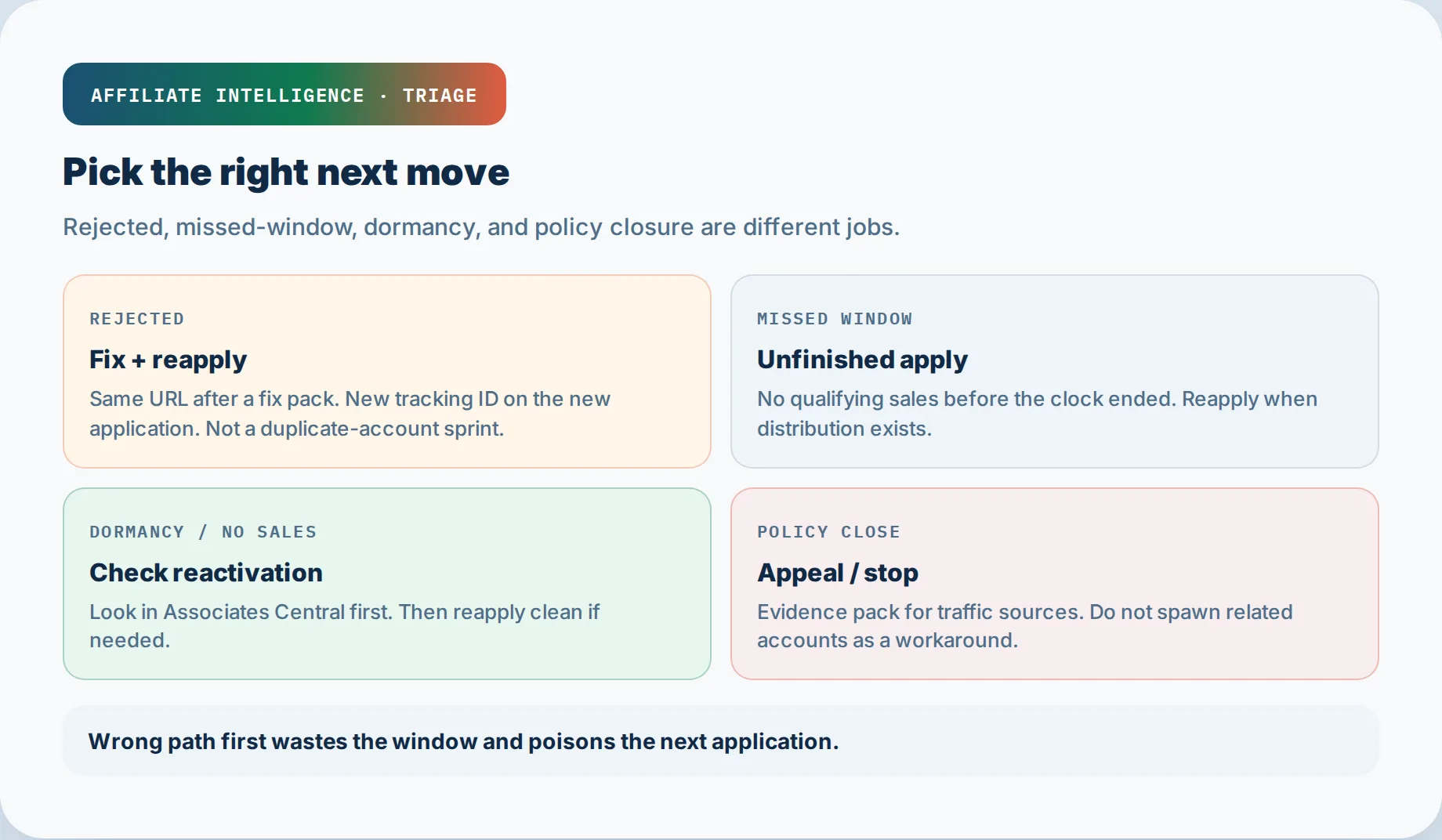
Goal: pick the correct path among appeal, reapply, or restart clean without creating duplicate-account poison.
Three states look similar in the inbox but need different moves.
- Rejected application: Amazon reviewed your application after qualifying sales and declined it. The Account Dormancy and rejected account help says Amazon cannot reinstate a rejected account or Associates ID. The correct path is to fix the property and reapply. Create a new tracking ID for the new application and update links.
- Closed for dormancy or no sales: you never cleared the qualifying-sales gate. The application can be withdrawn if there were not enough qualifying sales for 180 days. Check if your locale offers a reactivation path in Associates Central. If not, reapply after the site is established. Do not assume closure is permanent; sometimes the same login shows a reactivation option.
- Missed-window inactive: you signed up, never drove qualifying sales, and the window expired. This is not a rejection. It is an unfinished application. Reapply when distribution exists. Verify your locale’s day window because it can differ. Some marketplaces use different thresholds or windows; read your marketplace help, not a US-only summary.
- Banned or policy termination: if Amazon terminated the account for a policy violation, reapplying immediately on a new email or property carries related-account poison risk. Amazon’s Operating Agreement allows it to close other accounts you may open in the future if you violate terms. Do not build a duplicate account as a workaround. Walk the affiliate network due diligence checklist before you apply anywhere else; it forces you to check which networks will accept a prior termination instead of hiding it. Fix the underlying violation first and, where a contact path exists, ask about reinstatement before reapplying.
- Review-ban vs Associates: if you have an Amazon review ban or have been cut from another Amazon program, that is a different problem from an Associates rejection. Do not conflate them. Amazon’s review ecosystem and Associates program do not share one status ledger, but an active policy violation can bleed across if the same account is involved.
Checkpoint: You can classify your current state into one of these four buckets and state the next single action: appeal, reapply on the same property, restart clean after the window, or stop before duplicate-account poison.
Step 5: Social-Only or No Website: One Durable Pipe
Goal: choose one allowed property class and document a single public, durable distribution pipe.
Social-only is allowed. Amazon’s Application Review Process accepts Facebook open pages, Instagram, Twitter, YouTube, TikTok, and Twitch.tv. Exclusions include personal profiles, closed groups, hidden follower counts, and profiles where posts are invisible to non-followers. You must list the exact profile URL.
But "social-only" is not "no destination." You still need one durable pipe. A rented app profile can disappear or reset; platform risk isn’t abstract - price it into your affiliate forecast before you lean on a surface you do not control. The domain resilience playbook for rented-pipe and no-website risk covers what happens when the only hostname you control dies. You do not need a full website to pass, but you need one surface you can keep public, updated, and reachable. A link-in-bio page, a self-hosted landing page, or a long-lived YouTube channel can all work if you own or control the surface enough to keep it alive.
Use one platform at a time. If you list five social profiles but maintain none of them well, Amazon reviews the weakest one and you fail on that basis. Pick one, do the content work, then add more only after approval. The Influencer vs Associates split is covered in the pillar: Amazon Influencer is a different job class with a storefront and onsite commissions, not an Associates upgrade. If your surface is primarily shoppable video that performs inside Amazon’s own browse experience, that is the Influencer path. If your surface is offsite referral links, Associates is the closer fit.
Checkpoint: You have chosen one property class, listed one exact URL, and can state why that single pipe is durable enough to survive a review.
Step 6: Build the Appeal Evidence Pack
Goal: when traffic sources are questioned, answer with evidence, not argument.
Reviewers only see what you declare or leave findable. Build a small evidence pack before you reply.
- Declared sites: open your account in Associates Central and confirm the site list matches the live property. Remove old domains, subdomains, and hijacked handles you no longer control. An undeclared traffic source often reads as "unknown traffic source" to a reviewer.
- Purge hijacked or stale domains: if an old domain now hosts something unrelated or broken, remove it from your application. A reviewer who crawls a dead or repurposed domain may attribute its failure to you.
- Show where links live: produce a short list of exact page URLs where your current tagged links appear, with the expanded final URL visible. Do not say "on my blog" and leave it there.
- Fix missing tags: export the href of each link and confirm the
tag=parameter matches your current tracking ID. If you reapplied, create a new tracking ID and update every link before review. The Application Review FAQ is explicit: reapply with the new application’s tagged links. - Profile URLs, not network names: if social-only, list
https://www.instagram.com/YourHandle, nothttps://www.instagram.com. The Australian do and don’t help calls this out as a closure driver. - A privacy policy is not optional for website properties. Include a live URL to it in the evidence pack.
Before I trust an appeal, I assemble this pack and read the exact question Amazon asked. If they asked about traffic sources, show the declared current sites and link map. If they asked about tags, show the expanded URLs. Do not send a long narrative.
Checkpoint: You have six items in one folder: current site list, purged old domains, a tag-to-page map, expanded URLs, exact profile URLs, and a live privacy policy link.
Step 7: After Approval: First Tagged Link Hygiene
Goal: clear the gate, then verify one real tagged link so the account does not silently rot.
Post-approval, create and verify a real tagged link in Associates Central. Long and short links from SiteStripe include your Associate ID and tracking ID, but I still expand the final URL and confirm the tag= parameter survives. A stripped ID can look like an "unknown traffic source" failure later. This one habit beats over-building platform encyclopedias.
Then add soft bridges, not rate tables.
- The pillar covers program DD and rate-move framing. Read it once and move on.
- If "without a website" turned into a rented-pipe risk, the domain resilience playbook is the next stop.
- The beginner start map handles the one-link shipment without course theater.
- The scam and legit checklist is the income-promise filter before you scale.
- The network due diligence checklist applies if Amazon is not the fit.
One beat only on concentration: Amazon is one platform. The concentration risk and platform-risk line item essays explain why a single pipe, even a converting one, should not carry your whole forecast. Do not rebuild those here. For item-level reporting or a clicks-steady-but-conversions-down problem, the tag and funnel posts cover post-approval proof. I would only open those if your first tagged clicks fail to register or convert.
Checkpoint: You can paste one expanded Amazon URL into Associates Central, see the correct tag=, and name the single platform-risk or reporting article you would open if tags stop matching.
Troubleshooting Common Issues
Symptom: no qualifying sales ever arrive.
Fix: Confirm the final URL carries tag= in every published link. Then look at where the links live. A link buried in a DM, email, PDF, SMS, or a private group often fires nothing. Share links only from the property you declared. Then ask whether the content actually helps a buyer decide. If not, write the decision content first.
Symptom: rejected for "not using special tagged links."
Fix: Regenerate full links from Associates Central. Do not use a third-party shortener. If you reapplied, create a new tracking ID and update every link on your declared site. The exact URL should look like https://www.amazon.com/dp/ASIN?tag=yourID-20.
Symptom: rejected for "unoriginal content or lack of content."
Fix: Remove all affiliate chrome and read the page without ads. If it is a product image wall, add original judgment: who it is for, who should skip, what tradeoffs exist. Aim for a content base that remains useful without links, then reapply on the same URL after the property looks genuinely useful.
Symptom: rejected for trademark violation.
Fix: Remove Amazon screenshots, customer reviews, the Amazon logo, and any "amazon" variant in domain, subdomain, store ID, or social handle. Use only the official "Available at Amazon" logo or an approved text CTA like "Shop now at Amazon.com". Never recreate an Amazon-style button.
Symptom: application closed with no sales after 180 days, but no rejection email.
Fix: This is a missed-window inactive state, not a policy ban. Check Associates Central for a reactivation link. If none, reapply only after the site has real content and traffic. Do not open a second account while the first is still visible or restorable. That creates duplicate-account poison.
Symptom: traffic sources questioned, site list stale.
Fix: Update the site list to the exact current URL for every property. Remove dead domains and old handles. Show a map of where your tagged links currently live, with expanded URLs, and add a live privacy policy link. Evidence beats argument.
Symptom: sale counted then disappeared.
Fix: A qualifying sale must be completed, shipped, and paid. A return, cancellation, or refund initiated disqualifies the order. Do not forecast from any sale that has not fully cleared. Check your locale’s day window because some marketplaces use different thresholds or windows.
Symptom: you are sharing links in private messages.
Fix: Private-message link-push is a closure smell. Amazon’s do and don’t help says links cannot be shared via email, PDF, SMS, DM, or offline. Move the link to a public post or page on a declared property. One public surface beats ten private DMs.
Symptom: you want to reapply immediately after rejection.
Fix: Do not reapply without changing the property. Amazon does not reassess a rejected application. Fix thin content, missing tags, trademark use, undeclared sites, and disclosure. Then reapply on the same URL with a new tracking ID. The new domain is not the first lever.
Fix the gate failure in front of you, not the income fantasy.