Cookieless Affiliate Tracking: What Still Works (and the Ceiling)
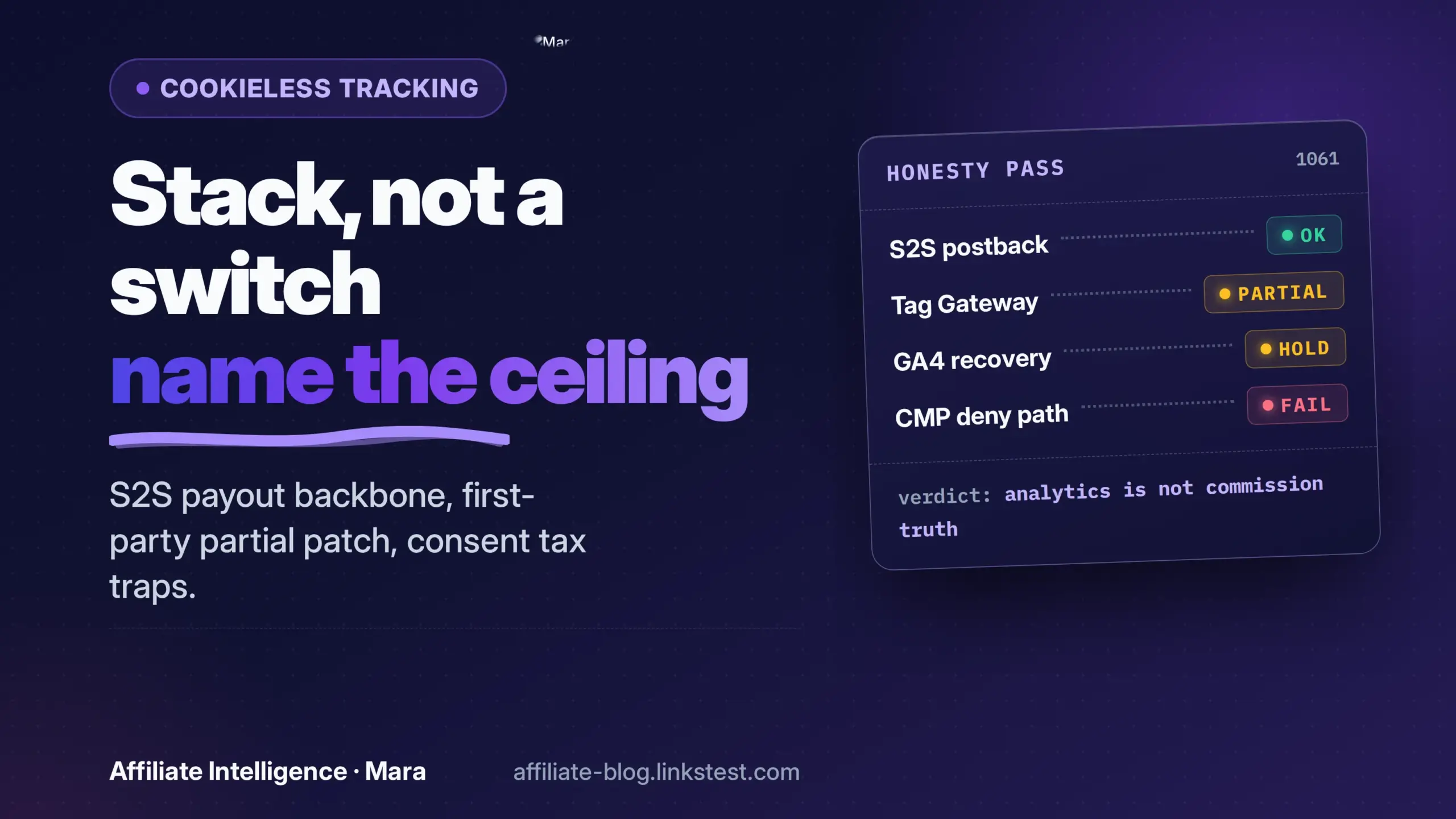
Cookieless affiliate tracking is the job operators actually search for: keep commissions attributable after third-party cookies die. Most publishers answer that job by flipping on first-party mode or a server-side tag, then treating the dashboard like a solved crossword. They shouldn’t. Google Tag Gateway, a server-side GTM container, and first-party cookies on a custom domain recover some signals. They do not resurrect identity graphs, view-through windows, or the attribution confidence third-party cookies used to fake. Analytics recovery still is not commission truth.
The failed assumption is that moving tags to your domain solves cookieless tracking. It doesn’t. The honest ceiling sits somewhere between “we recovered a slice of the lost data” and “we’re still flying blind on failure modes that hit affiliate payouts and budget decisions.”
This piece is not a rebuild of the audit trail habit. You already have a tracking spine for server-side proof mechanics, and a SubIDs in affiliate marketing guide for click-ID survival. Use this as the cookieless tracking map: which methods still work, which failure modes kill them, and which affiliate decisions cannot wait for a brochure “solved” stack.
Cookieless Affiliate Tracking Is a Stack, Not a Switch
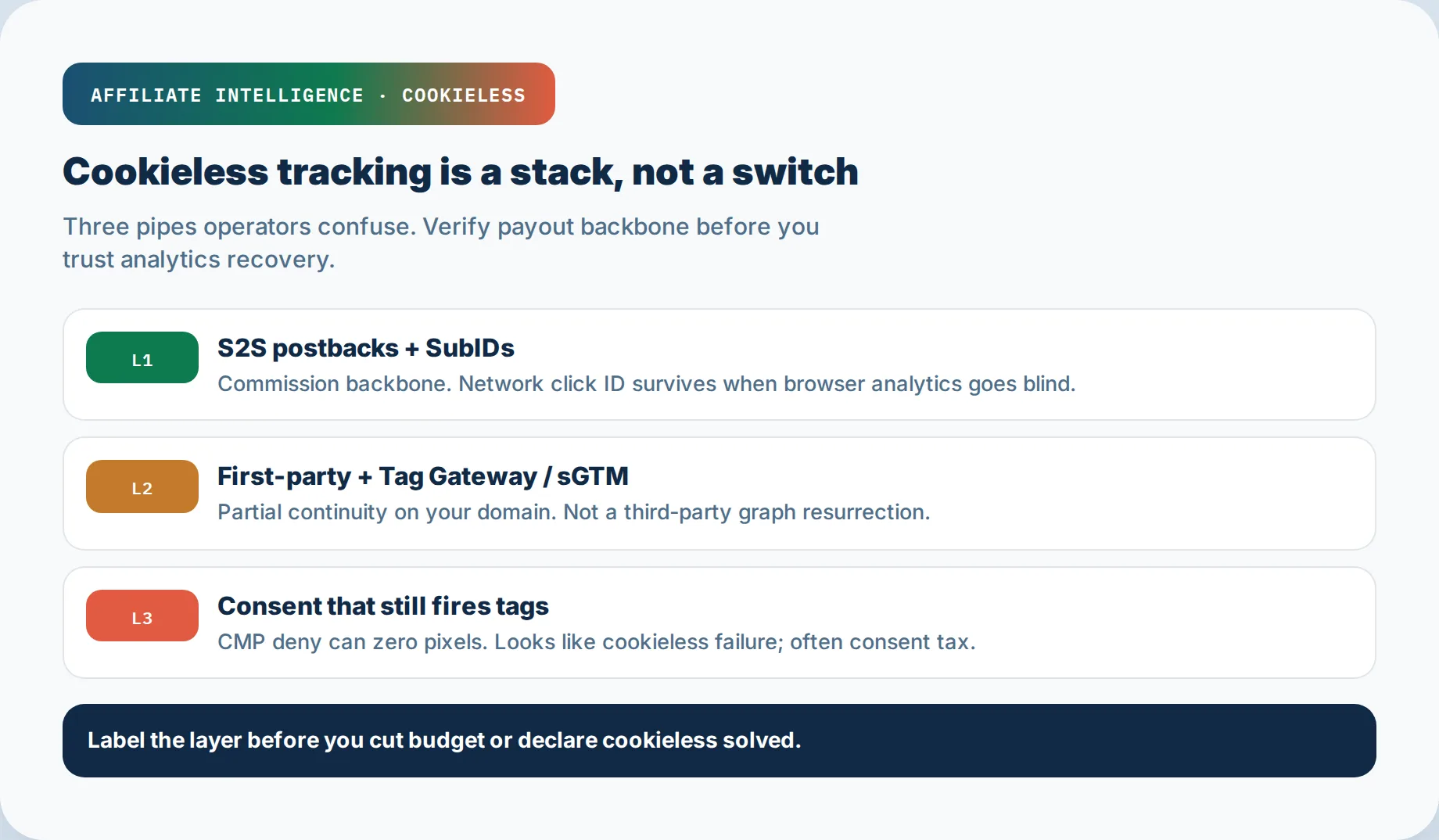
When someone asks for cookieless tracking for affiliates, they usually want a working attribution path, not a privacy essay. The usable stack is narrower than vendor slides:
- Network click IDs, SubIDs, and S2S postbacks remain the commission backbone. Verify the postback path before you trust any analytics recovery story. Start with S2S tracking for affiliates, then pressure-test green ticks with S2S postback failure modes.
- First-party cookies plus Tag Gateway or server-side tags recover continuity on your domain. Partial. Not a third-party graph resurrection. The sections below name what that patch actually recovers.
- Consent that still fires tags is a separate killer. A CMP can silently zero affiliate pixels after “reject.” That looks like cookieless failure and is often a consent tax. See the cookie consent tax.
Fingerprinting and cloaking are out of scope here. The rest of this piece is the ceiling check after you install the stack above.
The Failure-Mode Map: Stop Calling Everything “Cookieless”
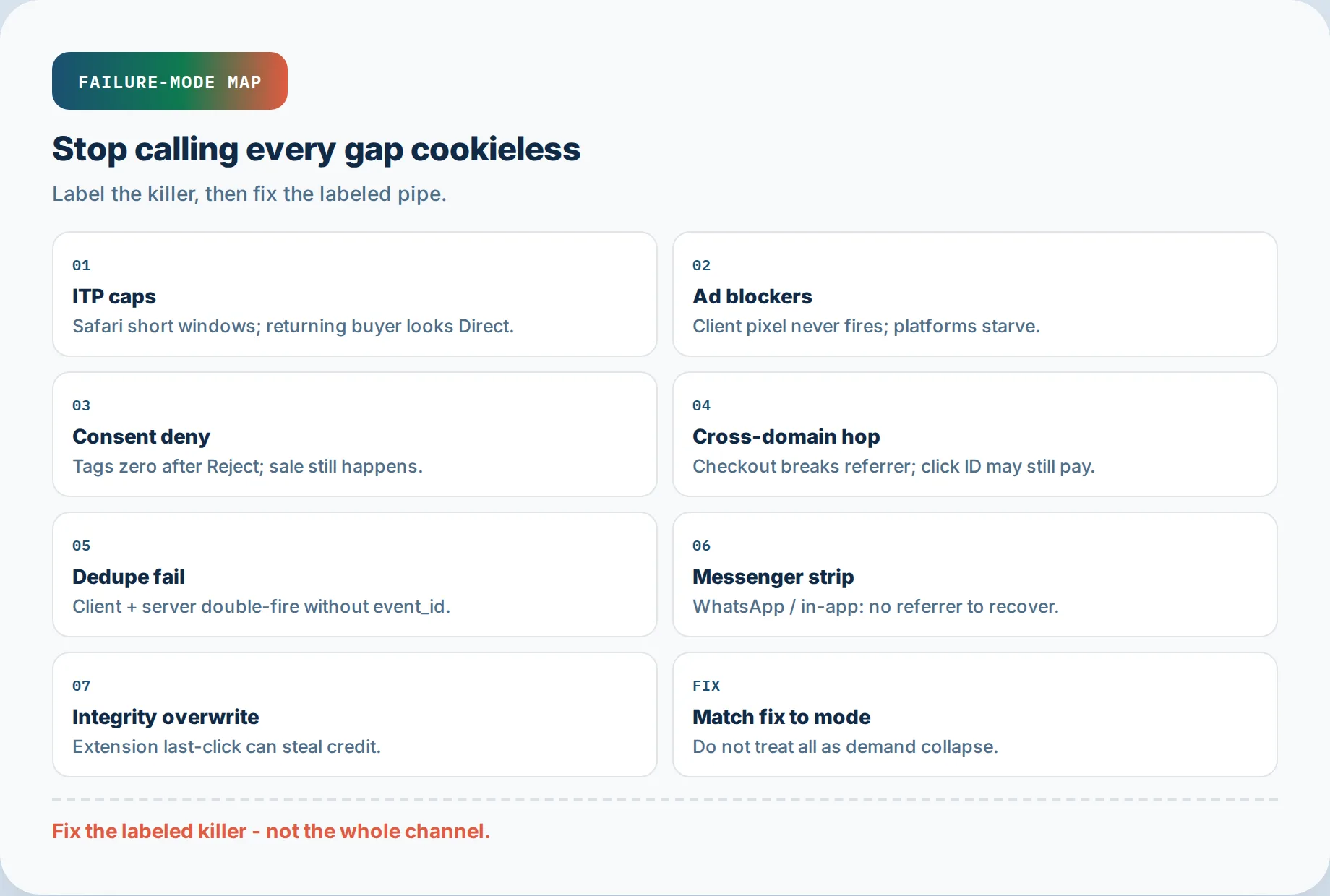
Before you treat under‑reporting as a demand problem, label the actual killers. Every lost conversion has a distinct failure mode, and lumping them all under “the cookieless transition” just obscures the fix.
Browser privacy / ITP-style caps. WebKit’s Intelligent Tracking Prevention caps JavaScript-set first-party cookies to seven days, and to just 24 hours when the visitor arrived via a link containing a tracking parameter like gclid or fbclid. If that visitor returns on day 12, the session can look like a new Direct visit even though the network click ID on your tagged link still paid. A sudden Safari-heavy Direct spike isn’t proof that your demand collapsed; it’s an ITP diagnostic.
Ad blockers / client-script death. A large share of users run ad blockers. When the script that fires your GA4 tag, Meta Pixel, or affiliate network pixel never loads, the event simply never reaches the platform. The platform then optimizes on an incomplete signal, even if the user was never “the ad audience” to begin with.
Consent implementations. A consent management platform or Consent Mode v2 setup that silently suppresses affiliate or ads tags after a “reject” click produces a different kind of hole: the sale happened, the CRM knows about it, but your ad platform never received the conversion. In markets where cookie consent rates are low, the gap between real conversions and measurable ones widens dramatically. That silent drain is the cookie consent tax, not a mysterious cookieless cliff. Also, review your consent flows against the affiliate compliance checklist.
Cross-domain / checkout hops. When a user hops from your content domain to a merchant’s domain that sits on a third-party checkout, the session often breaks. The referrer chain snaps, and GA4 shunts that paid traffic into Direct. Your click ID may survive to the network, but the analytics story vanishes.
Dedupe failures. When a browser pixel and a server-side tag both fire for the same conversion, the platform may see two events unless you send an event_id. Without deduplication, you inflate metrics and confuse Smart Bidding while the real payout still hangs on the network’s click ID.
Messenger / in-app referrer strip. WhatsApp, Telegram, Discord, and in-app browsers strip referrer information before the browser ever reaches your server. First-party mode cannot invent a WhatsApp referrer–this is dark social territory, and the dark social attribution guide unpacks that stack in detail.
Contaminants / integrity. Browser extensions that overwrite last-click cookies (think the Honey-era attribution shift) can silently redirect credit even if your tracking infrastructure is flawless. The integrity of the cookie at checkout matters as much as the pipeline that set it.
What First-Party IDs, Tag Gateway, and Server-Side Recover for Cookieless Tracking
The toolkit recovers partial ground, not the whole field.
First‑party cookies on your domain help with same-site continuity: the browser treats them as belonging to you, so ITP doesn’t treat them as third-party. But they don’t restore the cross-site identity graphs that third-party cookies once stitched together. A return visitor who cleared their first-party cookie on day 8 is still new to your analytics, even if your server-side container set the cookie itself.
Google Tag Gateway routes GA4 and Google Ads measurement requests through your own domain, making them look like first-party traffic. Google reports that advertisers who configured Tag Gateway saw about an 11% uplift in signals from Google tags; treat this as a partial recovery, Google-stack only, and it does not extend cookie lifetime. Important: it does nothing for non-Google platforms (Meta, TikTok, affiliate network pixels).
Full server-side tagging (sGTM-class) gives you a single endpoint where you can validate, enrich, and route events before they leave your infrastructure. It can improve resilience against ad blockers and ITP when events reach your server with usable identifiers. But it comes with real operational overhead: the server container must be hosted, monitored, and kept in sync. And if your web-side tags send events without the right transport config (e.g., a misconfigured server_container_url), half the traffic can bypass the server without a visible error. Always verify deduplication and endpoint health when you dual-tag client and server.
Test without torching production. A practical “ghost setup”: point a parallel path at a throwaway GA4 property with transport_url (or the equivalent server endpoint) and one catch-all tag that mirrors events into the test property only. Production reporting stays untouched while you confirm the server is actually receiving what you think it is. When GTM Preview lies or stalls, stop staring at the pane – hit your server endpoint with curl or Postman, read the container logs, and see whether the request arrived. Preview is a convenience. Request traces are the audit.
Click-ID capture (gclid / fbclid) + CRM persistence is where the real payout resilience lives. If you capture the Google or Meta click identifier on the landing page, store it in a hidden form field or first-party cookie, and later upload the conversion with that identifier via offline conversion import, you reconnect the ad click to the sale even if the browser session is a ghost. Google keeps the GCLID valid for 90 days, so even a long sales cycle can be stitched together. The same pattern applies to fbclid and other click IDs–but you need a system that persists the ID from session start through the CRM handoff, and remember the bridge-page reality that proxy clicks are not purchases.
Enhanced Conversions / CAPI-style match keys (hashed email, phone, plus click IDs and an event_id for deduplication) improve match rates on platforms like Meta and Google Ads. They can push attribution accuracy higher, but the ceiling remains probabilistic; match rates never hit 100%, and the model still depends on the quality of the first-party data you feed it. After recovery, verify whether those conversions are new-to-file; recycled demand won’t help incrementality. The paid-traffic tracking spine already covers the integration mechanics–see the full guide.

What You Still Lose: The Honest Ceiling
Even after you’ve stood up first-party cookies, a Tag Gateway, and a server-side GTM container, several gaps remain–and pretending they don’t will cost you budget.
Messenger dark social referrers. WhatsApp sends zero referrer info. Telegram does the same. No amount of first-party tagging will invent a source that the in-app browser strips before any pixel fires. Keep the proxy stack for dark social active; you need tagged links, unique codes, and post-purchase surveys running in parallel.
View-through / long anonymous identity graphs. Third-party cookies used to let retargeting pools follow users across dozens of domains for weeks, building a probabilistic picture of interest. Without that cross-site stitching, your view-through attribution becomes a black box. Platforms like Meta may still use their own logged-in graphs on-platform, but outside the walled garden you simply lose the long, anonymous tail.
Consent-denied sessions. Enhanced Conversions and server-side tags can’t send hashed user data if the user never consented to data collection in the first place. For small-volume programs, those models often never unlock. Google Ads consent-mode conversion modeling needs about 700 ad clicks over a 7-day period per country/domain grouping (plus a correct Consent Mode / TCF implementation) before models can train – then more time before numbers stabilize. GA4 behavioral modeling for Consent Mode wants at least 1,000 daily users with analytics_storage='granted' for 7 of the prior 28 days, and even that floor does not guarantee eligibility. Below those thresholds, “modeled recovery” is a roadmap slide, not a budget input. If you rely on those models to justify spend, you’re waiting on a signal that may never arrive.
Merchant / network cookie windows on domains you do not control. Your first-party cookie can survive ITP on your content domain, but when the user leaps to the merchant’s checkout, the network’s affiliate cookie is still subject to the merchant’s domain policy. If the merchant’s site runs a short cookie window or uses first-party cookies that ITP caps at seven days, your server-side patch doesn’t rewrite their TOS clock. The commission may still pay out because the click ID arrived before the cookie was set–or it may not. This is outside your control.
Platform self-attribution still claims too much. Even with a pristine server-side pipeline, Meta and Google will still report conversions that their own models attribute, and that number will often exceed what your independent reconciliation shows. More model complexity can’t invent missing events–as the MTA honesty guide explains. Trust the platform’s conversion count only after you’ve reconciled it against network postbacks and CRM outcomes.
When analytics recovery remains suspect, incrementality testing via geo-holdouts (step-by-step runbook) is the honest arbiter of demand.
Affiliate Payout Truth vs Analytics Recovery
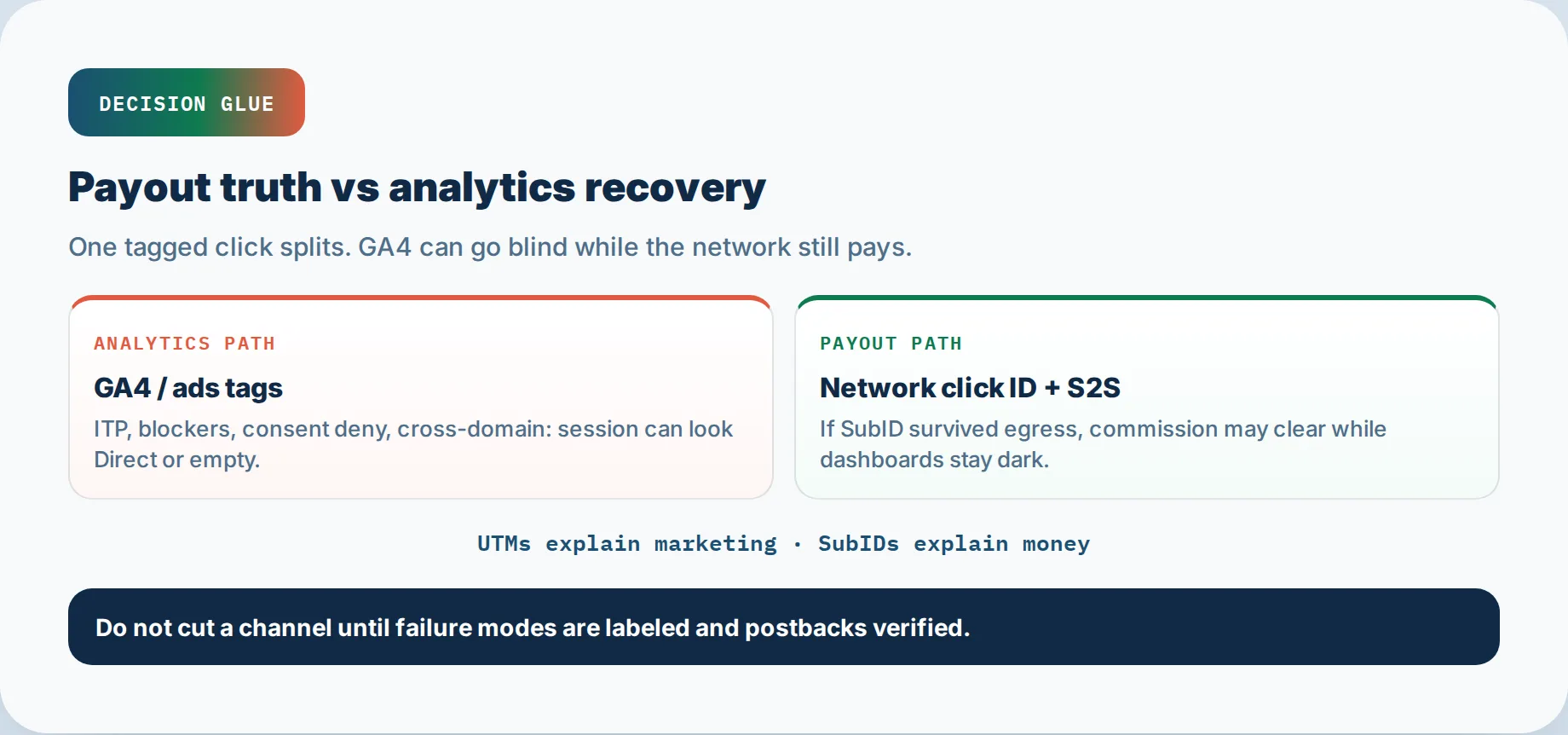
Here’s the decision glue: if the tagged link’s click ID or SubID survived to the network, you may still get paid while GA4 shows a blind Direct entry. That is the fundamental separation. UTMs explain marketing; SubIDs explain money. Cookieless affiliate tracking that ignores postbacks is theater. Keep S2S postbacks and click IDs as the payout proof layer. Don’t confuse the two books.
Do not cut a channel solely because cookieless analytics under-reports. Before you pull budget, separate consent gaps, ITP caps, ad-blocker loss, dark-social leakage, and actual demand drops. A Safari-skewed Direct spike after a community post may be a measurement artifact, not a failed campaign.
When stakes are high and platforms disagree, incrementality testing beats last-click theater. I wrote a geo-holdout method for small programs and a step‑by‑step runbook that isolate the true lift of a channel or campaign. That’s the override button. Spend a few weeks running a holdout before you trust a dashboard that claims “solved.”
Recovered events still need fresh vs recycled joins when you’re negotiating commission rates. If your server-side setup suddenly “recovers” a cluster of conversions, check whether they’re new‑to‑file. The NTF rate separates acquisition from recycled demand, and network partners will want that data on the table.
And keep consent and disclosure in the adjacent lane. If your CMP setup changed recently and you didn’t re-audit your tags, you could be funneling commissions into a consent-denied black hole while your compliance checklist gathers dust.
A One-Sitting Cookieless Honesty Pass
Before you trust any cookieless dashboard or cut a dollar of spend this week, run these eight checks. They’ll take an hour.
- Which failure modes are in play? List ITP, ad blockers, consent, cross-domain, messenger strip, dedupe. Two of them are probably active right now.
- Are you treating first-party / Tag Gateway as a partial patch or as “solved”? If anyone on your team says “we fixed cookieless,” pull the diagnostics.
- Do your egress affiliate links still carry durable SubIDs or click IDs before any cookieless story? Without those, the payout truth is a coin toss.
- Are gclid / fbclid persisted for delayed conversions where you buy ads? Check hidden fields on your lead forms; check the CRM field that holds the click identifier.
- If client and server both fire, is event_id deduplication verified? Look at the raw postback or the platform’s diagnostics pane. One duplicate conversion can quietly inflate your attributed revenue.
- After a CMP / Consent Mode change, did affiliate or ads tags silently zero? Re-test a full consent-denied journey in Preview mode. Tags blocked before the CMP loaded are one thing; tags blocked after consent is denied are another.
- Safari vs Chrome Direct / new-user split–ITP clue or demand story? A sudden swell of Safari Direct that’s markedly more “new” than usual is an ITP signal, not brand lift.
- Before cutting budget: is the gap analytics blindness, platform modeling lag, or real performance? Run the incrementality sniff test (holdout or pre-post) before you kill a channel that’s actually producing commissions.
Cookieless is not a resurrection spell. It’s a narrower, more honest toolkit. Instrument the ceilings. Stop trusting the brochure dashboard until it passes these eight questions. The win isn’t a solved report–it’s a system you can audit without lying to yourself.