S2S Tracking for Affiliates: Postbacks, Click IDs & First Verify
Affiliate S2S tracking is postback conversion plumbing: store a click ID and SubIDs on the click, receive a server message on conversion, match the join key. It is not a browser pixel. It is not server-side GTM or CAPI event forwarding. A green dashboard tile does not equal payouts. This article walks the happy-path handshake and the pre-scale verification. Wire the join key. Verify the return path.
Prerequisites
Before you touch a postback URL, gather the workbench.
You need the raw network or tracker tracking link, not the final browser URL you landed on after a redirect. You need row-level click report access, not the summary tile. The tracker selection guide and the custom click tracking cost walkthrough cover raw-access and build-versus-buy tradeoffs. You need one unique test SubID, lowercase and URL-safe, something like ddtest1-20260910. Use a private browser window so existing cookies do not mask the test. If policy allows, line up a controlled test conversion or an advertiser-provided sandbox event. If possible, get access to the raw incoming postback log. Aggregate dashboards will not show you a silent join-key break. The full staged verification lives in the network tracking due diligence checklist.
✓ Checkpoint: You can name the raw link and the test SubID without looking anything up.
Failed Assumption: Enable S2S Is a Switch, Not a Solved Loop
Enabling S2S is a switch, not a solved loop. The vendor page shows a green toggle. Nothing is solved.
That assumption is expensive. The bare search for “s2s tracking” mixes three different jobs: mobile MMP S2S, MarTech server-side forwarding, and affiliate network postbacks. A vendor saying “S2S” on a pricing page does not mean your affiliate payouts are wired. Know which job you are doing before you paste a URL. Affiliate S2S is the narrow job: a click ID and SubIDs get stored on the click, a server message returns them on conversion, and the network or tracker matches the event to the click.
A green tick is a delivery receipt, not an attribution receipt. That distinction drives everything.
MMP S2S vs affiliate postback
Mobile Measurement Partner S2S tracks installs, in-app events, and device-level attribution for apps. That is not the same plumbing as a network click-ID postback for commissions. Do not conflate them. An Adjust or AppsFlyer event stream does not prove your affiliate conversion matched a stored click ID. If you are an affiliate publisher wiring commissions, you need the network or tracker postback loop, not an MMP glossary.
CAPI Gateway and sGTM forwarding are different jobs
CAPI and sGTM forward browser events to ad platforms. An affiliate postback returns the network join key to your tracker. Treat them as separate systems. Meta Conversions API Gateway, Stape, and server-side GTM containers move analytics and ad-platform conversion events off the browser. They do not match a stored affiliate click ID. The full server-side proof spine is mapped in the UTM, SubID and server-side tracking guide. The one-sentence contrast: CAPI and sGTM forward browser events to ad platforms; affiliate postback returns the network’s join key to your tracker.
Pixel vs S2S ELI5: Browser Marker vs Server Conversion Message
A tracking pixel is a browser marker. You place an image or script on a thank-you page. When the page loads, the browser requests the pixel URL and passes cookie or URL data back. It depends on the browser being alive, unblocked, and holding the right cookie. Ad blockers, Safari ITP, Firefox ETP, and in-app webviews all cut that path. Pixel tracking is not wrong, but it is fragile.
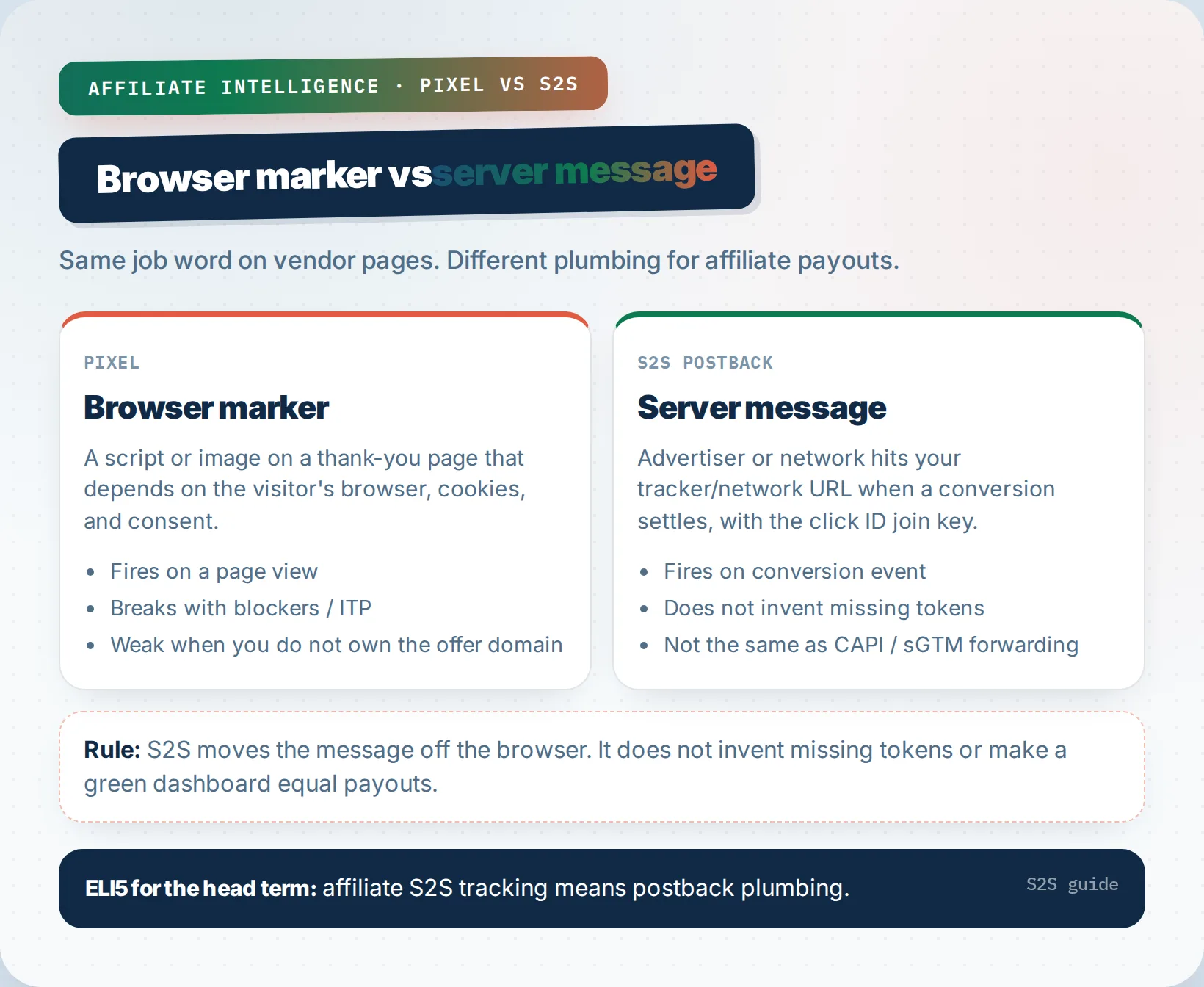
S2S is a server conversion message. When an action completes, the advertiser or network server sends an HTTP request directly to your tracking endpoint, carrying the click ID and whatever tokens you mapped. No browser sits in the middle. Traknow describes S2S as immune to ad blockers, cookie restrictions, and JavaScript errors. Think of the pixel as a marker taped to the page and the postback as a server receipt. The receipt can still be blank. It just does not depend on the browser.
Happy-Path Handshake Map
The happy path is structural. Five hops: click, store, convert, postback, match.
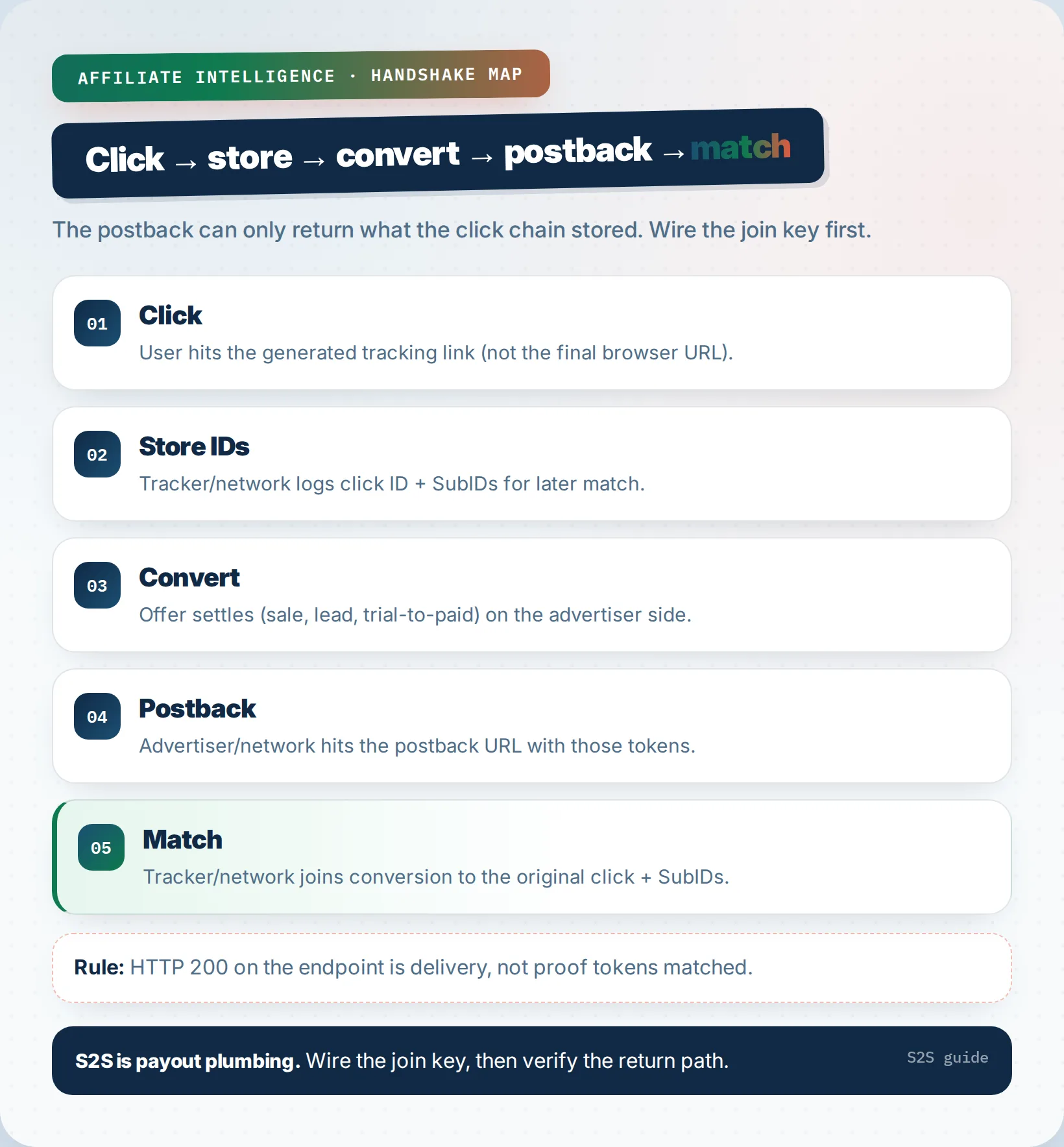
| Hop | What happens | Payload/state | Where it breaks |
|---|---|---|---|
| Click | User hits your generated tracking link with a test SubID appended. | ?click_id=abc123&sub1=ddtest1-20260910 |
Final browser URL pasted instead of the generated link; affiliate redirect never fires. |
| Store | Network or tracker records the click ID and SubID. | Click row contains both values | Macro mismatch; token dropped in a redirect; row-level report not checked. |
| Convert | Advertiser confirms the qualifying action. | status=pending, approved, or rejected |
Thank-you page load treated as a settled conversion; status not returned. |
| Postback | Advertiser or network GETs your endpoint with the matched tokens. | GET /postback?click_id=abc123&sub1=ddtest1-20260910&status=approved |
Wrong endpoint, domain not allowlisted, HTTP 200 but no match. |
| Match | Tracker or network matches click_id back to the stored click and credits it. | Matched conversion row with SubID | Join-key mismatch; blank SubID; raw log not inspected. |
The sequence is structural, not magical.
click:    user hits your generated tracking link?click_id=abc123&sub1=ddtest1-20260910
store:    network or tracker records click_id and sub1
convert:  advertiser confirms the qualifying action
postback: advertiser/network GET https://your.endpoint/postback?click_id=abc123&sub1=ddtest1-20260910&status=approved
match:    tracker/network matches click_id back to the stored click
Point to each hop. Scaleo documents the same flow: a unique Click ID is created on the click, stored in the network’s system, sent back on conversion, then matched and credited. The quotable rule: a postback can only return what the click chain stored. If the click ID or SubID died in a redirect before the network stored it, the postback cannot return it later. Do not chase the postback endpoint first. Chase the stored click record.
Click ID Is the Join Key
The click ID is the join key. It connects the initial engagement to the later conversion. Voluum defines it as the unique key that connects the click with the conversion. That join is the whole job.
The identifier waterfall: a UTM is not a GCLID. A GCLID is not the network click ID. The network click ID is not your tracker click ID. They are separate identifiers. Map them deliberately or you will send one token when the platform expects another.
Macro names change by platform. CAKE expects #s1#. Everflow expects {sub1}. Affise has no clickid macro for affiliate postbacks; you pass {sub1} through {sub8}, as Affise Help Center states. Nine times out of ten an operator sends {payout} when the platform expects {sale_amount}. It looks right and fails silently. The deep macro mismatch map lives in the S2S failure guide. For Google Ads click ID filters, see the Google Ads offline conversions piece.
Never copy the final browser URL after a redirect and paste it as your affiliate link. The page loads, the user can buy, but the affiliate redirect never fired, so no click ID exists. Use the generated tracking link. Every time.
Conversions Pixels Miss (and Thank-You Pages Lie)
Pixels fail for phone calls, offline sales, delayed payments, trial-to-paid upgrades, and recurring subscription events. These happen away from the browser or after the thank-you page. A confirmation page is not a settled payment. The customer can charge back, cancel, or fail review. A pixel on the thank-you page records a page load; a postback can carry status=pending, status=approved, or status=rejected. That distinction is why a green thank-you pixel should not own payout truth.
When checkout happens on a third-party payment domain and you do not own the offer domain, you often cannot place a pixel at all. The only path back is a server-side postback or a processor callback. Your click ID must survive the handoff and the payment provider must be able to fire a callback. If the conversion vanishes, it usually did not vanish because the customer vanished. It vanished because the ID did.
Do not confuse postback resilience with cookieless analytics recovery. The cookieless attribution piece covers what first-party IDs actually fix. That is a different job from proving a network payout. Postbacks prove the payment event; analytics first-party IDs recover session visibility.
SubIDs Must Return on the Postback
A click ID tells you a conversion happened. A SubID tells you which placement, campaign, or creative earned it. If your SubID does not echo on the postback, you can count a conversion and still optimize blind. That is not a reporting gap; it is a contract break.
The network chooses the parameter name. You choose the value. Impact uses subId1. CJ uses sid. ShareASale uses afftrack. Awin uses clickref. Products change their docs, so check live documentation before deploying. The full naming and leveling methodology is in the SubID guide. If your conversion rows show empty slots, the diagnosis sequence is in the blank SubID walkthrough.
When you inspect a conversion row, confirm the SubID returned, not just the click ID. A blank SubID column means the token mapping broke upstream. Treat it as an unread receipt, not a tracking failure. The postback can only echo what the click chain stored.
Pre-Join S2S Vet Questions
Before you send traffic into a program, ask these questions in writing.
- Do you support postback URLs for affiliates, and on what conversion status do they fire?
- Which click ID macro do I place on the click side, and in which parameter?
- Which SubID slots do you return on the postback, and what are their exact names?
- Where do I see raw postback firing status and failures, not just a green tile?
- Is my postback endpoint domain allowlisted?
The answer “we support S2S” is not an answer. You need macro names, firing status, and echo behavior in writing. The network tracking due diligence checklist turns this into a full stage gate. Before you trust a program, you want the macro names and the SubID echo documented, not promised.
✓ Checkpoint: You have a written answer for click side macro, postback return field, firing status, allowlist, and where to inspect the raw log.
Verify One Real Click Before You Scale
The only test that matters: prove one end-to-end row.
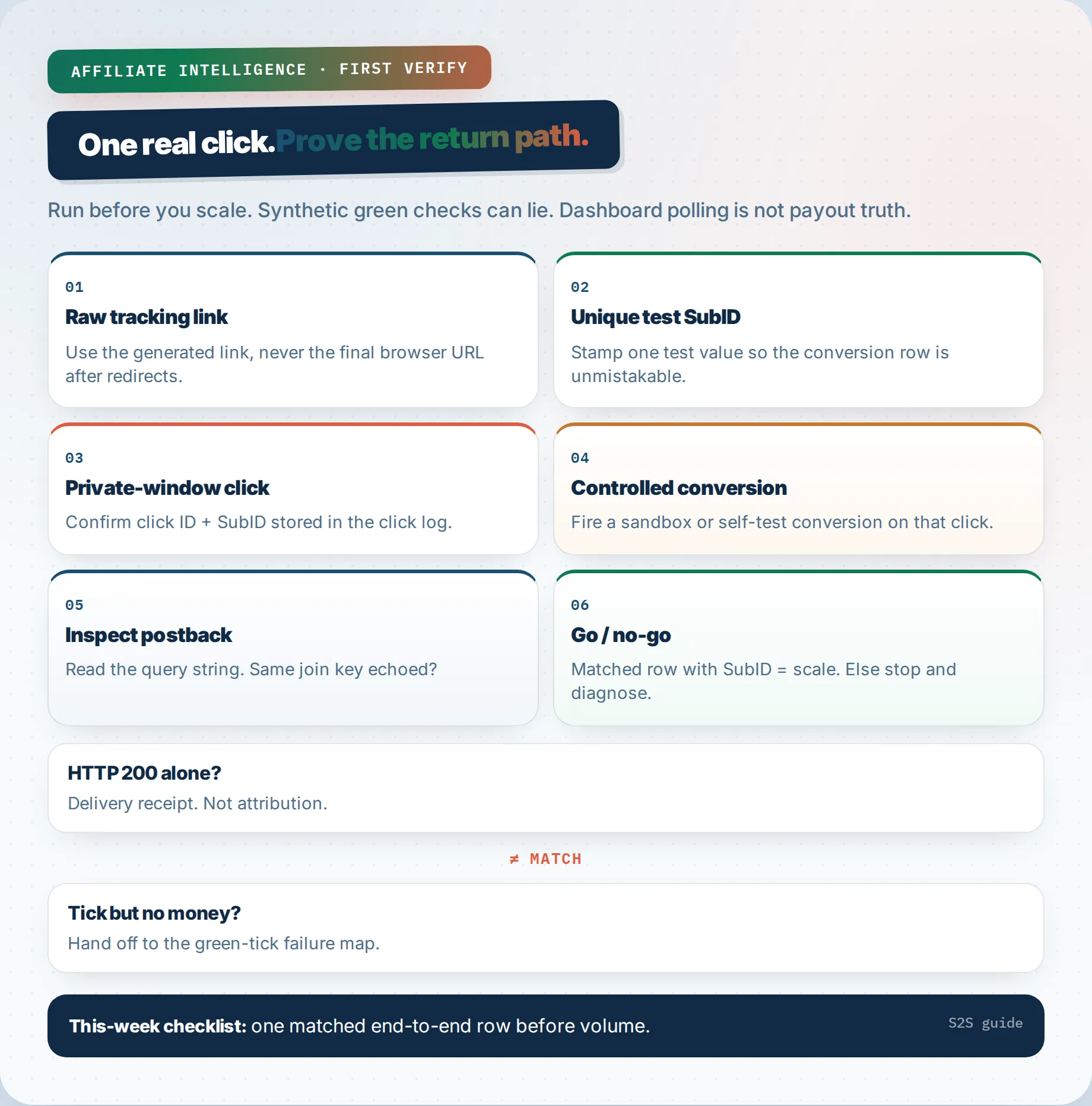
- Open a private window.
- Click the generated tracking link with your test SubID appended.
- Confirm the click row appeared in the network or tracker with the click ID and SubID stored.
- Complete one controlled test conversion, where policy allows.
- Inspect the incoming postback query string. It must carry the same click ID and SubID.
- Confirm a matched conversion row appears with your SubID.
A valid incoming postback must contain:
GET /postback?click_id=abc123&sub1=ddtest1-20260910&status=approved HTTP/1.1An HTTP 200 or a green UI tile is delivery, not attribution. You can receive a 200 OK even for an unsuccessful postback. Synthetic sandbox tests can also lie: they prove the endpoint responds, not that a real click chain survived. Before you trust anything, you want one raw click that turns into one raw matched postback with a returned SubID. The full silence-point map is in the S2S failure guide.
Go/no-go: one end-to-end row
☐ Raw click row stores click_id and the test SubID.
☐ Incoming postback query string carries the same click_id and SubID.
☐ Matched conversion row appears with the SubID.
☐ HTTP 200 is not treated as proof.
✓ Checkpoint: You have exactly one matched end-to-end row, SubID included, before volume.
This-Week Verify Checklist
Run this before you spend a dollar at scale.
- Raw link: generated tracking URL, not the final browser address.
- Test SubID: one lowercase, URL-safe value.
- Click store: click ID and SubID visible in the click report.
- Postback inspect: raw query string contains the matching click ID.
- SubID echo: conversion row returns the same SubID.
- Go or no-go: all five pass before volume.
If the tick lit but commissions are wrong or tokens mismatch, go to the S2S failure map. For the full UTM, SubID and server-side spine, go to the best practices guide. If the real decision is build versus buy the postback plumbing, read the DIY click logger vs paid tracker piece. Tracker selection lives in the tracker comparison.
Troubleshooting: First Response, Then the Right Sibling
Five common errors, with the first fix.
- Blank SubID on conversion. The click chain never stored the value in the network’s expected slot. Fix the click-side parameter name first. Full sequence: blank SubID diagnosis.
- Macro mismatch, green tick, no match. You wrote
cid={gclid}when the network expectscid={click_id}. Check the exact macro syntax against live docs. Deep map: S2S failure guide. - HTTP 200, dashboard green, no matched attribution. Delivery receipt, not attribution receipt. Inspect raw postback logs, not the tile.
- Pixel plus S2S double count without a dedupe key. Same conversion credited twice. Confirm one credit per transaction ID, or disable one method.
- Off-domain checkout, no postback. You often cannot place a pixel and the click ID may drop across the payment handoff. Verify the callback path or import from the processor.
The cookie-reject myth needs scoping. Cookies die in the browser on the user’s device. A postback lives between servers. If you set a cookie on an offer domain you do not own, the reject matters there. If your network stored the click ID server-side at the first redirect, the postback can still return it regardless of what the browser did after. The key question is not “did the browser reject a cookie.” The key question is “did the server store the join key before the browser had any say.” If it did not, the postback has nothing to return.
Point deep breakage to the S2S failure map. For the full stack, go to the server-side tracking guide. Do not rebuild either here.