Why International Affiliate Payments Fail: PayPal, Wise, and SWIFT Breakdown
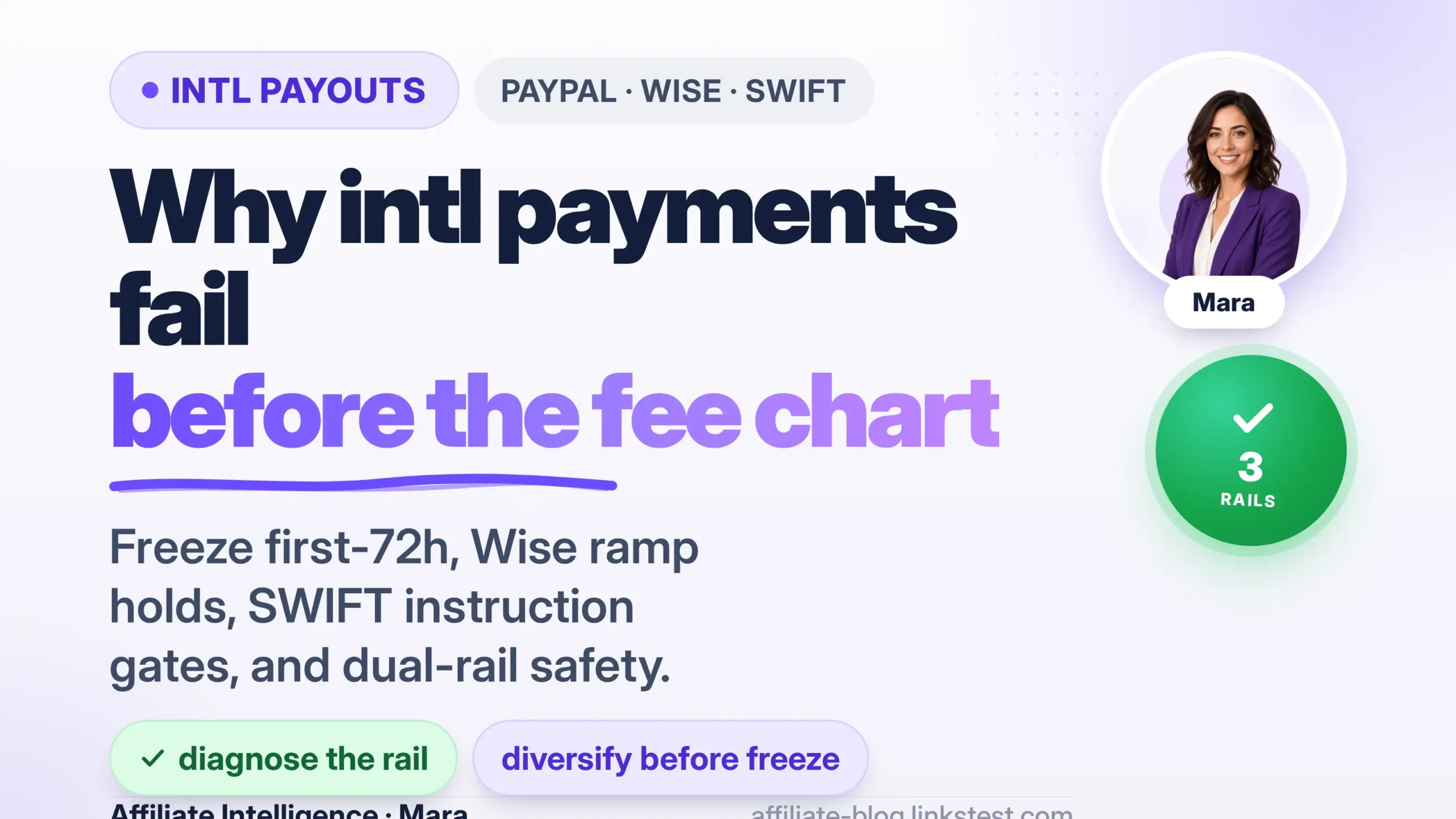
Operators choose a payout rail because the fee table looks cheap. Then a freeze, a ceiling, or a missing beneficiary field hits with no backup. That is the failure mode that matters here: not PayPal versus Wise pricing, but rail failure diagnosis, payout due diligence, and dual-rail safety for international affiliate publishers.
This is a tutorial. Follow the steps in order. Each one ends with a checkpoint.
Prerequisites
Step 0. Before diagnosing any failed payout, assemble four things:
- The exact payout method for each program, including currency and country.
- The country eligibility for receiving accounts on that rail.
- The written hold windows, review windows, and payout schedule from the program terms.
- A timestamped evidence pack: click ID, SubID, invoice or payment reference, support ticket IDs, and the balance shown before the failure.
If you are doing this after a freeze, you are already late. Do it before you push serious volume.
Checkpoint: You can name each program’s payout method, receiving country, hold clock, and where your evidence lives.
Failed Assumption: Cheapest Rail Wins
Operators often rank rails by headline fees. PayPal is fast and familiar. Wise advertises real exchange rates. SWIFT looks universal. The error is treating those points as the whole decision.
A rail has three properties:
- Fee structure – what you pay per payout.
- Failure mode – how it breaks: freeze, hold, ceiling, rejected instruction.
- Recovery time – how long it takes to restore cash flow with evidence in hand.
A cheap rail with a 30-day review queue and no secondary processor is expensive. A slightly more expensive rail with direct bank receipt and documentation history is safer.
Do not compare PayPal and Wise on fees. Compare them on what happens when the payment stops.
Checkpoint: For every program, you can name its failure mode and recovery path before you name its fee.
PayPal Limit or Freeze: First 72 Hours
Step 1. Diagnose, document, stop inbound, open the second rail.
PayPal’s own documentation says a limitation review usually takes 3 business days after you complete the required steps from the Resolution Center (PayPal account limitation review help). Merchant funds are often held for up to 21 days (PayPal merchant funds availability guide). Those are vendor floor numbers, not promises; a stated review clock is not a guaranteed release.

A common failure mode is continuing to send inbound volume into a limited account. That builds a larger balance behind a wall instead of creating a safe path.
First 72 hours protocol:
Hour 0-24: Evidence pack.
- Save every email, screenshot, and Resolution Center message.
- Record the exact limitation reason shown.
- Download statements, not dashboard screenshots.
Hour 24-48: Stop inbound.
- Pause new payouts into the limited account.
- Do not use the same PayPal address for new programs.
- Alert affiliate managers that the rail is temporarily unsafe.
Hour 48-72: Open the second rail.
- If bank transfer is available, enable it in one live program.
- If Wise is available, do a small test payout.
- If a second processor is already open, move scheduled payouts there.
Fail option: argue with the freeze for 72 hours while balance keeps landing behind the limitation.
When a program withholds for review, the contract governs. Do not burn the freeze by treating it as theft. The sibling guide to withheld commissions after review contract covers the review clocks and the evidence rules.
Checkpoint: You have the limitation reason saved, inbound stopped, and a second rail receiving a small test amount.
Wise Ceilings and Compliance Holds
Step 2. Ramp small, document source, then send larger.
Wise is not a get-out-of-bank card. Large transfers trigger source-of-funds questions. Wise says it may ask for documents showing where the money comes from for large amounts (Wise large amount transfer guide). That is expected, not a bug.

The fail pattern is making the first transfer the entire affiliate balance. A new account, a large incoming amount, and a sparse history reads as an anomaly.
Ramp shape:
- Small test first – a modest payout from a documented source.
- Source documentation – keep the affiliate platform statement, invoice, or payment report that matches the amount.
- Larger payout later – after the first transfer settles and the account builds normal history.
Receive-rail availability matters before you join. Wise account details depend on where you live, and some countries have restrictions or changes to what account details can be issued (Wise account details by country help). Check your country before you promise a program that Wise works.
Wise ramp
Small test -> document source -> larger payout
Fail: first transfer = full affiliate balance
Wise can also close accounts. Its process usually gives a window, commonly 90 days from the first email, to move money out (Wise account closure help). A hold clock is still not a guaranteed release. Treat Wise as a rail, not a warehouse.
Checkpoint: You know your country’s receive availability, have done one small test, and keep source documents per payout.
SWIFT Is Not a Global Equalizer
Step 3. Complete the instruction, then escalate to deposit ops.
SWIFT moves messages through correspondent banks. When it fails, the fault is usually in the instruction, not the network. A wire can fail or return when beneficiary data is incomplete, a correspondent is missing, or the receiving bank cannot match the named account.

Common voids:
- Incomplete beneficiary details – wrong account holder name, address, or BIC.
- Missing intermediary bank – certain currency corridors need a correspondent route.
- Missing “for further credit” – in multi-step chains, the final beneficiary must be legible to the last bank.
A vague purpose field adds friction. Use a specific, document-linked payment purpose, such as “Invoice 2026-814 for software placements under agreement dated 12 Jan 2026” (Airwallex failed international payment guide).
When a wire is rejected:
- Ask the sending bank for the UETR and SWIFT GPI tracker status.
- Ask whether the payment was rejected, returned, recalled, credited, or still pending.
- Escalate past the branch. Front desk answers are not deposit operations.
Branch staff may repeat what the screen says. Deposit operations can trace the chain and ask the correspondent bank directly.
SWIFT instruction gate
beneficiary + intermediary + for-further-credit complete
Fail: blame the network after a rejected wire
Checkpoint: You request the UETR, confirm the exact failure point, and ask for deposit operations when the branch cannot answer.
The Payout DD Most Publishers Skip
Step 4. Run the pre-join payout script.
The cheapest rail question is premature. Before joining a program, ask:
- Which payout methods exist, in which currencies, to my country?
- What is the threshold, hold window, review window, and reversal window?
- What documents unlock a paused payout?
- Which support path handles payout failures?
- What is the clawback policy after payment?
An instant-withdrawal pitch is a due diligence trigger, not a trust signal. Instant withdrawal plus a long reversal window means money can leave and then be taken back later. The stop commission clawbacks tracking prevention guide covers that risk. Ask where the lookback ends.
If a program migrates merchants or networks mid-cycle, a pending balance can vanish into the migration gap. The sibling guide on commissions during merchant network migration covers that ledger break.
Pre-join script
rails -> thresholds -> holds -> docs -> clawback policy
Fail: instant withdrawal with no reversal window
Checkpoint: You have written answers to all five questions before sending traffic.
Diversify Rails Before the Freeze
Step 5. Open and test the second rail now.
Never run all payouts through one processor. Processors can freeze, interrupt, or change appetite. A second rail tested before a crisis is cheap insurance. A second rail opened during a crisis is slow.
Build dual-rail safety:
- Select a primary rail per program.
- Select a backup rail with a documented receive path.
- Test a small payout on the backup before the balance is meaningful.
- Repeat this at each revenue threshold, not after the first hold.
Revenue concentration and rail concentration compound. If one merchant is most of your income and one processor moves that money, you have two single points of failure. The revenue concentration risk management guide walks through the dependency math.
I recommend testing the backup rail with a small amount from an already-approved balance. That proves the receive leg works before you need it.
If a processor dispute turns into legal risk, the optional liability trap affiliates without LLC guide explains the structural exposure. It is optional for payout rail work, but relevant once balances are large.
Checkpoint: You have a live, tested secondary rail and no program writes only to a single processor.
Troubleshooting Common Issues
Step 6. Fix the five common errors.
Error 1: ACH or wire stuck with no status.
Fix: Request the UETR and latest SWIFT GPI status. Ask specifically whether the payment is pending, returned, credited, or under compliance review.
Error 2: Missing intermediary bank.
Fix: Ask the sending bank to identify the correspondent route for that currency corridor. Re-send only after the intermediary is confirmed.
Error 3: Hold past the expected window.
Fix: Do not argue with the clock. Send a dated evidence pack and ask for the specific review deadline. If the answer shifts, record the contradiction.
Error 4: Single-rail concentration panic.
Fix: Open the backup now and test with a small amount. Do not pretend a future processor is protection.
Error 5: Confusing a hold with a release.
Fix: A 3-day review and a 21-day hold are vendor clocks, not guarantees. Keep a second rail until funds actually land in your bank account.
Diagnose the rail, then diversify. Arguing with a freeze while all cash sits on one processor is not a strategy. It is a delay.
Checkpoint: You classify any stalled payout as threshold, hold, review, instruction failure, or rail closure before acting.