Cloaked Landing Pages vs Redirect Hygiene: What Will Get Your Account Suspended
A branded /go/ slug feels like compliance. That feeling is the most expensive assumption in affiliate paid traffic. Publishers often launch with a clean redirect, assume the hop is safe, and only learn otherwise when an account goes dark. Here is the thesis: if the hop’s job is to hide the offer from a reviewer, it is cloaking. If it keeps the same honest offer trackable, it may be hygiene. The rest of this piece is the diagnosis.
The Failed ‘Pretty Link Is Fine’ Assumption
Operators often treat a clean /go/ slug as a compliance shield. They reason that a branded short link is standard practice, so Amazon, Google, and Meta will all pass it. A common failure mode is structural, not personal: a publisher sets up what looks like a tidy hop, then the redirect returns a 200 HTML page instead of a clean server status. The referrer gets stripped. The Site URL that held the Amazon Special Link disappears. Google Ads sees one destination while the account-level reviewer saw another. The operator is surprised.
The surprise is the diagnosis problem. Calling a hop “Pretty Links” or “a clean URL” does not change what the hop removes from the audit trail. Google Ads is blunt: cloaking is not allowed under the circumventing systems policy, and accounts will be suspended upon detection without prior warning (Google Ads). That is not a strike system. That is an off switch.
So before I trust any redirect, I ask one question: what does this hop obscure? If the answer is “nothing,” the hop may be fine. If the answer is “the origin site,” it fails Amazon. If the answer is “the final landing page,” it fails Google Ads. If the answer is “the paid relationship,” it fails Google Search and the FTC-style disclosure expectation. The issue is never the redirect itself. The issue is what the redirect removes.
Taxonomy: Banned Cloaking vs Redirect Hygiene
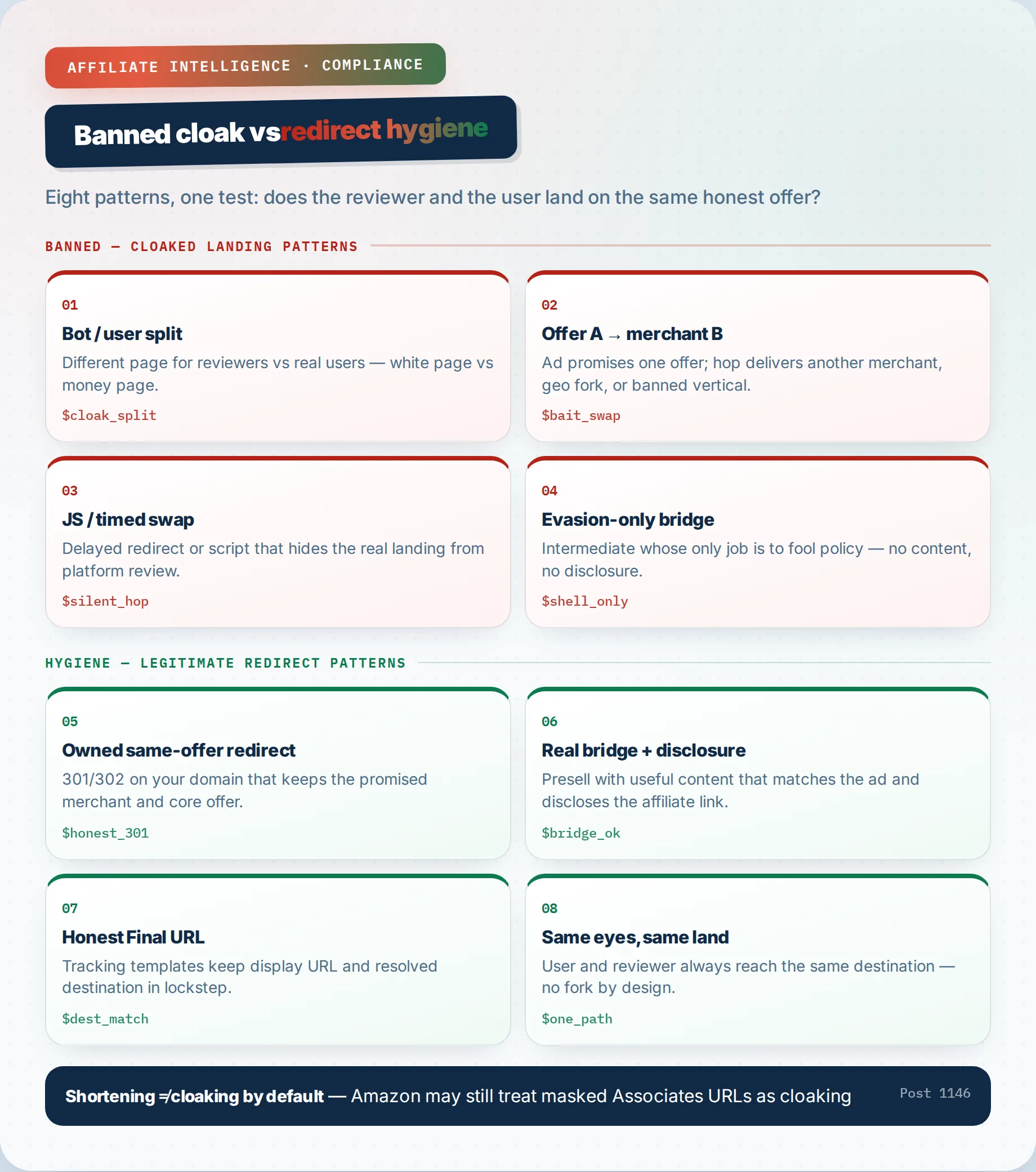
Let me split this cleanly. Banned obscuring usually has one of five signatures. It masks the origin Site URL, which Amazon needs to see. It hides the final destination from a reviewer. It splits the experience so a reviewer sees one page and a real user sees another. It uses JavaScript or time-delayed swaps to change the destination after the fact. It strips the referrer so the audit trail breaks before the merchant even loads.
Redirect hygiene is boring and visible. An owned-domain server 301 or 302 points to the same final offer for users and crawlers. The commercial anchor carries rel=”sponsored” (nofollow is acceptable, sponsored is preferred). The affiliate ID, SubID, and UTM values survive the hop. The click logs record the path without pretending to be the merchant. Nothing in this stack hides the fact that a paid relationship exists.
The most common technical mistake is a redirect that quietly strips sub-IDs or UTM parameters, which destroys the reporting affiliates rely on (Reditus). That is the exact failure path to chase in the redirect chain commission leakage audit. My test: can an honest actor audit the click path and confirm the destination? Hygiene keeps that path visible. Obscuring removes exactly the evidence Amazon and Google need. For the full compliance sweep across Amazon and Google rel=sponsored, use the deep dive on affiliate link cloaking compliance.
Before an operator self-accuses, the line is precise. A language swap or mobile layout on the same honest offer is personalization, not cloaking. What crosses the line is a geo fork that changes the merchant, a reviewer/user split that changes the destination, or a hop that exists only to evade review. The common advice “never put the raw affiliate URL in the ad” is fine when the intermediate page educates or discloses. It becomes cloaking when the intermediate exists to hide the final merchant from a reviewer. Operators who route non-compliant health or finance offers through a cloaked hop to pass Meta review are running the banned obscuring playbook, not a routing convention. Name the failure mode; do not treat it as a deployable tactic.
One more line. Reviewer/user splits and page-level differences are not link-level hygiene. That is landing cloaking. If the hop sends a reviewer to one page and a buyer to another, the hop is now a theater prop, not a redirect.
Two Referees: Program TOS vs Ad Platforms
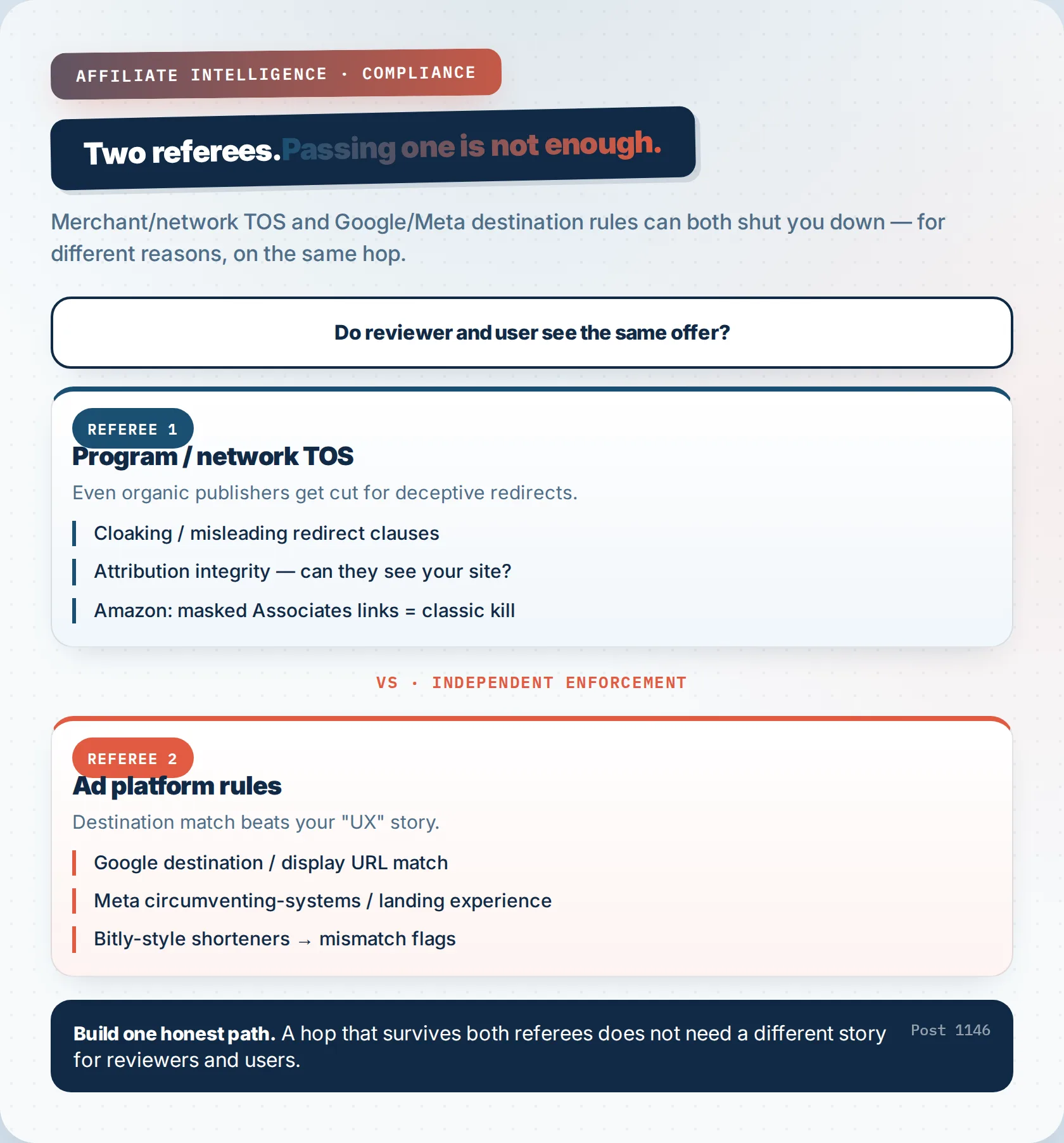
Here is the operator reality nobody wants to sit with: a hop can pass one referee and fail the next. Program terms of service check whether the merchant can still see where the traffic came from and whether attribution stayed intact. Ad platforms check whether the destination the reviewer approved matches the destination the user reaches. Two separate jobs. Two separate failure modes.
Amazon is the program-side referee. Amazon’s Associates Central Help states plainly: “No. Per the Operating Agreement, we do not allow Associates to automatically redirect visitors to Amazon.com or to cause the Amazon.com site to automatically open either within a frame or in a new browser window” (Amazon Associates Central). Amazon’s Program Policies also disqualify purchases from a “Redirecting Link” that sends users indirectly to an Amazon Site without requiring an affirmative click on the intermediate site (Amazon Program Policies). That is not a UX preference. That is attribution integrity. Amazon needs to see the Site URL that held the Special Link. If the hop masks it, Amazon cannot audit origin.
Google Ads is the ad-platform referee on the other side. Google requires ads to accurately reflect which app or website the user is directed to when they click (Google Ads destination mismatch). A destination mismatch gives at least seven days warning before suspension. The circumventing systems policy does not. That asymmetry matters: a redirect that fails destination match may get a warning; a redirect that hides the final offer is treated as cloaking and can suspend the account on detection.
The structural trap is that one hop can pass Amazon and fail Google, or pass Google and fail Amazon. Amazon cares about origin visibility. Google Ads cares about destination parity. A ShortLink that preserves the Amazon destination but masks the origin site might pass a casual Google review and still fail Amazon later. A clean /go/ slug that preserves the origin site but swaps the final page for reviewers may pass Amazon and trigger Google Ads circumventing systems. If the path cannot be explained in one sentence to both referees, do not scale it. For why approved paid campaigns still get restricted, see the brand bidding audit, the paid traffic ban risk deep dive, and the broader ad suspension guide.
Before posting in a program support queue whether cloaking is OK or whether a pretty link will get you banned, remember that the question itself can flag the account for human review. The safer path is to self-audit against the published terms, not to invite a human reviewer to inspect a suspicious setup.
A suspension labeled cloaking is not always a page split. It can be destination mismatch, a broken hop that strips parameters, or another affiliate’s hijack. Audit the click path before rage-appealing. Open the ad suspension guide and the redirect chain commission leakage audit first.
Bridge Without Theater
A legitimate bridge page is not an alternate page for reviewers. It is the same honest offer with an extra layer of value on top. Think of a review or comparison page that helps the reader decide, then passes the click through a clean redirect. The offer stays the same for everyone.
The theater version is a split-screen: a safe page for the review crawl and a money page for real users. That is not a bridge. That is cloaking dressed as a landing experience. And the data says the theater does not actually close the attribution loop anyway. In one Walmart and Impact setup, the advertiser uploaded 40 actual conversions from Impact back to Meta. Meta matched only 4. That is a 10% match rate (Bridge Page Meta Ads reality check). The bridge did not turn into a full-loop signal, and it certainly did not justify a reviewer-specific alternate page. The 4-out-of-40 result is the same warning the paid traffic tracking platform setup pitfalls frames as a routing failure, not a reason to add theater.
Amazon Pointer, Not Rebuild
This is not the place to rebuild the full Amazon compliance manual. That lives in the affiliate link cloaking compliance deep dive. The Amazon pointer is narrow: Amazon says no to automatically redirecting visitors to Amazon and no to opening Amazon in a frame or a new browser window. If your hop obscures the Site URL that held the Special Link, you are already in trouble before the affiliate tag has a chance to survive.
The trick is not to rebuild the rules. The trick is to run the Amazon-origin test before Amazon runs it for you. Can Amazon still see where the Special Link lived? If yes, the hop may be hygiene. If no, that is the failure mode. That is the whole pointer. Keep the rulebook distinction tight: non-Amazon CPA or network programs may allow managed redirects or link management, but “allowed for CPA” does not mean “allowed for Amazon.” And click-tracking dashboards and vanity metrics are not worth an Associates ban; do not cloak Amazon links for dashboard convenience.
Same-Offer Self-Audit
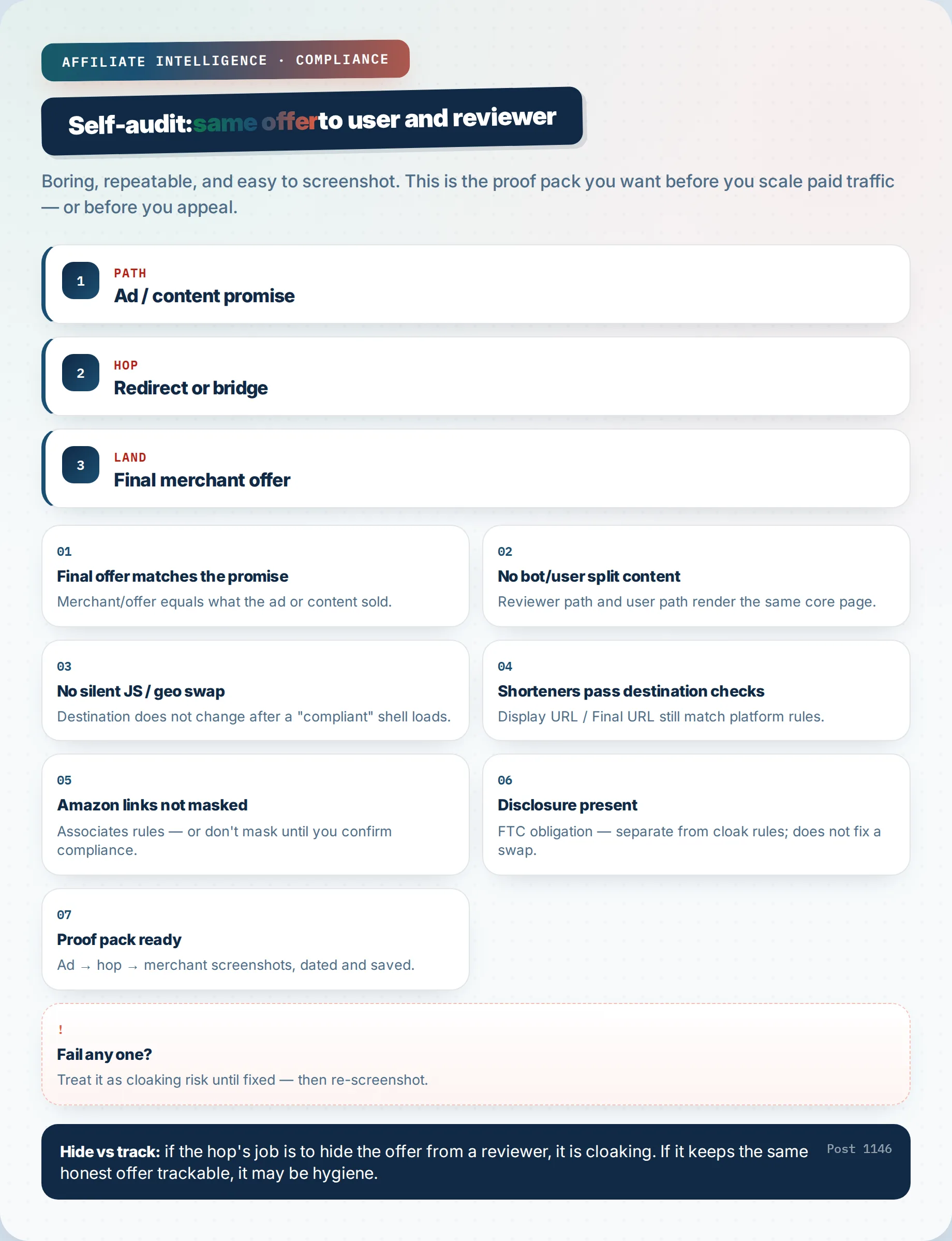
Run this before scaling paid traffic. It takes less time than an appeal, and it works for any program, any network, any tool. For the umbrella pass on disclosures, consent, and program terms, pair this with the 12-point affiliate compliance audit. The self-audit is five steps.
- Name the referee. Are you about to face Amazon’s origin visibility check, Google Search’s commercial label check, or an ad platform’s destination match check? Every hop has at least one referee. Most have two or three.
- Use an owned-domain server 301 or 302 redirect. Avoid a JavaScript location hack. Server redirects send clean status codes and preserve the honest path. JavaScript swaps can hide the real landing from a crawler and trigger exactly the behavior that looks like cloaking.
- Serve the same destination to reviewers, crawlers, and users. If the page changes depending on who is asking, that is banned obscuring, not hygiene.
- Add rel=”sponsored” to commercial anchors. Use rel=”sponsored” or rel=”nofollow sponsored” on paid placements, not sitewide internal navigation.
- Verify that the affiliate ID, SubID, and UTM values survive the redirect. A hop that works but strips the attribution payload is a financial failure wrapped in a compliance pass.
Before opening a ticket or appeal, build a proof pack: screenshots of the ad creative, the intermediate landing page, and the final merchant URL, with timestamps, plus a curl or server-log capture of the redirect chain. The redirect chain commission leakage audit is the check against a broken hop or an affiliate hijack.
The counterargument is fair: branded shorteners and pretty links are mainstream affiliate hygiene. They look more trustworthy. They get clicked more readily. They can be updated in one place. The tool is not the problem. But a plugin label does not create compliance. The line is visibility, not the tool. If the clean slug hides the origin from Amazon or the destination from Google, the clean slug is a liability. Google’s destination mismatch rule is explicit: ads must accurately reflect which app or website the user is directed to (Google Ads). That rule does not care what plugin you used.
Short FAQ
Is a /go/ slug automatically compliant? No. A slug describes the tool, not the behavior. If the hop preserves origin, destination, and disclosure, it is hygiene. If it hides any of those, no label saves it.
What separates redirect hygiene from banned cloaking? Visibility. Hygiene keeps the same honest offer, referrer, and attribution payload auditable. Cloaking removes the evidence one referee needs to see.
Can one redirect pass Amazon but fail Google Ads? Yes. Amazon checks whether the origin and Special Link are visible. Google Ads checks whether the approved destination matches what the user reaches. They are different gates.
Do bridge pages fix the attribution loop? A same-offer bridge can improve the user path. A reviewer-specific bridge does not fix anything; it adds a ban vector. The 40-to-4 Walmart/Impact match rate shows the tracking gap remains.
What triggers a warning versus immediate suspension? Destination mismatch gets at least seven days warning before suspension. Circumventing systems, including cloaking and hiding the offer, can suspend on detection without prior warning.
Can a “cloaking” ban be a false positive? Yes. Destination mismatch, a broken hop that strips SubIDs, or another affiliate’s hijack can look like cloaking in a support ticket. Audit the path before rage-appealing.
Does an FTC-style disclosure fix cloaking? No. Cloaking is about whether the hop hides origin or destination; disclosure is about the paid relationship. See the 12-point affiliate compliance audit.
If the hop hides the offer from a reviewer, it is cloaking. If it keeps the same honest offer trackable, it may be hygiene.