Affiliate Return Rate Calculation for Physical Product Commissions: Why Your Keep Rate Matters More Than the Sticker Rate
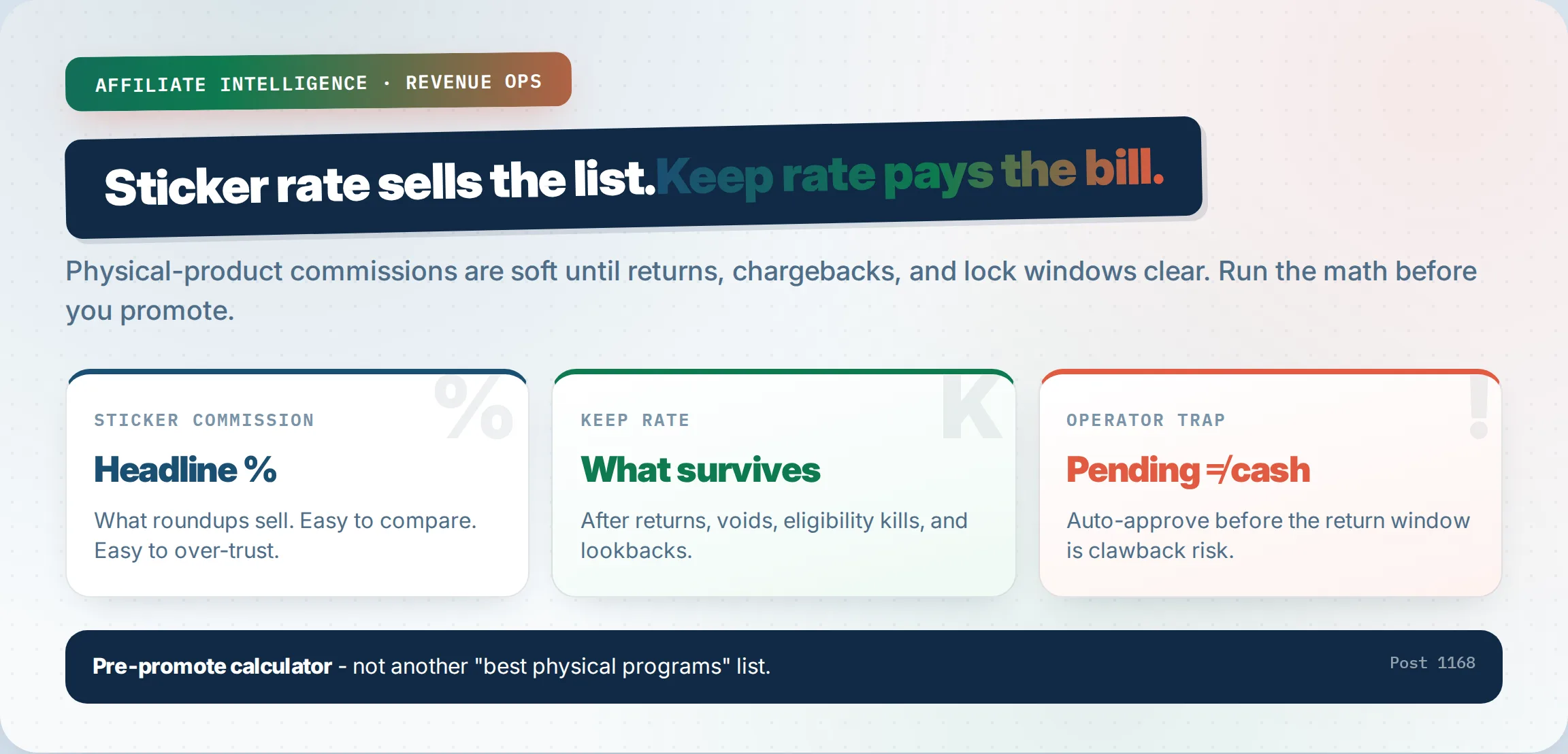
Those “best physical product affiliate programs” roundups are built to sell logos and headline percentages – not kept earnings. The operator who picks a 30% apparel program over a 12% consumables program because “30 is more than 12” is the same operator who later watches a third of their pending commissions evaporate in returns, chargebacks, and eligibility kills. The listicle sells the sticker rate; you soak up the reversals.
The average U.S. ecommerce return rate was 20.4% in 2024 and is projected to hit 24.5% in 2025, per fulfillment data compiled by Red Stag Fulfillment. In categories like apparel, 30-40% isn’t unusual. Combine that with open-ended lookback windows, chargeback clocks that can run 120 to 540 days, and opaque “commission may apply” SKU tags, and the shiny headline rate is often a trap.
A mid-rate program with a short, honest lock period – say, commissions that harden at the 30-day mark – can beat a “generous” 25% rate on electronics or supplements when you measure what actually hits your payout. The full comparison between SaaS and physical product income geometry lives over in the comparison of SaaS and physical product affiliate income geometry. Here, I’m assuming you might promote physical offers and asking: will the math survive returns?
The Only Metric That Matters: Keep Rate
If you track nothing else for a physical program, track your keep_rate. That’s the fraction of gross commission that survives returns, chargebacks, cancellations, eligibility kills, and voids over the relevant window. Sticker rate × keep_rate = the actual revenue you can model.
Publishers who pick programs by sticker percentage are flying blind. If a merchant’s return window is 60 days while commissions auto-approve in 7, a large share of a “great month” on the dashboard is still soft – and a chunk can reverse after you already planned cash around it. That’s not a rare edge case; it’s the default structure for many retail programs. If you don’t know your keep_rate for a program, assume it’s worse than you think.
The Keep-Rate Equation: Clicks × CVR × AOV × Rate × ?

Effective EPC ≈ conversion × AOV × commission_rate × keep_rate. The last term is the discount that makes all the difference. Do not invent a single vertical return percentage and call it universal. Use program data if the affiliate manager shares it (rare). If not, apply a hard discount – I start at a 20% haircut for most physical programs and go heavier for fit-critical or electronics-heavy catalogs. Treat pending commissions as soft, not as tomorrow’s cash.
Partial returns and exchanges are a subtle drain. A customer returns one item from a multi-SKU order, the merchant keeps the rest of the sale, and the program terms often state that any return voids the entire commission on that order. Eligibility is not “the store still got paid something.” If the terms are vague, assume commission is wiped.
Also watch oversized bounties or LTV-funded front-end commissions on sticky physical funnels. They create tail risk. When return pressure spikes in January after a December push, those generous-looking payouts can vanish. Price that concentration before you scale.
The Three Clocks That Steal Your Commissions

Every serious program review needs to answer four questions. Write them down, paste the terms, and check the dates.
-
When does a commission lock (if ever)? Lock and validation dates vary by network and program – always verify the current network documentation and publisher terms. Older explainers (e.g., AMNavigator on lock dates) are useful for the concept, not as today’s calendar. Impact’s structure of locking one month after the end of the month of the action is one model, not a universal guarantee – check your terms.
-
How long is the merchant return/cancel window vs. the network validation/hold? If a program pays on day 60 but the store accepts returns for 90 days, you’re carrying exposed commissions for 30 days after you mentally booked the revenue. Auto-approve or “fast payout” before the reversal window closes isn’t a favor – it’s clawback risk transferred to you.
-
After payout, how long can they still look back and reverse? Card chargeback windows are often longer than store return policies – commonly on the order of months, and longer for some future-delivery cases. Verify current card-network and processor rules when planning your exposure. Refund ≠ chargeback.
-
Are partial returns/exchanges still commission-eligible? Read the program terms, not just the rate card. If the language says “all returns void the affiliate commission,” that includes partials. If it’s silent, ask.
Reserves and holdbacks can look like punishment. They can also mean more predictable final payouts, because the merchant is pre-funding chargeback and return exposure instead of sending you surprise negative lines later. Read the percentage and release rules before you decide the program is hostile.
The full clawback taxonomy, exposure tracking, and dispute hygiene playbook lives in the guide to commission clawback prevention and reversal tracking. Don’t rebuild it here. Just know that everything you see as “approved” before the reversal window closes is a forecast, not a balance.
Category Smell Tests: Stop Guessing, Start Vetting
Directional return-rate burdens (courtesy of Red Stag Fulfillment and Branvas) give you a structural edge before you send a single click:
- Apparel: 30-40% (fit, bracketing, buyer’s remorse)
- Footwear: 25-40%
- Electronics: 8-15% (defects, compatibility)
- Home goods/furniture: 15-20% (size mismatches, damage)
- Beauty/skincare: 4-12% (shade, allergy)
- Supplements: 5-10% (expectation gap, subscription churn)
These aren’t guarantees, just risk concentration patterns. If your traffic skews coupon-heavy or incentive-driven, assume a worse keep_rate – those buyers return at higher rates (see the coupon cannibalization guide for the signals). Before you promote:
- Know self-referral / same-household / same-network void patterns before you “test buy” yourself – many physical programs auto-kill those commissions.
- Read the return policy and the commission eligibility language on returns/partials. Not just the rate card.
- Scan recent product reviews and support patterns for return-complaint density and shipping-delay rage. A merchant with 30% negative comments about sizing or “item not as described” will bleed your commissions.
- Ask the affiliate manager if they share return/cancel rates by category. Silence + instant approve → discount harder.
- Check shipping speed and cross-border fulfillment honesty. Slow, opaque shipping kills conversion and inflates returns. If customers wait 3 weeks for a “fast” product, returns spike.
- Treat opaque “commission may apply” or zero-pay SKU tags as keep_rate = 0 until proven. Quarantine those products.
Consumables and reorders can improve geometry because repeat buyers who stick lower the effective return pressure per customer. But each order still resets the return window, so don’t over-forecast.
Network Geometry Without the Hype
Amazon Associates offers low percentage-of-AOV, but even that requires keep-rate math. A 4% commission on a $200 electronics purchase that returns at a 10% rate nets you $7.20, not $8. Meanwhile, a retail network might offer 12% on a $40 beauty item with a 5% return rate, netting $4.56. The percentage isn’t the story; the net EPC after returns is.
Some operators jump to networks promising higher headline rates. The same filter applies: do the lock rules, return windows, and chargeback mechanics let you keep what you see? This is not the place for a “top networks” list. If durability and holds are your question, the program economics guide covers whether a commission structure can last.
Ticket math matters: low % × high AOV vs. high % × tiny AOV only works if keep_rate holds. I’d rather a 6% rate on a $200 order with a clean lock and 5% return burden than a 20% rate on a $40 fashion impulse buy that returns at 35%. The network isn’t your friend. The lock rules are.
When to Walk Away: Soft-Money Rules for Physical Programs
If a commission never locks and lookbacks are open-ended, every dollar in pending is soft. Do not concentrate a month’s revenue forecast on it. One high-return SKU cluster – say a gadget wave hit by shipping delays – can generate a pile of pending that vanishes after returns or chargebacks surge.
Diversify categories the same way you diversify programs. A month that looks brilliant on pending can turn into a net negative if you let one high-return cluster dominate. Watch your reports for unexplained adjustments, reversed lines, or investigated transactions after a physical push. Those are early warnings before you build the next content batch.
The soft-money planning framework for long-term forecasts is the 12-month soft-money forecasting guide. If one program is most of your pending book, the concentration risk guide is the quick companion read.
Your Pre-Promote Vetting Checklist (One Sitting)

Before you send traffic to any physical offer, run this. If you can’t answer the lock date, don’t send the traffic. That’s the whole test.
- Sticker % ≠ kept %. Calculate your effective rate with a keep_rate discount.
- Know the four clocks: lock date, return window, chargeback lookback, and partial-return eligibility.
- Apply category-specific return-rate assumptions. Apparel, footwear, electronics hurt more.
- Read the return policy and commission eligibility language – not just the rate card.
- Check shipping speed, cross-border honesty, and fulfillment reliability.
- Quarantine opaque “commission may apply” or zero-pay SKUs. Assume 0 keep_rate until proven.
- Ask if reserves or holdbacks exist; understand the release rules, don’t ignore them.
- If post-payout lookbacks are open-ended, treat all pending as permanently soft.
- Diversify SKU categories so one high-return cluster can’t zero a month.
- Monitor weekly reports for reversed or investigated lines after any physical push.
- For post-reversal ops, refer to the clawback guide. Don’t rebuild it here. Just use it when the money goes backward.
Run the boring math now. The adjustment email teaches it the hard way.