Consent-Resilient Affiliate Tracking Stack – Stop Losing Payouts
The Failed Assumption (Three Myths That Kill Resilience)
Operators often ship a Consent Management Platform, keep a browser conversion tag, and call it a consent resilient affiliate tracking stack. Others buy the folklore that moving tags to a server-side container makes consent irrelevant. Both camps end up with a measurement gap they cannot diagnose because they never watch the Network tab after a Reject All.
Three myths kill resilience.
First: a banner plus a browser pixel equals compliance coverage. It doesn’t; a consent banner must actually halt tags when storage is denied (here’s the audit checklist).
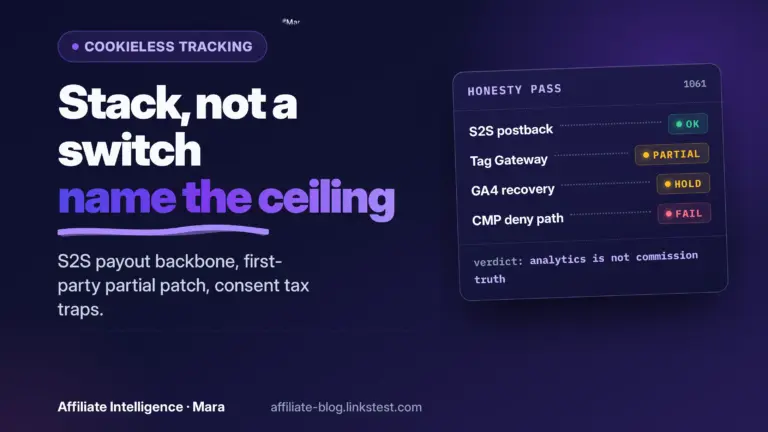
Second: server-side tracking bypasses consent. It doesn’t; moving a tag to a server container does not erase the storage rules written into Consent Mode defaults or legal requirements. Server-side is a resilience layer for ITP and ad blockers - not a GDPR workaround.
Third: first-party cookies alone solve attribution on deny. A first-party cookie set via JavaScript on Safari lives 7 days at best and still requires a granted analytics or marketing storage signal. Alone, it is not deny survival.
The structural scenario is the scaffolding: a user denies marketing storage. Your affiliate conversion tag is gated on that signal and does not fire. The network stays dark for that hit. Yet the click ID that left on the egress link still exists. If the program supports a postback keyed to that ID, commission can clear without rewriting client storage rules. The stack must carry that click ID through all consent states, not pray the pixel fires.
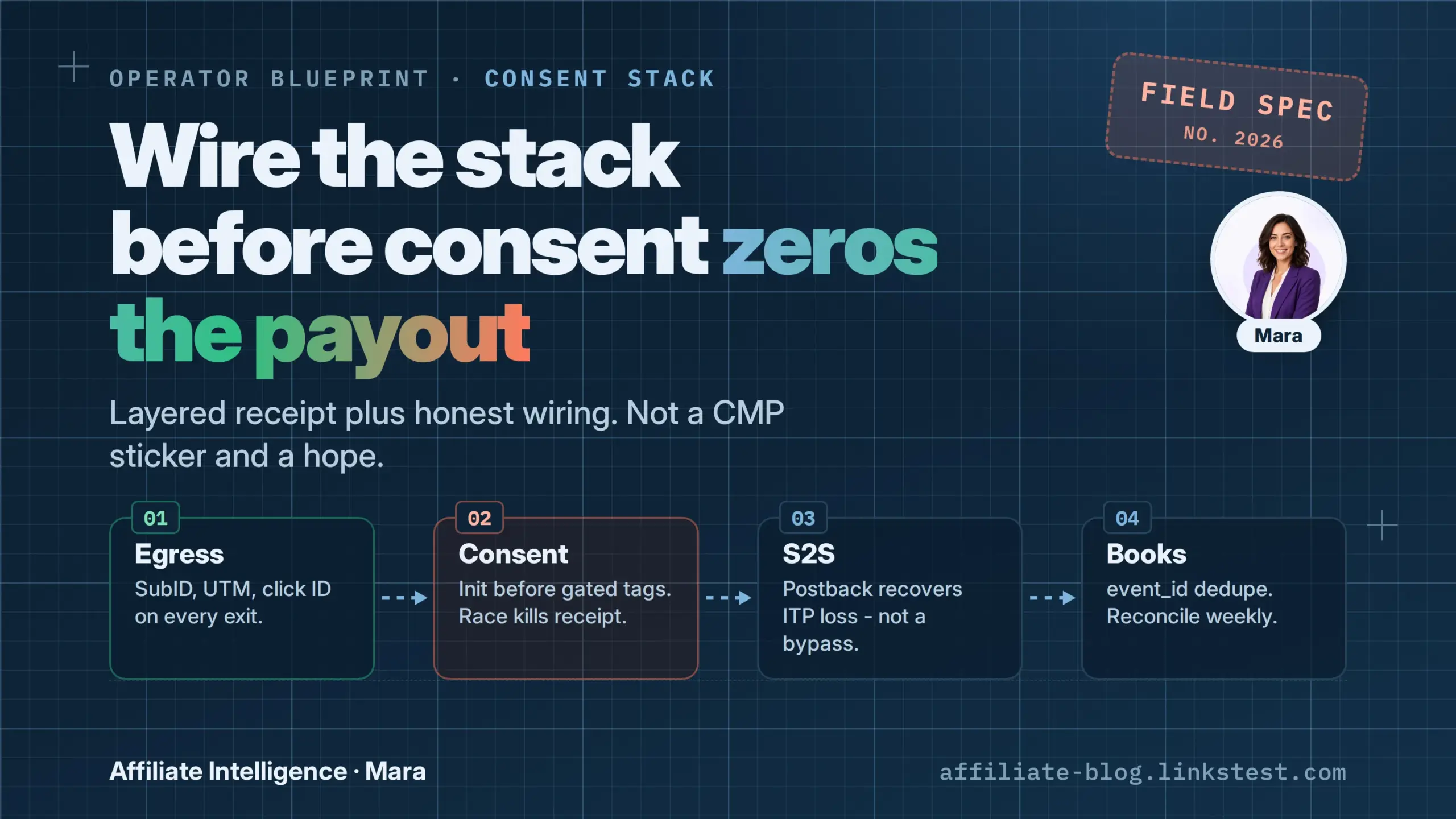
A consent-resilient stack is layered receipt plus honest wiring. Server-side without consent-aware signals is just a faster way to mis-measure. The tax encyclopedia lives in the Cookie Consent Tax diagnostic. The negotiation brief to turn loss into a rate uplift lives at the Consent-Loss Negotiate brief. The gate-proof and classification primer lives at the Cookie Compliance piece. This article is the build/wire/prove layer those three hand off to.

What a Resilient Stack Means Here
A resilient stack doesn’t mean you never lose a signal. It means you design receipt layers so a denied consent signal zeroes the browser pixel but does not silently zero your payout truth.
Happy path: egress click IDs stay intact on every affiliate link; consent signals gate client tags correctly; first-party identifiers are used where policy allows, with known ITP ceilings; a network or merchant postback (or equivalent) clears commissions on deny; and books get reconciled weekly.
Parallel path: coupon codes, CRM hidden fields, QR codes. These are soft backups. They help some programs catch additional conversions, but they are not a substitute for SubID and postback discipline. Treat them as attic receipts, not your ledger.
This piece will not: rebuild the Reject-All theater primer (go here), write the consent-tax failure encyclopedia (go here), draft a rate-negotiation packet (go here), teach full first-party ceilings (go here), or map S2S production failures (S2S postback failure map). It will not rank CMP vendors, prescribe fingerprinting or accept-all dark patterns, or give legal advice.
Before you wire anything, run one check: if your CMP’s Reject All still fires a marketing or affiliate storage tag, stop. Classify and gate-proof first. Stack folklore feeds on the idea that a server call can outrun a consent signal. It cannot.
Stack Layers: Wire These as a System
A consent-resilient affiliate tracking stack has five layers. Wire them as a system, not a product catalog.

Egress spine: SubID, UTM, click IDs
Every affiliate egress must carry a SubID, UTM parameters, and a network click ID. On deny, URL-borne identifiers are often the only bridge to commission. Redirects that strip these parameters kill resilience.
A dead cookie is not a dead commission if the click ID survived and a postback can fire. The SubID complete guide and the server-side tracking guide detail inventory and naming discipline. The short of it: if your links do not preserve the click ID through every redirect and SPA transition, your stack has no spine.

Consent-signal wiring (init before tags)
Consent Initialization sets default consent before any gated affiliate or conversion tag fires. Network-tab fire-order proof is mandatory. A common failure is the race condition documented by Analytics Mania: “A tag read consent state before a default was set.” That strips attribution before consent even renders.
Advanced vs. Basic Consent Mode is an observed-vs-modeled tradeoff. Document your choice. Do not assume a universal recovery percentage. In Advanced mode, Google models some unconverted users, but modeling floors apply: Google Ads requires at least 700 ad clicks over 7 days per country and domain grouping to trigger conversion modeling (Google Ads Help). GA4 behavioral modeling has its own thresholds. Below those floors, modeled columns stay empty - a planning assumption, not a rebuttal to your gap chart.
The Conversion Linker (or equivalent) must not keep writing click identifiers after a deny. Audit linker triggers against the same consent state as conversion tags. A green Consent Overview badge is not enough.
First-party layer (helper, not savior)
Use first-party cookies and keys where policy allows. Safari ITP caps JavaScript-set first-party cookies at 7 days; server-set HTTP cookies can extend that if the IP subnet matches the main domain. Even so, ITP versions cut link decoration and click IDs from URLs. First-party alone is not deny survival for longer cycles. Pair it with postback and URL-borne IDs. The ceilings are mapped in the cookieless attribution piece.
Server-side / postback layer
Vet programs before scale: “Do you support S2S/postback/first-party/cookieless attribution?” Red-flag third-party-cookie-only stacks. A postback keyed to the click ID can clear commission when the client stays dark. Awin, analyzing 150,000 tracking calls, found server-to-server carried a cookie in 12.6% of tracking calls where the MasterTag did not - 9.3 points from cookie restrictions and 3.3 from content blockers (Awin server-to-server tracking). That is one network’s data, not a universal promise, but it illustrates the structural gap.
Honest framing: server-side recovers ITP fragility and many ad-block losses - not a consent bypass. If a network only offers a third-party pixel, walk away or negotiate. Production breaks are mapped in the S2S postback failure map.

Dual-path hygiene and reconciliation
When you run both browser pixel and server-side API, event_id (or equivalent) deduplication is mandatory. Without it, you double-count granted traffic and corrupt bidding. Meta’s Conversions API requires a matching eventID (Meta developer docs). The same principle holds for any dual-path setup.
Weekly, reconcile network-approved conversions against GA4 and Google Ads observed conversions. The gap is a measurement delta, not a demand collapse. That delta feeds the Cookie Consent Tax diagnostic or the negotiation brief. The worst move: staring at a gap and doing nothing.
Minimisation and soft layers
Use opaque, random identifiers over raw PII in publisher-controlled affiliate cookies. Soft backups - coupon codes, CRM hidden fields, recurring codes - are attic receipts. They are not the hero. Soft geo consent defaults are a documented wiring config, not jurisdiction shopping. Run soft click-ID survival checks on SPA and referrer paths. Honest server-side framing, again: resilience, not a loophole.
Wire + Prove Checklist (One Sitting)
- Inventory every receipt path: browser pixel, server-side container, network postback, coupon/CRM fields.
- Prove consent-ready-before-tags. Open a cold incognito session, hit Reject All, and watch the Network tab.
- On reject, ensure client marketing/affiliate storage stays dark while the postback and SubID path is designed for commission survival where the program supports it.
- On grant, fire only those categories where consent is claimed, with click IDs still on the egress link.
- On consent withdrawal, confirm later client fires stop immediately.
- Document your Advanced/Basic Consent Mode choice and any modeling floor exclusions.
- Vet programs: ask about S2S support, first-party cookie fallback, cookieless receipt paths.
- Weekly reconciliation: network approved vs. GA4/Ads observed. Turn gaps into the diagnostic, not silence.
- Soft geo consent defaults documented. Soft click-ID survival on SPA transitions confirmed.
- If the gate is still theater, go to the Cookie Compliance piece first.
- If the stack is wired and books still collapse, go to the Cookie Consent Tax.
- If payout truth holds and the merchant owns the CMP tax, go to the Consent-Loss Negotiate.

What to Do Next
Classification and Reject still broken? The Cookie Compliance piece comes before any more stack spend.
Stack wired, books still collapse? The Cookie Consent Tax diagnostic.
Payout truth holds, merchant owns the CMP tax? The Consent-Loss Negotiate brief.
Need depth on one layer? The cookieless ceilings, S2S postback failures, SubID methodology, and server-side tracking guide posts cover the deep dives.
Layered receipt beats one-pixel hope. Consent-aware server-side beats loophole folklore. Reconcile beats dashboard faith.