Chatbot-Driven Affiliate Sales Funnels with NLP: Build, Track, and Avoid Attribution Traps
Chatbot-driven Affiliate Sales Funnels with NLP: A Practical Build (and the Failure Modes to Watch)
I keep seeing affiliate programs built like a junk drawer—everything tossed in, nothing labeled, and somehow we’re surprised when it jams.
Chatbot funnels can be the opposite: labeled, routed, measurable. But only if you treat the bot like a funnel component with incentives, not a cute widget.
Warmly’s definition is clean: a chatbot sales funnel is a step-by-step journey that guides someone from first interaction to conversion (and beyond) via chat automation (Warmly). For affiliates, the “beyond” part is where things get messy: attribution, disclosure, reversals, and the quiet ways last-click gravity eats your margin.
This post is my audit-style build: what to implement, what breaks, and how to know if it’s actually incremental.
Key Takeaways
Conversational commerce is simply businesses interacting with customers via messaging apps, chatbots, and voice assistants (Influencer Marketing Hub). That matters because chat compresses the path from intent → recommendation → click (or checkout).
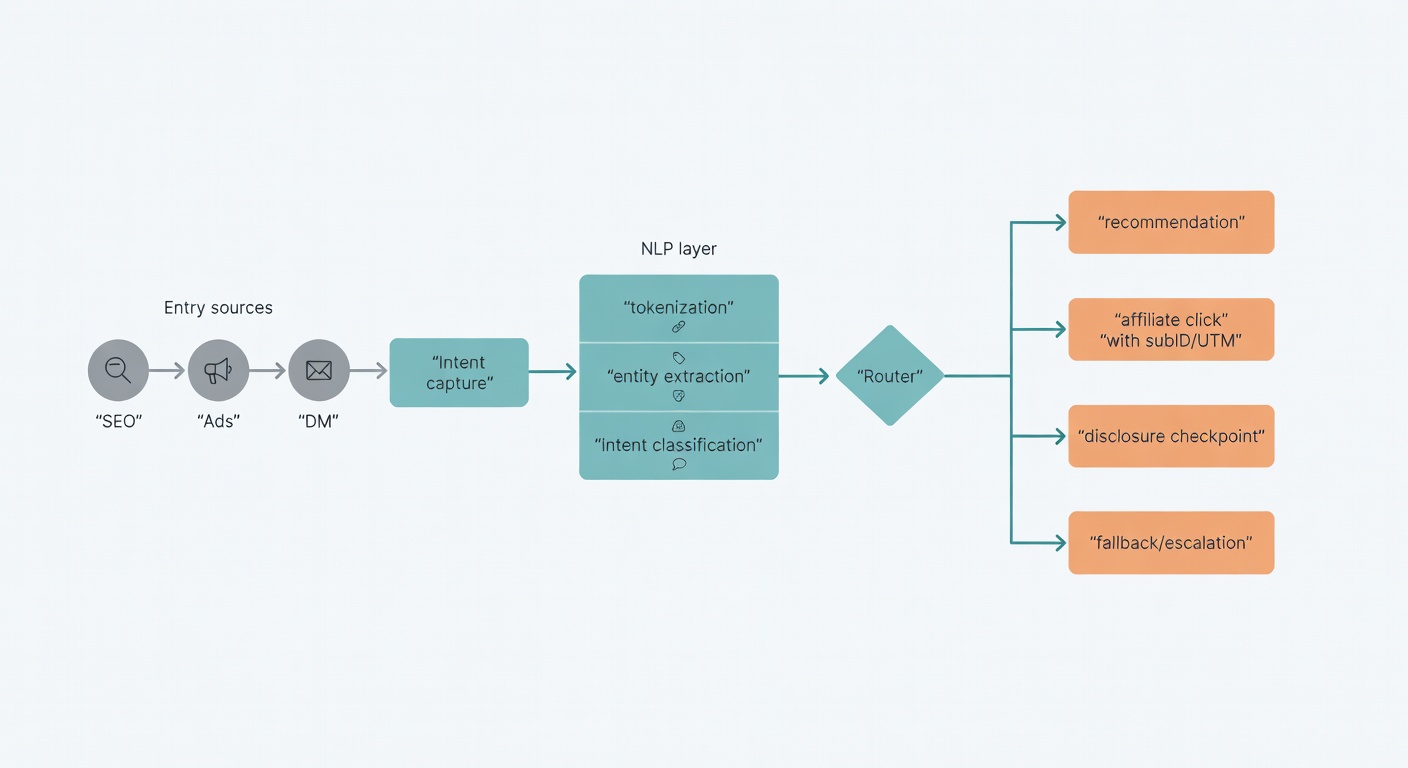
NLP is the difference between a bot that dead-ends and one that qualifies, routes, and converts. At minimum, intent recognition relies on tokenization, entity extraction, and intent classification (Tencent Cloud)—and you need those pieces to avoid “keyword soup” responses.
For affiliates, the hard parts aren’t the UI. They’re disclosure inside chat, attribution hygiene (subIDs/UTMs), and offer integrity when the bot is “speaking” for you.
Start narrow: one offer, one entry point, one KPI set. Then expand to omnichannel once you’ve got an audit trail you trust. If you only remember one thing: pay for value creation, not value capture.
What “Chatbot-Driven Affiliate Funnel” Actually Means (and Why It’s Different From a Normal Pre-sell Page)
A normal affiliate pre-sell page is static: you guess the reader’s intent, write for the median user, and hope your CTA matches their situation.
A chatbot-driven affiliate funnel is interactive: it captures intent in real time, then routes the user to the right recommendation and conversion action. Warmly frames it as a guided journey through funnel stages (Warmly). StackCommerce’s angle is the bigger shift: discovery and purchase moving into conversational interfaces, shortening the buyer journey and pushing purchase closer to intent (StackCommerce).
Here’s the simplest funnel map I use:
Entry (SEO / ad / DM) → Intent capture → Recommendation → Affiliate click (or in-chat checkout) → Follow-up
Now a concrete example.
Imagine you rank for “lifetime VPN under $50.” Instead of dumping people on a comparison table, your page opens a chat:
- “Budget cap?” (entity: budget)
- “Devices?” (entity: device count / OS)
- “Main use: streaming, travel, privacy?” (entity: use case)
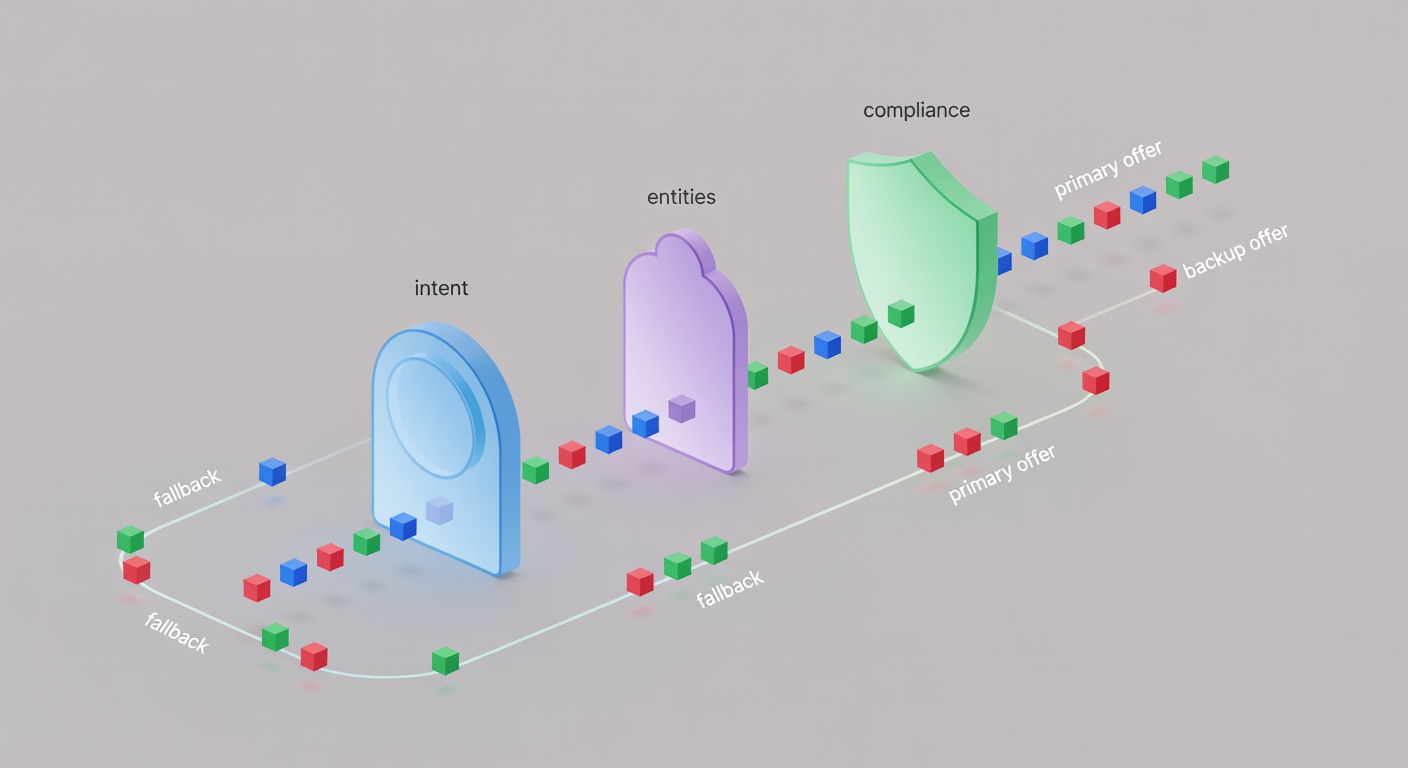
Then it routes to two offers: primary + backup. Not twelve. StackCommerce literally uses the phrasing “lifetime VPN for under $50” as an example of how products get discovered via conversational queries (StackCommerce).
The upside: less scrolling, more context, fewer wrong clicks.
Here’s the catch: you’ve also created a new place for leakage—bad disclosures, sloppy link parameters, and “helpful” coupon behavior that steals credit. Run the boring checks first. They catch the expensive problems.
Where competitors stop short: they explain stages, not the incentive math
Landbot and Manychat-style guides are good at mapping chatbots to funnel stages (awareness → action) (Landbot, Manychat). But they mostly skip the affiliate-specific incentive math: who gets paid, when, and what behavior that creates.
That omission is why people celebrate “bot revenue” while quietly paying for checkout interception. Exactly.
Alright, now we can talk tactics without lying to ourselves.
NLP That Makes (or Breaks) the Funnel: Intent Recognition, Entities, and Routing Logic
Intent recognition is your bot’s ability to figure out what the user is trying to do, not just what words they typed. Tencent Cloud’s breakdown is the one I’d tape to a monitor: tokenization, entity extraction, intent classification (Tencent Cloud).
Operationally, I care less about the textbook definition and more about the routing consequences:
- If the user is price-sensitive, show a short list and lead with constraints.
- If they’re comparing, give a side-by-side and ask one tie-breaker question.
- If they’re compatibility anxious, route to specs and “works with X?” confirmation.
- If they want a human, don’t trap them in bot purgatory.
No tracking. No trust.
Intent taxonomy starter (affiliate commerce)
| Intent (example label) | Typical user message | What the bot should do |
|---|---|---|
| price_under_X | “Under $50?” | Confirm budget entity; filter offers |
| compare_A_vs_B | “Nord vs Surfshark?” | Ask 1 qualifier; present 2 options |
| compatibility | “Works on iPhone + Fire TV?” | Extract devices; validate offer fit |
| refund_policy | “Can I cancel?” | Answer + link to merchant policy page |
| deal_or_coupon | “Any promo code?” | Provide allowed code rules; avoid bait |
| setup_help | “How do I install?” | Provide steps; reduce post-click friction |
| trust_or_safety | “Is this legit?” | Provide proof points you can substantiate |
| talk_to_human | “Can I ask someone?” | Escalate / capture email / schedule |
The improvement loop is boring but effective: label conversations, add training examples, tighten routing, repeat. LivePerson explicitly talks about mapping misunderstood phrases to intents and using annotation to improve comprehension (LivePerson).
If confidence is low, your bot needs a graceful fallback: clarify once, then escalate. Don’t keep guessing.
Rule-based vs LLM + RAG: choosing the minimum tech that won’t embarrass you
Rule-based decision trees are fine when your offer set is small and questions are predictable. Quickchat calls out the classic failure mode: fixed scripts hit dead ends when the user asks something unexpected (Quickchat AI).
LLM-based agents handle nuance better. But they need grounding, because hallucinated pricing or availability is how you torch trust. Quickchat describes RAG (retrieval-augmented generation) as the method to connect the model to real catalog data (Quickchat AI).
My rule of thumb:
- <20 offers/SKUs and tight positioning: rules + good copy.
- Many variants or lots of “it depends” questions: LLM + RAG (and guardrails).
And yes—vendor lift claims exist (4–5x conversion, AOV boosts, etc.), but treat those as hypotheses until your own cohort data agrees (Quickchat AI). If you disagree, I’m open to it—just show me what you’re measuring.
Funnel Architecture: Entry Points → Qualification → Recommendation → Click/Checkout → Follow-up
Manychat’s blunt advice is right: you don’t get results if nobody enters the chat, and qualification needs to be tight—three questions max (Manychat). Conversational commerce also isn’t just website chat; it includes messaging apps where people already spend time (Influencer Marketing Hub).
Here’s a blueprint that survives my stress test.
1) Entry points (pick one first)
- On-site widget on high-intent pages (comparison, pricing, “best X”).
- Click-to-message ads (FB/IG) if you can afford paid testing.
- Instagram DM automation if your audience already lives there.
Pick one. Future-you doesn’t want three half-instrumented entry points.
2) Qualification (the “max 3 questions” rule)
Question 1: constraint (budget / use case)
Question 2: compatibility (device / size / skill level)
Question 3: preference (speed vs price, beginner vs pro)
Then route. Don’t interrogate.
3) Recommendation (2–4 options)
Two is my default: primary + backup. Four is the ceiling unless you like decision fatigue.
4) Conversion action (where the money happens)
- Affiliate link out to merchant landing page (most common).
- In-chat checkout where platforms support it; StackCommerce flags the direction of travel: in-chat discovery and purchase reducing friction (StackCommerce).
5) Follow-up (tags, segments, reminders)
If someone didn’t click, tag the intent and send one follow-up message with a tighter recommendation. If they did click but didn’t buy, your follow-up should address the likely objection you saw in chat.
A realistic scenario (hypothetical, but common):
A mid-size creator runs an IG story: “Need a VPN for travel?” Swipe → DM flow. The bot asks budget + devices + travel frequency, recommends Offer A (primary) and Offer B (backup), then sends a single reminder 24 hours later to anyone who finished qualification but didn’t click. Clean. Measurable. Not creepy.
The win isn’t a spike. The win is a system you can trust next month.
Quiz-style branching is the “boring” way to get clean intent data
If free-form chat makes your data messy (it will), quizzes are structured intent capture. Thrive Themes calls a product recommendation quiz “a type of funnel” designed to guide users to an offer they’ll actually want (Thrive Themes).
And if you want the answers to become segments, Quizell’s HubSpot integration explicitly positions quiz responses as zero-party data synced into HubSpot for segmentation and follow-up (HubSpot Marketplace – Quizell).
Honestly, I’m relieved when a tactic is boring. Boring is auditable.
Affiliate-Specific Terms & Traps Inside Chat (Attribution, Disclosure, and Offer Integrity)
Conversational commerce works because it’s personal—but that also means users are cautious about privacy and manipulation, and you should avoid collecting highly sensitive data (Influencer Marketing Hub). In affiliate chat funnels, the traps are more mechanical:
Disclosure placement (don’t get cute)
Put a clear affiliate disclosure:
- Early in the flow (before recommendations), and
- Immediately before the affiliate link
Not buried. Not implied.
Attribution hygiene (your audit trail)
Checklist I use:
- Use consistent UTMs per entry point.
- Use subID parameters for: entry point, intent route, recommendation slot (A/B).
- Keep link formatting consistent so you can diff logs when something breaks.
- Don’t mix codes and links without a plan for how credit is assigned.
Offer integrity (don’t promise what the merchant won’t honor)
If the merchant excludes renewals, regions, or coupon stacking, your bot can’t “override” that with vibes. That’s how reversals happen—and if you’ve ever stared at a reversal report at midnight, you’ll get it.
One more wrinkle: if your chat flow retargets existing buyers with “need help checking out?” prompts, you can accidentally create checkout interception behavior. Pay attention to the incentive here.
Human handoff and escalation: don’t let the bot ‘close’ what it can’t support
LivePerson describes a delegation model where an agent can hand a conversation to a bot while staying in the thread, monitoring and pulling it back if needed (LivePerson Dev Docs).
Translate that for affiliates (even solo ones):
- If the user asks a complex question, capture email and reply manually.
- Offer a “talk to a human” path with a realistic response window.
- Keep the context (intent + entities) in the handoff so you’re not starting cold.
Don’t skip this step.
Measurement That Doesn’t Lie (Too Much): KPIs, Testing, and a Simple Incrementality Sniff Test
Quickchat lists big outcome claims for recommendation agents (conversion lifts, AOV lifts, ROI timelines) (Quickchat AI). Treat those as vendor claims until your own numbers confirm them. REP AI also emphasizes KPIs and optimization loops for conversational recommendation systems (REP AI).
Here’s what I track for affiliate chatbot funnels:
Core KPIs (funnel + affiliate reality)
- Engagement rate: % who respond to the opener
- Qualification completion: % who answer all questions
- Recommendation CTR: clicks on recommended options
- Outbound click-to-sale rate: network sales / outbound clicks
- Reversal rate: reversals / transactions (watch for spikes)
- Time-to-conversion: median minutes/hours from click to sale
Tests that actually move things
A/B test one variable at a time:
- Opening prompt (specific beats “how can I help?”)
- Number of questions (2 vs 3)
- Number of recommendations (2 vs 3)
- Objection handling timing (answer before link vs after)
One good test beats a month of “grinding” with no measurement.
A simple incrementality sniff test
You’re not building a PhD attribution model. You’re trying to avoid paying yourself for demand you already created.
Run a cohort comparison over the same traffic source and time window:
- Bot exposed vs no bot (or bot vs static “top pick” link)
- Compare: outbound clicks, sales, reversal rate, and (if you can) new-to-file proxies like first-time email capture
If the bot cohort only increases clicks but not sales—or increases sales but also reversals—you’ve got a funnel problem, not a traffic problem. The win isn’t “more activity.” It’s more incremental outcomes.
Try it on one offer, one partner type, one traffic source. Then scale what holds up.
Data hygiene: structured product/offer data is ‘SEO for AI’
StackCommerce calls it “SEO for AI”: structured, semantic product data that helps AI understand and recommend products (StackCommerce). Quickchat also emphasizes that the assistant needs clean product attributes to recommend well (Quickchat AI).
For affiliates, this looks like an offer sheet your bot (or quiz) pulls from:
- Price range + update date
- Eligibility/exclusions
- Primary audience + use cases
- Positioning bullets (what you can substantiate)
- Landing URL + tracking template (UTM/subID)
- Disclosure snippet (copy/paste consistent)
Meal prep for your funnel. Boring on Sunday, lifesaving on Wednesday.
Sources
- Warmly — The Chatbot Sales Funnel: What Is It & How To Build It
- StackCommerce — AI Is Changing Affiliate Commerce: Preparing for the ChatGPT Era
- Influencer Marketing Hub — Conversational Commerce Explained
- Tencent Cloud — How do chatbots recognize intent?
- Manychat — The Secret to Profitable Chatbot Funnels
- Quickchat AI — Product Recommendation Chatbot