AI-Powered Affiliate Content Personalization at Scale (Without Creepy Tracking)
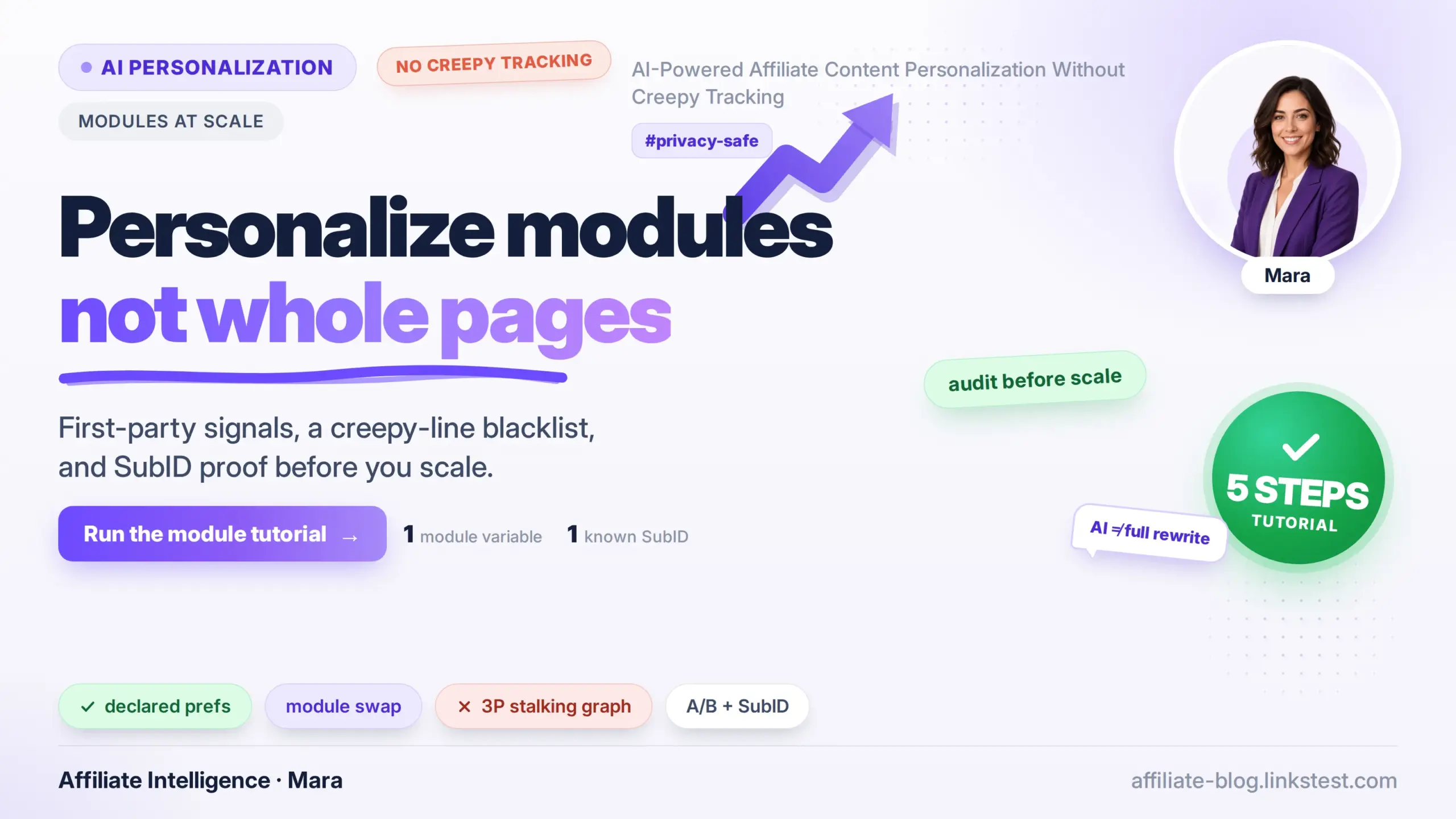
Operators often bolt an LLM onto a live affiliate page, let it rewrite every headline and CTA, and call the result personalization. Then the network report goes quiet and nobody can say which change moved the number. That failure has a name: randomization with better vocabulary. This tutorial is the fix. You will not get a CDP vendor encyclopedia here. You will get a module-level, consent-gated, SubID-measured pipeline for personalizing affiliate content at scale without inferring anyone’s secrets.
Prerequisites
Before you touch a live page, you need five things.
[ ] One live affiliate article that already earns
[ ] Access to the network's SubID report
[ ] A consent or preference capture point (form, quiz, banner)
[ ] An A/B variant or manual module swap with known IDs
[ ] A 14-day observation window
If any of those five are missing, stop and build it before you write one prompt. A subscriber who lands on a money page and leaves is not a consent record. A network report with a blank SubID column is not a receipt. Trust a personalization win only with a live article, a label, and a reason.
Checkpoint: You can open the network report, find a SubID column with values in it, and name the single article you will run the first test on.
Failed Assumption: AI Sprinkle Is Not Personalization
The dangerous pattern: an operator points a model at a whole article, asks for more personalized copy, and ships the output. Every paragraph changes. The offer changes. The CTA changes. Somewhere in that diff sits a real lift, if it exists. You will never find it.
That is the core problem. Personalization is not a data problem; it is an audit problem. You cannot attribute what you cannot isolate. A whole-page rewrite changes fifty variables at once, so the test dies before you ship it. The performance number might move, but the reason will not survive a second look.
The industry has been stuck at this exact point for years. A Winterberry Group 2024 survey found 61% of enterprise marketers described their personalization capabilities as basic or developing (Logarithmic personalization without permission analysis). The reason is rarely budget or talent. It is that nobody can name which signal changed the module and what the module did to the click.
Treat any AI sprinkle that changes the entire page as an untestable artifact. Keep the shell. Change one module at a time. That discipline turns a vague demo into a revenue conversation. If format choice is part of the problem, the content formats defensible against AI shopping covers which page shapes survive zero-click pressure. If the page lost attribution after a category reset, the Amazon halo effect affiliate content strategy explains why.
Checkpoint: You can explain, in one sentence, why a whole-page AI rewrite cannot be attributed to any single change.
Define Modules, Not Full-Page Clones

The page has two layers. The shell stays stable: intro, headings, product table, footer. The modules are the swappable pieces: comparison tables, pull-quotes, CTA blocks, offer cards, proof snippets, trust signals. You personalize modules, not the whole article.
article: best-noise-canceling-headphones
shell:
  - h1, h2, body paragraphs
modules:
  - m-cta-primary       (primary CTA block)
  - m-offer-card        (deals table)
  - m-proof-comparison  (spec comparison table)
  - m-trust-badge       (money-back / warranty callout)
Assign every module a stable ID. Lowercase, hyphenated, no spaces, no personal data. That ID is your audit handle: it shows up in the SubID later, and it tells you which module changed in the test log.
AI sits in the loop as a structuring layer, not a silent executor. It reads the paragraph states, scores readiness, and proposes which module to show. It does not get to rewrite the article and vanish. If the model proposes a new module, that module gets an ID and a changelog entry before it goes live.
Scaling this without module discipline collapses into page duplication. Enterprise teams that shift to modular content report production-time reductions up to 75% on benchmarks (CoreMedia modular content benchmark). The same logic protects an affiliate site: swapping a CTA is a five-minute job; rewriting a 3,000-word article is a project.
Checkpoint: You have a module map of one article with a known ID per slot, and you can name which slots AI may change and which it may not.
First-Party and Consent Signals Only
Here is the signal floor. Build every personalization rule from these four layers, in this order, and nothing else:

1. Declared preference  (preference center, quiz answer, chosen segment)
2. On-site journey intent (article category, scroll depth, comparison views)
3. Consent               (explicit opt-in for personalization)
4. Context baseline      (device, geo, traffic source, time)
A declared preference beats an inferred secret every time. A reader who selects “I am shopping for a gift” in a preference center has told you the use case. A reader whose third-party profile happens to include recently visiting a grief support page has told you nothing they meant to share. The second one is not personalization; it is leakage.
Before trusting a signal, ask two questions. Did the reader hand it to us, or did we take it? And does the promised offer match the consent? If a visitor consents to product recommendations but not behavioral profiling, you may swap the offer card within the article context. You may not build a cross-site interest graph and target them elsewhere.
McKinsey research found 71% of consumers expect companies to deliver personalized interactions, and 76% get frustrated when it does not happen (McKinsey personalized marketing research). The upside is real and measured on first-party signals. Kia shifted to first-party collection and reported a 4x higher conversion rate and a 268% increase in CTR against benchmarks (Contentful first-party and zero-party data case study). That kind of lift starts with a preference center and a clear value exchange, not with a silent third-party tracker.
Use a hard rule: if a signal cannot be produced from consented first-party data, it does not enter the module selector. Contextual relevance from the page itself is the fallback, and it is often good enough. A visitor reading a MacBook comparison gets the MacBook CTA because the page says so, not because you inferred they are a high earner.
Checkpoint: You have a written signal floor with exactly four layers, a consent gate wired to the module selector, and a promised-offer match check for every module.
The Creepy-Line Blacklist and User Controls
Before any inference runs, block the sensitive categories. Health. Grief. Kids. Vulnerable finance. Block these classes first, before a model ever sees a signal.
The FTC’s position is broad for a reason. Health information includes anything that enables an inference about a consumer’s health (FTC collecting, using, or sharing consumer health information). Run the check against the compliance audit FTC program rules checklist. In 2023, the FTC’s first Health Breach Notification Rule action against GoodRx produced a $1.5 million civil penalty for sharing health information with advertising platforms (FTC GoodRx enforcement action). A purchase history row, a location ping, a search string can all qualify. Do not let a model infer a category the reader did not declare.
Put a hard blocklist in the selector:
blocklist:
  - health-condition
  - grief / bereavement
  - children-under-13
  - vulnerable-finance (debt, hardship, distress)
  - reproductive-health
  - political / religious identity
If the only way to personalize for a reader is to infer one of those, serve the contextual default and stop. No fingerprinting playbooks. No burner accounts. No distress-signal targeting. Any vendor that pitches grief-sensitive offers as a feature is a vendor to fire.
The second half is user-facing. A reader who sees a different offer from the one on the cached version must be able to find out why. Add one visible control: Why did I see this? with a plain-language line per changed module, plus a toggle to turn personalization off. If a consumer can inspect the reason a module changed, the mechanism stops being a black box.
Checkpoint: You have a hard blocklist wired into the selector, and a user-findable control that explains why each module changed, with an off switch.
Affiliate Disclosure and the Consent Promise
Affiliate marketing is lawful when the material connection is disclosed clearly and conspicuously. The FTC’s Endorsement Guides state that an endorsement must reflect the honest opinion of the endorser and cannot be used to make a claim the marketer could not legally make (FTC Endorsement Guides: What People Are Asking). A connection between the creator and the merchant is material if it would affect how a reasonable consumer evaluates the recommendation.
For every changed module that carries an affiliate link, place a plain-language disclosure near the first link on the page and repeat it next to any module where the relationship is not obvious. Make the reader able to inspect why the module changed and turn personalization off. Compliance here is operational, not cosmetic: a disclosure buried below the fold or hidden behind a vague label fails the clear and conspicuous standard. Regulators treat each post separately; civil penalties for FTC violations can reach up to $51,744 per violation in 2026, with each non-compliant post counted separately (affiliate marketing compliance checklist for brands).
Measure and A/B or Do Not Ship
A/B one module variable at a time with a known ID. The SubID is the receipt, not the strategy.

variant-a: article-slug-cta-control
variant-b: article-slug-cta-declared-gift
subid:     articleslug-cta-a / articleslug-cta-b
window:    14 days
decision:  keep the variant if conversions per reached reader lift
Change one thing. The offer stays the same, the URL stays the same, the anchor text stays the same. Only the module selection logic differs. That is the test.
Why SubID and not a dashboard total? The network owns payout truth, not the analytics snapshot. Networks and GA4 rarely agree on the same conversion count, because one measures commission-eligible actions and the other measures behavioral events. If you measure on GA4, you will believe a false total. The full tracking guide and blank-column diagnostic are in the affiliate link tracking best practices UTMs SubIDs server-side.
Wait fourteen days. That is a noise filter, not a statistical theorem. A Tuesday spike from a newsletter is weather, not evidence. When you read the result, separate visibility from intent: if the move wins because more readers saw the module, you measured position. If it wins per reached reader, you measured relevance. The full placement method, including scroll-depth segmentation, is in the LLM intent scoring paragraph CTR SubIDs.
Keep the result loop tight: variant plus SubID plus A/B window plus keep/kill. If a chatbot funnel is part of your test surface, the chatbot affiliate funnels NLP attribution traps shows where those conversions get lost. But do not let this test become a funnel rebuild. One module, one ID, one receipt.
Checkpoint: You have one module variant running with a known ID, a SubID in the network report, and a 14-day keep/kill rule you wrote down before shipping.
Scale With Templates and a Pilot Rollout
Once one module wins, scale by refreshing modules inside a template. Do not rewrite pages. Do not clone the winning article and hope.
1. Write the variant into a reusable module template (e.g., gift-intent CTA).
2. Apply it only to articles where the same signal fires.
3. Keep the shell text untouched until a separate test says otherwise.
4. Pilot on one article segment before rolling out sitewide.
A pilot gate is the difference between an insight and a religion. Run the winning module on one new article for one 14-day window. If it replicates, promote it to the template library. If it does not, kill it and log why.
Vendor retention due diligence applies before you let any vendor touch the selector. Ask for a written data-flow map, a kill switch, and a changelog export for every module. If the vendor cannot produce those three, walk away. The full pre-scale audit is the affiliate compliance audit 12-point checklist for FTC program rules. Disclosure is still required even when the offer is personalized. If the format question resurfaces at scale, review the earlier affiliate content formats defensible against AI shopping answers discussion.
Checkpoint: You have a template library containing only winning, ID’d modules, and a pilot gate that a module must pass on a fresh article before broad rollout.
Testing and Verification: The Ship Gate
Before trusting a personalized page in production, run this go/no-go list.
[ ] SubID is not blank in the network report
[ ] Consent gate fires before the module selector
[ ] Module audit shows why each module changed (declared / journey / context)
[ ] Promised offer matches the consent the reader granted
[ ] Disclosure is present near the first affiliate link
[ ] Blacklist blocks all sensitive-category inference paths
[ ] User control explains and disables personalization
Any no is a ship blocker. The module audit is the one most teams skip: if you cannot reproduce, from your own log, why a module changed, the system is already a black box.
Checkpoint: You can answer why did this module change for every live variant on the page, with the evidence in the log.
Troubleshooting Common Issues
1. SubID column is blank.
Your parameter name is wrong for the network. Impact uses subId1, CJ uses SID, Awin uses clickref. Fix the name, run one controlled click, and confirm it appears in the report before touching the article.
2. A/B shows no lift after 14 days.
You changed more than one variable, or the winner is a visibility effect. Re-read the variant diff. If the anchor text or position also changed, you have a confound. Re-run with one difference.
3. A module is inferring a sensitive category.
Stop. The blacklist should have caught it. If the selector inferred health from a third-party enrichment, remove that vendor and default to contextual.
4. Full-page rewrite killed revenue.
This is the original sin. Roll back to the shell, re-apply one winning module, and measure the delta alone.
5. Consent mismatch after personalization.
A reader opted into recommendations but got a retargeting-style offer. The consent gate is not flowing into the module selector. Wire consent status as a first-class filter, not a banner checkbox.
Here is the closing rule. If you cannot audit why a module changed and prove lift with a known SubID, you are not personalizing. You are randomizing with better vocabulary.