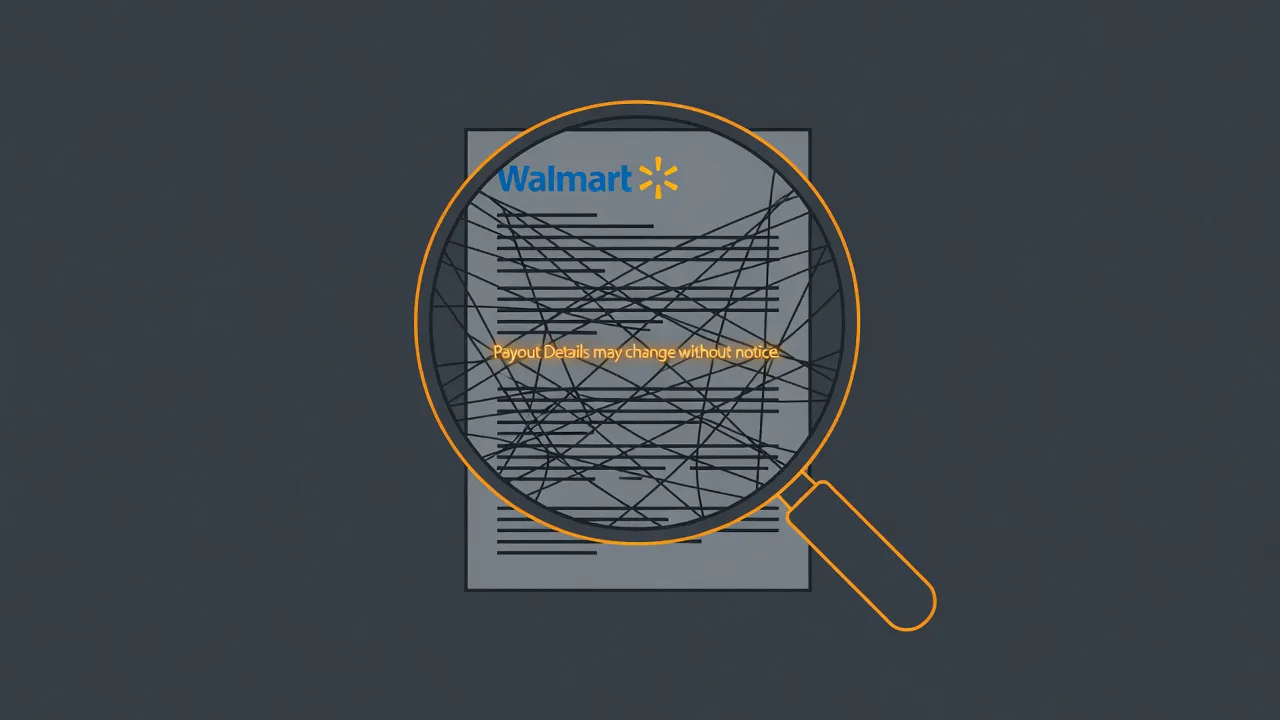
Walmart Affiliate Program: What the Brochure Leaves Out
A retail logo is not a commission plan. The plan lives in Impact Payout Details and the Walmart Operating Agreement, not on a benefits page promising “up to 4%.” Operators who skim the marketing copy and then build SEO content around Walmart’s billion-SKU catalog are making a bet on a brand, not on a contract. That bet can pay. It can also unravel fast when you notice the paid-search ban, the 90-day payment clock, or the week a category’s commission drops to zero.
Before you trust that “fastest approval process” claim on affiliates.walmart.com, understand what you’re underwriting. A high-trust brand plus modest headline rates looks like the sensible, boring alternative to Amazon Associates. But boring can still be dangerous if you don’t read the kill-switches. This is the Walmart-specific due diligence you do before you scale.
For the wider math of whether any retail program’s rate can survive, I wrote a separate piece on commission sustainability. Here, we stay on Walmart: the plumbing, the traps, and the operational fit.
The Failed Assumption: Easy Amazon Alternative
If you are evaluating the Walmart program as your first affiliate surface, start with the beginner start map — pick one niche, one offer, get the pipe live before layering a big-box retailer on top.
A publisher assessing the walmart affiliate program might think: Walmart is a household name with millions of products, the commission is 1-4% (marketing page), and the trust is baked in. What could go wrong?
Plenty. The real filter is not the logo. It’s the Operating Agreement and the live Payout Details inside Impact. That up-to-4% sticker sits on top of category tables that can change without a brochure rewrite. And the TOS forbids structural tactics some operators assume are fine. Paid-search is largely off-limits. Non-US audience sites are explicitly discouraged. Coupon extensions eat last-click credit. The cookie window is shorter than most competitors.
And if you don’t verify current category rates before you write your next “best product” page, you’re building on a foundation that can shift tomorrow. I’m not saying “avoid Walmart.” I’m saying stop comparing it to Amazon as if one wins. The question is whether Walmart fits your traffic model and your risk tolerance after you’ve priced in the terms. Many operators will walk away. Others will run it as a tertiary program with clear limits. Either way, the brochure won’t tell you.
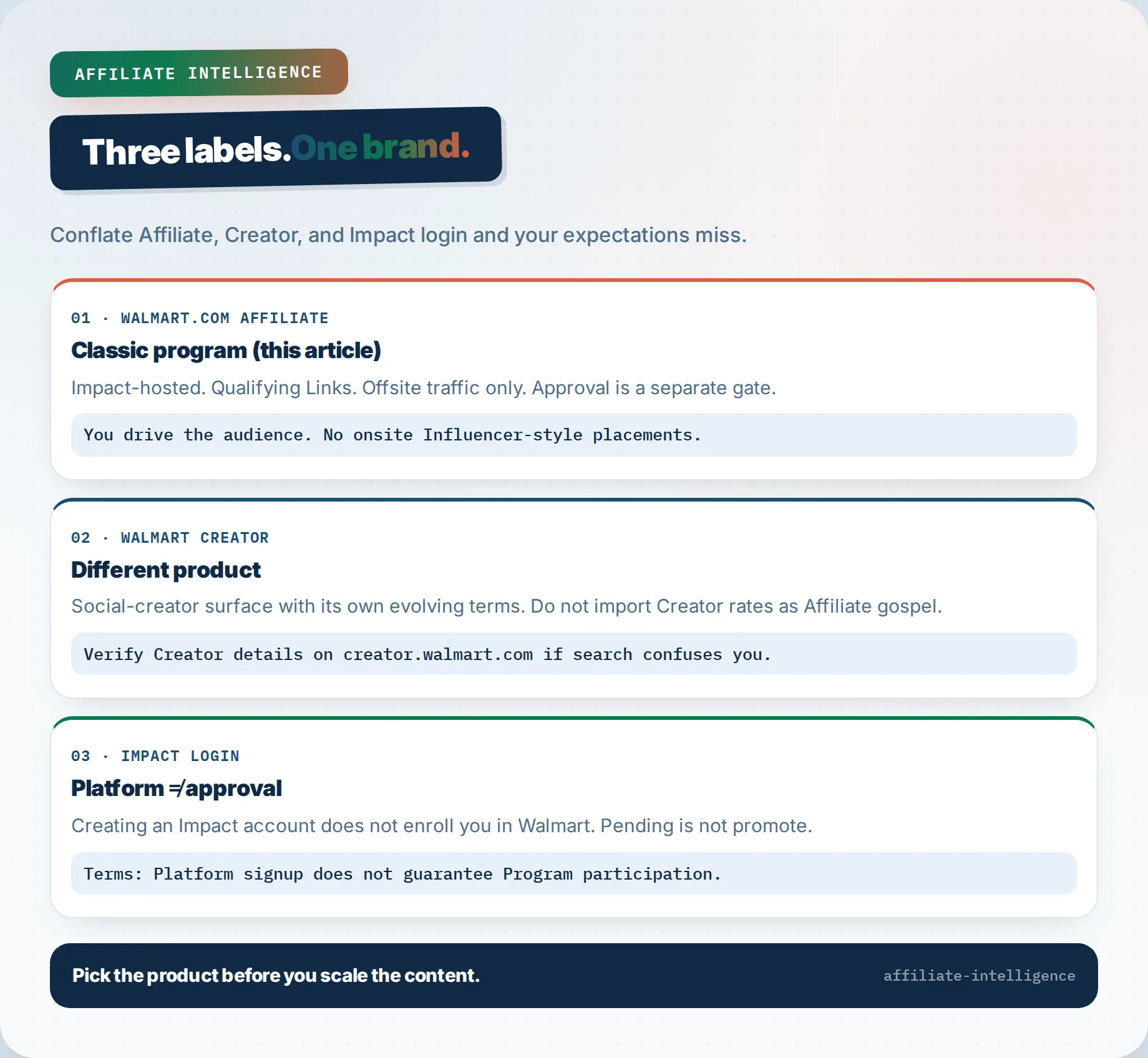
Taxonomy: Affiliate vs Creator vs Impact Login
The classic Walmart.com Affiliate Program is hosted on Impact (formerly Impact Radius). Creating an Impact account is not the same as getting approved. The terms are explicit: “Creating an account through the Platform does not guarantee your participation in the Program.” Approval is a separate gate.
Meanwhile, search results are now cluttered with references to Walmart Creator, a different program at creator.walmart.com designed for social creators. Creator is a separate product with its own evolving terms; don’t import its commission figures as stable comparators. Verify current Creator details directly at creator.walmart.com. This article is about the standard affiliate program, not Creator. Conflate them and you’ll set wrong expectations.
One more reality check: the Walmart Affiliate Program is entirely offsite. You drive the traffic. There is no Amazon Influencer-style onsite placement. If your strategy depends on earning from product page video placements, this is the wrong pipe.

Economics Clocks (Before You Promote)
Sticker Rate vs Portal Reality
The benefits page and FAQ say 1-4%, but those are marketing bands. The actual category-specific rates live inside the Affiliate Portal under Payout Details, and they can change. The terms state Walmart “may change Payout Details without notice.” That means the “4% on apparel” you read on some third-party blog might be stale. Before you commit to a content vertical, verify this week’s rates in your Impact dashboard.
Referral Window and Cookie Folklore
Your referral window isn’t “72 hours” because a guide says so. It’s whatever the current agreement and Impact settings define. The benefits page mentions “three return days” with scoped language - this is about tracking sales that happen within three days of a click, but read the terms carefully. The actual cookie duration might differ for some link types or exclusive offers. Verify in the portal. And yes, the window is often shorter than other retail programs - verify Target’s current window separately if you’re making comparisons.
Exclusions That Kill Commissions
Excluded categories matter as much as the sticker rate. Sam’s Club purchases, Pharmacy, Travel, Financial Services, tires, and gift cards are all non-commissionable per current terms. The portal lists additional exclusions. If you build a content site around a niche that overlaps heavily with these, you are volunteering unpaid traffic.
Payment Physics and Lock
From the current agreement: payment is roughly 90 days after month-end, and commissions are subject to a 60-day return lock. That means the commission you see as “pending” isn’t cash. It’s a forecast.
Until the return window closes, money can reverse. I talk about the math of keep-rate vs. sticker rate in this piece on physical product returns, and clawback mechanics in stop commission clawbacks. Those posts cover the operational math; here, know that pending is soft.
Cookie Blockers and Qualifying Link Hygiene
If a visitor’s browser blocks cookies, you get no credit. If your Qualifying Links are improperly formatted, you get no credit. That’s in the terms. Frame it as a hygiene checklist: test your links, check cookie-privacy impacts, and assume some leakage.

TOS Kill-Switches (Read Before SEO Scale)
SEO scale does not outrun these contract terms. Read them before you build your cluster.
Paid Search and Ad Networks Ban
You may not “place ads on, or participate in any way in, ad networks or paid search content networks.” That kills the “just buy Google traffic to Walmart” idea. If your model relies on paid-search, you need a program that explicitly allows it. This one doesn’t.
Trademark Bidding Rules (Exhibit A Nuance)
Exhibit A of the terms is nuanced. You may not bid on Walmart’s Trademarks alone as a keyword (or confusingly similar stand-alone terms). You may bid on keyword strings that incorporate a Trademark - the agreement’s own examples include “Walmart.com Electronics” and “Walmart Toys” - provided that string sends traffic only to Walmart’s Site. Restricted strings such as “Rollbacks” or “Advertised Values” stay off-limits. Assuming brand terms are a free-for-all is a mistake; so is assuming every Trademark mention in a keyword is banned. I cover the full trademark-PPC audit framework in brand bidding.
Link Manipulations and Framing Prohibitions
No obscure shorteners. No framing or wrapping the site. No price-tracking or price-alert widgets. No cookie stuffing. Coupon or browser extensions that overwrite affiliate cookies are a last-click risk - Walmart’s terms don’t explicitly ban extensions, but they do require that only properly formatted Qualifying Links are used, and extensions that inject their own tags can break credit. Be paranoid about link integrity.
Eligibility Hazards (Non-US and Disclosure)
The terms say websites that “primarily serve a non-US based audience” are unsuitable. That’s a walk-away signal if your audience isn’t US-centric. Also, Impact account residency rules can create friction. Plus, FTC disclosure: place a clear, conspicuous endorsement label near every Qualifying Link. The terms require #WalmartPartner or paid link. I expand on audit-wide disclosures in the compliance audit.
Content License Grant
There’s a clause granting Walmart a content/likeness license. It says you grant permission to use your content (photos, blogs, videos) about Walmart for promotional purposes. This is worth reading in full - it redefines “just links” into a deeper brand-use agreement. I’m not a lawyer; this is a heads-up, not legal advice. The current Operating Agreement also opens with a mandatory individual arbitration provision and class-action waiver (Section 22) - flag it and read that section before you enroll; this is not legal advice.
Approval Hygiene and Mid-Program Shocks
Pending is not approve. Variable approval timelines are normal; do not push traffic while your application is under review. If the gate fails, read why applications get rejected.
Once live, zero-commission episodes happen. Shopping categories can get de-monetized mid-quarter. Have a remonetization plan: swap to a different retailer or to alternative categories that still pay. Platform risk and rug-pull incident response give you frameworks for when the pipe fails.

Fit Tests: When to Walk Away
A publisher could argue: “I run a huge volume of US-traffic comparison content, 1-4% on high AOV goods is fine, and I’ll just avoid paid-search.” That’s a coherent model, and many operators make Walmart work as a secondary revenue stream. But the math still bites. Even with a high-volume site, a 3-day cookie window and a rigorous paid-search ban limit your room to maneuver. You’re betting on organic reach alone, with returns that often shrink after reversals and exclusions.
If your model requires longer cookies, onsite placements, or unrestricted paid-search, Walmart is the wrong pipe. If you can’t absorb a 60-day lock and a 90-day payment lag, skip it. Concentration risk is real: don’t let any one retail program become your livelihood. I explore the danger in concentration risk management. Walmart can be a useful piece of a diversified mix, but if you find yourself reaching for it as a primary income engine, you’ve probably misjudged the economics.
Target is a parallel retail program with different terms; run that DD in the Target affiliate program checklist. If you are mixing Creator rewards with classic Affiliate cash, read the Partners vs Creator taxonomy first. If a marketplace application rejects you cold, use the AliExpress reconsideration roadmap as the rejection playbook, then remonetize. For now, decide: apply, promote with strict controls, or walk away this week.
One-Sitting Walmart DD Checklist
Stop reading and run this. Operators who skip the checklist are volunteering unpaid traffic.
- Confirm the program is hosted on Impact; your Impact login is not approval.
- Read the current Operating Agreement and note the version date.
- Open Payout Details in the portal - this is your real rate sheet, not the FAQ.
- Map the Referral Window and its conditions; verify in Impact.
- List exclusions for your niche: Sam’s Club, Pharmacy, Travel, tires, gift cards, and others.
- Price the return lock (60 days) and payment lag (90 days) into cash flow.
- Scan paid-search bans: no ad networks, no paid search content networks.
- Check Exhibit A for trademark keyword restrictions; hand depth to brand bidding.
- Verify disclosure labels (#WalmartPartner or paid link) are prominent.
- Test Qualifying Link format and cookie behavior.
- Do not send traffic while application is pending.
- Have a remonetization plan if a category commission goes to zero.
- Review the content license grant clause so you’re not surprised.
- Soft-link to economics sustainability, return-rate math, clawbacks, and platform risk.
- Walk away if your model conflicts with any of these.
Walmart’s brand can earn you money. But it can also erase it quietly. Read the contract first.