Affiliate Ad Suspension Guide: Google & Meta Account Bans Beyond Disclosure
Most affiliate operators treat disclosure as the boundary. Get the FTC disclaimer in place, keep the landing page honest, avoid obvious lies - then assume the ad account is safe. That assumption is expensive. According to StubGroup’s analysis of Google’s Ad Safety Report, Google suspended 24.9 million advertiser accounts in 2025 alone. In StubGroup’s review of 1,000+ Google Ads suspensions over a 12-month window, the two largest suspension labels - Circumventing Systems at 37% and Unacceptable Business Practices at 28% – are both charges a clear disclosure never fixes. (source)
My thesis is plain: this guide treats suspension as operational triage, not a disclosure gap. The question is not “Did I disclose?” It is “Can the reviewer see what this business actually is, where the click actually lands, and whether the path survives a second read by a different machine?” If you came looking for a disclaimer checklist, you will find the floor. If you came to understand why disclosed affiliates still get banned, stay.
The Compliance Myth: Disclosed Is Not Safe
A common failure mode: operators believe disclosure is the boundary, but platforms are judging business model and destination control. An affiliate site with a pristine disclosure, a clear “About” page, and a hand-crafted pre-sell can still get suspended for Circumventing Systems. The disclosure tells the user you are compensated. It tells the platform nothing about whether you control the destination, whether the business is legible, or whether the path from ad to payout survives review logic that changed overnight.
Disclosure is necessary. It is not protective. Those are different things. Amazon Associates adds a second boundary beyond the FTC: its program policies require original content to contain commentary, analysis, or transformation for additional value, so direct-linking and thin added-value pages fail for a structural reason a disclosure footer cannot fix. (source) The affiliate link compliance piece maps that distinction further (affiliate link cloaking compliance).
Look at what the suspension data actually shows. Circumventing Systems and Unacceptable Business Practices together account for roughly two of every three Google Ads suspensions in the StubGroup cohort. Neither label is about whether the affiliate marked the link. Circumventing Systems is about patterns of evasion - old redirects, linked accounts, verification mismatches. Unacceptable Business Practices is about misstating or hiding what the business is, reaching past the creative into the landing page and how the advertiser operates.
So the operator who says “I disclosed, I should be fine” is carrying a false mental model. The platform is running a different audit entirely. If you have not run a real compliance pass before spend, start with the 12-point audit on FTC and program rules (12-point affiliate compliance audit). But understand that is the floor, not the house.
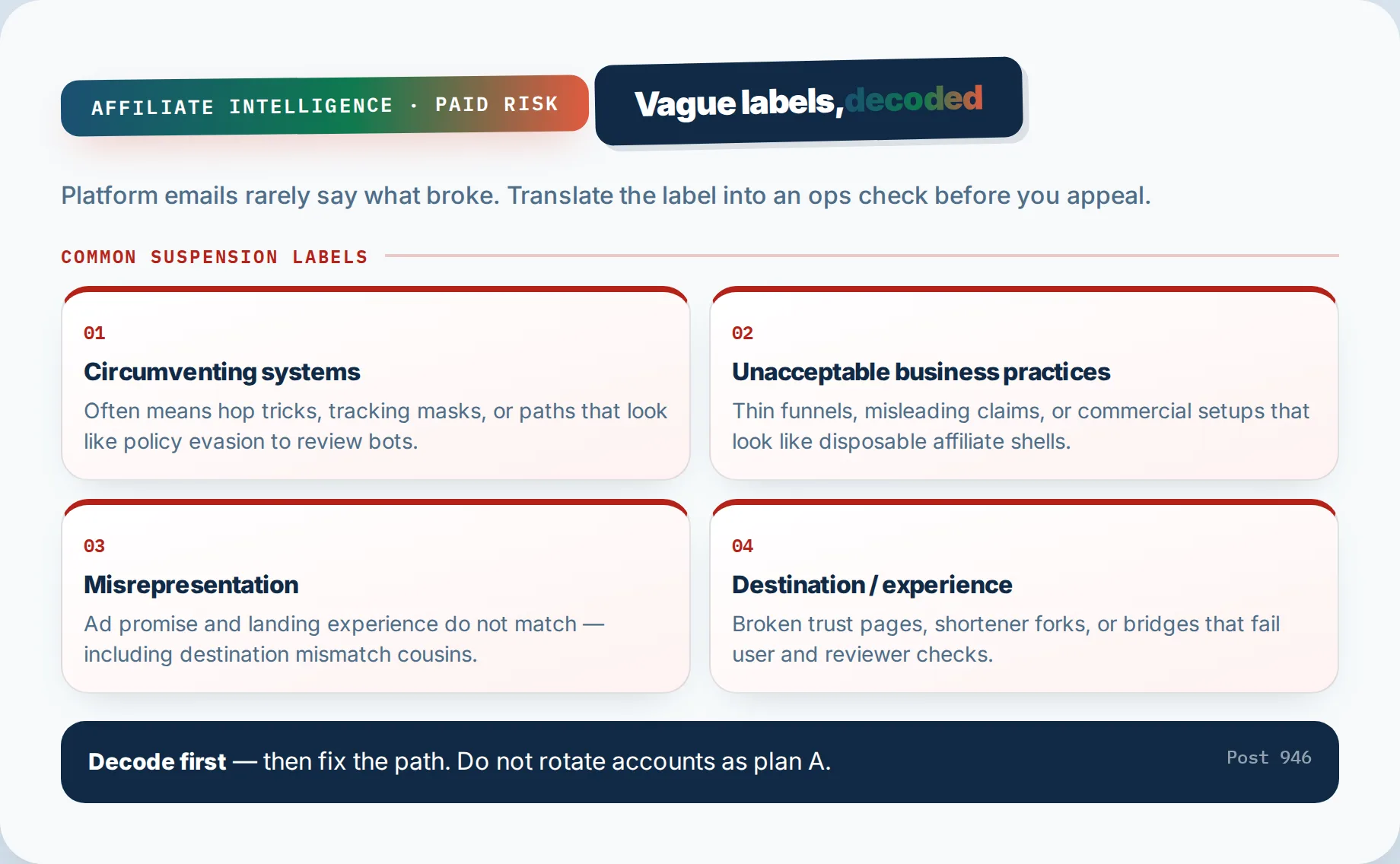
Policy Label Decoder: What the Charge Actually Means
Publishers read labels as verdicts. I read them as diagnostic categories. The label tells you which layer of the funnel collapsed - creative, business model, destination, or account history. Once you know which layer, the corrective action stops being guesswork.
Google gives destination-requirement violations a warning at least seven days before suspension. The egregious labels - Circumventing Systems, Unacceptable Business Practices - suspend immediately, without prior warning, per Google’s account suspensions documentation. (source) That asymmetry is the decoder’s first clue: if you got time, the problem is destination-level. If you got none, the problem is pattern-level.
Circumventing Systems: Pattern of Evasion, Not One Ad
Circumventing Systems is what Google calls it when behavior reads as an attempt to bypass review. The policy text is explicit: creating new accounts after a suspension, submitting false information in verification programs, and creating variations of disapproved domains to re-enter the system are all listed examples. (source)
Operators often underestimate that old redirects, multiple accounts, and false verification details read as circumvention even without cloaking. A paused campaign from two years ago containing a redirect chain from a rebrand can trigger the same flag as deliberate cloaking. The pattern is what is scored, not the intent.
Long third-party tracker or hop-heavy Final URLs sit in the same pattern family. If the display URL says one domain and the click bounces through three trackers before landing, the reviewer reads the hop chain as destination mismatch, not as clean measurement. Own your hop hygiene in the ad URL: keep the final URL on a domain you control, keep redirects minimal and documented, and make destination parity obvious. Tracker theater does not make the path safer; it makes it look like the thing Google is trained to flag. The redirect hygiene cleanup (cloaked landing vs redirect hygiene) and Amazon cloaking rules (affiliate link cloaking compliance) cover the structural line without crossing into cloaking.
That is why the first response to a Circumventing flag is not to defend yourself. It is to audit every URL, every linked account, every payment profile, and every verification detail before you touch the appeal button. I will not teach account rotation here - creating a new account to re-enter the system is itself the listed violation, and it converts a fixable situation into a permanent one.
Unacceptable Business Practices: Misstated Business Truth
A common failure mode is treating disclosure as the only honesty signal. Unacceptable Business Practices asks whether the business itself is legible. Google’s policy bans “hiding or misrepresenting info about your business, products or services” – which is broader than fraud. (source) It catches drop-shipping sites with no contact information, services the operator cannot actually deliver, and business identities that do not match across the web.
Meta’s version runs on the same operating logic with different vocabulary. Meta’s Unacceptable Business Practices policy bans ads and offers built on deceptive claims, fake urgency, and undeliverable promises, and its reach extends past the creative into the landing page and the wider Business Account. Both platforms are asking the same question: is this business what it says it is, across the whole surface the reviewer can touch?
Misrepresentation and Destination Mismatch: Affiliate-Specific Triggers
The paid path that survives review is a page with original value, not a redirect shell wearing a disclosure. Google’s destination requirements are explicit: ads must accurately reflect where users are sent, and insufficient original content includes “destinations solely designed to send users elsewhere.” (source) That one clause is the quiet killer for affiliates. A bridge page that exists only to hand a click to a merchant reads as a doorway page, regardless of how clearly the affiliate link is marked.
This is where the bridge-page reality check earns its place in the triage kit (bridge page Meta Ads reality check). The bridge page is necessary for tracking, but it does not solve the destination-mismatch problem - it can sometimes sharpen it. The distinction is original content: a page with real comparative value, original writing, and a defined user job survives review differently from a thin pre-sell that is just an affiliate shell.
Meta’s Version: UBP and Account Integrity
Operators often treat Meta restrictions as account glitches. They are not. Meta’s ad review system relies primarily on automated tools, with manual review in some instances, and ads remain subject to review and re-review at any time, per Meta’s Advertising Standards. The ad review process typically completes within 24 hours, although it may take longer. (source) Meta’s global review team includes over 15,000 reviewers. (source) The policy surface extends to the Business Account level, not just the creative. As of August 2026, conduct formerly labeled circumventing systems sits under Meta’s Account Integrity standard - which means the identity-and-behavior flag and the claims flag are separate problems with separate fixes. The approved-campaign-death deep-dive tracks this distinction in detail (paid traffic ban risk deep dive).
One vertical-risk failure mode worth writing down before spend: Meta treats YMYL and health-claim creative with extra scrutiny, so a compliant-looking supplement or financial affiliate account can still take a rejection on claim strength, not disclosure. Name the risk in the pre-launch plan. Do not treat it as a copy-tweak problem.
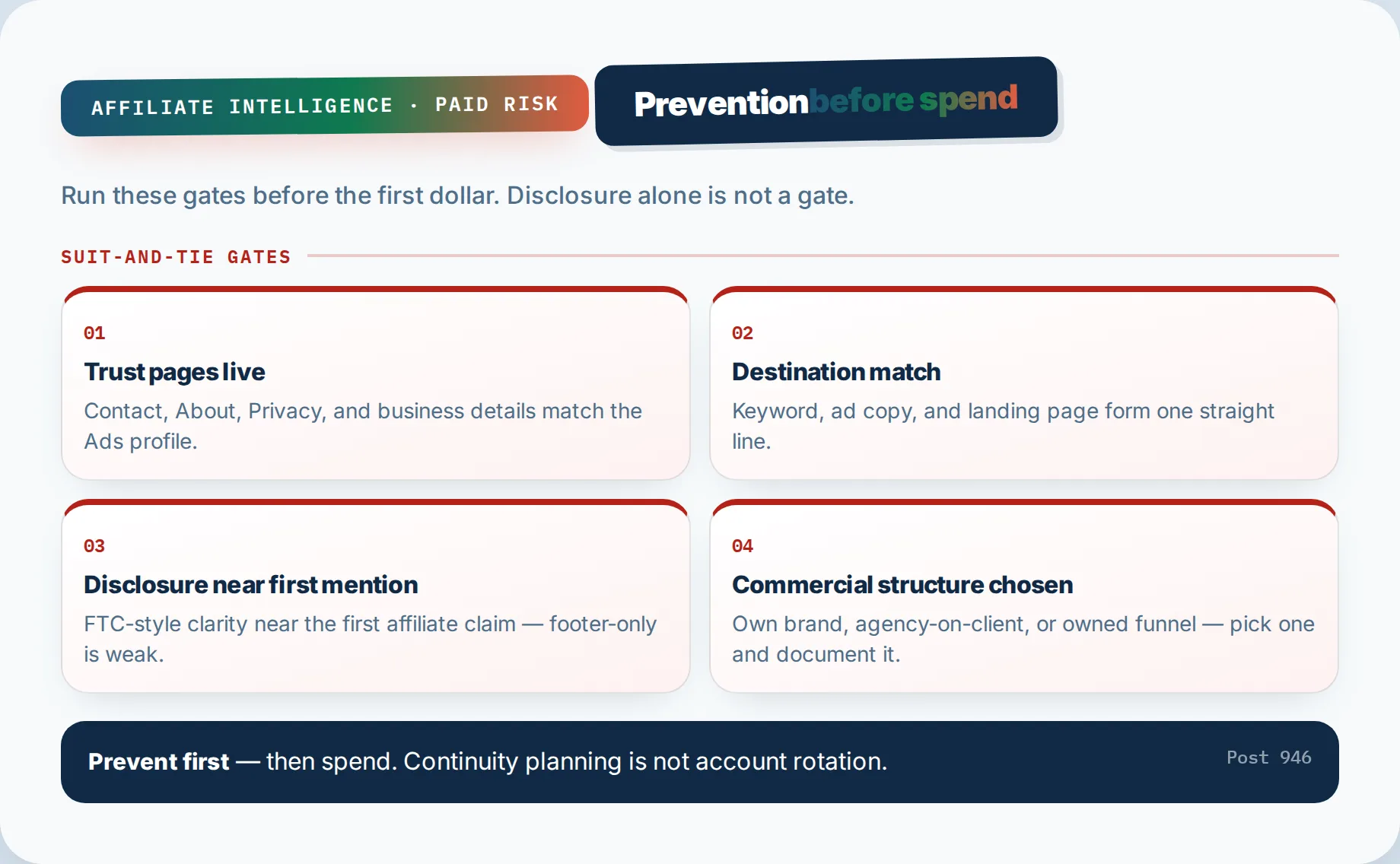
Suit-and-Tie Prevention Before You Spend
Prevention is not more disclosure. It is making the business and destination legible before the algorithm has to guess. The cheapest suspension is the one that happens after spend, not before it.
Before the identity checklist, three structural checks matter. Direct-linking to a network offer from an ad is the classic Google ban path; default to an owned content page that matches the ad’s promise, not a redirect shell. The bridge-page reality check covers why the page has to carry real substance (bridge page Meta Ads reality check). Trust-page texture matters too: privacy, terms, contact, and disclosure should sit near the first commercial claim. Missing legal pages read as thin affiliate spam even when the offer is real. Lead-magnet or forced opt-in squeeze landers are a separate Google failure mode; name them in the plan, because they collapse trust before the click.
Then check the program’s PPC and brand-bidding clauses before the first dollar. Merchant and affiliate bidding the same domain is mutual risk, not just a program-compliance problem (brand bidding audit). Verify conversion tracking before scale: if the platform never receives a purchase signal, you are optimizing on a proxy. Access hygiene is structural, not cosmetic: a personal-profile ban can kill every linked ad account, so prefer Business Manager roles over single-login dependency. That is role design, not an account-farming recipe.
Keep continuity light: owned content or list when paid is dark (paid traffic ban risk deep dive). Review the paid traffic tracking platform setup pitfalls guide so the pixel and payment layer does not become the failure point (paid traffic tracking setup pitfalls).
Before spend, I want five things on file. One: the legal business name, address, and payment profile match the website, the ads account, and the registration documents, exact match, no DBA mismatches. Two: the destination has original content, real contact information, and a defined value beyond the affiliate link. Three: every URL in the account, active or paused, leads to a live, compliant destination with no legacy redirect chains. Four: admin access is documented, with at least one person who can act on a Friday afternoon. Five: brand-bidding and trademark clauses are reviewed so the merchant program’s own terms do not arm a platform flag later.
Google is rolling advertiser verification out to all advertisers. Most get verified in three to five business days, but missing a deadline can pause ads overnight - one mortgage marketer lost over $10,000 in ad spend after missing a June 2025 verification deadline. (source) Verification is not a formality. Submitting false information during verification is a listed Circumventing Systems violation, so the process is both a gate and a trap. (source)
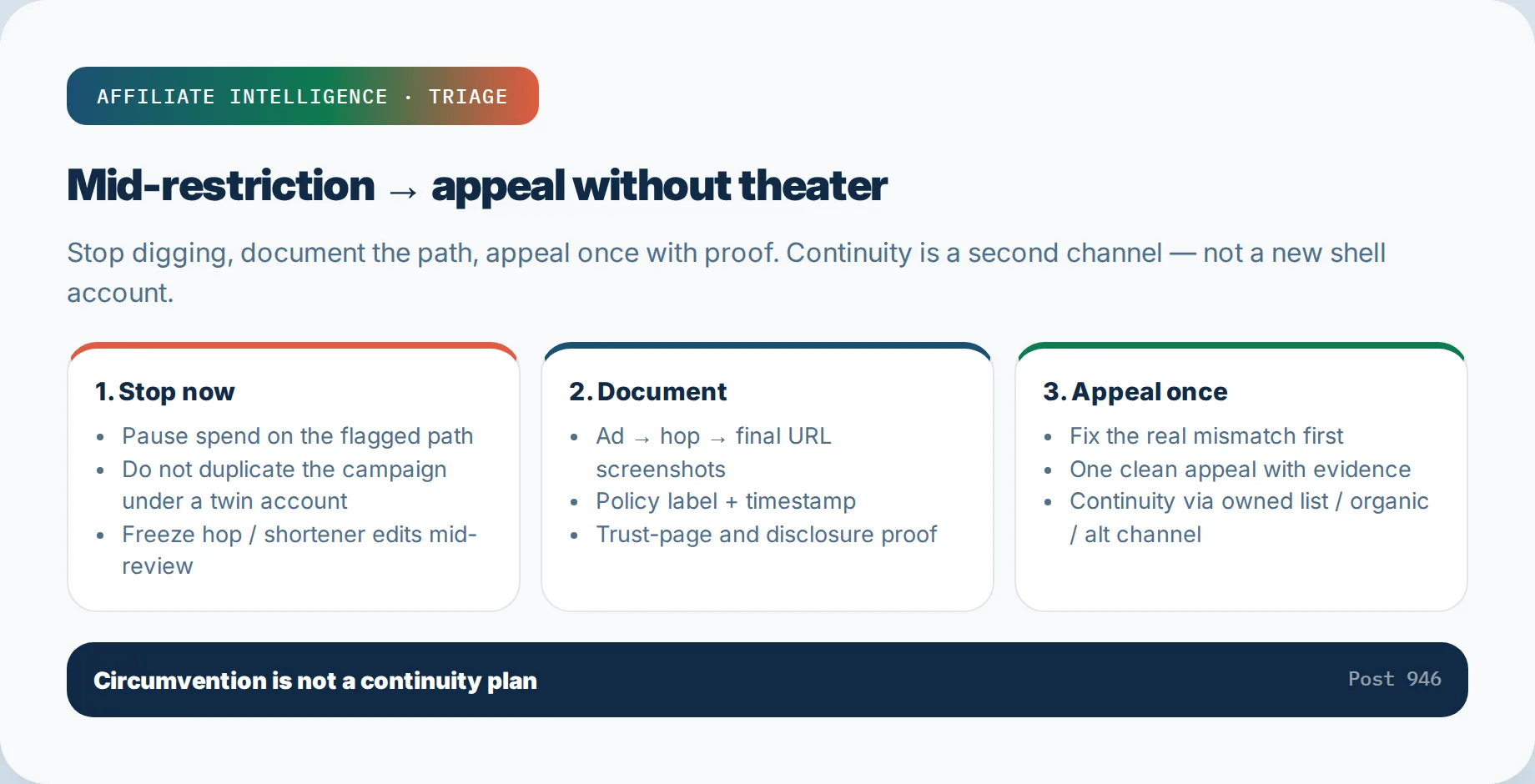
Mid-Restriction Stop-List: Pause Before You Dig Deeper
When the restriction hits, the first move is not to explain. It is to stop repeated appeals, new accounts, and testing ads against the wall. Most operators do the opposite - they file three appeals in two days, open a second account to “keep things moving,” and resubmit variants of the same ad to see what sticks. Each of those actions feeds the Circumventing Systems classifier.
Google says directly that misusing the appeals function can suspend appeal processing for seven days, and that too many appeals for the same suspension may not be processed at all. (source) Filing before you have changed anything is not persistence; it is volume. And creating a new account after suspension is the textbook second violation that makes the first one permanent.
So the stop-list, in order: pause all spend. Freeze all account changes. Map every asset - ad accounts, domains, pixels, payment methods, user access, old campaigns with paused sitelinks. Then, and only then, document what you actually changed before writing a word of appeal. The moving-reviewer problem deserves its own risk category (paid traffic ban risk deep dive).
Billing False Alarm: Check the Card Before You Declare a Ban
Before you treat a Meta account as a policy ban, check billing. A tiny unpaid balance or an expired card can show up as delivery or permission failure, and Meta pauses ads for failed payment even when the creative, account, and landing page are clean. Triage the obvious first: confirm the card, update the payment method, clear the balance. Payment failure is a billing issue, not a policy verdict. Do not waste a policy appeal on a card problem. (source)
Proof Pack and Appeal Hygiene
Before opening appeal theater, build the proof pack: screenshots ad to hop to final URL, timestamps of each change, the exact quoted policy label, and a short note on what changed after the flag. After a cold ban, recovery scammers target desperate operators; the official appeal plus fixed evidence is the only path. Continuity means preserving compliant owned assets and a documented second path, not buying aged accounts or renting identities. That is the line between recovery and circumvention (paid traffic ban risk deep dive).
Appeal Without Theater + Continuity Without Circumvention
The counterargument worth taking seriously: appeals feel futile. A suspended account often gets an automated response, the platform withholds the specific trigger, and the operator is left guessing. It is easy to conclude that appeals are theater and the only real move is a new identity elsewhere.
I will steelman it: if the first appeal is rejected with no explanation, and the business is bleeding, a rational operator might reasonably say the process is closed. The temptation to route around the system is real.
The rebuttal: the disciplined alternative still works because the platforms tell you what they are scoring. Google reinstates “only in compelling circumstances” and wants thorough, accurate, honest appeals. (source) Neither platform promises warmth. Both leave a narrow, real path for an operator who can show what changed. The appeal that says “we found legacy redirects in three paused campaigns, removed them, and verified all billing details” beats the appeal that says “we did not do anything wrong” every time. That is documentation, not theater.
Appeal discipline is part of the stop-list. File once, after the assets changed, with clean evidence. Do not file repeated appeals for the same suspension. Do not open a new account while an appeal is pending - that is the circumvention clause burning the path you are standing on. Google’s documentation is explicit that creating new accounts after suspension is itself a violation. (source)
Continuity is the other half, and it is where people get it badly wrong. Continuity means a second legitimate path - a second platform, a second offer, a second admin - built before the restriction, not a resurrected identity after one. If your entire paid revenue depends on one Meta account, you do not have a traffic strategy; you have a single point of failure. The continuity play is unglamorous: a second channel with its own verified account, its own payment profile, and its own compliant destination, live before you need it. That is the difference between an interruption and an extinction event.
There is a clean line between structural cleanup and circumvention. Removing legacy redirects, matching verification details, and consolidating verified assets is cleanup. Creating a fresh identity to re-enter the system is circumvention. One restores the account; the other forfeits it.
Review-Survival Pass
The pass is not “Will this convert?” It is two harder questions: can a reviewer see what this is, and can the platform verify what happened after the click? Conversion rate tells you the offer works. Neither tells you the path survives a second review.
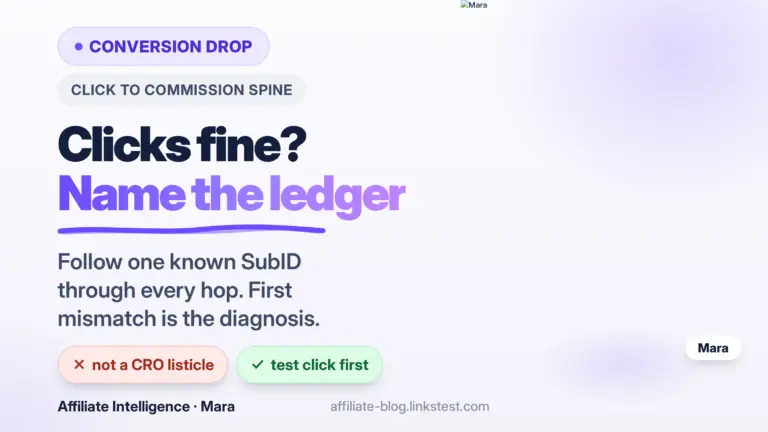
Before you resume spend, run the pre-flight audit. Open the ad in preview and click through as a reviewer would: does the final URL match the display URL, load on mobile, and show the same offer the creative promised? Does the destination have original content, contact details, and a clear business identity, or is it a shell that exists to hand the click away? Google’s destination requirements are explicit that destinations “solely designed to send users elsewhere” fail the insufficient-original-content test (source). Can you match a click to a conversion with a SubID or click ID that survives the redirect, or are you optimizing on a proxy that never doubles back to revenue?
Then check the identity layer: do the account and payment profile details match the website, registration documents, and verification file, exact match, no aliases or abbreviations? Does every URL in the account - active or paused - lead to a live, compliant destination with no legacy redirect chain? Is admin access documented with a backup who can act outside business hours? Have the merchant program’s brand-bidding and trademark clauses been reviewed? The compliance audit (12-point affiliate compliance audit), redirect hygiene guide (cloaked landing vs redirect hygiene), and tracking platform setup pitfalls (paid traffic tracking setup pitfalls) map to the three layers most likely to fail.
The tracking problem is the quiet reason affiliates get flagged even when creative is clean. In one Walmart/Impact affiliate case, Meta matched only 4 of 40 actual conversions because the platform never got a purchase signal from the merchant checkout. When the algorithm cannot verify what happened after the click, the whole path sits under suspicion. The bridge page gives a slightly better training signal, but it does not close the loop (bridge page Meta Ads reality check).
The practical test is honest before it is optimistic. A path that survives review is legible before it is profitable.
Media-Buyer Questions
Close on action, not summary. If you have a media buyer - or if you are one - these are the questions that surface the real suspension risk in the next seven days. They are not polite. They are the questions that get answered in a suspended-account postmortem and somehow never get asked before spend.
One: who owns admin on every ad account, every Business Manager, and every payment profile - and what happens if that person is unreachable on a Friday afternoon? If there is not a documented owner and a backup, the continuity plan is already fiction.
Two: what changed in the last thirty days - tracking template, final URL, landing page, billing method, verification status, even a paused campaign with old sitelinks? The change you did not register is the one the classifier registers first.
Three: which single account would sink the business if it went dark, and what is the second path already in place? The brand-bidding audit covers the merchant-side terms that can arm a platform flag, but the buyer-facing version is simpler: if one account is load-bearing, you do not have a paid strategy, you have a bet (brand bidding audit).
Four: which policy layer is this account most exposed to - destination, claims, business model, or account history? The decoder tells you where the next flag will come from before it arrives.
Run those questions every week. Not quarterly. The platforms are re-reading your campaigns more often than you are, and the cheapest defense is a clean, legible account that never gives the machine a reason to look twice. Start there, before the restriction email does.