
Affiliate Fraud Detection False Positives: Legit Traffic That Gets You Flagged
Automated filters optimize for catching bad actors, not for certifying good actors. That distinction matters more than most operators admit. When an affiliate dashboard flips to “On Hold / Under Review,” the common first move is to argue that the traffic is real, that you did nothing wrong, that the system is broken. That is a moral argument, and it usually fails because fraud queues are not built for moral reasoning. The better move is mechanical: classify which legitimate pattern tripped the detector, freeze every change, then assemble SubID-level evidence so a human reviewer can clear the case in one sitting.
I recommend treating a fraud flag as a classification prompt, not a verdict. The filter saw a shape that historically means fraud. Your job is to attach a legitimate story to that shape. Four patterns account for most affiliate fraud detection false positives: viral spike or velocity surge, geographic concentration, unusually high conversion rate on bottom-funnel pages, and a referrer mix shift from email or dark social. Before you write a single sentence to an affiliate manager, name the pattern and pull the matching evidence.
This is not a compliance audit problem. If the flag cites disclosure, paid search, or trademark terms, start with the compliance audit checklist or the brand bidding audit instead of the defense packet below. What I am walking through here is the false-positive defense spine for traffic that is legitimate but looks wrong.
Failed assumption: a fraud flag is a verdict
Operators often treat automated review like guilt. The moment a hold appears, they start listing reasons they are innocent: been a partner for years, never had a chargeback, traffic is organic. Affiliate managers often receive those emails. They read as appeals to character, not evidence, and they rarely move a fraud queue.
Affiliate fraud is expensive enough that filters are built jumpy on purpose. Global affiliate fraud cost an estimated $3.4 billion in 2025, roughly 17.3 percent of total affiliate spend, according to industry data compiled by Track360. When Impact.com reports that one in four affiliate traffic sources can be fraudulent, programs lean toward suspension over payout. That does not make the flag correct. It makes the flag predictable.
The failed assumption is that a fraud flag is a verdict because it feels like one. It is actually a sorted bucket. Automated systems look at millions of events daily and classify outliers as review-worthy. Meta alone processes over 100 million ad reviews per day, with roughly 87 percent handled by automation, per the paid traffic ban risk analysis. At that scale, a legitimate spike and an automated attack can land in the same queue because they share the same surface shape: fast velocity, tight geo, strong conversion. One returns clean after evidence. The other gets blocked.
A flag, in other words, is a request for documentation. Not an accusation. If you read it as a demand for proof, you will do the right work. If you read it as a moral insult, you will argue in chat with no attachments and lose.
Four legit patterns that look like fraud
Four structural scenarios produce most false positives. Each one is a shape that fraud detectors see daily, and each one has a legitimate version that explains itself if you can attach the right artifacts.
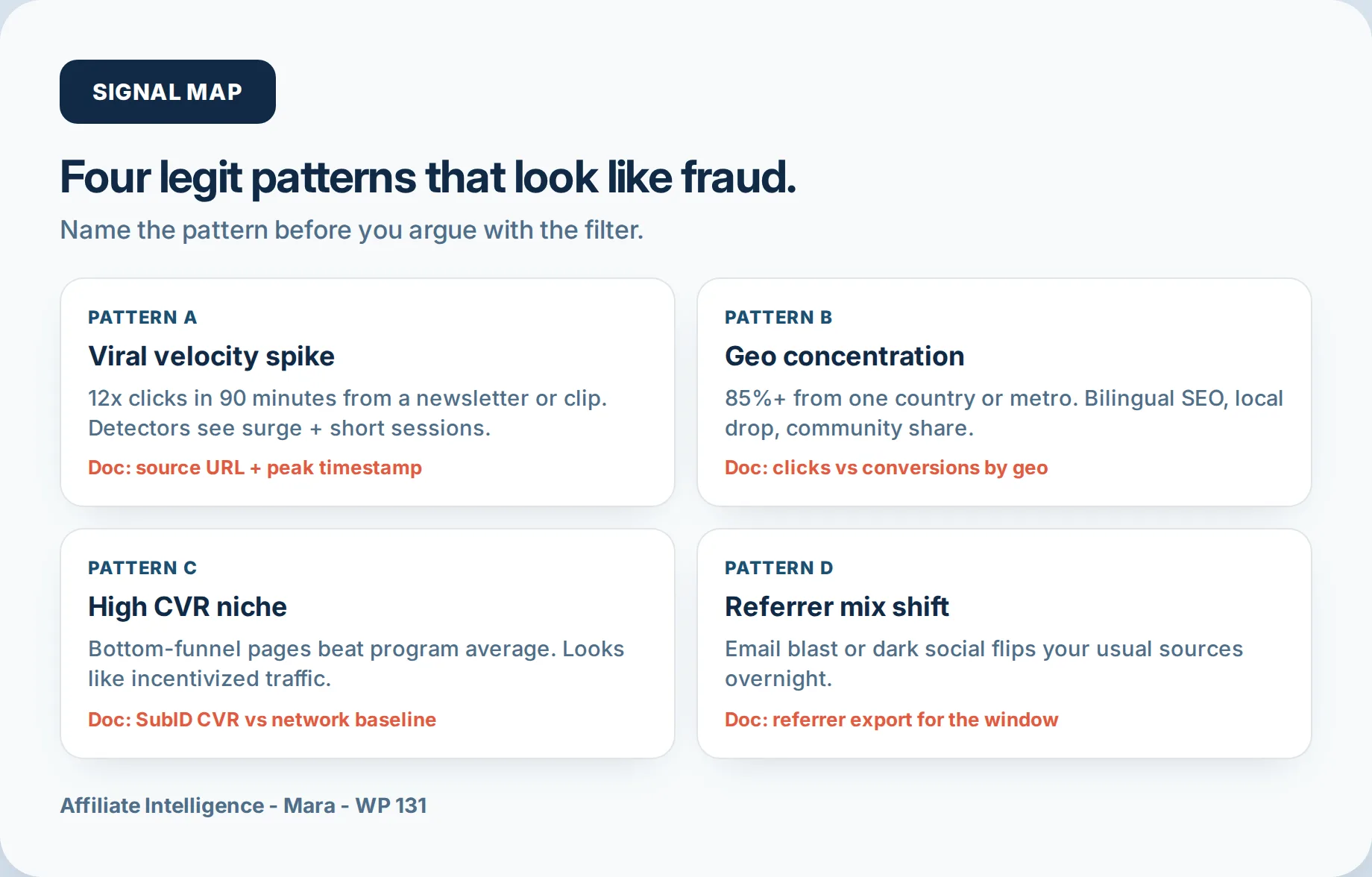
Viral spike or velocity surge. If a newsletter plus a clip sends clicks up 12x in 90 minutes, velocity rules fire before a human reads the referrer. Imagine a niche comparison post gets picked up by a creator for a detail: ‘This is the only tool I would use for X.’ Clicks jump from 40 per day to 900 per hour. The detector sees a burst, not a story. To defend it, you need the source URL, a screenshot of the post or email, the peak timestamp, a referrer export, and a server log sample that shows IP diversity across many networks rather than one data center. That last piece matters: a bot farm concentrates on a handful of IPs or infrastructure providers, while a viral spike spreads across residential IPs, devices, and browsers. A clean SubID and UTM tracking setup lets you isolate exactly which placement drove the surge.
Geo concentration. A cluster in one metro area can be legitimate if the content ranks for bilingual local SEO, a regional influencer shared it, a WhatsApp or Telegram group pushed it, or a campus or community forum drove it. A filter often sees ’80 percent of clicks from one city’ and flags it as a click farm. Your defense is an audience geo versus buyer geo export. If the audience geo matches the buyer geo for the product, and the landing page serves that market, the concentration is explainable. If the audience geo is, say, Manila while the buyer geo for a US-only offer is entirely absent, that is a different problem, and you should treat the flag as a real signal, not a false positive.
High CVR on bottom-funnel pages. A page designed for high intent, like a comparison table or a ‘which one should you buy’ post, should convert far above a program average, because the program average includes top-of-funnel listicles and display traffic. If your bottom-funnel page converts at 11 percent while the program average is 2.35 percent, that gap is not inherently fraudulent. It is page intent. The detector scores you against the wrong baseline because it compares all pages together. The defense is to export your page-level conversion rate and pair it with session duration: short sessions on curiosity traffic are normal for a bottom-funnel page, while a true bot farm tends to produce near-zero seconds across the board.
Referrer mix shift. An email blast to your own list, a push from a private community, or dark social traffic from apps that strip referrers will change the referrer distribution overnight. A system built to catch paid traffic hiding behind ‘direct’ entries will flag that shift as suspicious. Your evidence packet should include the ESP campaign ID and timestamp for the email, the post URL for the social share, and a screenshot showing the referrer shift aligned with your distribution event. This is often the easiest false positive to clear because the trail is external and time-stamped.
These four patterns share a common failure mode: the operator sees the shape, cannot explain it immediately, and starts changing things to make it look more ‘normal.’ That is backwards. The shape is the evidence. Freeze it.
What detectors actually score (without vendor shopping)
I am not going to build a 12-tool grid. Fraud SaaS shopping posts are the wrong genre for this conversation. What you need is an accurate model of how your network’s rules are likely scoring you, because that tells you which export to pull first.
Most affiliate fraud stacks run a velocity layer before anything else. A sliding window counts events per identifier, usually IP, affiliate ID, or fingerprint, over a window like one minute or one hour. If the count exceeds a threshold, it fires. A well-tuned velocity layer catches 60 to 80 percent of bot-driven and ring-driven fraud at near-zero cost, per the Track360 implementation guide. The downside is what you are living through: a legitimate campaign launch, a newsletter send, or a viral clip can trip the same threshold. The false positive rate is not zero. Track360 notes that if a platform runs twelve rules at 0.2 percent false positives each, the aggregate false positive rate is roughly 2.4 percent as a mathematical example, meaning roughly 2.4 percent of legitimate conversions could be held for review. That is the cost of catching fast-moving fraud.
Beyond velocity, detectors score IP diversity and data center presence. A data center IP is not proof of fraud, but it is a strong proxy signal, because fraudsters route through data centers to mask their origin. If your traffic includes legitimate corporate or education users behind a NAT, that concentration can look suspicious. The defense is to pair IP data with device or behavioral signals, and to export your server log showing a mix of residential ISPs, real user agents, and human-like session lengths.
Time-of-day clustering also matters. A burst at 3 a.m. local time is more suspicious than a burst at 9 a.m., because real audiences cluster around waking hours. If your spike corresponds to a content release, a podcast mention, or a time-zone-specific promotion, write that in the narrative. Short sessions on curiosity traffic are normal; detectors sometimes read a two-second visit to a bottom-funnel page as bot-like, but a human looking at a comparison table may bounce fast if the answer is obvious.
The point is not to game these signals. It is to know which signal likely fired so you can gather the right counter-evidence without guessing.
Evidence packet before you email the AM
Before you email the affiliate manager, assemble a packet that a human reviewer can clear without scheduling a call. A generic “we did not do anything” appeal without attachments usually stalls. Documented appeals for similarly vague holds clear faster because they reduce reviewer workload. The ad suspension guide covers the paid-platform version of that same evidence habit.

The packet should contain six artifacts, in order:
- Source URL and screenshot. The exact page that generated the spike, with timestamps. If it was external, the post URL or email campaign ID. This names the trigger.
- Timestamp table. Peak timestamps in your timezone, matched to the distribution event. A minute-by-minute narrative for the 72 hours around the spike is enough.
- Referrer export. Top referrers from your analytics or server logs, not just the network’s dashboard. If the referrer is empty due to dark social, say so and show the share count or message volume that correlates.
- SubID-level click and conversion table. Export from your tracking platform or network at the SubID grain, showing which placements produced the clicks and which produced conversions. This isolates the source and proves you are not lumping unknown traffic in. The tracking spine article covers how to structure SubIDs so this export is automatic.
- Geo clicks versus conversions. Show the top geos for clicks, then the top geos for conversions. If they align, the audience is real. If they mismatch wildly, you have a different problem, and you should treat the flag as a real signal before escalating.
- Server log sample. A sample of raw logs from the spike window showing IP diversity, user agent variety, and session depth. This is the strongest counter to a bot assumption. A true bot farm looks monotonous: same IP, same device, same millisecond timing. Your export should look human.
If your high CVR triggered the flag, include a comparison of your bottom-funnel page CVR against the program average, with session duration. If your review is already a payout hold, read the withheld commissions article for what the contract actually allows.
Escalation timeline
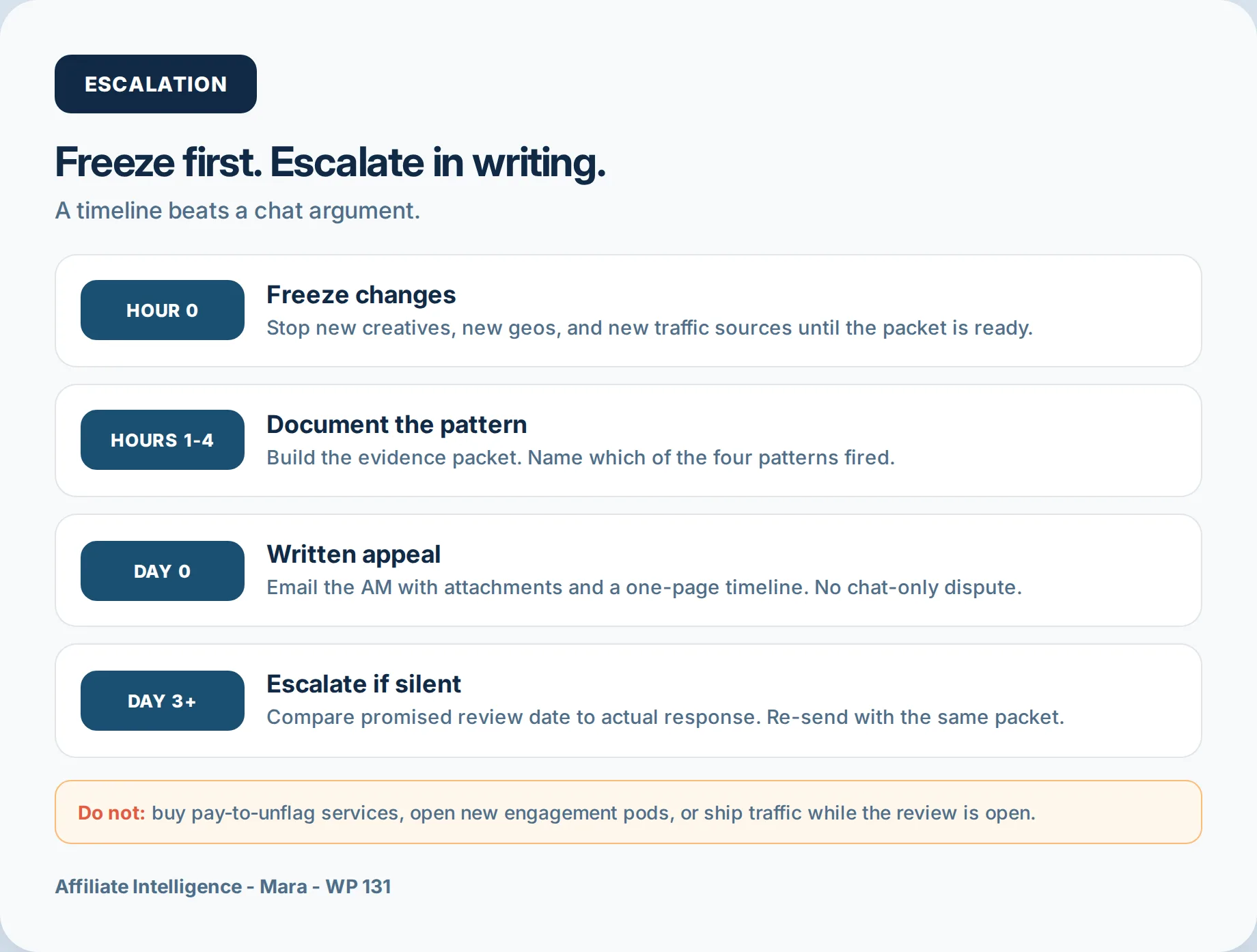
The sequence is freeze, document, written appeal, escalate if the review window slips. Most operators do the appeal before the documentation, and they do it in chat instead of writing.
Freeze traffic and creative. The moment the hold appears, stop any new traffic sources, pause any tests, and do not fix anything that would change the evidence. Preserve the dashboard state with a screenshot. If you edit links or redirects, you destroy the trail.
Document. Export every artifact listed above while the data still exists. Do not rely on the network to keep granular logs available. Save the dashboard status, the held amount, any warning banner, and the exact policy text cited.
Written appeal. Send one email or ticket with the packet attached as a PDF or zip. State the pattern you believe tripped the filter, explain it in two sentences, and attach the evidence. Ask explicitly for human review, not another automated pass. Include a timeline: what happened when, with timestamps. That timeline is your strongest proof of legitimacy because it shows a story, not a smear of clicks.
Escalate if the review window slips. Before I escalate, I compare the promised review date in the hold notice to the actual response. If the date passes with no update, escalate in writing to the network’s compliance or fraud team, citing the original ticket number and the missed deadline. Do not start a new thread. Do not open a chat with a different rep. One written trail, one owner.
The escalation path is boring on purpose. Emotional theater in a fraud queue reads as desperation, not legitimacy.
What not to do when flagged
A fraud flag can be a real signal, and I want to acknowledge that plainly. If the hold cites PPC, trademark leakage, or missing disclosure, this defense packet will not save you. Go to the brand bidding audit for paid search issues or the compliance audit for FTC and program rules. The false-positive spine assumes your traffic was legitimate and your promotion was clean. If it was not, documentation will only prove the violation.
When you are flagged, do not spin up a new traffic source to prove volume, do not buy engagement pods or fake reviews to look better, do not pay any service that promises to unflag your account, and do not argue in chat without attachments. That last one is the most common mistake. A chat argument is a time sink and a documentation gap.
The worst move is a new account. A single new account spun up immediately after a suspension can convert a recoverable issue into a permanent block, because it reads as Circumventing Systems. That is covered in the ad suspension guide. If you are already weighing a new application after a block, read the application rejected article for the real reasons. If you are tempted, you are probably reading the flag as a verdict instead of a classification prompt. Return to the packet.
One-sitting checklist + short FAQ
Assemble the packet before the next spike. That is the entire advice. You can do most of this work in one sitting, before you ever need it, and it changes the outcome from a coin flip to a documented appeal.
- ☐ Spike got you flagged? Name the source URL, pull the timestamp table, export referrers, and show server log IP diversity. If it was an email blast or social push, attach the campaign ID or post URL. That clears most velocity flags.
- ☐ Geo cluster legit? Export audience geo versus buyer geo. If they align, the cluster is explainable. Include bilingual SEO, a local influencer, or a messaging group share in your narrative. That is not evasion; it is context.
- ☐ CVR too high? Separate your bottom-funnel pages from your top-funnel pages, then compare to the program average. A high CVR on a comparison page is page intent, not fraud. Show session duration and conversion path to prove human behavior.
How long to wait on review? Compare the promised review date in the hold notice to the actual response. If the date slips by more than a day or two, escalate in writing to compliance with the original ticket number. Do not open a parallel chat.
If the review becomes a payout hold, the withheld commissions article explains what the contract allows. If the fraud review later leads to a reversal, the clawbacks article covers what tracking terms to check. The common thread is the same: evidence over emotion, written trail over chat, frozen state over frantic edits. Start the packet now, before the hold, because the system that flags a legitimate spike does not wait for you to explain.