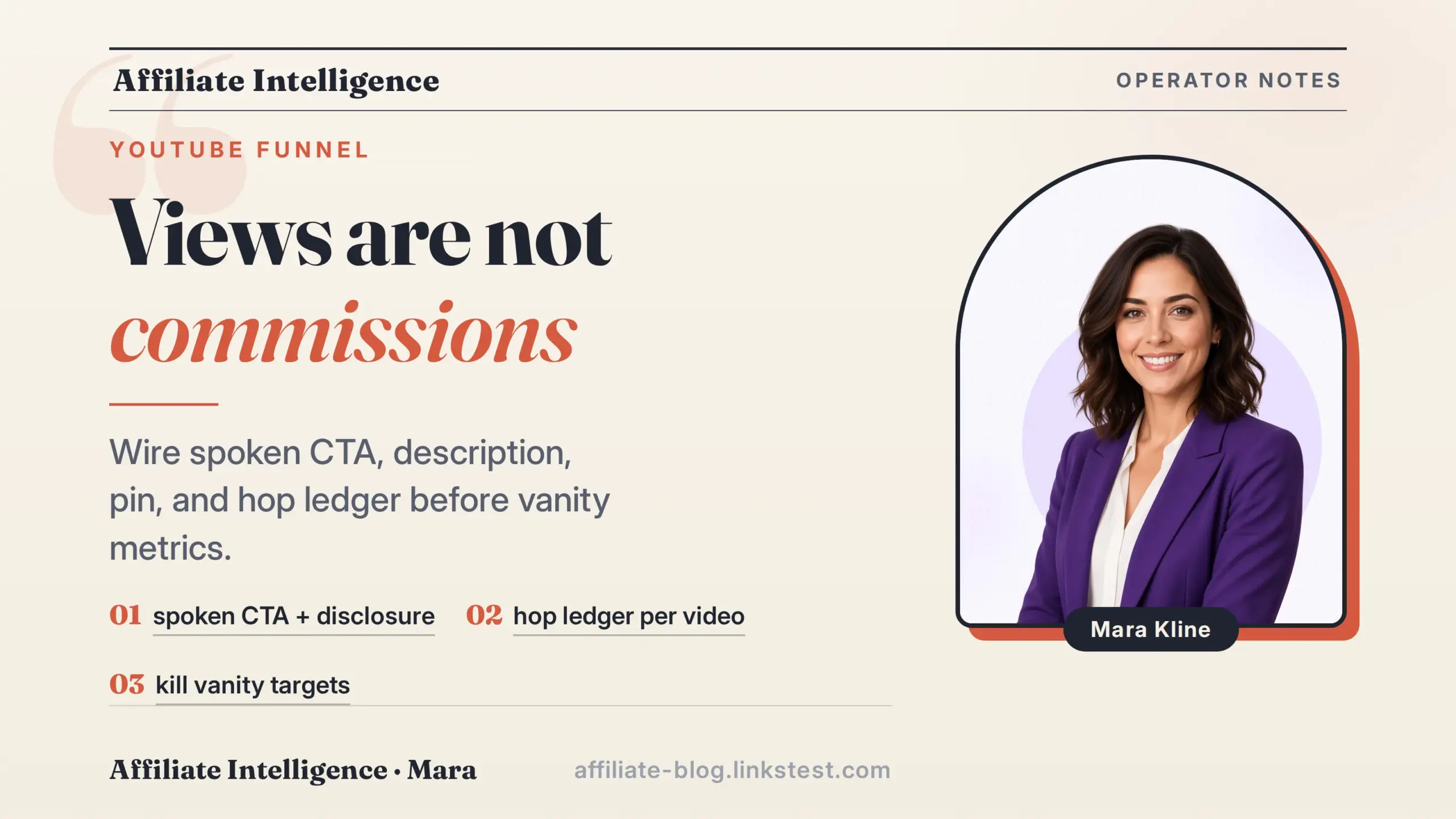
YouTube Affiliate Funnel: Views Are Not Commissions
Most operators think youtube affiliate marketing means growing an audience and pasting links in the description. That’s a category error. A view count is not a commission; a subscriber is not a payout. The actual system is: spoken call-to-action - visible link surface - tracked destination - attributed sale. Skip any of those links and you’re running an unpaid product page, no matter how many people watched. A viral video with an untracked description dump is still an unpaid audience.
The Failed Assumption: Views Are Not Commissions
If you are still building your first affiliate commission pipe, the starter guide will get you one live tracked link on one surface - the only start metric that counts.
Views, subscribers, likes, and even hitting AdSense monetization thresholds have zero relationship to affiliate income. The metric you need - attributed commissions - sits inside a network dashboard, not a YouTube Studio real-time card. If your channel racks up views while attributed commissions stay flat, you are optimizing for an unpaid audience.
The funnel is a physical map. Someone hears your spoken CTA, finds the link surface you named, clicks through, and eventually buys - and a cookie or click ID records your commission. Mobile viewing makes the map flimsier. On phones, the description often collapses before the first commercial link. Without a pinned comment or a well-placed oral instruction, the viewer never sees the link. That’s not a platform failure; it’s a funnel design problem. If your content doesn’t lead a user from audio to a visible link, you’ll collect “watch time” but never a commission.
This is not a Pinterest board problem - Pinterest has its own vanity metrics trap. For now, accept that YouTube affiliate income requires a link funnel, not a subscriber graph. Fix the pipe before you chase more views.
Metrics That Matter (and Vanity That Does Not)

Ignore subscriber milestones and RPM myths scraped from PAA noise. The only numbers that deserve a spreadsheet column are tracked outbound clicks, attributed commissions, and earnings per click (EPC) on your own traffic. A commission-per-view ratio (commissions divided by views) can help you compare your own videos internally - but it’s not a universal industry benchmark, and I’d never stake a rent payment on it.
The structural scenario that forces a pivot: high views, high curious clicks, and zero attributed sales. That’s an intent or offer mismatch, not proof that “YouTube affiliate doesn’t work.” Maybe the link dump leads to a product that no viewer is ready to buy, or the cookie window expires before a delayed purchase. Maybe later viewers share the link privately, and the sale vanishes into dark social. When that happens, you need to reconcile the gap, not film another video.
The Funnel Map: CTA -> Description -> Pin -> Cards / End Screens

Treat your channel as a link-funnel asset, not a personality contest. This piece maps the placement order that survives mobile truncation and viewer indifference. Longform-first is the default for this funnel shape; Shorts lack the same end-screen and card surfaces, so this piece does not build a Shorts strategy here.
Spoken CTA + disclosure-first description
Tell the viewer where the link lives: “The links I mentioned are in the description, right below the disclosure.” Say the disclosure out loud near that CTA (ideally early in the video, not only at the end). Text-only placement in the description is not enough on its own under FTC endorsement guidance: viewers can miss description copy entirely, so the disclosure has the best chance of being clear and conspicuous when it is included in the video itself. Then make sure the description still leads with a clear, conspicuous affiliate disclosure before any commercial link. A template: “Affiliate disclosure: I earn from qualifying purchases. First offer link; second resource link.” Not twenty untracked URLs. That’s noise, not navigation.
Pinned comment as the second surface
When the description collapses on mobile, the pinned comment can become a high-visibility second surface - treat that as a hypothesis to measure with your own hop, not a permanent law. Use it as a second placement with the same disclosure discipline. Don’t rely on comments alone if program or platform terms constrain promotional language - verify current rules. For how to assign jobs and prove description vs pin, see YouTube affiliate link placement: assign jobs, then prove which surface wins.
Cards, end screens, and longform-first judgment
Cards and end screens exist only on longform videos; Shorts cannot host the same interactive elements. If you’re in the YouTube Partner Program, you can link external websites through end screens - use them as another tracked placement. But the heart of a YouTube affiliate funnel is the spoken CTA-to-description pipeline, not a last-second end card. Fix the description and pin first.
Tracking That Survives: Which Video Earns

Flying blind on total affiliate revenue is the default failure state. Without unique identifiers per video (and ideally per placement), you’ll see a lump-sum commission and have no idea which content actually paid. SubIDs are the fix.
Per-video minimum, per-placement better
At minimum, append a unique SubID - or a distinct tracking link - to every video. Better: separate IDs for the description link, the pinned comment, and the end screen. An illustrative naming convention: yt_<video_slug>_desc, yt_<video_slug>_pin, yt_<video_slug>_end. It’s not sacred, but it survives audit. If you’re new to SubIDs, the complete SubID guide maps parameter names across networks; for hybrid UTM + SubID patterns, the email click-zone hybrid article gives naming strategies that avoid collision. For advanced tracking setups, see also the affiliate link tracking best practices guide.
Survival test + monthly Analytics x SubID reconcile
Click your own test link through a short wrapper, then inspect the browser address bar and network developer tools. Confirm your UTM parameters and SubID survive YouTube’s redirect chain. If they vanish, you’re paying for clicks you can’t attribute - fix your redirects or avoid shorteners that strip query strings. At month-end, pull outbound click counts from your own hop or short-link ledger (YouTube Studio is not a reliable outbound ledger for description-link clicks); line those taps up alongside the network’s SubID report. Kill videos that generate views but no commissions, and scale the ones that earn. If later private shares hide conversions, revisit the dark social attribution guide for proxy-tracking methods.
Offer Fit, EPC Framing, and Cookie Clocks
Commission percentage is not earnings power. A 30% cut on a $10 product might still deliver a lower commission per click than 5% on a $200 purchase if conversion rates differ. Frame everything around EPC or commission-per-click on your own traffic; do not chase industry medians that weren’t built from your funnel.
How-to and freebie tutorials can rack views while starving sales - viewers come to learn, not to buy. Comparison content, “best for” roundups, and decision-stage videos usually match buyer intent far better. Match the video topic to the purchase stage.
Cookie windows then introduce a timing gap. As of current program terms, Amazon Associates’ 24-hour cookie is notably short, while other merchants often offer longer windows - verify each program’s current terms. If your content serves a research-heavy buyer who needs a week to decide, a short cookie means they click today and you earn nothing later. Verify the specific duration in the program’s terms; don’t blame the video when the cookie expires too soon.
Some programs provide zero creative assets and no affiliate manager - the activation gap is real. Before you assume the offer doesn’t convert, confirm the program gives you enough to build a complete funnel. YouTube Shopping’s affiliate product is a platform option with separate eligibility rules; check current YouTube Help for requirements, but treat it as one possible surface, not the backbone of your income.
Disclosure and Account Hygiene
Affiliate disclosures must be clear and conspicuous in the video itself (spoken or on-screen near the endorsement), and also placed above the first commercial links in the description and in any pinned comment. Description-only disclosure is a weak backup, not the whole job. When your video features a gifted product, that’s a material connection under FTC guidance - the same disclosure obligation applies. The FTC’s Endorsement Guides page describes what “clearly and conspicuously” means (including why YouTube description-only placement is not enough on its own), and the compliance audit checklist walks through a dozen program-level checks.
Don’t treat YouTube’s paid promotion label or Shopping tags as a substitute for affiliate disclosure when both apply; verify current UI requirements in the platform’s policies. If you’re tempted to “pretty-link” affiliate destinations to avoid spam filters, pause. The difference between a compliant redirect and a cloaked hop is painstakingly thin; the cloaked landing page guide explains where redirect hygiene crosses into program risk.
Worth-It Judgment: Fix the Funnel, Scale, or Walk Away
Course roadmaps and income screenshots are marketing until per-video tracking proves a ledger. Before you trust any course roadmap that promises YouTube commissions, look at your own network report and ask whether attributed commissions match the hype. If you need unrestricted naked links, infinite cookies, or full-time livelihood from vanity views alone, either rebuild the link funnel or swap the offer/channel pairing.
A high commission rate on a program that doesn’t support your content is a promissory note, not income. If after fixing the pipe the numbers still don’t justify the time, walk away this week. But if you’re seeing attributed conversions and just need volume, scale the longform template that already works - not the viral Shorts that can’t carry links. If your landing is your own domain, the domain resilience playbook and the newsletter-driven audience guide explain how to capture email addresses so you’re not dependent on a single platform’s algorithm. But that’s a later step; fix the link funnel first.
One-Sitting YouTube Funnel Checklist (Before You Upload Again)

- Define success as attributed commissions, not views or subscribers.
- Map the complete link path: spoken CTA -> description -> pinned comment -> end screen (longform only).
- Place a clear disclosure above the first commercial link in every surface.
- Attach at least one unique SubID (or distinct tracking link) per video.
- If volume allows, add separate IDs for description, pin, and end screen.
- Click a test link and confirm that all parameters survive YouTube redirects.
- Pick offers with buyer-intent fit and a cookie window that matches your audience’s decision timeline.
- Kill pure how-to/freebie content if there’s no attached buyer pathway.
- Default to longform videos that support description, pin, and end-screen surfaces.
- Reconcile your own hop’s outbound click counts with the network SubID report every month.
- When a video earns but a later private share masks the conversion, revisit the dark social article for proxy signals.
- If program padding hides behind vague promises, cross-check with the scam/legit checklist.
- Treat the Pinterest vanity-metrics sibling and the SubID guide as fast references when you need to audit surface-level metrics or parameter naming.
If the channel under review is TikTok instead of YouTube, separate Shop affiliate from classic click-out links with TikTok Shop affiliate vs classic affiliate links before you treat views as proof of a working pipe.
Build the link funnel before you chase more views. Tag every video before you scale uploads. The ledger, not the vanity, decides whether YouTube affiliate payouts actually show up.
When views or clicks look fine but commissions stay flat, run the sibling YouTube affiliate links not converting diagnosis before rewriting the whole funnel map.
If the description URL is plain text instead of a blue hyperlink, run the YouTube description links not clickable: eligibility fork before treating it as a conversion problem.
If the funnel pipe exists but you are still dumping the same URL on every surface, run the YouTube affiliate link placement: assign jobs, then prove which surface wins map before scaling uploads.