LTV-Based Affiliate Commission Structure: Pay for Customer Value, Not Orders
The payout model, not the rate card, is what you are underwriting. A flat percentage on orders pays for the order, not for what the customer becomes. If the program cannot distinguish a one-order customer from a six-quarter customer, the problem is the structure, not the percentage. This is an operator walkthrough: assemble the payout-model sheet, join partner-level LTV, bind the promise with caps and windows, and pay for validated value without leaking margin into lifetime fiction.
Assemble the Payout-Model Sheet
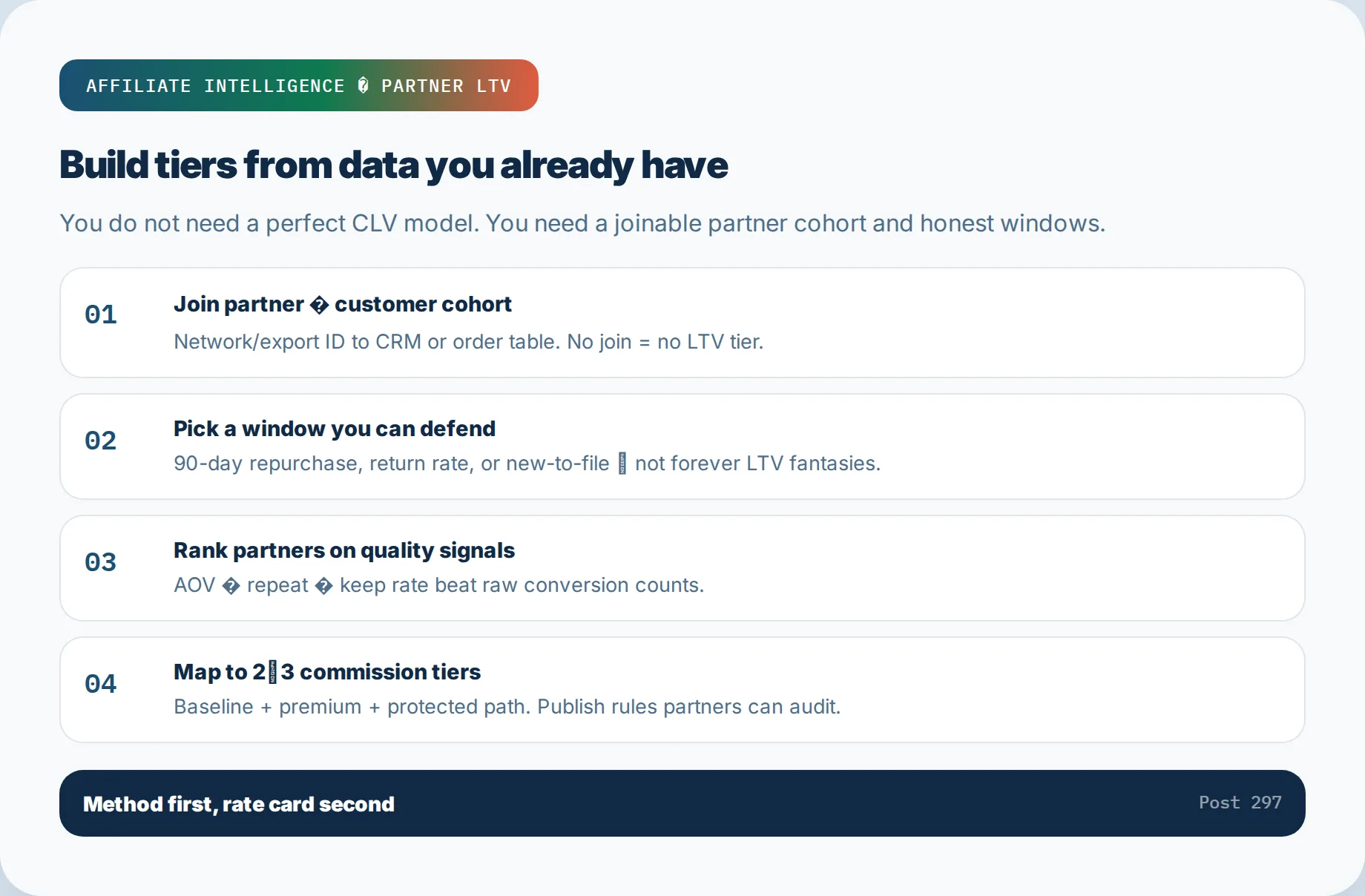
Get one sheet ready before touching the rate card. You need columns, not opinions: partner ID, first-order date, cohort revenue by month, refund window, margin per order, and a written new-to-file (NTF) definition. The NTF definition is not a vibe. Write one sentence: new means first-ever purchase date, or first order in 24 months. Get finance, marketing, and the affiliate manager to sign that sentence. If you cannot write it, any partner LTV number is theater.
Match the pending period to the refund policy where your platform documents it. Rewardful’s default pending period is 30 days following the sale, and its documentation recommends setting the pending period to match your business refund policy — for example, a 90-day refund policy should mean a 90-day pending period. The point is not the number; it is that the payout clock must equal the clock during which the customer can still walk away. If refunds process after payout, you handle overpayment manually, which is exactly the manual work the gate should prevent. Rewardful’s pending-period documentation states the rule plainly.
Why this matters: without the sheet, you will redesign the rate card from memory, and memory rounds the bad terms up and the lock windows down. A hold period is not a pause; it is the only time you can still reverse a payout without chasing it. The sheet makes the hold explicit, tied to the real refund policy, not to the mood of the moment.
Checkpoint: Every partner row has partner ID, first-order date, cohort revenue by month, refund window, margin per order, and an NTF flag.
Flat Percentage Looks Neutral and Misprices Partner Quality
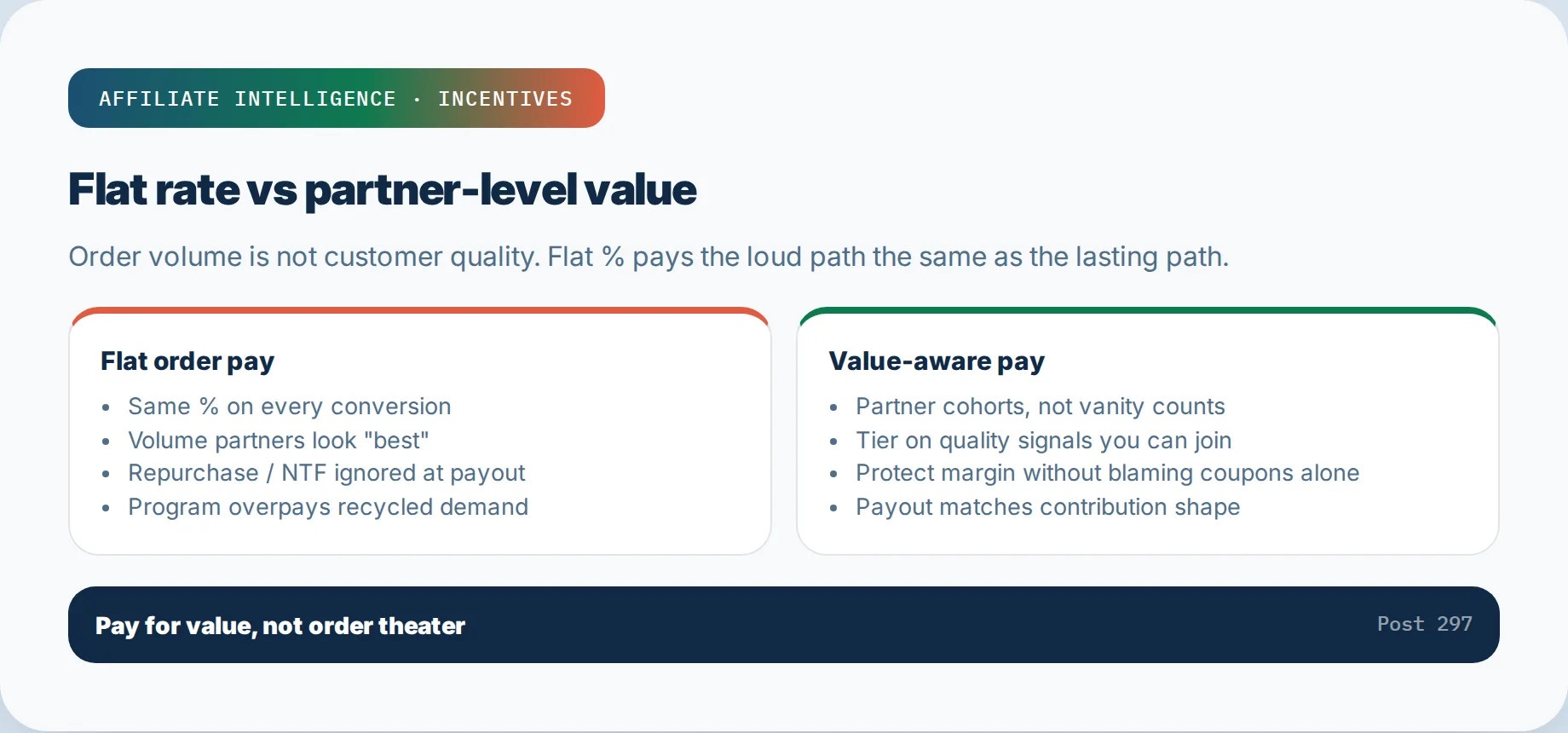
A flat order-based commission is a subsidy, not a price. It pays the same percentage for a customer who buys once and disappears as for one who returns for six quarters. That is volume fiction dressed as fairness.
Structural example. Two partners each send 100 first orders. Partner A’s cohort flattens after order one; Partner B’s cohort repeats and compounds. A flat commission treats both as identical. They are not. Different job, different pay: content partners create demand; checkout-layer coupon partners capture it. Paying both the same slice ignores where demand originated. This is not a morality claim; it is arithmetic. The flat rate is a tax on creation and a subsidy for capture.
The deeper margin-fit question is whether the sticker rate matches the unit economics at all. The program economics sustainability guide walks through yield versus sticker price: a rate that looks competitive in a competitor deck can be underwater once refunds, margin, and cohort behavior land in the same column. Chasing competitor rates inherits their unknown economics; grounding rates in your own LTV, CAC, and margins is the only repeatable path.
Why it works: once you name the mispricing as a model problem, you stop trying to fix it with a better percentage and start fixing the structure. A percentage change on a broken model is a louder version of the same error.
Checkpoint: You can state which partner types the current flat model overpays and underpays, using your own order and NTF data.
Join Partner-Level LTV, Not Blended LTV
Stop paying off blended LTV. Blend hides who earns uplift. Join affiliate ID to orders, then to retention or gross profit. The raw material sits in your OMS and affiliate exports; no new stack required.
SELECT
  a.affiliate_id,
  DATE_TRUNC('month', o.first_order_at) AS cohort_month,
  COUNT(DISTINCT o.customer_id) AS customers,
  SUM(o.revenue) AS cohort_revenue,
  SUM(o.gross_profit) AS cohort_gross_profit,
  SUM(CASE WHEN c.first_seen_at = o.first_order_at THEN 1 ELSE 0 END) AS new_customers
FROM affiliate_attribution a
JOIN orders o ON a.order_id = o.order_id
JOIN customers c ON o.customer_id = c.customer_id
GROUP BY 1, 2;
Then flag new-to-file. The definition matters: new means first-ever purchase date, or first order in 24 months. Write one sentence; get finance, marketing, and the affiliate manager to sign it. If you cannot, partner LTV is theater. The new-to-file quality proxy article makes the case plainly: a dashboard without an NTF column is incomplete, because revenue rankings often favor checkout-layer partners while content partners drive true first purchases.
Spreadsheet fallback matters. If SQL is not available this week, export partner IDs and order IDs, then map once in a spreadsheet with a vlookup or index-match. Partial mapping is worse than none; reconcile unmatched IDs before paying anything on the join. The join is not decorative. It is the scoreboard that shows whether a partner’s revenue flattens after order one or compounds.
Why it works: the partner-level join surfaces the curve per partner — does revenue flatten or repeat? That shape, not the first-order total, is what you should pay for. Sort partners by cohort gross profit per customer at 90 or 180 days and the mispricing from the flat model becomes undeniable.
Checkpoint: You can sort partners by 90- or 180-day cohort gross profit per customer, and the NTF flag is applied.
Caps and Windows: Bound the Promise
Lifetime without known churn is a permanent margin leak. If you cannot see the retention curve, do not write lifetime. Pick a structural bound.
Options:
- First-year-only. Partner earns on months 1–12, then nothing.
- 12–24 month fixed window. Same logic, longer tail.
- Amount cap per referred customer. Stop when partner has earned X dollars or X orders.
For recurring programs, the headline rate means little without the lifetime rule. Track360’s recurring commission economics comparison works the example: on a $100/month plan at 30% over a 20-month average tenure, lifetime commission costs $600 (30% of revenue); a 12-month fixed window costs $360 (18%); and a tiered front-loaded model costs $270 (13.5%). The percentage never changed. The lifetime rule changed everything. That is the point: you design the rule, not just the rate.
payout_model:
  type: capped_recurring
  window_months: 12
  cap_amount_per_customer: null
  cap_orders: 3
  scope_note: "Read plan terms before promising lifetime."
Why it works: caps convert an open-ended promise into a forecastable cost. Finance can book a liability. The commission engine should enforce the rule automatically; spreadsheets cannot hold it once partner count passes a handful.
Checkpoint: You have chosen either first-year, 12–24 months, or a hard amount/order cap, and written the scope assumption.
Front-Load Then Taper: Acquisition Incentive Without Forever Liability
Pay a higher rate while the partner’s work is actually happening — the first cycle — then taper. Do not carry that high rate into renewal years the partner did not earn.
commission_schedule:  # illustration; shape matters more than the exact rate
  first_cycle:
    rate: 0.30
    duration_months: 6
  subsequent:
    rate: 0.15
    duration_months: 6
  tail:
    rate: 0
Why it works: this is the acquisition tool, not a forever annuity. The partner sees a strong early number; the P&L sees a bounded one. For SaaS, a front-loaded taper keeps the effective rate lower than the sticker. Track360’s lifetime comparison is the clearest live explainer: same headline, three different effective costs. The shape is the point, not the exact rate.
If you run a subscription product, consider first-year-only high instead: all the incentive, no renewal liability. The customer becomes pure margin after month twelve, which is exactly where the long-tail profit lives.
Checkpoint: First-cycle rate and tapered ongoing rate are written, with durations and the zero point.
Start Conservative, Raise Later
Do not launch at the model’s midpoint because the midpoint feels right. Start below it. Set a documented raise trigger tied to retention evidence, not partner pressure.
Network rate-cut governance matters. Some networks and agreements limit how fast rates can change — and a merchant that can cut rates unilaterally with minimal notice creates a planning risk for partners running paid traffic. Digistore24’s affiliate agreement breakdown advises looking for agreements that require at least 30 days’ notice before commission changes. If your network’s publisher terms spell out rate-change rules, read them before launch. That constraint means your first rate is harder to reverse than you think.
base_rate: 0.20  # placeholder, not universal
raise_trigger:
  partner_cohort_retention_90d: ">= 0.70"
  refund_rate_below: 0.08
  review_cadence: quarterly
Why it works: you preserve room to raise without a cut. A cut is governed and painful; a raise is a reward. Start conservative and let the retention data earn the bump.
Checkpoint: Your base rate and raise trigger are in the same document as the payout model.
Retention / Refund Gates: Do Not Pay LTV on Unvalidated Activations
Early LTV gates invite fake activations. A partner chasing a first-cycle bonus can drive signups that cancel at the refund deadline. Paying LTV before that risk clears is paying for fiction.
What do you change? Hold validation aligned to your refund window, not your eagerness to show partners they are paid.
validation_gate:
  pending_days: 30
  refund_window_days: 30
  activation_rule: "paid_at_least_once and not_refunded"
  chargeback_lookback_days: 60
Rewardful’s pending-period documentation is blunt: set the pending period to match your refund policy — e.g., 90 days for a 90-day policy. If refunds process after payout, you handle overpayment manually. Hold periods of 30–60 days before a recorded commission becomes payable eliminate most retroactive reversals; the clawback taxonomy guide covers the full trigger set — chargebacks, self-referrals, KYC failures, bonus abuse, and dormancy — and notes that a well-designed hold period removes 60–80% of situations that would otherwise require a clawback. For physical products, the keep-rate math explains why you pay on kept revenue, not sticker price: returns eat the difference.
Why it works: the gate delays only the incentive, not the truth. It pays LTV on validated activations.
Checkpoint: Your refund window and gate duration are the same number, and the activation rule is written in the terms.
What Breaks on Implementation
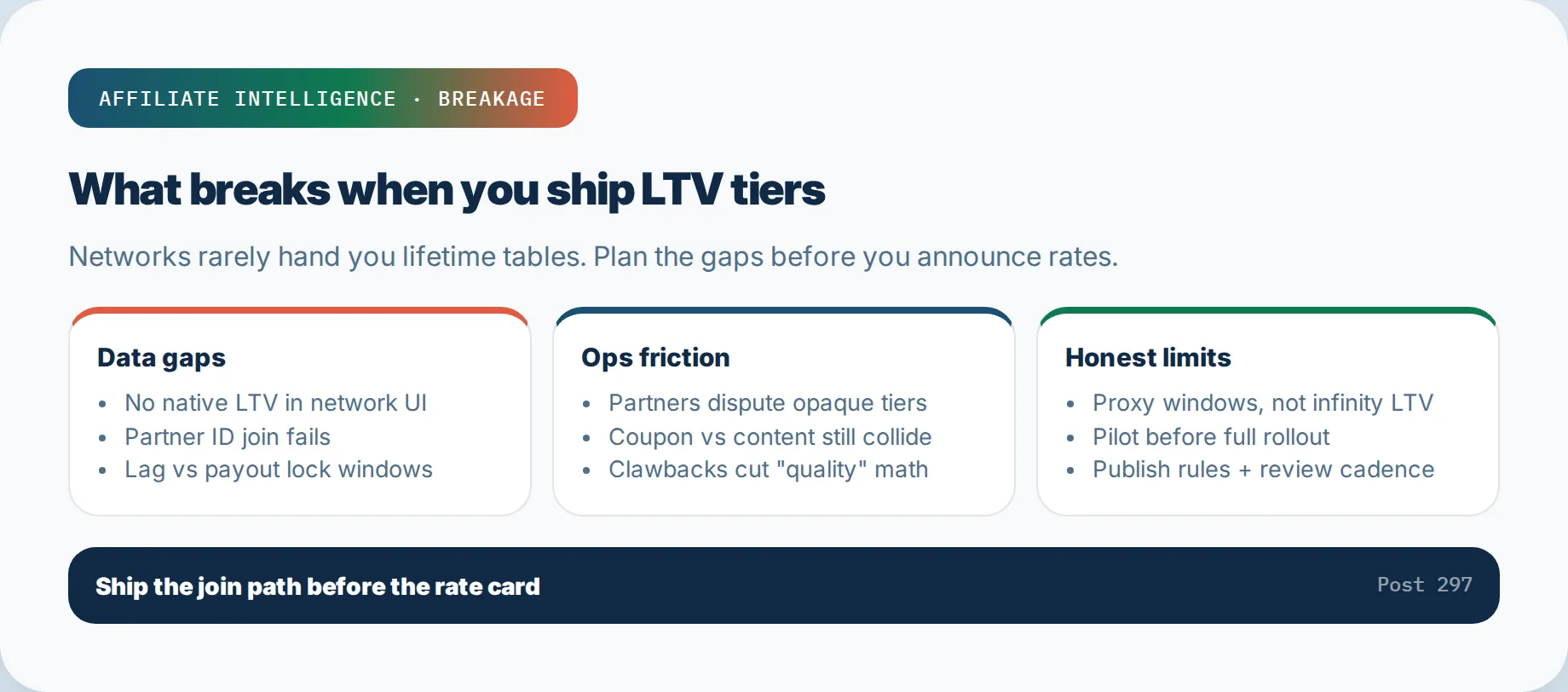
Most LTV rollouts fail in the plumbing. Name the failure points before the first payout.
- No native network LTV. Your network export may not expose partner-level LTV, so you will have to join IDs across systems. If that mapping is partial, you silently drop partners from the cohort. Reconcile unmatched IDs before paying anything on the join.
- Coupon/discount cohorts. A coupon partner can look high-LTV while actually intercepting decided buyers. The coupon cohort breakage guide separates additive from capture with five signals. Last-click can reward coupon partners for the final touch on 20–40% of sales other channels created.
- Fraud/stacking smells. Lifetime-tier promises widen the fraud surface; self-referral rings and fake activations collect annuity. Cohort monitoring flags abnormal churn. The clawback taxonomy names the reversal triggers. Prevention work often recovers 10 - 25% of leaked marketing budget, per Tapfiliate’s fraud prevention guide, though invalid-traffic rates vary widely by program and vertical.
- Attribution collisions. Last-click overwrite mislabels the work. If a checkout extension overwrites a content cookie, you tier rates on an attribution model that already mislabels jobs. The extension overwrite guide and Digiday’s Honey scandal coverage document the pattern: browser extensions can quietly influence attribution even when the user declines the pop-up, and Impact.com removed Honey’s extension after an investigation uncovered attribution manipulation.
- First-order loss. Ecommerce can lose on the first order and still win on measured cohort LTV — only if later value is measured. If you never join later orders, you will cut a partner who was profitable at month six. Platform dashboards show short-window attributed ROAS; cohort LTV reveals actual post-click customer behavior and repeat purchases. Cutting budget at day 14 because LTV looks flat misses repeat revenue that arrives at day 45. Ecommerce cohort LTV often needs 60–90 days to mature.
Why it works: a breakage map turns pretty tiers into implementation checklists. Each failure point gets an owner and an article or internal report.
Checkpoint: Each breakage point has an owner and a sibling article or internal report assigned.
This-Week Glue and Troubleshooting Common Issues
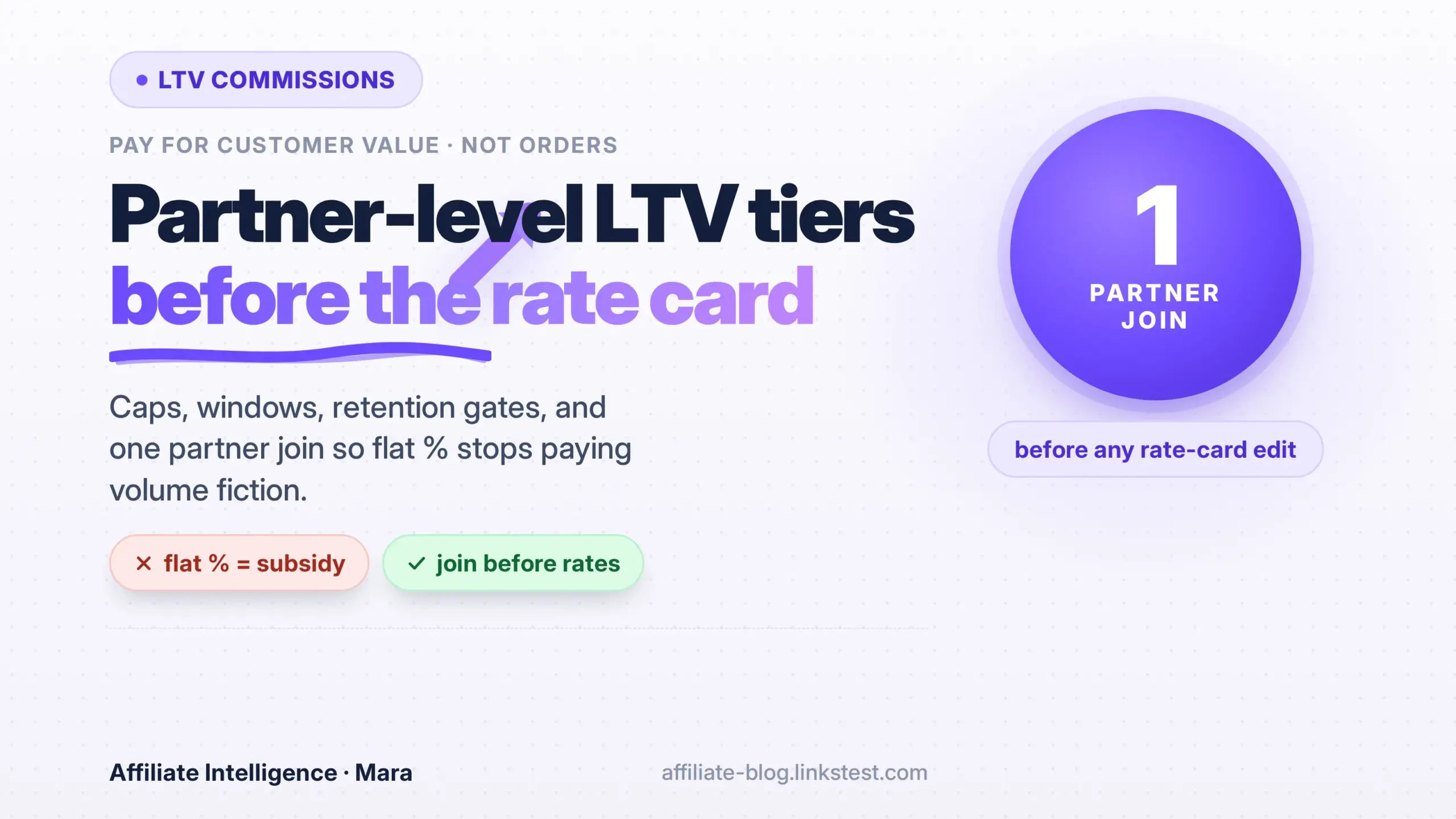
Do not edit the rate card this week. Run one partner-level LTV or NTF join instead. That join will tell you whether the tier structure is a design problem or a measurement problem.
Common issues and exact fixes:
- No partner-level join in your network. Export partner IDs and order IDs, then map once in SQL or a spreadsheet. Reconcile unmatched IDs before paying anything on the join.
- NTF flag says “maybe.” Write the one-sentence NTF definition. New means first-ever purchase, or first order in 24 months. Get finance and marketing to sign it before any payout hinges on it.
- Lifetime commission on a product with unknown churn. Replace lifetime with a 12-month or first-year window, then revisit when you have two full cohort years.
- Payout before refund window closes. Set pending period equal to refund window. If refund policy is 90 days, gate at 90 days.
- Tier threshold gaming. Cap the bonus and audit boundary cases quarterly. The threshold becomes the target; audit it.
- Rate cut impossible because network governance. Start conservative. Read the network’s rate-change rules before launch, and document the raise trigger instead of a cut trigger.
Checkpoint: One join scheduled before anyone touches the rate card.
FAQ and Next-Week Join Questions
When are flat rates still fine? Early program, consistent catalog, last-click only, no partner-level data yet. Flat rates are not inherently wrong; they are a starting point, not a finished structure. The switch to LTV tiers matters when you have enough cohort data to see the curve per partner.
Profit vs revenue LTV. Use gross profit, not top-line revenue, for commission ceilings. Revenue-based LTV overstates acquisition capacity; margin-adjusted LTV reflects the profit you can actually spend. The formula is monthly ARPA × gross margin ÷ monthly churn — a customer with 3% monthly churn lasts roughly 33 months.
When should you stop inventing tiers and fix measurement first? If you cannot produce a partner-level join this week, stop designing the rate card. Measurement is the gate before the structure. A tier designed on blended data is a fancier version of the same mispricing.
What is the this-week assignment? One partner join, not a redesign. Run the partner-level LTV or NTF join before any rate-card edit. The join will tell you whether the problem is structure or measurement.
Next-week join questions to answer:
- Which partner IDs failed the join, and why?
- Which NTF flags are still “maybe”?
- Whose 90-day cohort gross profit per customer clears the raise trigger?
- Who is profitable at month six despite first-order loss?