Chatbot-Driven Affiliate Sales Funnels with NLP: Build, Track, and Avoid Attribution Traps
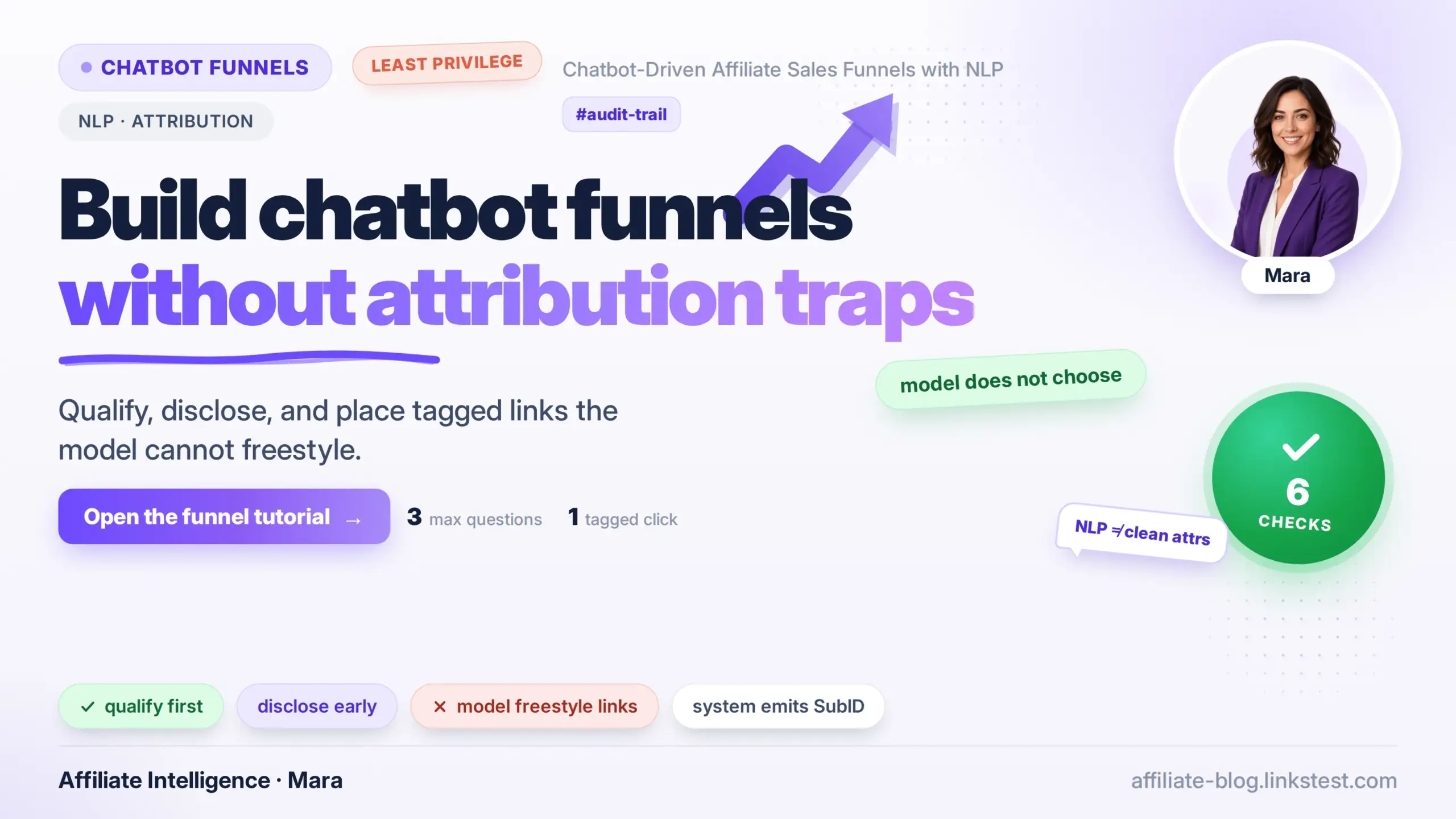
Operators often assume a chatbot plus NLP equals clean monetization. It does not. The control surface decides whether you earn commissions or silently erase them. This tutorial walks the build in order: qualify first, route a recommendation, disclose before the showcase, place tagged links the model cannot freestyle, then defend the last click.
Prerequisites
Gather four things before building anything.
First, know the entry channel. A website widget, Instagram DM, voice assistant, and checkout assistant are different surfaces with different disclosure and link rules. Second, build an offer list where every URL is already tagged with a SubID or click ID and a UTM. Third, write one disclosure line you can reuse in chat, not a footer-only sentence. Fourth, decide the handoff path for users the bot cannot qualify.
Keep the stack minimal. One chat surface, one quiz or template flow, one offer list, one tracking report. Do not connect a general-purpose LLM to your merchant program without an allowlist.
The failed assumption starts here: operators treat chatbot + NLP as clean monetization. It is not clean. It is a control problem.
[Checkpoint] You have a one-page evidence pack with entry channel, tagged offer list, disclosure line, SubID/UTM plan, and handoff path.
Failed Assumption: Chatbot Plus NLP Equals Clean Monetization
A common failure mode is buying the hype that an open LLM conversation will qualify, recommend, disclose, and attribute all by itself. It will not. An LLM is a probability engine, not a deterministic sales clerk. When a model picks links from memory or invents a clean merchant URL, the attribution trail dies before the redirect hop.
Think of the chatbot as a funnel architecture, not a conversational companion. The product is the control surface: a short deterministic qualification flow feeding a curated offer set. The NLP layer should parse intent, not pick products. If the model owns last-click placement, you are running an unpaid product page.
Structural scenario: a publisher launches a chat assistant that answers product questions with freeform text and pastes affiliate links from its training data. Clicks look healthy. Commissions stay flat. The model never emitted a SubID. The source of the problem was not model quality. It was the absence of a link-emission boundary. The operating test is whether the model can recommend but cannot choose the destination URL.
[Checkpoint] You can classify a chatbot funnel by its control surface, not by how many NLP features it has.
Qualify Before You Dump Into an Offer
Goal: stop sending chat leads into an offer dump. Ask a maximum of three intent questions before any recommendation.
The first reply is where most funnels fail. If the opening message contains an affiliate link, you have built a junk drawer, not a qualification gate. Ask three short questions instead: use case, budget or timeline, and one constraint. Multiple-choice answers work better than free text because they keep the flow deterministic.

Every question you cut preserves completion. Keep the gate short. If a user refuses to answer, route them to a human or a resource page. Do not force a recommendation.
Why this works: qualification separates tire-kickers from buyers before a commission link appears. It also gives you a reason to place a specific offer later. A user who said “migrating from competitor X, budget under $50/month, need it this quarter” gets a different recommendation than a user who said “just browsing.”
[Checkpoint] You have a three-question qualification gate and a handoff branch. No affiliate link appears before the gate closes.
Deterministic Quiz Beats Open LLM in Production
Goal: lock the live path to a quiz or template. Use the LLM only for strategy, not production link choices.
Open chat is useful for brainstorming offer angles and drafting quiz copy. It is wrong for picking products and URLs at runtime. A controlled quiz with fixed answer branches is deterministic. An LLM generating product picks on the fly is not.

Here is the production split:
LLM brainstorm -> quiz/template live path
fail: open chat picks products and URLs
Use a keyword or intent filter before the NLP layer. If a user’s first message is “refund policy” or “order status,” route to support, not to an affiliate flow. The NLP layer should score intent, not trigger a product dump. Run a strict filter first: buying-intent keywords enter the funnel; support keywords exit.
Why this works: a deterministic flow emits the same recommendation for the same inputs, which makes tracking possible. An LLM wrapper around a fixed quiz still feels conversational but does not vary on the parts that matter. A hybrid keeps costs down and auditability up.
A structural scenario: a publisher builds an open chat that answers “best running shoe for marathon training.” The model produces three different product sets across three sessions. None carry a SubID. The operator cannot tell which answer drove any sale. Locking the product set to a templated quiz solves that. For the next layer beyond the quiz, the AI content personalization at scale without creepy tracking guide covers module-level personalization without silent tracking.
[Checkpoint] You have a live path where the LLM may suggest strategy but the production flow is a templated quiz with fixed branches.
Route Recommendations, Do Not Lecture
Goal: answer the ask with two to four options, not a wall of text.
A chatbot is a routing interface, not a content essay. When a user asks for a recommendation, acknowledge the specific constraint they named, then present a short list. Two to four options. No more. Each option is a product card or a one-line summary, not a paragraph. The user clicks or asks a follow-up.
Why this works: routing reduces decision friction. A long conversational answer buries the affiliate link and triggers support questions. A short list keeps the click and the SubID near the user’s intent. If the user needs detail, offer a “Why this?” expandable panel. That panel can carry specs, not another pitch.
A routing flow that works does not answer “what is the best X” with a 300-word essay. It should say: “For your budget and timeline, these three fit. Want me to compare?” Then it stops.
[Checkpoint] Your bot recommends two to four options and stops. It does not lecture.
Disclosure Before the Showcase
Goal: place disclosure before the first commercial recommendation, not in a footer.
Disclosure in chat is different from a blog disclosure. A session-start banner alone does not travel with later recommendations. Place a short inline disclosure next to the first product card and again on merchant change. 10 to 16 words. Plain English. Avoid “sponsored links” when you mean “we may earn a commission.”
Example inline copy: “We may earn a commission if you buy through these links.”
Proximity matters because the FTC test is whether a reasonable consumer actually receives the information, not whether a disclosure exists somewhere (FTC disclosure guide). A user who sees the disclosure at the moment of influence can make an informed click. A disclosure buried behind a settings icon functionally does not disclose. One anonymized pilot across 210,394 chat sessions reported product CTR +6.8% and revenue per session +3.2% when disclosure was layered at the first recommendation rather than hidden (Brambles.ai disclosure pilot). That is a design pattern, not a universal guarantee.
Confirm compliance with counsel where needed. This tutorial covers placement hygiene, not a jurisdiction-by-jurisdiction legal map.
[Checkpoint] Your bot shows a short disclosure inline before the first product card and repeats it on merchant change. Voice interfaces speak the disclosure aloud.
Least Privilege for Affiliate Links
Goal: let the model suggest an option, then have the system emit a curated tagged URL. The model never chooses the last click.
The architecture is a click path, not a free-form link generator. The model receives a curated offer set with tagged URLs. It can suggest a SKU or an option. The system then emits the correct SubID/UTM URL. The model never pastes a merchant URL from memory. This is least privilege.

curated tagged link set -> model suggests SKU/option -> system emits SubID URL
fail: model invents or pastes clean merchant URLs
Why this works: the model output becomes a suggestion, not an instruction. The code owns the URL. A prompt injection or hallucination cannot silently strip your SubID because the model cannot select the destination. The OWASP Top 10 for Large Language Model Applications recommends enforcing privilege control in code rather than giving the model tokens. The same logic applies to affiliate links.
Your audit trail is the SubID on every outbound. If you need to run paragraph-level CTR tests with SubIDs later, the LLM intent scoring and SubID CTR tests guide covers that separately. For this build, verify one controlled test click lands in the network report with your SubID before launch.
[Checkpoint] Your bot can say “I recommend option B.” The system, not the model, emits the tagged link. A test click shows your SubID in the network report.
Last-Click Leaks and Support-Bot Traps
Goal: protect the commission trail from client-facing bots and support channels.
Last-click attribution gives the full commission to the final tracked touchpoint. If a support bot or a client-facing assistant pastes a clean URL after your affiliate click, that support bot can overwrite your commission. The same risk appears when a user asks a retailer’s own assistant for help after clicking your link. Last-click is the model many affiliate programs default to.
A pre-launch behavior review catches this. Run a set of sessions where a user opens your affiliate link, then asks a support bot a follow-up. Check whether the support bot overwrites the click ID. If it does, you need a handoff rule: support conversations must not emit untracked product links.
Why this works: the model’s output is just text. Your commission lives in the redirect and cookie chain. A chatbot that answers “click this link” with a clean merchant URL is a commission leak. The conversion drop funnel diagnosis checklist covers the six-hop chain when clicks are healthy but payouts are not. The predictive offer selection without last-click lies guide explains why last-click attribution often hides who created the decision. The AI agents running affiliate campaigns: what actually breaks guide maps the failure modes when agentic tools get too much agency. For a different channel, the YouTube affiliate funnel views are not commissions guide shows why surface views and actual commissions can diverge.
Structural scenario: a publisher’s quiz funnel sends a user to Merchant A with SubID quiz_flow_01. The user then asks Merchant A’s on-site assistant, “Will this fit my laptop?” The assistant pastes a clean product URL. The user buys from that second click. The publisher gets nothing, even though the original referral created the sale. That is not a traffic quality problem. It is a support-bot leak.
[Checkpoint] You have a pre-launch behavior review that tests support bots and client-facing assistants for clean-link overwrites. Any support surface that can emit product links is excluded from last-click-sensitive flows.
Troubleshooting Common Issues
Five common error patterns and the exact fix.
- First reply is an affiliate dump. Fix: remove the link. Add three intent questions before any offer.
- Model emits varying product sets. Fix: lock the live path to a templated quiz. The LLM can brainstorm strategy, not pick SKUs at runtime.
- Disclosure appears only once at session start. Fix: add inline disclosure on the first product card and repeat on merchant change.
- SubID blank in the network report. Fix: check the network’s exact parameter name. ShareASale uses
afftrack, Awin usesclickref, Impact usessubId1. Test one click and verify before launch. - Support bot overwrites the attribution. Fix: route support questions to a handoff that never emits untracked product links. Review pre-launch.
When a conversation needs nuance, hand the user to a human with the full chat context. Do not let the bot keep pitching. Offer integrity matters. Qualify first, disclose before the showcase, place tagged links the model cannot freestyle, then measure beyond last click. Treat a chatbot as a controlled funnel, not a conversational companion with a commission problem.