SubIDs in affiliate marketing: a complete guide to advanced tracking and attribution
In subid affiliate marketing, operators run entire campaigns tagging only UTMs, then open the network report and cannot answer the only question that pays: which placement actually produced the commission? That is not a data gap. That is a metadata gap. A SubID is the label you attach to a click, stored server-side by the network or tracker, and returned in the payout report when a conversion fires. It is not a universal query string. It is a contract with your tracking stack, and most operators break it before the first click.
The expensive mistake: treating SubID like a universal query string
Operators often assume a query parameter is a query parameter. They append subid=homepage, hit save, and wait. Thirty days later they have two structurally different pictures. A UTM-only campaign shows total clicks and total conversions, but cannot split hero placement from footer placement. A SubID-tagged campaign returns that split inside the network’s own conversion rows. The difference is not volume. It is whether your label survived long enough to matter.
Subids in affiliate marketing are not a universal key that any network reads. Manual SubID append works only when the network or advertiser accepts it. Most of the time, no, unless explicitly documented. ShareASale expects afftrack. Awin expects clickref. CJ expects sid. Impact expects subId1. If you hand-append subid= to a ShareASale link, the network silently discards the value. No error, no warning. The column stays blank and you misunderstand why.
A structural scenario proves the point without war stories. A user clicks an affiliate link on mobile. The link passes through a shortener, a network redirect, and a landing page with a fourth redirect. Somewhere in that chain a 302 drops the query string. The client-side ID never lands. The user converts anyway. The network shows a conversion, but your tracking layer shows nothing labeled. You did not lose the sale. You lost the proof of where it came from.
The thesis is simple. A SubID is metadata you define that persists inside the network or tracker chain. It is not analytics decoration. It rides with the click through redirects, into the network’s storage, and back via postback or report export. The parameter name is not yours to choose. The value is. That split is the whole game. Per the Coinis tracking glossary, SubIDs are the only piece of an affiliate link the publisher fully owns; the network dictates the offer ID, click ID, and destination URL. What remains is the publisher’s private analytics layer.
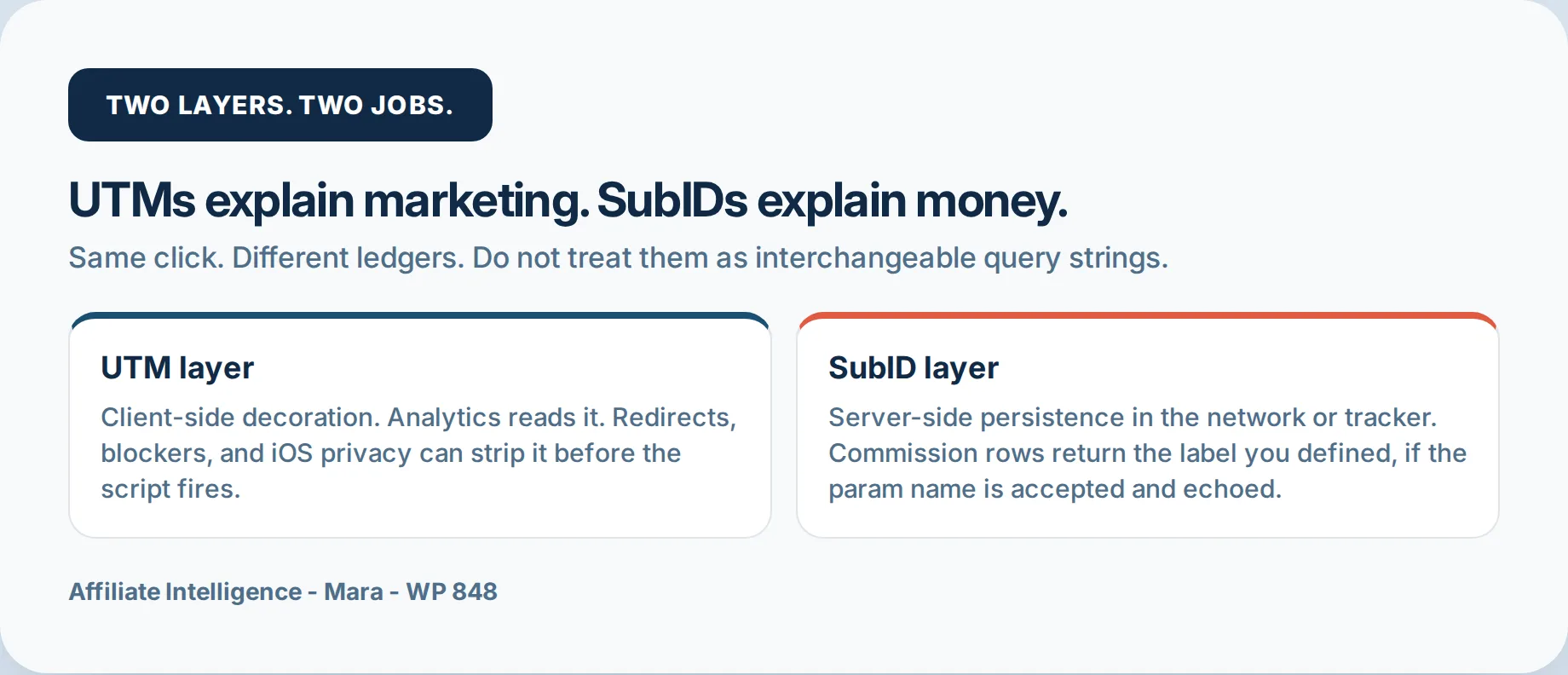
UTM layer vs SubID layer (analytics vs payout)
UTMs are client-side decoration. They live in the browser URL, read by your analytics script. That visibility is their failure mode. Redirects strip them. Ad blockers block the analytics script. iOS and Safari privacy rules eat known click IDs in private browsing. A UTM that never reaches the analytics call is just a string that did not matter.
SubIDs work differently. The network stores them server-side and returns them in conversion reports or postbacks. When implemented correctly, a SubID survives the redirect chain because your redirect server persists it forward. It does not rely on the browser to report anything.
The clean URL trap is real. Operators who tag campaign-only UTMs and leave SubIDs empty get beautiful analytics and zero payout truth. They know which session came from where, but not which placement earned the commission. That breaks future segmentation because the raw material never existed. The fix is not retroactive. You cannot backfill a SubID after the click.
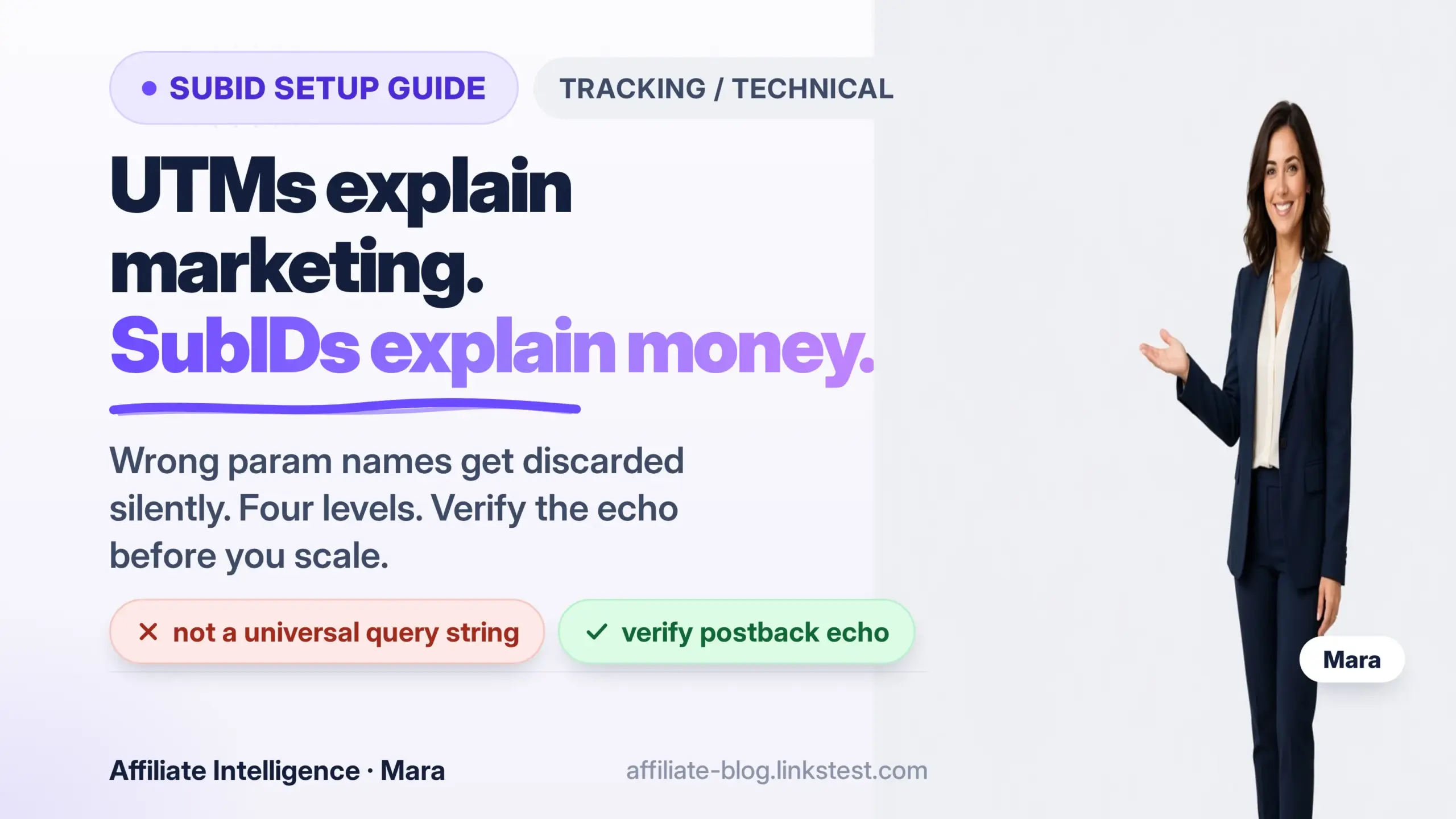
The quotable split: UTMs explain marketing. SubIDs explain money. One asks where the visitor came from. The other asks what got paid. Both can coexist on one link, but only the SubID feeds the commission report. For the bigger architectural decision on which ledger owns truth when dashboards disagree, read the server-side tracking guide. Before I trust a SubID report, I confirm which ledger it came from.
Five use cases that justify the setup work
Traffic segmentation is the first and most common reason. Pass source, placement, device, or hour through a SubID slot and you can cut a campaign by row instead of guessing. A paid campaign might be profitable as a total, but the network report grouped by SubID shows 80 percent of waste in a handful of placements. You cannot pause those placements if you never labeled them.
A/B testing merchants and creatives runs through dynamic SubIDs. One base link, one changing value. You see which merchant converts and which creative failed without rebuilding the link for every variant. The report answers the question directly because the label carries the test cell.
Commission negotiation with traffic-quality proof becomes possible. An advertiser who sees placement-level data from your SubID report can agree to a higher rate for the placements that drive quality orders. Without that proof, you have opinion. With it, you have a spreadsheet with rows that move money.
Fraud audit by source or sub-affiliate uses SubIDs to trace an abnormal conversion rate back to a specific sub-affiliate or placement. A network report grouped by your SubID shows the outlier in one row. A single SubID with a wildly improbable conversion pattern deserves a closer look before it inflates your payout.
The gclid loop is the highest-leverage use case for paid search operators. Pass the Google click ID through a SubID field, the network returns it on conversion, then you import that gclid as an offline conversion. The algorithm then optimizes on actual affiliate sales, not link clicks. That loop takes one SubID slot and a working postback. The silent filters that break the import live in the offline conversion diagnostic, not here.
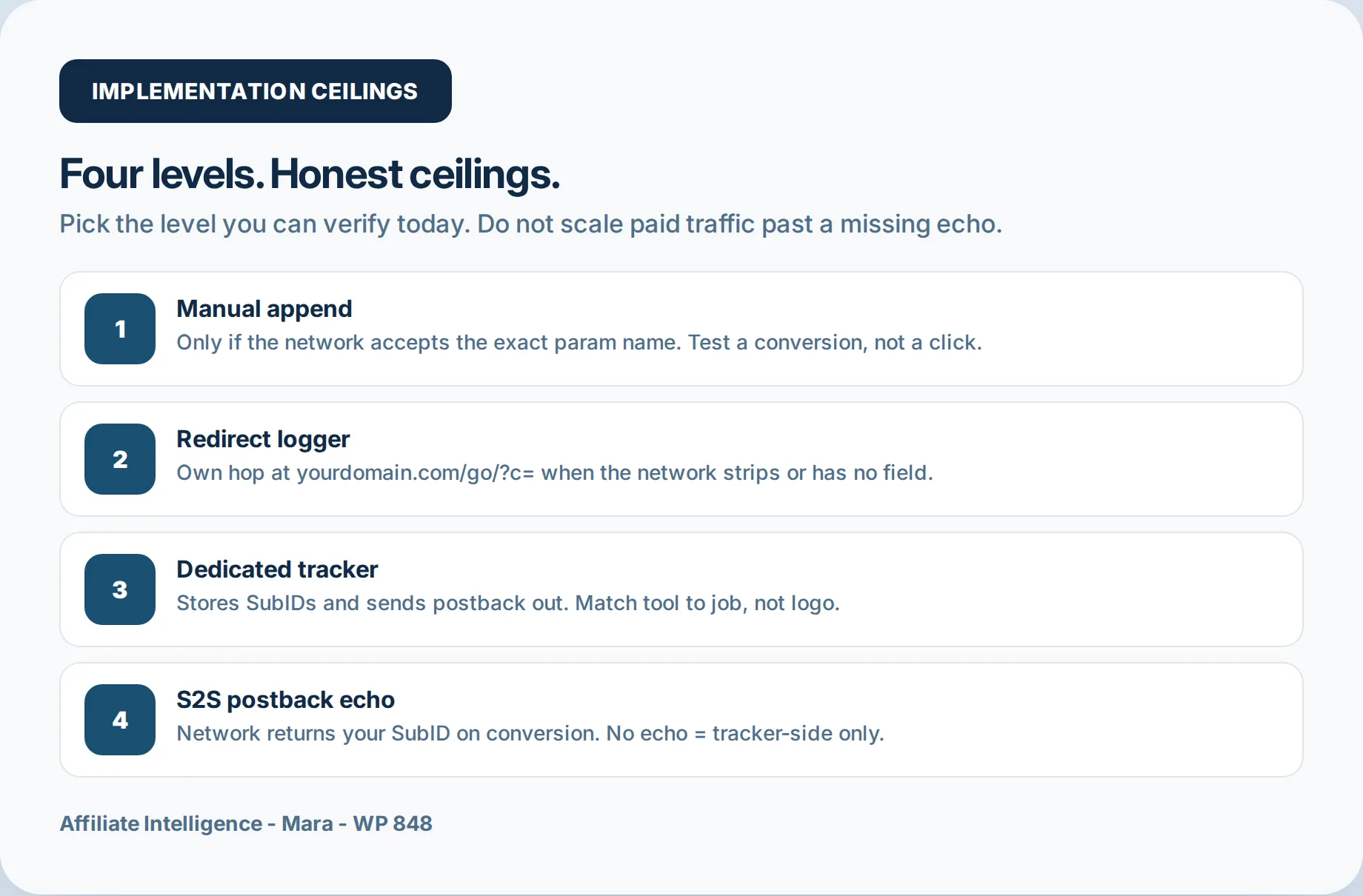
Four implementation levels (with honest ceilings)
Level 1: Manual SubID append. This works only when the network accepts hand-appended parameters. The parameter name is not universal. The table below is the baseline for five major networks.
Primary parameter documentation sits with each network: Impact, CJ Affiliate, ShareASale, Awin, and Rakuten Advertising.
Amazon Associates does not support SubIDs. Use Tracking IDs assigned per site, section, or campaign instead. That is the documented workaround, not a parameter hack, as Amazon Associates explains. Check live network docs before deploying because some programs require the Link Builder to position the SubID correctly. A hand-append can fail silently even when the spelling is perfect. Always verify with a test conversion, not a raw click. The value must appear in the network report after the conversion posts.
Level 2: Redirect or self-hosted logger. When a network strips manual parameters or has no SubID field, you need a hop you own. Run a minimal redirect at yourdomain.com/go/?c= and log the query string server-side before forwarding. A ten-line server pattern is enough: capture timestamp, campaign label, SubID value, user-agent, then issue a 302 to the affiliate URL. This does not force the network to participate, but it preserves your segmentation data when the network report stays blank. A link shortener with custom parameters is a lighter fallback for tiny tests, but it will not survive redirect chains that strip query strings.
Level 3: Dedicated tracker. The tracker holds SubID fields and sends the postback out. This is where campaign physics enter: rules, landers, cost sync. Do not buy from a logo list. The tool must read your network’s exact parameter name, store the value, and return it on conversion. The tool-fit guide and the tracker comparison cover that decision without a scoreboard.
Level 4: S2S postback echo. The full loop is click, SubID registered, network echoes the value in the conversion postback, tracker matches it. That is the only way you see the same SubID from your side and the network side in one record. The ceiling is honest: if the postback does not return your SubID, visibility stays tracker-side only and the network report still cannot be segmented by placement.
The hard rule: a vendor with neither postback nor SubID capability is not a paid-traffic partner. Do not scale paid traffic into a program that cannot return your label. The S2S failure map covers what a green tick actually means and where the echo dies.
Naming conventions at scale
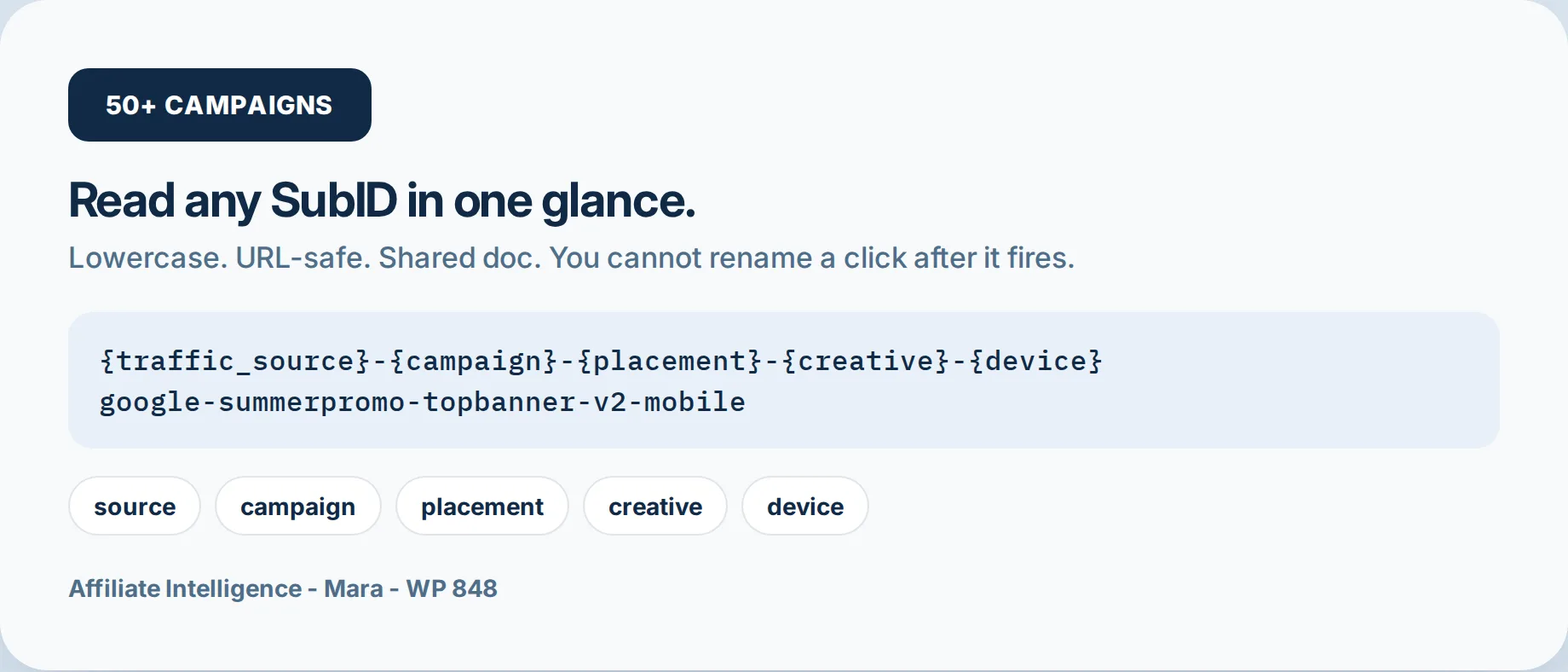
Once you hit 50 campaigns, naming consistency is the product. The template I recommend is simple: {traffic_source}-{campaign}-{placement}-{creative}-{device}. A real string reads google-summerpromo-topbanner-v2-mobile. You can read it instantly and so can anyone else on the team.
Keep values lowercase, URL-safe, and under length limits. Use hyphens, never spaces or special characters. I recommend a shared enforcement doc, not a Notion page nobody opens. List the slot meaning, the parameter name per network, and the exact grammar. When a new placement appears, the doc defines the value, not someone’s mood. A shared enforcement doc also blocks the collision trap described in the Coinis glossary: reused slot meanings across concurrent campaigns create false positives in optimization reports.
A badly named SubID cannot be fixed after the click. The click record keeps the old value. That is why the schema is a contract, not a suggestion.
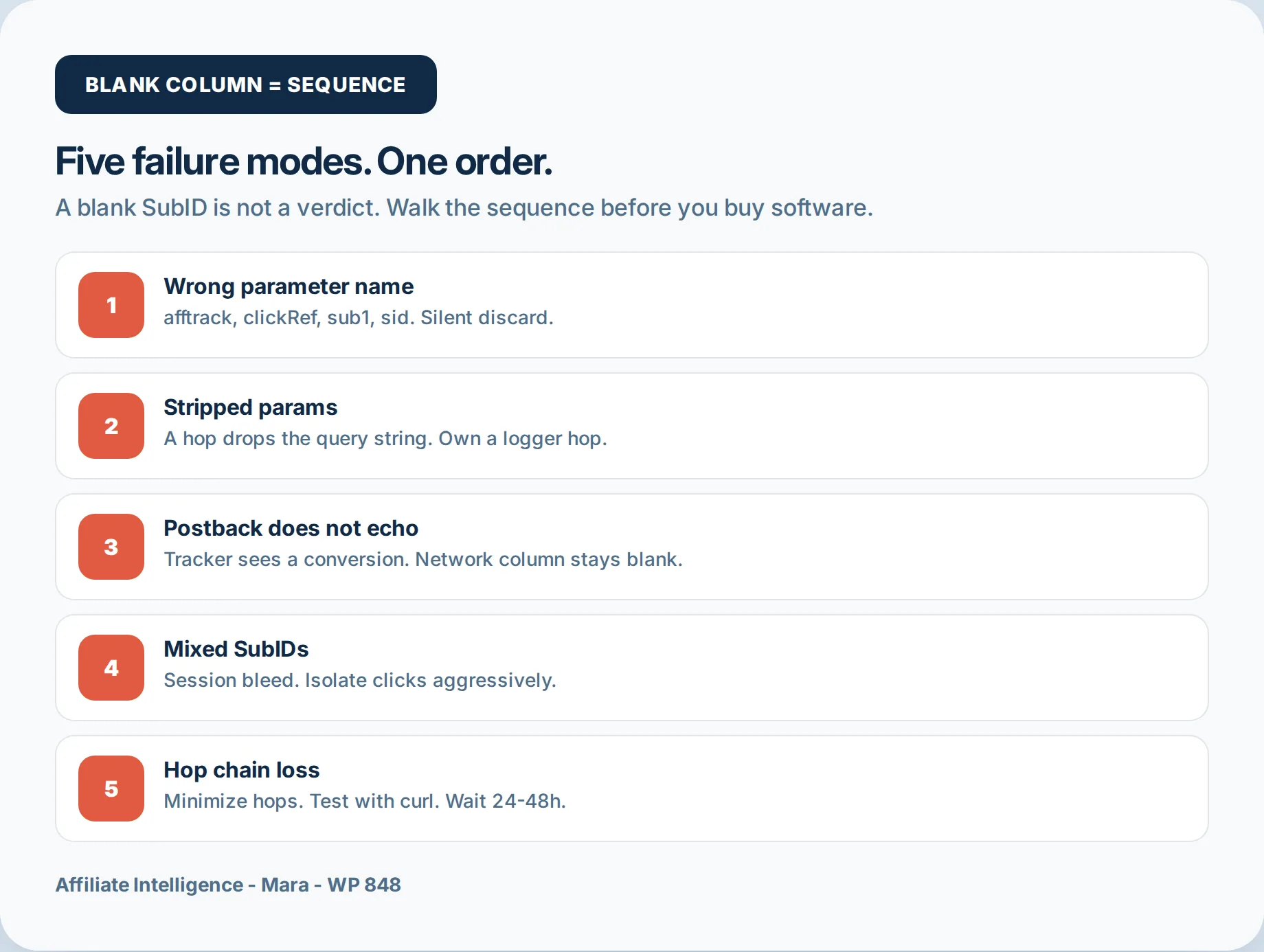
Troubleshooting: five failure modes
The wrong parameter name is the cheapest failure. You appended subid= and the network expected afftrack. The label had no receiver. Check live docs again, rebuild, retest.
Stripped params are the quiet killer. A hop points to a bare path and throws away everything after the question mark. The SubID exists on hop one and is gone by hop two. The workaround is the redirect logger you own: trace each hop and stop at the first one where the value disappears.
A postback that does not echo the SubID is the Level 4 ceiling again. The tracker sees a conversion, but the network report column is blank. Verify the raw postback payload. If the token is absent, the mapping is wrong, and no software purchase fixes it.
Duplicated or mixed SubIDs come from session or cookie isolation failures. Two clicks share a session and the values bleed together. Configure isolation aggressively.
Hop chain loss happens when hop three strips params. Minimize the chain and test with curl. Every extra hop adds latency that quietly eats conversion rate at scale.
The diagnostic sequence is one controlled click with a known ASCII label like subtest-20260824-placement. Confirm the exact parameter name from live docs. Build with the network Link Builder if required. Click once and capture the full redirect chain with query-string logging. Wait 24 to 48 hours before reading the report. If the column stays blank, compare against your owned log. Treat a blank column as a sequence, not a verdict. The blank-column deep dive walks each checkpoint in order.
Close the loop before spending. Label the click with a known ASCII value, verify the network echo, wait out the reporting lag, and read the payout report. If the label is absent, stop and fix the sequence. Only scale traffic into programs that return the label.
What SubIDs cannot do (honest gap)
Cross-device tracking is not solved by SubIDs unless the network supports a deterministic ID across devices. A SubID labels the click. It does not carry the identity.
Merchant redirect changes can silently break your carefully built chain. A merchant swaps a redirect flow and your SubID dies before the network stores it. You built the link, but the destination changed shape.
SubIDs do not prove incrementality. They show which placement converted and nothing about whether the sale would have happened anyway.
If the postback omits the SubID, merchant numbers and your numbers will not match. The network credits a conversion without the label, and no reconciliation closes that gap.
Finally, dashboards are not real time. Polling latency means a report can lag hours or a day. Do not optimize from a stale screen.
One-sitting setup checklist
Pick the level you need today, not the level you hope to need next quarter. Define the naming schema and write it down. Configure the SubID fields for the network’s exact parameter name. Verify the network receives the value on a test click. Configure the postback echo before scaling. Test one click with a unique label. Confirm the report row shows the label after the lag window.
The whole job should take under an hour the first time, minutes after that. If you skip the verification step, you are building theater. So build the contract, test the return path, and only then spend traffic. Label the click, verify the echo, read the payout report, and only scale traffic into programs that return the label. That is the entire discipline.
When the question is not naming architecture but which label the brand can see, use the SubID vs SharedID visibility guide - partner-private Sub ID versus brand-visible Shared ID, plus the one-test-echo protocol. This hub stays the naming system; that sibling owns the visibility job.