Affiliate Paid Traffic Tracking: Platforms, Setup & Pitfalls
Paid traffic to affiliate offers is not the same as paid traffic to your own checkout. You buy clicks into a path you do not fully control, and you get paid only if tracking and the offer economics survive production. This is the operating map: when paid is rational, which inventory to test, how to build a joinable tracking spine in 2026, and which failure patterns to open as deep-dives instead of rebuilding here.
Depth manuals: flat commissions despite better ad metrics, Meta bridge-page reality check, Google Ads offline conversion silent filters, and why approved campaigns still die. This piece will not teach ban evasion or account rotation.
Prerequisites: before you buy a click
Paid traffic does not invent a broken offer. If organic content cannot pre-sell well enough to cover payout minus refunds and tracking loss, ads only accelerate the loss.
Paid is rational when: contribution margin after a realistic CPC still clears, you control a landing or bridge you can instrument, and you can independently verify clicks and conversions. Organic-first is smarter when the offer cannot cover a modest CPC, you cannot get a readable conversion signal back, or you have no honest disclosure surface.
Cash runway. Validation and payout timing vary by program - some pay after a short return window; others hold for weeks before commissions become payable. Paid media invoices arrive on the ad platform’s clock. You are financing traffic before cash lands. Size spend to that gap, or insolvency is a math outcome, not a surprise.
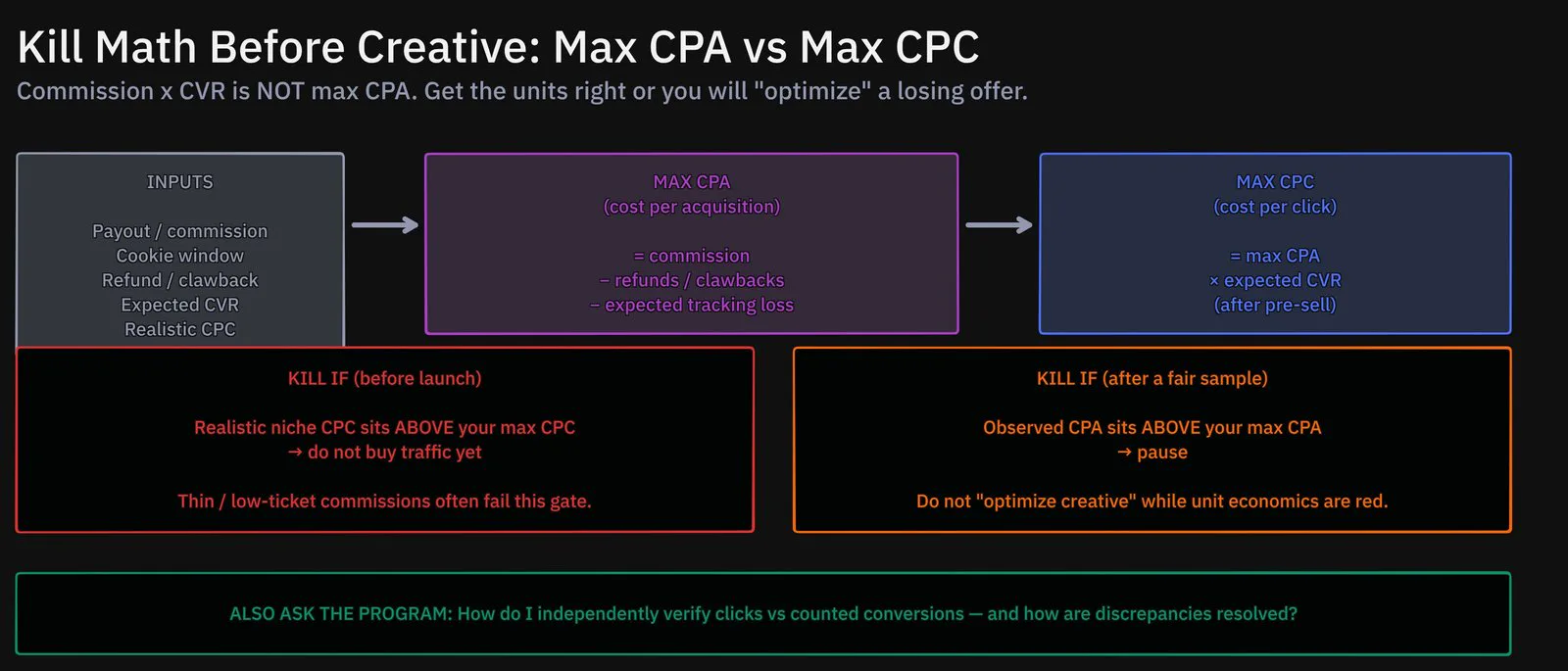
Ask the program: how do I independently verify that the clicks I send are the conversions you count, and what does discrepancy resolution look like? Vague answers mean the offer is untestable with paid.
Step 1: Platform reality (intent, interruption, policy)
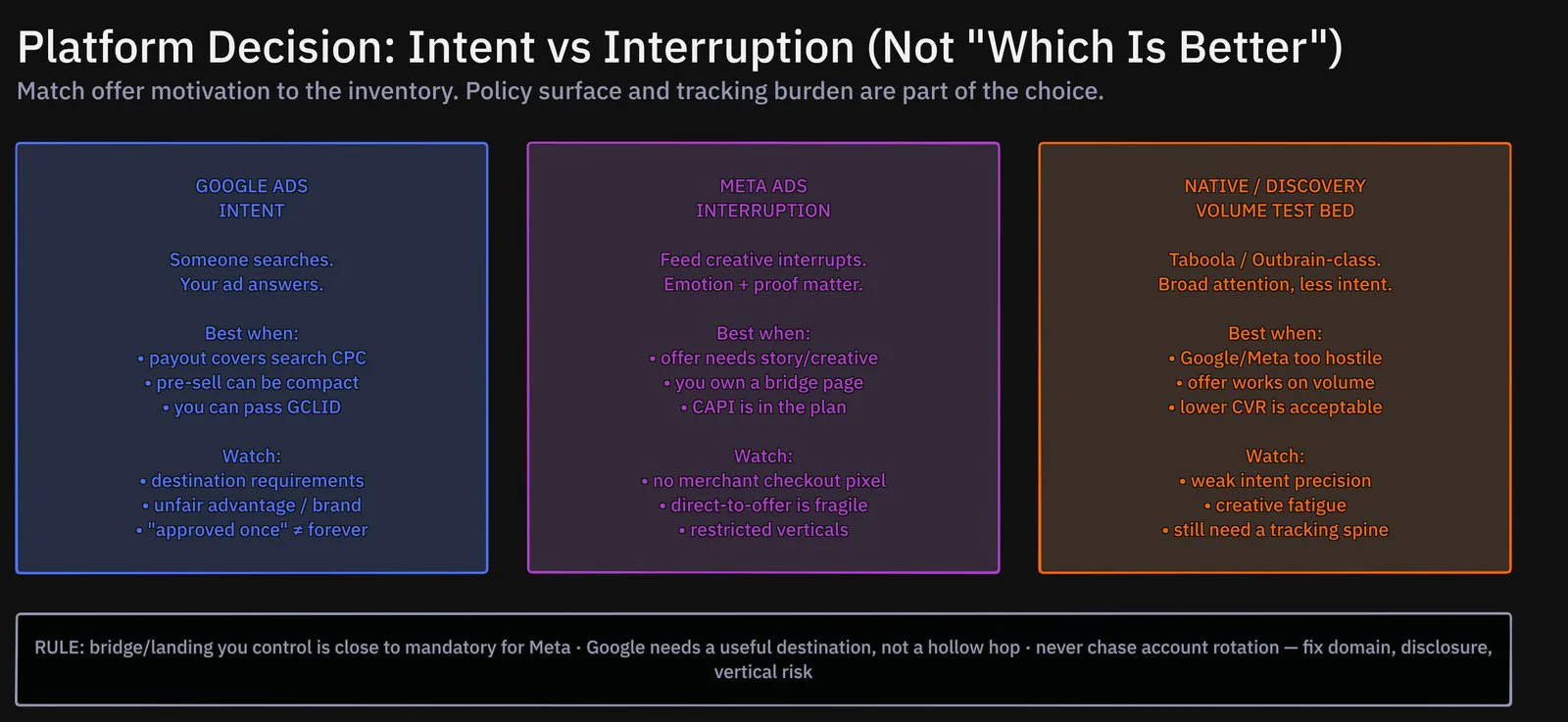
Google Ads vs Meta is not “which is better.” It is search intent vs feed interruption, policy surface vs creative burden.
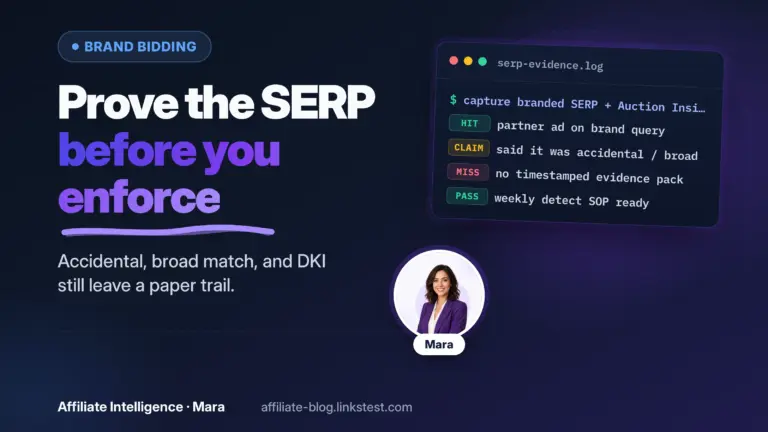
Google. Intent inventory. Current destination requirements require a functional, useful destination. Disapprovals include destinations solely designed to send users elsewhere and redirects from the final URL to a different domain. Your bridge must earn a click onward - do not auto-redirect. Destination requirements and Unfair advantage (affiliates advertising against applicable affiliate program rules, and double-serving) say violations do not suspend an account without warning; Google says a warning comes at least 7 days before suspension. That warning language does not cover the whole Misrepresentation family. Under Misrepresentation / unacceptable business practices, Google says accounts are suspended upon detection without prior warning, and you may not advertise again. That family also covers implying affiliation or endorsement by another brand and impersonating other businesses - the real risk when a bridge mimics the merchant.
Meta. Interruption inventory. Review Meta’s Advertising Standards before you scale a vertical. Direct-to-merchant affiliate links without a page you control are fragile for review and for tracking. A bridge you own is usually where disclosure, click-ID capture, and first-party consent live.
Native (Taboola / Outbrain class). Rational when search/social policy surface is hostile and the offer can absorb volume tests - not a precision search substitute. Confirm current advertiser / landing-page rules before you scale: Taboola’s Realize Advertising Policies, and Outbrain’s advertiser guidelines.
If account stability is the real fear, read the ban-risk deep-dive linked above and return with prevention (landing quality, disclosure, vertical risk) - not rotation tactics.
Step 2: Economics and kill math
Inputs before creative: commission, cookie / validation lag, refund or clawback exposure, expected CVR after pre-sell, realistic CPC or CPM.
Max CPA = commission after refunds, clawbacks, and expected tracking loss. Max CPC = max CPA x expected CVR. If niche CPC sits above max CPC, do not buy. After a fair sample, if observed CPA exceeds max CPA, pause.
Minimum sample. Pre-register a conversion count before you judge. A practical gate: aim for expected conversions >=3 in the test window. With expected conversions around that floor, a chance zero is uncommon - so do not kill on one unlucky day, and do not “scale” on one lucky day either.
Step 3: Tracking spine that survives 2026
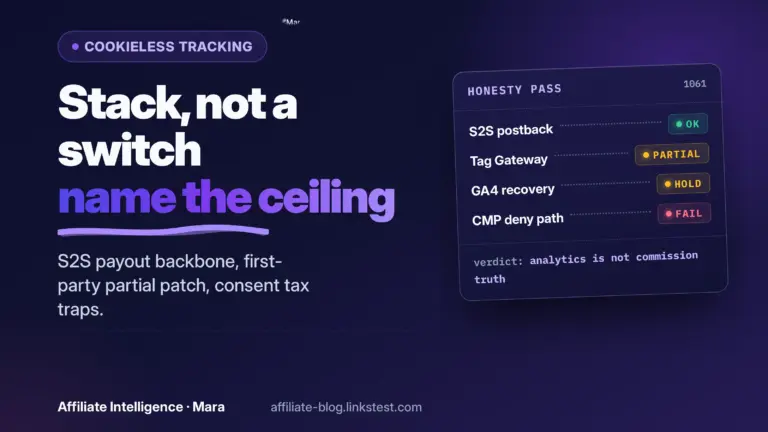
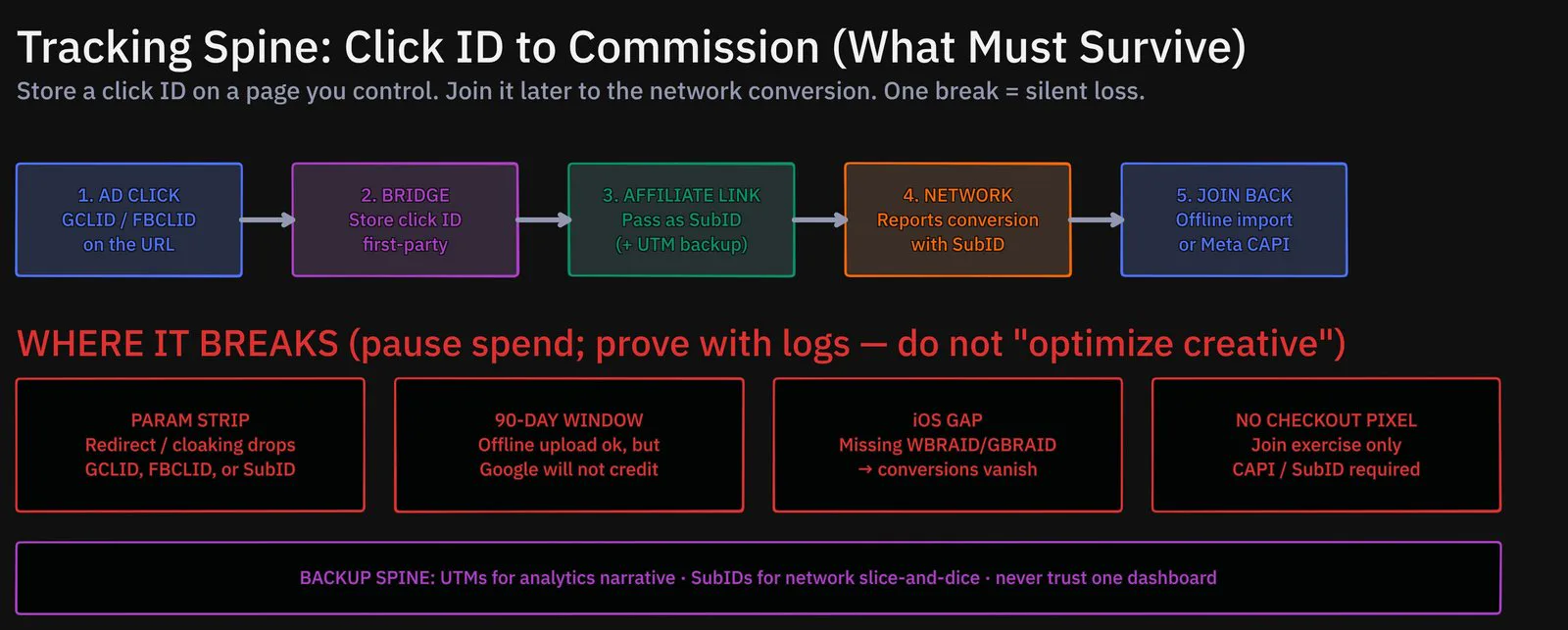
Non-negotiable: store a click identifier on a property you control (GCLID and/or Meta click ID, plus UTM + SubID backup), then join it to a conversion the network reports later. ITP and ad blockers make browser-only measurement fragile - plan for server-side joins where you can.
Google path (2026). Capture GCLID on your landing/bridge (with required cookie/consent disclosures), then make sure it survives the outbound hop into a SubID (or equivalent) on the affiliate link - a tracker that drops query params creates dead joins. Join network conversions and upload offline conversions. Current Help: starting 15 June 2026, offline conversion import and enhanced conversions for leads uploads move to the Data Manager API and are blocked in the Google Ads API (About offline conversion imports; enhanced conversions settings updates). Do not leave a legacy Ads-API uploader as your only path.
Google recommends enhanced conversions for leads for many new setups. ECL wants hashed user-provided data (email, etc.). Most affiliates never collect that on a bridge - so GCLID-keyed offline import can still be the honest path, uploaded through Data Manager / the documented GCLID setup (Set up offline conversions using GCLID). Size lookbacks with Ads conversion windows and time-lag reporting, not folklore. Silent filters after a “clean” upload stay in the offline deep-dive linked above.
For iOS measurement gaps, Google’s iOS 14 campaign measurement updates introduce privacy-preserving click parameters: gbraid helps measure app conversions from ads on iOS, and wbraid helps attribute website conversions when the click came from ATT-affected iOS app inventory. Current How to upgrade offline imports guidance: include the GCLID whenever possible to maximize accuracy; add GBRAID / WBRAID whenever available; at a minimum, add GBRAID or WBRAID to an existing or new conversion action in all scenarios; when you use BRAIDs, set conversion count to Every or the upload can error; upload everything available in the row and include an Order ID to prevent duplicates.
Meta path. You usually cannot place a pixel on the merchant checkout. Bridge page -> capture click IDs / consented first-party signals -> join on network postback / IPN -> Conversions API. A browser pixel (or CAPI gateway) on a domain you do not control is not a true purchase join. Hard limits from current server-event docs: event_time can be at most 7 days old; if any event in the batch is older, Meta returns an error for the entire request and processes none. For website events, event_source_url is required and should match your verified domain; set an accurate action_source.
Whether a late network payout fits that 7-day window depends on when the network fires its postback. If the postback fires when the conversion is registered (pending), you can usually send the CAPI event inside the window. If the network only notifies you when the commission is approved weeks later, that approval signal will not fit - send the pending conversion to Meta on time, and keep approval / rejection for your own ledger and cash math. Some operators also send a separate custom refund or chargeback event when the network later reverses a sale; treat that as operator practice to keep your own records honest, not as a documented Meta Purchase reversal path.
Meta’s Conversions API best practices recommend a redundant Pixel + CAPI setup sharing the same events so the server catches what the browser misses. Deduplicate with event_id when both fire. Watch Event Match Quality. Honest bridge limits: the bridge-page deep-dive linked above.
Backup spine. UTMs for analytics narrative; SubIDs for network slices - see the SubID guide. Start with a verified one-row join before you automate. Tools do not remove the merchant-checkout blind spot.
Step 4: Funnel without lying to yourself
Direct-to-merchant linking backfires for cold traffic. Prefer a page you control that pre-sells, discloses, and captures IDs. Google’s destination rules require destinations that offer unique value - original content or additional functionality - not a thin shell whose primary job is to send users elsewhere. Query-specific pre-sell pages usually beat one generic bridge for search. On that page, put the affiliate disclosure early and near the link (FTC endorsement guidance). Let the user click onward - destination requirements treat auto-redirects and “send elsewhere” shells as risk.
Segment by intent, geo, and device when the offer behaves differently. Search copy mirrors query intent; Meta creative carries emotion and proof. Do not paste one asset across platforms and expect identical economics.
Step 5: Production failure map
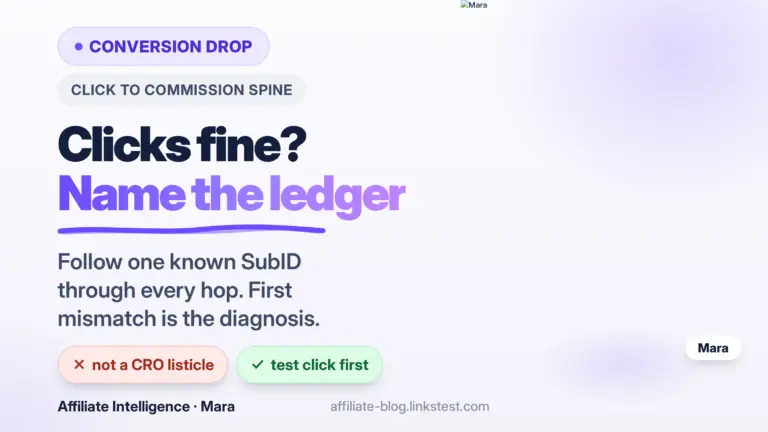
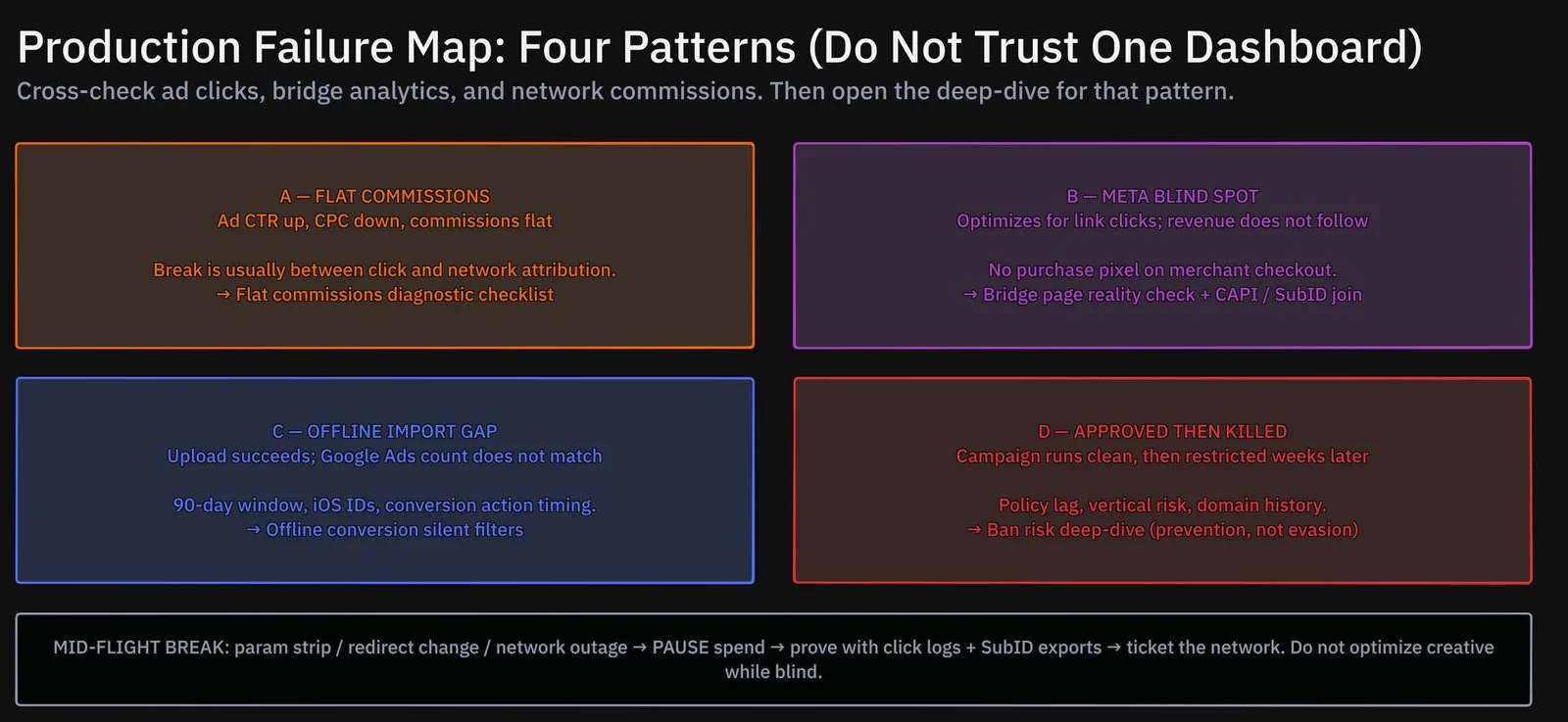
Cross-check ad platform clicks, bridge analytics, and network commissions. One dashboard is not proof.
- Pattern A - Ad metrics improve, commissions flat -> open the flat-commissions diagnostic linked above.
- Pattern B - Meta optimizes on soft events while purchase stays blind -> bridge/CAPI limits; see the bridge deep-dive.
- Pattern C - Offline upload looks clean but counts disagree -> silent filters deep-dive; confirm Data Manager path.
- Pattern D - Approved then restricted -> ban-risk deep-dive. Destination and unfair-advantage families use Google’s >=7 day warning language; Misrepresentation / unacceptable business practices can suspend on detection with no prior warning. Do not assume every policy gives you a week.
- Mid-flight break - Param strip, redirect change, soft 404 / sold-out variant, network outage -> pause spend, prove with logs/SubID exports, ticket with evidence. Do not optimize creative while blind. Map: silent attribution breaks.
- Cash hold - Network “investigation” or payout freeze after a spike -> treat as runway risk you sized for, not a reason to keep buying clicks into an unpaid ledger.
Step 6: Operating cadence
Pre-register kill rules: max CPA, expected-conversion sample gate, and a review window that respects network validation lag. Diversify before you need a second channel - single-pipe spend is existential risk when policy lag hits.
Weekly: click IDs still appending? SubIDs still populating? Offline/CAPI join still matching within Meta’s 7-day and Google’s conversion-window rules? Landing claims and disclosure still accurate? Policy emails unread?
If after honest tracking and a fair sample the unit economics do not clear commission minus expected loss, stop. Paid is optional. Cash-flow insolvency is not.
One-sitting checklist
- Offer economics filled (commission, CPC assumption, CVR, max CPA/CPC, cash runway vs validation lag).
- Platform chosen with policy constraints written (destination / unfair advantage >=7d warning; Misrepresentation / unacceptable business practices = immediate suspension risk; Meta Advertising Standards; native landing-page rules).
- Bridge or landing live with clear disclosure and unique value; onward navigation is a user click, not an auto-redirect.
- GCLID and/or Meta click ID capture verified in logs with consent hygiene.
- SubID + UTM backup verified on a test click.
- Join path tested: Data Manager / GCLID offline row, or CAPI event inside the 7-day window with
event_source_urlthat should match your verified domain and correctaction_source. - Kill rules and review date on calendar (expected conversions >=3 before judgment).
- Deep-dive links for flat commissions, bridge, offline filters, ban risk.
- Second channel or organic pipeline noted before scaling spend.
This playbook cannot guarantee account safety, invent a merchant checkout pixel, or turn a thin offer into a paid machine. When paid fails the math, escalate to owned media - not to another banned tactic.