Affiliate Dark Social Attribution: Tracking Private Shares
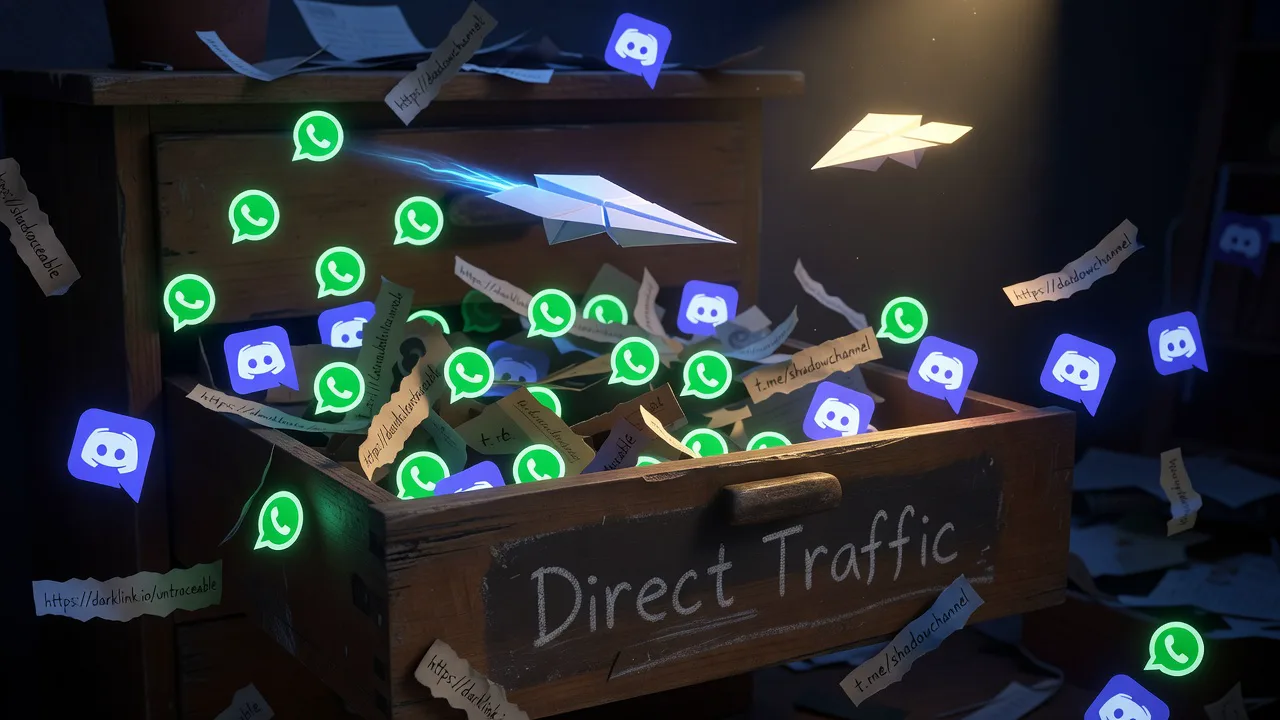
Direct is not a compliment. It’s the junk drawer – what Burst Statistics labels the unknown-source Direct bucket – where WhatsApp, Telegram, Discord, SMS, and forwarded newsletters dump traffic your analytics cannot attribute. If you’ve looked at a channel report, seen Social sessions fall off a cliff while Direct spikes, and whispered “well, social is dead,” you’ve probably been lied to by your dashboard. The failed assumption is that Direct means typed URLs and that missing social referrers means the channel stopped working. The reality is uglier: private shares and in-app browsers starve GA4 of the referrer it needs, so sessions get dumped into (direct) / (none) – the “I have no idea” bucket.
My goal here is not to promise perfect WhatsApp attribution. There is no perfect WhatsApp attribution. More model complexity won’t invent a referrer that never arrived (if you’re pondering multi-touch attribution with a few hundred conversions a month, be honest about the volume floor – I wrote a separate guide on multi-touch attribution honesty). What I’m offering is a proxy stack you can run this week – tagged links, unique codes, post-purchase surveys, and Direct landing-page forensics – so you stop misreading Direct traffic and cutting channels that still drive commissions.
The Failed Assumption: Direct Typed Your URL; Social Is Dead
When a creator drops a link into a Telegram channel and subscribers open it inside the in-app browser, the referrer often dies. GA4 records that session as Direct, not Social. The same thing happens when someone taps a friend’s WhatsApp message, forwards your newsletter to a colleague, or shares your comparison page in a Discord server. In SparkToro’s 2023 app-referrer checks, 100 percent of visits from WhatsApp, Slack, Discord, and Mastodon showed up as “direct” with zero referral information, and 75 percent of Facebook Messenger referrals carried nothing. Those visits land in the Direct bucket not because someone typed your URL, but because the messenger stripped the source.
The flattering fiction is that high Direct traffic equals brand love. The structural truth is that Direct is often the unknown-source bucket. If your community manager posts a link and you see a homepage-heavy Direct spike 20 minutes later, that’s not coincidence – it’s a clue. The channel report says Social is flat, so you might defund the Telegram effort. Wrong move. You just paid for activity that your measurement chain lost.
Treat Direct as a diagnostic, not a compliment. And if you’re still thinking a fancier attribution model will rescue those missing referrers, remember the volume gate above.

What Dark Social Means for Affiliate Operators (Channel Map)
For this audience, dark social is private or referrer-hostile distribution of your affiliate, bridge, or content links – WhatsApp, Telegram, Signal / SMS, Discord and private Slack drops, DMs, newsletter forwards, and some in-app browsers. It’s not a mystical revenue category. It’s not a substitute for network S2S SubIDs on links you control. And it’s definitely not all Direct traffic.
Here’s the commission split that matters: if the tagged link survived – if the click ID stayed intact in the URL and the network still registered it – you may get paid. But your analytics story is what breaks. That story is what makes you under-invest in the channel that quietly produced that revenue, or worse, cut it entirely because “Social” sessions fell. Programs lose faith in their own community efforts when the dashboard paints them as ghost channels. The network’s payment logic is separate from your attribution story. Keep that tension alive.
(Newsletter forwards are a special case of this leakage. When someone forwards your email without the original tracking, those extra readers often land in Direct. The relationship between owned distribution and dark-social measurement is something I touch on in the piece about affiliate publishers surviving AI search with newsletters.)

Why the Referrer Dies: Failure Modes You Must Separate
To react intelligently, you must separate the ways a source gets lost. Not every Direct visit is dark social. Some of it is just garbage.
In-app browsers and messaging apps strip or mangle the HTTP referrer. Open a link in the Telegram or WhatsApp in-app browser, and your server receives no referrer. GA4 sees nothing, files Direct. The same goes for Instagram DMs, Facebook Messenger’s webview, and many mobile mail clients.
Share buttons and copy-paste can murder your query strings. A CMS share widget that rebuilds the URL may drop UTM parameters or SubID tags. Someone manually copying a long URL from a browser and pasting it into a DM almost always strips parameters unless you’ve used a short link that preserves them.
GA4’s (direct) / (none) is the unknown fallback. If a UTM is malformed, the session may still end up as Direct rather than “Not Set.” Inconsistent naming – source=WhatsApp on one link and source=whatsapp on another – splintered the data and pushed what should have been social into Direct.
Privacy / ITP effects also inflate Direct, but they’re not dark social. Safari’s Intelligent Tracking Prevention caps JavaScript cookies at 7 days; after that gap, a returning user appears as a new Direct visitor. A Safari-vs-Chrome Direct split that’s wildly tilted toward Safari new users is often an ITP clue, not proof that 50 percent of your traffic is WhatsApp shares.
Contaminants in the same bucket: bots, data-center hits, untagged PDF and QR links, internal team traffic, and some AI-referral homepage landings. Label those so you don’t call everything dark social.
And here’s the texture keeper: when Direct is unusually homepage-heavy after a community drop, you’re looking at a signal. Always inspect Direct by landing page, not just by channel total.

The Proxy Stack: Honest Measurement, Stacked
Stop wishing for perfect attribution. Start layering recoverable signals. These defenses stack – each recovers a different slice of the invisible referral pie.
Control the Link Before the Messenger (UTM + SubID)
Tag every link that enters a private channel before it hits the messenger. As Short.io’s guide on tracking referrers shows, UTM parameters survive inside the URL even when the referrer doesn’t. Use utm_source=telegram, utm_medium=community, utm_campaign=launch-q3, and append a SubID – for instance, utm_content=channel-deals – so you can compare performance across different Telegram groups or WhatsApp lists. Deep SubID discipline lives in my complete SubID guide, but the short rule is: tag with a naming convention, enforce it across every egress link, and use a link shortener that preserves the full query string. Share buttons must pass parameters, too; test them by copying the generated link and checking for your tags.
If the link’s click ID survives to the network, you might still earn commission even in a world of missing analytics. But the UTM layer gives you the measurement you need internally. Without it, your email and messenger campaigns are invisible.
Unique Codes / Vanity Paths for DM and Community Funnels
Not every click survives. Screenshots, spoken referrals, and manual search mean your tagged link may never reach the buyer. In those cases, give each funnel its own unique promo code or a short, memorable vanity URL (e.g., /telegram-offer). The code’s redemption traces the source when the URL can’t. Influencer marketers use dedicated codes for this exact reason, and the same logic applies to private affiliate communities. One code per funnel, tracked in your e-commerce system, tells you where the sale originated even if the analytics session is a ghost.
Post-Purchase “How Did You Hear?” Surveys
When pixels fail, ask a human. A simple open-text question on your confirmation or thank-you page – “How did you first hear about us?” – will surface friend, WhatsApp group, Telegram channel, and podcast answers that no tracking script can see. Operators who add open options like friend referral, WhatsApp/Telegram group, and newsletter forward often surface orders that the pixel filed as Direct. The directional signal is the point – not a guaranteed lift percentage. Memory is fallible, but the signal is still worth tracking. Read the results weekly. You’ll find sales that never touched a tracked click.
Direct Landing-Page Forensics + Publish-Date Overlays
Open GA4, filter to Direct traffic, and add landing page as a secondary dimension. Do you see deep content URLs – blog posts, comparison pages, long tail paths – showing up as Direct? People don’t type those. Those are dark social or untagged campaign clicks.
Now overlay your community publishing schedule on the Direct trend. Did your Telegram channel post go out at 10 a.m. and a sharp Direct spike on that exact content URL appear at 10:15? That’s your dark social, not brand love. Pair this with a glance at branded search queries in Google Search Console (using the branded search filter): a lift in people searching your brand name that coincides with the community drop strengthens the correlation. It’s not causal proof – but it’s a far better stakeholder narrative than “we think social is down.” This overlay is the conversation you take to the person who wants to cut the channel.
Optional: First-Party / Tag-Gateway Setups (Partial Recovery)
A quick honesty check: server-side tagging and first-party mode (where you serve Google’s scripts from your own domain) can reduce some referrer stripping by making the tracking cookie a first-party one. This helps with Safari ITP cookie truncation, but it does not restore referrer data that was already stripped by the messaging app. It’s a partial patch, not a cure. The full cookieless measurement story deserves its own companion – this article isn’t it.

Decisions That Dark Social Should Change (Cluster Glue)
The biggest risk of ignoring dark social is cutting a channel on a lying report. Operators often say social revenue is down, so they pause the community manager. But when you overlay that manager’s posting calendar against Direct and branded search, both often moved with the campaign. That’s incrementality, not failure.
Before you make a cut, ask whether Direct + branded search rose when your private drops happened. If they did, consider an incrementality test rather than a dashboard-driven death sentence. I wrote a geo-holdout method for small affiliate programs and a step-by-step runbook exactly for this situation. You isolate a geographic region, pause the private channel, and watch whether total conversions (or new-to-file counts) drop.
Seeing a private path of traffic doesn’t prove the customer was new. Keep new-to-file joins in view. I’ve explained the NTF rate that separates acquisition from recycled demand and how publishers can use NTF to negotiate better rates. Just because someone came via WhatsApp doesn’t mean they’ve never transacted with the brand before.
One more caution: friend-share culture combined with public discount codes can mimic coupon cannibalization, where existing demand uses a friend’s code at checkout. The five signals for that coupon cannibalization check are worth a quick look if your codes start leaking.
The stakeholder frame is simple: “Social is down” on a report may be a dashboard artifact while brand lift is up. Teach the overlay conversation without theater. Show them the correlation, hand them the diagnostic, and refuse to kill a channel on last-click alone.
A One-Sitting Dark Social Pass
Before you adjust a single budget line this week, run these eight checks. They’ll take an hour.
First, list every private channel you actually use: WhatsApp, Telegram, Discord, SMS, newsletter forwards, DMs. If you aren’t tracking their existence, you can’t measure their impact. Second, confirm that every outbound link from those channels is tagged with UTM plus SubID before it’s pasted into the messenger; untagged links are invisible. Third, test your share buttons: click Share on a few content pages, copy the generated link, and confirm the query string still carries your tags. Fourth, segment Direct traffic by landing page over the last 28 days. Homepage-only Direct might be brand; deep-page Direct is almost certainly dark social or untagged campaigns. Fifth, split Safari versus Chrome Direct new users: a lopsided Safari share points to ITP, not a viral WhatsApp campaign. Sixth, create unique promo codes or vanity URLs for each DM and community funnel you run. Seventh, open your post-purchase survey field and read the last week’s responses – do you see friend, Telegram, or podcast answers that never touch a pixel? Eighth, before you cut a channel, check whether Direct + branded search moved with your private drops. If the answer is unclear, plan an incrementality check, not a channel cut.
Questions Before You Trust Direct or Cut a Channel
Dark social is not a mystical 80 percent claim; it’s the auction-adjacent reality of private shares. Instrument proxies – stop treating Direct as a compliment – and you regain enough signal to stop sabotaging your own distribution. Before you trust that Direct number or cut a channel this week, ask yourself: Are all egress links tagged? Do I have a unique code in place for every DM funnel? Is my post-purchase survey read weekly? And if I killed this private channel tomorrow based on my current dashboard, would I still feel confident after checking the overlay? If not, you’ve got work to do – and now you know exactly where to start.