Target Affiliate Program: Due Diligence Before You Scale
A retail logo is not a commission plan. The plan lives in portal Payout Details and the Partners Operating Agreement, not on a benefits page promising “up to 8%.” Operators who skim the marketing copy and build SEO content around the Target brand are making a bet on a logo, not on a contract.
That bet can pay. It can also unravel fast when a category drops to zero commission, the paid-search ban kills a whole traffic source, or the approval from Impact never translates into an active account inside Target Partners.
This is the Target-specific due diligence you do before you scale. It’s the retail-program sibling to the Walmart due diligence I’ve published separately. Don’t conflate them. Read both, then decide which pipe fits your model, because the contracts differ in ways that matter.
The Failed Assumption: Easy Retail Trust
If you landed here before shipping your first tracked link, the beginner start map will get your pipe live in a week — then come back to evaluate Target program specifics.
A common beginner failure mode runs parallel to the logo trap: joining every retail program at once. Amazon, Walmart, Target, ShareASale merchants, and three niche networks all get applications before a single tracked sale proves the pipe works. That spreads you thin on approval hygiene, Payout Details mapping, and link testing. Run one retail pipe at a time until tracking, disclosure, and portal reconciliation work end to end. Then add Target as a second pipe, not as program number seven in a dashboard nobody reads.
The structural temptation runs like this: Target is a top-tier US retailer with massive brand recognition. Operators researching the target affiliate program see “earn up to 8%” on the landing page and nearly build content around that number without ever opening the Impact dashboard.
Here’s what that misses. The 8% is a ceiling, not a baseline. The live category table inside Payout Details can change without a brochure rewrite. Several major categories pay nothing at all.
The EPC published in Target’s own FAQ is roughly $3-$4 per 100 clicks according to the current FAQ - not a typo - a structural reality that reflects how many clicks land on low- or zero-commission items or fail to convert inside the cookie window.
A high-trust brand plus a modest sticker rate looks like the sensible, boring retail play. But boring can still be dangerous if you haven’t checked the kill-switches. The program’s paid-search ban, the slow payment lag, and the heavy category exclusions mean you can spend months building real SEO authority only to discover your niche was de-monetized from the start.
The difference between a program that pays you and one that pays you only on paper is operational fit, not brand love. For a deeper look at the sustainability question every retail commission depends on, read my piece on judging affiliate program economics. Here, I’m going to walk through the Target plumbing so you can answer the only question that matters today: apply, promote with strict controls, or walk away this week.
Taxonomy: Partners vs Creator / Club vs Network Login
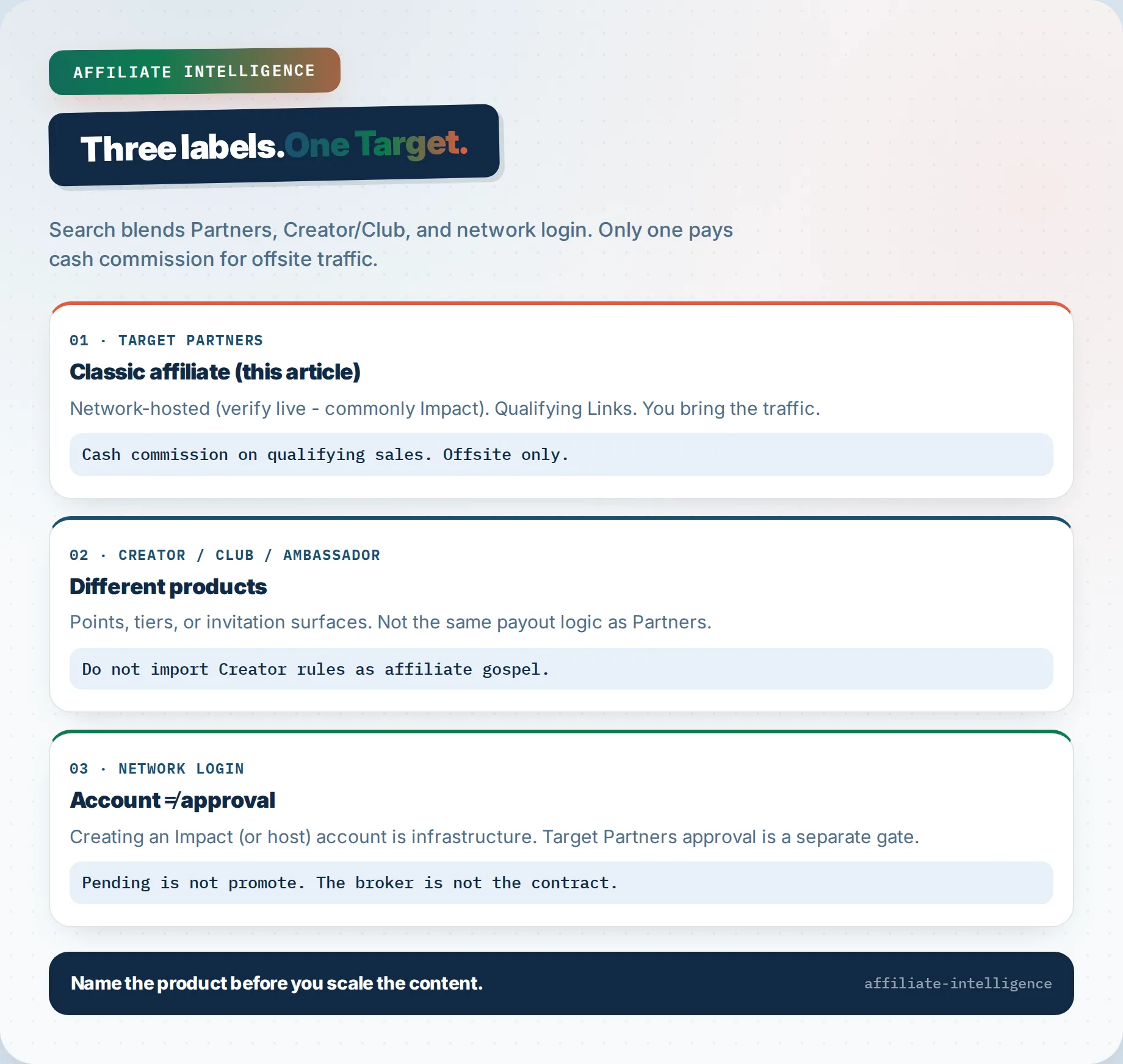
The search landscape is a mess. A publisher types “Target affiliate program” into Google and gets articles that blend together three entirely different products: the classic Target Partners commission-based program on Impact, a gamified creator community, and an invitation-only ambassador tier. Conflate them and your commission expectations will miss by a mile.
This article is about Target Partners, the traditional cash-commission affiliate program. It’s hosted on the Impact network (as of this writing, verify the live listing at partners.target.com (also Target’s affiliate landing page)). You create an Impact account, apply to the program, and if approved, you generate tracking links that pay you a variable percentage on qualifying sales.
That first step trips people up. Creating an Impact account is not Target approval. The network account is infrastructure. The program application is a separate gate, and acceptance is never guaranteed. A common failure mode is stopping at the network account without completing the program application. The broker is not the contract.
Target also runs a creator rewards program and an LTK Ambassador tier that launched alongside the Partners ecosystem. These are separate ecosystems with different payout logic - points-based rewards rather than cash commissions, and different eligibility thresholds. They are not tiers of the affiliate program.
If you came here wanting cash commissions for offsite traffic you drive yourself, you’re looking at Target Partners. The program is entirely offsite. There is no onsite storefront or product-page placement like Amazon Influencer. You bring the traffic, and you earn only when someone clicks your link and buys within the cookie window.

Economics Clocks (Before You Promote)
Sticker Rate vs Portal Reality
The headline “earn up to 8%” is a marketing band. The actual category-level rates live inside your Impact Payout Details, and they can change without a brochure rewrite. Target’s own linked rate-card URL no longer resolves according to the current terms. The terms state that rates and exclusions are set in your individual insertion order.
Before you write a single comparison post or gift guide, get approved, log into Impact, and open Payout Details for your account. Map every category your niche touches. If your content vertical overlaps heavily with zero-commission categories, you are volunteering unpaid traffic. Remonetize immediately or choose a different program.
Referral Window and Cookie Folklore
Target’s FAQ says the cookie is 7 days with last-click attribution, and you earn commission on every qualifying order placed within that window, not just the first purchase. That’s a genuine advantage over shorter-window competitors, especially for home goods and apparel where browsing cycles are long.
Do not lock that 7-day figure as timeless gospel. The terms control cookie behavior. Verify the current Referral Window in your portal and note that exclusive offers or link types might carry different rules. Cookieless sessions from ad blockers or privacy settings still produce zero credit regardless of window.
Seasonal Intent Windows
Target runs predictable seasonal moments: Circle Deal Days in spring, back-to-school in late summer, holiday promotions, and clearance cycles. Publish affiliate content aligned with those calendars to capture high-intent traffic.
Do not project EPC from a single holiday spike. Seasonal lifts are temporary. The boring months are where the real economics surface.
Payment Physics and Return Lock
Payment lag can stretch 2-3 months between a sale and cash in hand, depending on the current validation and payout schedule in your agreement.
Pending is not income. Until the return window closes and the payment clears, every reported commission is a forecast. Target’s standard return policy for most items is 90 days according to the current policy, which can extend further depending on product category and payment method. A commission recorded today can reverse three months later.
I cover the math of keep-rate vs. sticker rate in my physical return-rate guide and the clawback mechanics in stop commission clawbacks. Price the return lock into your cash-flow model, not your excitement.
Tracking Loss and Extension Last-Click
Ad blockers, cookie consent rejections, and malformed Qualifying Links are silent credit killers. Coupon or browser extensions that overwrite affiliate cookies add another layer of last-click risk.
If your dashboard shows healthy clicks but thin conversions, start with link hygiene: test your links through a clean browser, check that the tracking parameters survive redirects, and assume some percentage of your audience never fires an attributable conversion.
The tracking best practices guide can help you audit what’s measurable. This is measurement hygiene, not fingerprinting workarounds.

TOS Kill-Switches (Read Before SEO Scale)
SEO scale does not outrun contract terms. Before you build a content cluster, read the current Partners terms and check whether your delivery model already violates them.
Paid Search and Brand Bidding Ban
Target’s current terms prohibit “SEM tactics that include, but are bidding on Target or Target owned brands or misspellings of the brands; paid search.” This kills the “just buy Google traffic to Target” idea. If your model relies on paid search, you need a program whose terms explicitly allow it. This one doesn’t.
I hand the full trademark- and PPC-clause audit framework to my brand bidding guide. What matters here: assume a broad prohibition applies, and do not plan a paid traffic strategy until you’ve read the live clause and confirmed what, if anything, the program allows outside brand terms.
Link Manipulations and Framing
The terms typically prohibit framing, wrapping the site in iframes, using link shorteners that obscure the destination, or employing price-tracking widgets that inject their own tags. Keep your Qualifying Links as direct, unaltered links generated from Impact.
Coupon extensions that silently rewrite the affiliate cookie are a particularly nasty last-click risk; you can’t control the extension, but you can avoid distribution channels that attract coupon-appended traffic.
Disclosure and Eligibility Smells
Clear and conspicuous disclosure is non-negotiable. The terms mention using #TargetPartner or equivalent labels near every affiliate link. For wider compliance depth, see my 12-point audit. This isn’t a decorative checkmark. A missing disclosure can get your account terminated before you earn a dime.
Eligibility hazards from the program’s perspective include thin content sites that look like reskin jobs, price-comparison or reseller positioning that competes with Target’s own value proposition, and incomplete applications that show no real promotional plan. If you’ve been rejected, my application-failure diagnostic can help you map what might have gone wrong.

Approval Hygiene and Mid-Program Shocks
Pending does not mean promote. Review times vary; ghosting happens. Do not send traffic while your application is under review. If you build a page built around Target links, publish it, and the application sits in limbo, you’ve spent effort on content that can’t convert.
Once live, the program can shift without warning. Categories get de-monetized mid-quarter. Commission rates compress. A line that paid 5% last month might pay 0% next month if the category table changes. If you find yourself in that situation, remonetize the same session: swap to an alternative retailer or a different Target category that still pays.
I recommend a change log for every program you run because memory is not an audit trail. My platform-risk pricing and mid-cycle incident response guides give you the frameworks to respond when the pipe fails.
And yes, if your category still shows near-zero in Payout Details while the brochure copy says “up to 8%,” you are volunteering unpaid traffic. Remonetize or walk.
Fit Tests: When to Walk Away
A publisher could argue: “I run a US-traffic-heavy lifestyle site, I’ll push home decor where the commission is 5-8%, I’ll build organic traffic, and I’ll avoid paid search entirely.” That’s a coherent model, and many operators make Target Partners work as a secondary or tertiary revenue stream.
But if any of these describe your setup, Target is probably the wrong pipe:
- Your traffic relies on paid search, and you can’t or won’t separate ad campaigns from the brand-bidding ban.
- You need an onsite placement (Amazon Influencer-style storefront) that this program doesn’t offer.
- You are counting on Target as a primary income engine or live-or-die revenue source. Concentration on one retail logo is a structural risk. I explore the danger in concentration risk management.
- Your audience is predominantly non-US. The program is designed for US-focused traffic.
- You are still onboarding your first retail affiliate pipe and have not finished approval hygiene, link testing, and portal reconciliation on that program yet. Finish one pipe before you add Target.
Target Partners can be a useful piece of a diversified affiliate mix, but if you find yourself comparing it to Amazon Associates and thinking “this is the replacement,” you’ve probably misjudged the operational constraints. The sibling Walmart DD walks through a parallel retail program with different clocks; read both before you commit. If search is blending Partners cash with Creator / Club rewards, start with the Target Partners vs Creator taxonomy before you scale either pipe.
One-Sitting Target Partners Checklist
Stop reading and run this. Operators who skip the checklist build on brochures.
- Confirm the program host: as of this writing, Target Partners lives on Impact. Check partners.target.com.
- Separate program application from Impact account creation. Actual approval is a separate gate.
- If Target is not your first retail pipe, confirm your primary pipe already passes link test, disclosure, and portal reconciliation. Do not add Target while three other programs sit pending.
- Read the current Partners Operating Agreement. Screenshot the version date. You’ll need it later.
- Open Payout Details inside Impact. This is your real rate sheet, not the “up to 8%” landing page.
- Map every category your niche touches. List exclusions and low-pay categories; zero-commission categories are a walk-away signal for that content vertical.
- Verify the Referral Window and cookie attribution rule directly in the portal. Do not trust third-party 7-day gospel.
- Price the return lock and payment lag into your cash flow model. Pending commissions are not cash until they clear.
- Scan the paid-search and brand-bidding restrictions in the terms. If you use paid traffic, check whether a single ad group violates the ban.
- Confirm your disclosure labels are clear and on-page. #TargetPartner or equivalent.
- Test your Qualifying Links in a clean browser. Watch for ad-blocker interference, session drops, and extension injections.
- Do not send live traffic while your application is pending. Pending is not approved.
- Build a remonetization plan: if a category drops to zero, know which alternative retailer or Target category you’ll switch to within 24 hours. If the gate is a cold application reject (not a category cut), use the AliExpress reconsideration roadmap as the rejection playbook.
- Soft-link to the commission sustainability guide, return-rate math, clawback mechanics, platform-risk tools, and mid-crisis incident response for when the pipe doesn’t hold.
- Walk away this week if any of these checks expose a conflict. The brochure will not warn you. The contract already did.
The win isn’t a trusted logo. The win is a system where you know exactly what gets paid, when it can reverse, and what you’ll do when the terms change. Run the checks.