Affiliate Commission Cannibalization From Coupon Partners: 5 Signals to Check
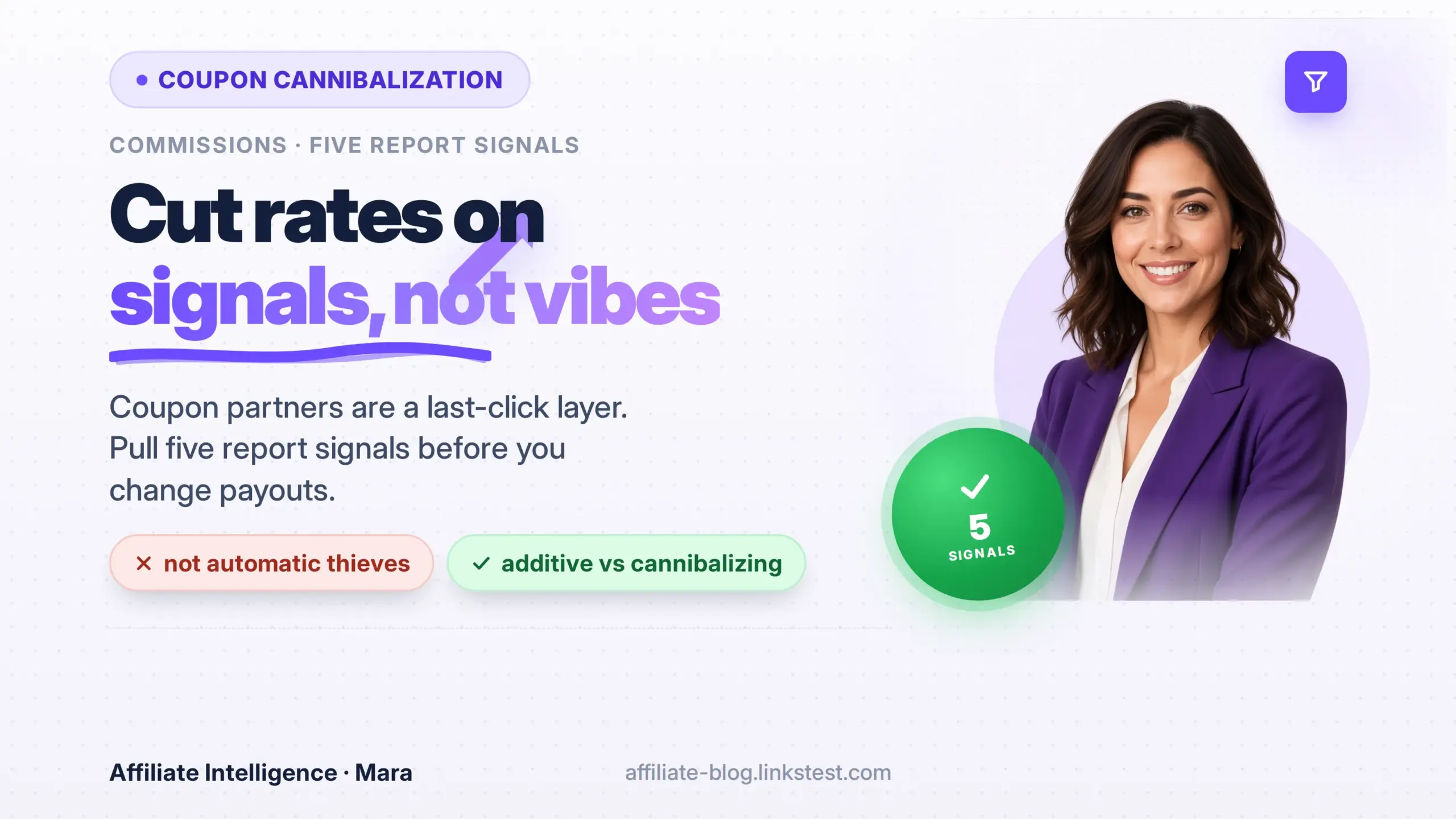
APMC estimates affiliate is involved in roughly 25% of online transactions, but last-click recognizes about 12% of them. That gap is not a tracking error. It is a structural blind spot, and it lands hardest on operators who manage coupon and cashback partners. My position is direct: coupon partners are not automatically thieves. They operate a last-click layer job. The real failure mode is paying them as if they created demand they only captured. Before I cut a coupon rate, I want five report signals that separate additive behavior from cannibalizing behavior.
Failed assumption: coupon partners are automatically thieves
Operators often arrive at this conversation already angry. A content publisher drove the research, the user reached checkout, then a coupon extension fired and the ledger paid the coupon partner. The instinct is to call it theft and cut the partner. That instinct skips the actual question: was the coupon partner creating demand or intercepting it?

The structure matters more than the moral label. Last-click attribution credits the final touch before conversion. Coupon and cashback partners sit at that final touch by design. They are not sneaking into the funnel; they are positioned at the point of highest purchase intent, which is exactly where last-click logic gives them credit. The German market study from the Affiliate Partner Marketing Circle makes the cost concrete: affiliate is involved in about 25% of online transactions, while last-click recognizes closer to 12% (APMC via LinkedIn). Half the channel’s real contribution is invisible to the model most teams still report on.
LinkConnector clickstream data adds texture. Across its network, coupon affiliates introduce the purchase funnel 27% of the time, and their cookies occur before the user enters the cart 69% of the time (JEBCommerce). That does not sound like a partner that only swoops in at checkout. So the failed assumption is treating coupon partners as a single category with a single verdict. Before you cut a rate, classify each partner as additive or cannibalizing. The five signals do that classification.
How last-click coupon credit happens (structure, not scandal)
The mechanics are simple enough to sketch without a single named villain. A content affiliate writes a review, the shopper reads it, clicks the affiliate link, and reaches the merchant site. At checkout, that shopper opens a new tab, searches for a coupon code, or a browser extension offers one. The extension fires a click, which drops a fresh affiliate cookie. Under last-click rules, the earlier content cookie gets overwritten. The coupon partner gets the commission, even if no value was added.
This is not a conspiracy. It is the default behavior of hard post-click cookies, which overwrite any previous post-click cookies when a new click occurs (Commission Factory). The shopper’s journey did not change. Only the order of clicks changed. The ledger still pays the coupon partner.
The Honey-era policy changes made this pattern visible at scale, and the program changes that followed are worth reading before you assume you are immune (Affiliate Attribution After Honey: 5 Program Changes That Actually Happened). The structural point is not that a specific extension was caught. It is that the same last-click overwrite exists in most programs that include coupon, cashback, or extension partners. The question is whether your reporting can see it.
Five report signals before you change payouts

Report signals are triage, not verdicts. Each one flags a pattern that deserves a closer look before any payout change. Run these five on your own data.
Signal one: assisted versus last-click share. Pull the path report from your network. Compare how often a coupon partner appears as the last click versus how often it appears anywhere else in the journey. A coupon partner with high last-click share but low assisted share is capturing demand it did not introduce. A partner with meaningful assisted share is doing more than closing. LinkConnector found coupon affiliates were part of the purchase funnel outside of closing 53% of the time (JEBCommerce). That is your baseline: if your coupon partner never shows up except at the final click, flag it.
Signal two: public code reuse on content landings. Take your top ten content landing pages and check whether they surface the same generic coupon code your coupon partners promote. A public code that appears on a content review page becomes a checkout shortcut for readers who were already convinced. When they apply it, attribution shifts to the code owner, not the content creator who created the demand. Shared coupon codes create exactly this attribution conflict, because a single code can represent multiple touchpoints (iDevAffiliate). If your code reuse is high on content landings, you have a structural leakage problem, not a partner problem.
Signal three: NTF gap. New-to-file rate is the fastest proxy for whether a partner adds or recycles demand. Join your affiliate attribution to your customer file and compare NTF rate by partner type. If your coupon partners show a much lower NTF rate than your content partners, they are converting people already on your file. That is recycled demand. Partnerize reported coupon site-originated purchases were 57% more likely to be new users than other channels, which tells you the signal can go either way (JEBCommerce). The gap, not the absolute number, is what matters. If you do not have NTF defined, fix that before touching payouts. One sentence definition is enough: new customer means first-ever purchase date, or first order in 24 months. Write it down, then measure (New-to-File Rate: The Affiliate KPI That Separates Acquisition From Recycled Demand). Publishers who need the negotiation packet soft-link to prove new customers and get a better rate.
Signal four: extension hop share. Count the share of sessions where a browser extension fires after a content click but before purchase. High extension hop share means the coupon layer is systematically overwriting earlier affiliate cookies at checkout. Commission Factory describes soft cookies as one mechanism to prevent this, because soft cookies do not overwrite existing hard cookies (Commission Factory). But even without soft cookies, you can measure the hop rate. If more than a trivial share of your content-attributed journeys end with an extension touch, you have a checkout interception pattern worth isolating.
Signal five: brand-bid overlap. Check whether your coupon partners or their sub-affiliates also bid on your brand terms in paid search. Brand-bid overlap is the clearest sign of interception: the shopper was already searching for you, and the coupon partner steps in at the final step to claim credit. Over 50% of shoppers use Google to discover or find a brand, and brand searches are the highest-intent traffic you own (PartnerStack). Pull your search term reports and compare against affiliate SubIDs for the same window. If a brand query appears in both, investigate before you keep paying full commission (Affiliate Brand Bidding Audit: What Trademark PPC Clauses Actually Prohibit).
Additive versus cannibalizing: decision language
Once you have the five signals, stop using words like good and bad. Use a decision language that maps to what you actually pay for. An additive coupon partner recovers abandoners: shoppers who were already going to buy but needed a nudge to finish, or shoppers the coupon partner introduced directly. A cannibalizing coupon partner intercepts decided buyers: shoppers who reached checkout through content, search, or email, then applied a coupon at the last second and gave away full commission.
The structural scenario is cleaner than any moral claim. If content creates demand and a coupon site takes last click at checkout, the ledger still pays the coupon partner. That is capture. If a shopper arrives on the coupon site first, discovers your brand, and then buys, that is creation. The distinction is not about the partner’s intent. It is about where the demand originated.
This is where the harder measurement tools earn their keep. A holdout test of 5 to 10 percent of traffic is the cleanest way to see whether suppressing a coupon partner actually moves conversion (Track360). If conversion barely moves when the partner is suppressed, those sales were not incremental. If it drops materially, the partner is doing real work. Pair that with the NTF gap and you have a decision language, not a vibe.
The deeper measurement paths are covered in the NTF rate article (New-to-File Rate) and the geo-holdout runbook (Geo Holdout Testing for Affiliate Programs). Use them for the partners where the five signals are ambiguous.
What to do instead of a vibes-based rate cut

A vibes-based rate cut is when an operator sees a coupon partner at the top of the revenue report, feels uneasy, and cuts the rate without evidence. That move creates two problems. It guts a partner that might be additive, and it leaves the structural leakage in place because you never identified which signal was actually failing.
Different job, different pay. That is the principle. If a coupon partner mostly recovers abandoners and introduces a meaningful share of new customers, pay them fairly for that job. If a coupon partner mostly intercepts decided buyers and has a low NTF rate, pay them less, but do it with a rule, not a grudge.
Tier rates by partner type and NTF performance. Pay a lower base rate for checkout-layer partners, with a bonus for verified new customers. Exclude brand terms from any coupon partner’s paid search permissions. Require unique or partner-specific codes instead of generic sitewide codes, because unique codes are more controlled and traceable, while generic codes leak and create attribution conflicts (iDevAffiliate). Hold pending evidence before any cut: run the five signals, ideally a holdout or geo test, and document the result. Then change the payout. If the review later turns into a reversal, the clawbacks article covers what tracking terms to check.
Do not jump straight to multi-touch attribution as a savior. It has real volume requirements, and most programs do not have enough conversion volume for reliable MTA (Multi-Touch Attribution Conversion Volume Requirements: Honest Guide for Affiliates). Tiered rules and code hygiene get you most of the way with far less complexity.
Publisher-side hygiene (brief)
If you test coupon codes as part of your signal work, use a separate-session checkout. A browser with coupon extensions installed can drop cookies and contaminate your test, which makes you chase a pattern that only exists in your test environment. Hard cookies overwrite prior post-click cookies, so testing a code in a session where other affiliate cookies are already present will give you a false read (Commission Factory).
The same split applies when you document shopper behavior. Keep the content click in one browser or device and run promo-code searches in another. Most programs pay on last referral URL, not a blended path, so a mid-checkout coupon search can overwrite the content cookie even when the shopper still intends to support the creator.
Cashback partners add a stricter rule: click through the portal and finish checkout in that same session. Tab-hop to reviews, comparison sites, or a fresh coupon search before purchase, and another affiliate often takes last click. Cashback disputes then fail because the portal never held credit. That is not a tracking bug. It is the same overwrite mechanics with a shorter tolerance window.
Also keep two problems separate. Compliance is about whether a partner violates your terms: cookie overwriting, stand-down failures, hidden extension behavior. Coupon politics is about whether you think the partner type deserves to be paid at all. Do not confuse the two. Enforce compliance with evidence. Decide coupon economics with the five signals. Merging them produces vindictive rate cuts and ignored leaks.
One-sitting checklist + short FAQ
I recommend running this in one sitting.
- Pull assisted versus last-click share for your top ten coupon and cashback partners.
- Check public code reuse on your top content landing pages.
- Join affiliate attribution to customer file and compute NTF gap by partner type.
- Measure extension hop share on journeys that began with content or search.
- Run brand-bid overlap between search terms and affiliate SubIDs.
- Classify each coupon partner as recover abandoners or intercept decided buyers.
- For ambiguous partners, schedule a holdout or geo test before changing payouts.
- Write the rate rule: tier by NTF, exclude brand terms, require unique codes.
FAQ
Should I cut all coupon partners if the NTF gap is huge? Not automatically. First check whether the partner introduces demand elsewhere, then run a holdout. Cutting without a test often moves the revenue loss somewhere you cannot see.
What if my network does not expose assisted path reports? Export last-click and clickstream or SubID data, then join manually with order timestamps. If the network cannot provide full path data, treat that as a measurement gap and use a geo holdout to compensate.
How long before a holdout gives me an answer? Long enough to cover a full purchase cycle and the return window. Pre-register the metric, then read net, returns-adjusted, new-customer revenue. If early numbers look decisive, wait anyway. The cleanest read comes from patience, not speed.
The decision is not whether coupon partners belong in your program. It is whether your payout rules match the job they actually do. Run the five signals, write the rule, and stop funding demand capture with acquisition budgets.