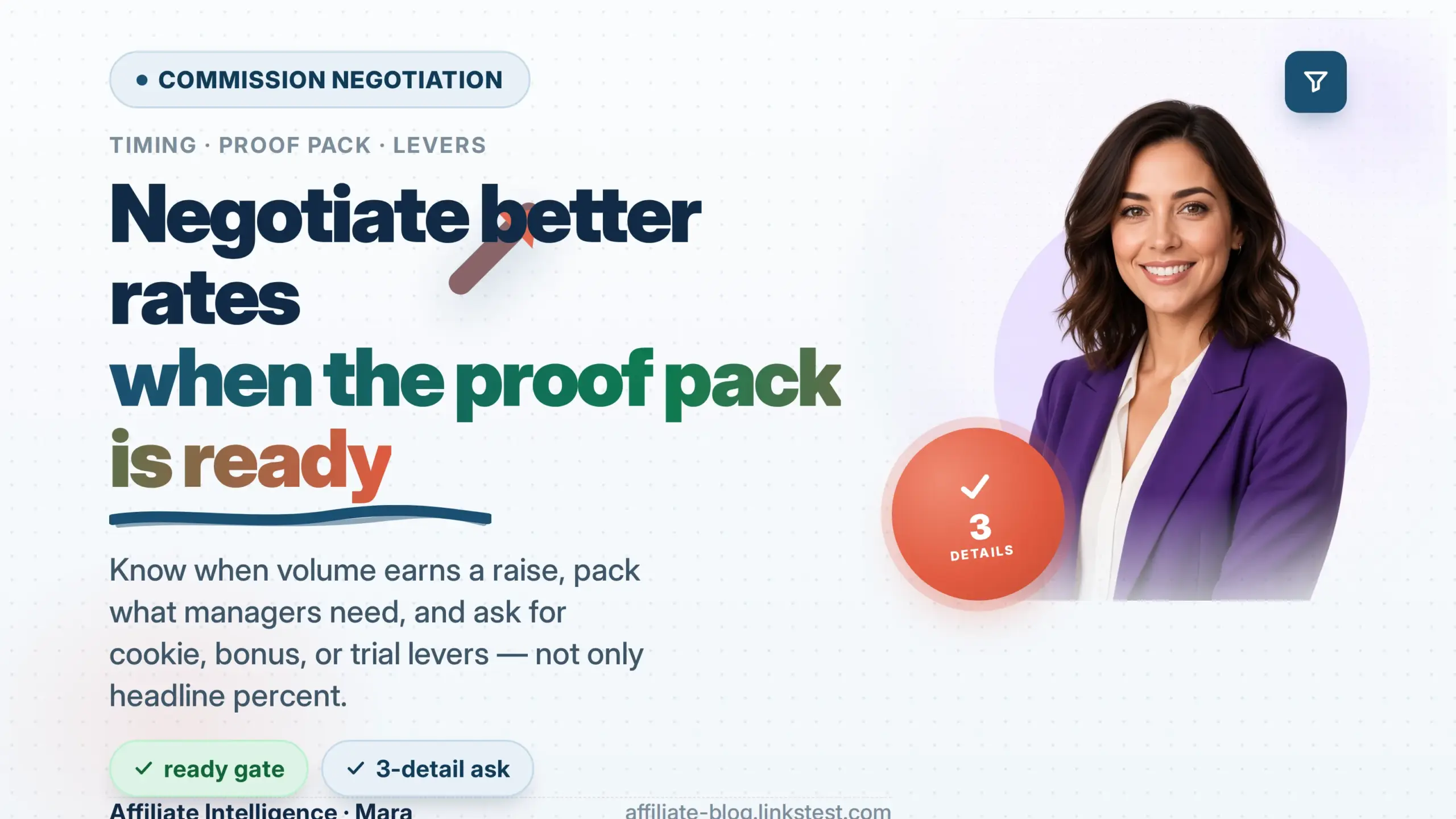
When Affiliate Marketers Should Negotiate Better Commission Rates
The Failed Assumption: Ask Always or Never Ask
Operators often treat a commission negotiation as a binary: email for a higher percentage whenever you feel underpaid, or never ask and quietly underearn. Both are failure modes.
The first makes you read as a cost, not a partner. The second keeps you a commodity. The fix is a sequence of checkpoints: negotiate after proof, with the right lever, inside a time box. This is a tutorial, not a persuasion list. If you have enough volume and wonder whether now is the moment, start here.
Step 1: Prerequisites - What You Need Before the First Ask
Before any ask, collect five things. Skip this and you negotiate on vibes, which loses.
First, 90 days of click, sales, and EPC data. Not one good week. Three months that show a trend. Most affiliate marketers consider an EPC above $0.50 strong, while anything below $0.10 signals the offer or the placement needs optimization before you ask for more (Post Affiliate Pro). A weak number means the ask is premature.
Second, access to the live network or merchant terms. Not a screenshot from six months ago. The current cookie window, rate, and bonus language.
Third, a promo calendar. The ask lands better tied to a slot you can actually deliver: a launch, a seasonal push, a newsletter drop.
Fourth, a named affiliate manager or contact. A person, not a support inbox.
Fifth, a change log. Terms, cookie, payout model, notes from support, screenshots.
Goal: assemble a baseline. Action: pull the 90-day report, save the live terms, write the next promo date, name the AM. Why: a manager can only forward an ask that survives inspection.
Checkpoint: You can state your trailing-90-day EPC, your live terms, and your next promo date without opening a dashboard.
Step 2: When You Are Proven Enough - And When You Are Not
Timing is the entire negotiation. Ask before you can prove value and the merchant learns you are a risk. Ask after and you are a partner with a number.

Ready means consistent sales plus quality proof. Consistent is a repeatable pattern over months, not one lucky week. Quality proof means the sales are not just coupon redemptions at checkout.
Not ready looks like this. No trail yet: clicks but no confirmed revenue. Coupon-only stigma: your traffic converts only with a discount code, which merchants read as demand recapture rather than creation. And the immovable margin category: physical goods, commodity ecommerce, low-ticket retail. Ecommerce affiliate commissions typically run 3 to 10 percent (FluentAffiliate), and a thin-margin category has a hard ceiling no pitch will move.
Early asks backfire for a structural reason. The merchant’s safest answer to an unproven partner is no. Once you get a no, the relationship resets. Better to skip the premature ask and set a revisit date.
The play: if you are not ready, do not email. Fix the trail first. Build a month of clean revenue, then set a date 30 to 60 days out and prepare the Step 3 pack.
Structural example: a mid-ticket SaaS review site has driven clicks for eight weeks. Merchant-side revenue is thin and most of it came through a stacked discount. That publisher is in the not-yet column. A rate email now would be read as audacity. A month of clean, non-coupon sales first changes the entire conversation.
Checkpoint: You can name whether you are ready or not-yet, and if not-yet, you have a dated plan to get ready.
Step 3: The Proof Pack Managers Need
Proof is the only currency in this negotiation. A manager who wants to raise your rate needs something to forward internally. Give them a one-page pack, not a dashboard dump.
The pack has four parts.
Volume, EPC, or revenue. Pick the strongest metric and show the trailing 90 days. A 2025 benchmark across 2,368 retail brands found clicks rose 2% year over year while transactions fell 5% and conversion dropped 6% (FluentAffiliate). Raw click volume no longer impresses. Separate quality from volume.
Audience quality. Who is clicking, and are they the merchant’s buyer? This is where new-customer proof changes the conversation. If you can show the share of your traffic that arrives as new-to-file, you stop being a commodity rate. The full method lives in the new-customer proof method.
Promo plan. What you will run next, and when. A concrete slot, not a vague promise.
Retention, when recurring. If the product is a subscription, show repeat or retention signals for the customers you referred. That single number justifies a richer structure. For the depth on LTV and tier design, the argument lives in the LTV and recurring structure depth.
Then attach the guardrails you offer: a volume commitment, an exclusivity window, a geo limit, a content type. A publisher who offers guardrails reads less like a demand and more like a partner who shares risk.
I recommend one page. Four parts, then guardrails. If it takes longer than five minutes to read, cut it.
Checkpoint: You have a one-page pack an AM could forward without editing, and it includes at least one guardrail you are offering.
Step 4: What Is Negotiable Besides the Headline Rate
Operators fixate on the percentage. That is the weakest ask.

Ask instead what other levers exist. Cookie window. Bonus. Trial rate. Performance tiers. Launch bonus. A fee plus commission hybrid. High-performing brands now use an average of two to three different compensation models in a single program (impact.com). A single-rate demand fights how modern programs already work.
Start with the hidden tiers. Most programs have private or unpublished rates for top partners. Ask what exists before you pitch a number. You cannot ask for a tier you do not know exists.
Then run bonus versus rate math. A flat forever raise is the most expensive ask because it compounds on every future sale without a target. A bonus is time-boxed and conditional. Compare total payout on the same 90-day volume: a two-point rate bump versus a milestone bonus tied to a promo you control.
Structural example: a publisher doing 60 sales a month on a $100 product at 10% earns $600 monthly. A two-point bump to 12% adds $120 a month, forever, with no conditions. A launch bonus of $300 for clearing 50 sales during a two-week promo pays more than the bump in that window and costs the merchant a fixed, capped amount. Both sides can do that math in seconds.
Also consider the trial rate. If a program pays on trial activations and you can drive signups cheaply, ask to lift that number instead of the headline purchase rate. Semrush rebuilt its model around trial and sale payouts and saw partner signups jump (impact.com).
One more beat, and only that: consent-loss uplift is a separate lever from a rate hike. If you have data showing tracking gaps, that conversation is its own ask, detailed in the consent-loss uplift method. Do not bundle it into a rate email and muddy both.
The shift I recommend: from “more percent” to “better total payout.” The effective-rate and sustainability math lives in the effective-rate and sustainability math.
Checkpoint: You have identified at least one non-headline lever and know the total-payout difference between a rate bump and a bonus on your numbers.
Step 5: The Ask - Three Details, One Time Box
Now the ask itself. Three details and one time box. Anything longer becomes an open negotiation, and open negotiations die.

Structure it as a fill-in, not a script.
Detail one: what you already delivered. One sentence with a number. “Trailing 90 days: 1,240 clicks, 61 sales, $9,780 revenue, 4.9% conversion.”
Detail two: the next promo. One sentence with a date and a slot. “Two-email newsletter drop the week of the launch.”
Detail three: the specific ask. One sentence. Not “more money.” The lever from Step 4. “A two-point bump on the base rate, effective after this promo clears 40 sales.”
Then the time box. “Applies for the next 60 days; revisit before it expires.”
Attach the Step 3 guardrail. “In exchange: 50-sale minimum this quarter, no competing offers in the niche during the window, geo limited to the US.”
Why three details and a date? A manager can forward that without rewriting it, and a time box means the ask has an end. Propose a tiered or performance structure where it fits, rather than a flat forever increase. Flat forever raises are the hardest yes to get. A tiered bump with a review date is the easiest.
Checkpoint: You have a five-line ask written: delivered, next promo, specific lever, time box, one guardrail.
Step 6: Margin Reality and the Soft No
Sometimes the percentage cannot move. The Step 2 category ceilings are real. A maximum commission threshold typically preserves a 20 to 30 percent profit margin after fees, processing, and support (Digistore24). If the merchant is already at that ceiling, no proof pack breaks it.
When that happens, ask for another lever instead. A longer cookie costs nothing upfront. A bonus costs only if you hit it. A better trial or lead rate shifts payout to an action with healthier margins.
Treat the AM or network as an ally, not an obstacle. They are the person who can move you through the internal process. Set monthly check-ins. The cadence builds the pattern that eventually earns the raise.
A soft no should always come with a revisit date. “Not now, but let us check again after the holiday push” is workable. “No” with no date is a signal. Ask for the date. If they will not give one, you have learned something about the program.
I’ll say it again: the goal is total payout, not the headline. A capped rate with a longer cookie and a bonus can beat a two-point bump on a rate that never pays out because the cookie is short.
Checkpoint: You have a written response to both outcomes - a lever alternative if the rate is capped, and a revisit date if the answer is not yet.
Step 7: After the Raise - Verify, Watch Pending, Diagnose First
Before I trust the new rate, I check the live terms. A raise is not real until the network and the merchant both show it. Confirm the rate, cookie, and any bonus conditions on both sides before you count the money. The verify live terms method is in the verify live terms method.
Then watch pending and reversal risk. Some programs claw back rewards if a customer downgrades or refunds within a defined window. The full clawback playbook is in the clawback playbook. A raised rate raises clawback exposure too, so check the reversal window on your referred cohort.
Finally, diagnose before you negotiate again. If your PPC commissions are flat despite better ad metrics, that is a tracking or attribution problem, not a rate problem. Asking for more money on broken attribution wastes your position. The diagnosis flow is in the flat PPC diagnostic.
Checkpoint: You have confirmed the new terms are live in both systems, noted the reversal window, and ruled out a tracking fault before your next ask.
Troubleshooting Common Issues
Five stalls come up repeatedly, with the fix for each.
- “Should I ask now or wait?” If you have no 90-day trail, wait. If you have the trail but no pack, build the pack. If you have both, ask.
- “My headline rate went up but my payout did not.” The effective rate changed elsewhere: shorter cookie, lower bonus, a reversal you missed, or attribution switched. Re-run the Step 4 total-payout math.
- “I asked and nothing changed.” Not a permanent no. Hold the monthly cadence and the revisit date.
- “The AM agreed, but the network still shows the old rate.” Ask for written confirmation and recheck both dashboards after the next payout cycle. A verbal yes that never appears in the system is not a raise.
- “They offered a bonus instead of a rate bump and I said no too fast.” Run the total-payout math from Step 4 before rejecting. A capped bonus can pay more than a small bump on your current volume.
A raise is earned with inspectable proof and a clear lever. Asking early without a pack teaches the merchant you are a risk, not a partner.