How to Choose an Affiliate Tracker: Keitaro, Voluum, RedTrack, Binom Compared
Most tracker comparison pages are purchase risk, not decision support. Feature charts and AI optimization marketing do not answer event economics, who hosts the box, whether S2S SubIDs land, or whether you bought a media-buyer tracker or an affiliate-management suite by mistake. The durable decision is category fit plus cloud event economics versus self-host ops tax, proven with a SubID, cost, and exit checklist before renew or migrate. The broader logo-shopping failure mode is covered in match tool to job.
The failed assumption (feature lists are not a decision)
Start from failure modes, not feature charts. A tracker can show real-time clicks, AI routing, and a green conversion tick while still bleeding budget through event overages, broken SubID matching, or a category mis-buy. The features that matter are operational: who hosts the data, what the event cap math costs at your projected volume, whether S2S postbacks resolve a click ID to the original campaign, and whether the tool is built for buying traffic or for managing affiliates. Price the failure modes before the logo: cloud overage at high click volume, self-host maintenance debt, cost-token drift that turns reports into fiction, and exit lock-in after years of click history. The durable choice is category fit plus cloud event economics versus self-host ops tax, proven with a SubID test click, a 48-hour cost reconciliation, and an export check before you renew or migrate.
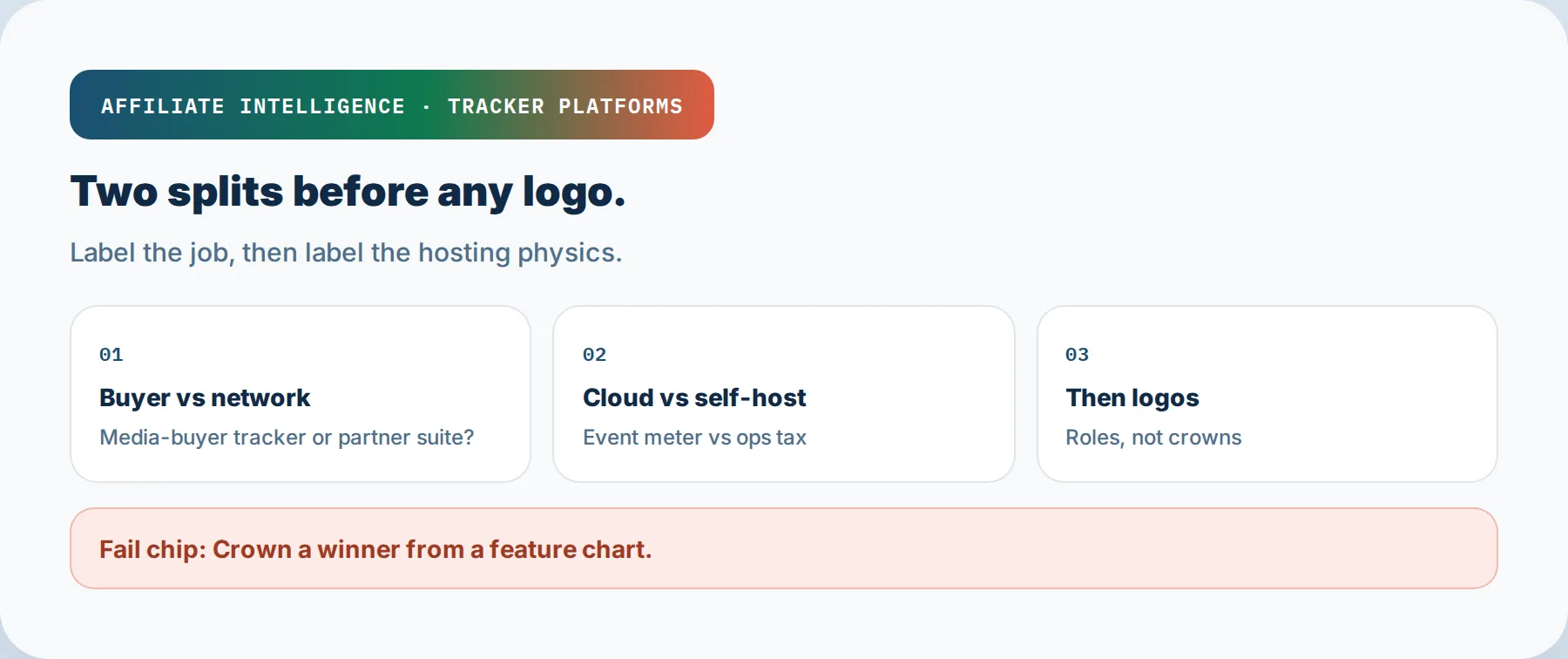
First split: buyer-side tracker vs affiliate-management software
Before comparing Keitaro and Voluum, label the job. A buyer-side media-buyer tracker sits between paid traffic and the destination. It records the click, routes it to a lander or offer, passes a click ID or SubID into the network, receives the S2S postback, and attributes the conversion back to the exact campaign, zone, placement, device, or creative. The operator uses that data to blacklist bad placements, split-test landers, and shift budget by hour and GEO. Keitaro, Voluum, RedTrack, and Binom are in this category.
An affiliate-management platform manages partners, offers, and payouts as a program or network. Everflow, HitPath-class platforms, and TUNE-class software handle partner portals, tiered commissions, invoicing, and network-side fraud decisions. Buying the second when you need the first is the expensive mis-buy. It is not a near tie. Voluum and Everflow solve different jobs: campaign-level media buying versus partner program management, as both the ClickerVolt Voluum vs Everflow comparison and the Track360 regulated-vertical comparison stress. If you run your own paid traffic, a partner platform adds overhead you do not need. If you manage affiliates underneath you, a media-buyer tracker will not run the program. If the actual problem is choosing an ad platform, start with the paid ad platform tracking pitfalls playbook.
Second split: cloud vs self-hosted (physics, not brand loyalty)
Cloud trackers give less ops, quicker start, and vendor uptime, but event caps or overages become the silent total cost at high-click traffic. Pops, push, and broad testing can push millions of events per month. A capped cloud plan that looks cheap at 200,000 clicks changes shape when a broad push test sends 4 million events in a month. The overage line, not the sticker plan, becomes the real price. RedTrack publishes event quotas by tier on its pricing page, and Voluum prices by monthly events with overage fees on its pricing page. Plans change; validate current caps before scaling, not after.
Self-hosted is the typical Keitaro or Binom path on a VPS. There is no per-event SaaS meter, but the operator owns updates, backups, SSL, disk, monitoring, and load when traffic spikes. Keitaro publishes mandatory VPS sizing by daily clicks in its installation docs. No monthly software fee does not mean no recurring cost. Infrastructure, monitoring, and labor still recur. Choose by operational control versus operational tax, not by brand loyalty.
Cloud event caps and overages are the silent TCO
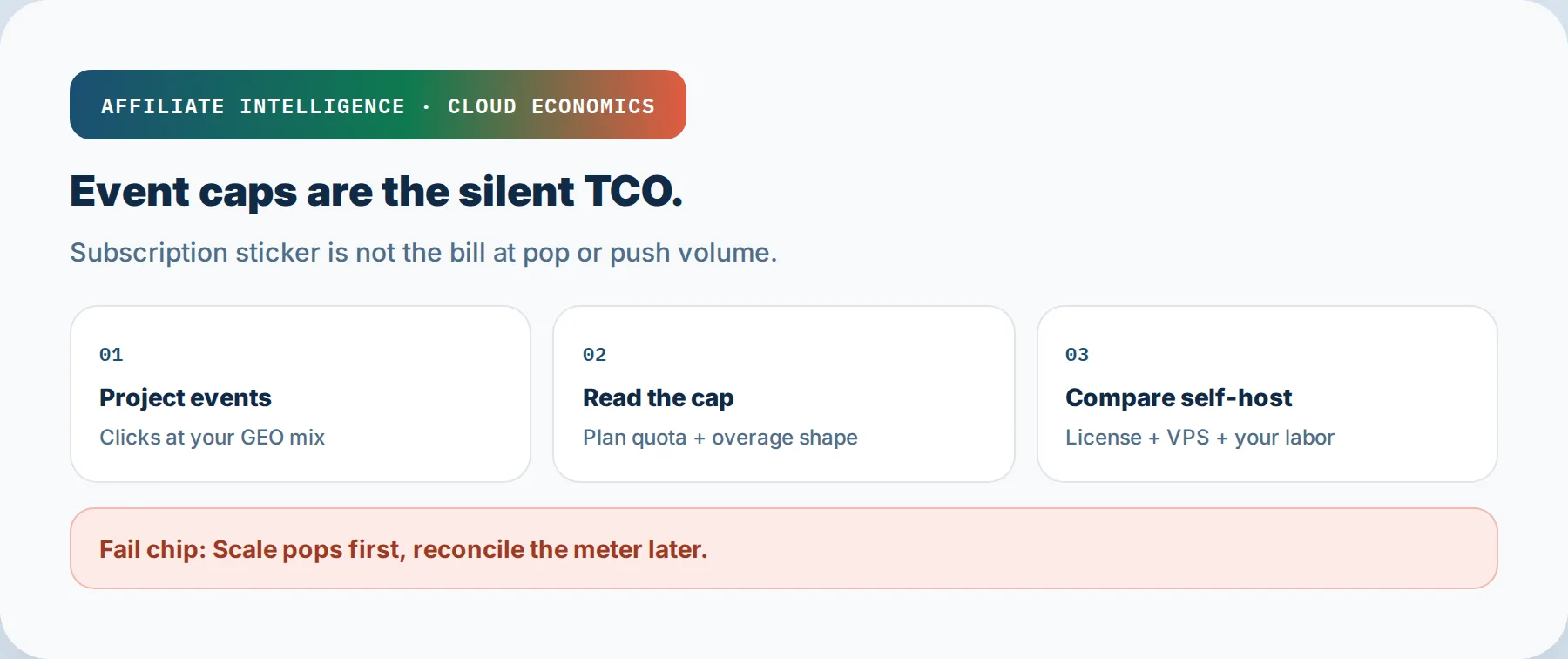
At pop, push, or broad testing volume, cloud pricing is structural, not cosmetic. The sticker plan usually includes a monthly event allowance. Over capacity, the vendor keeps tracking and adds an overage fee per 1,000 events. Voluum documents this model in its upgrade billing documentation: upgrading immediately ends the current billing cycle, starts a new one, and combines base fee plus previous-plan overages minus a prorated refund. The same economics apply to event-heavy traffic even without upgrading. If your projected month exceeds the cap by a few million events, the effective cost can dwarf the base fee.
Run the math before scaling:
- Project monthly events and clicks from the next three traffic tests.
- Compare the projected volume against the current plan cap on the live pricing page.
- Model the overage tier at the projected volume, then compare that total against the next plan or a self-hosted license plus VPS cost.
Voluum pricing pages show event allowances by plan, and RedTrack pricing pages show event quotas by tier. Plans change, so validate the numbers at decision time, not from memory.
Exit export due diligence before nesting click data
Before you store years of click history in any tracker, check the exit. A SaaS price-hike or an export wall is a failure mode, not a surprise. If raw clicks and conversions cannot be pulled cleanly, you are renting a ledge, not owning the ledger. Run four checks:
- Export format: can you pull raw event-level data, or only aggregated CSV dashboards?
- Raw event fields: does the export include SubIDs, click IDs, cost, payout, status, timestamp, and campaign keys?
- Schedule: can exports run on demand and on a recurring schedule?
- Contract terms: is export access tied to the current plan, and what happens after cancellation?
A tracker that locks the raw detail but lets you see pretty charts is a reporting dashboard, not an infrastructure purchase.
Latency and refresh (money, not aesthetics)
Redirect delay. A single well-run redirect can add a couple hundred milliseconds. Sloppy chains or cold DNS push into the 0.5 to 2 second range commonly discussed by media buyers. The redirect tracking glossary confirms that one hop is rarely noticeable while chains of three or four compound. Each hop is another TLS, DNS, and request cycle, and mobile users feel the delay before the destination content starts. The urllo redirect response time guide puts the benchmark plainly: under 50 ms is excellent, and cumulative latency matters most. Multi-DC and CDN matter here because redirect proximity to the traffic GEO changes the latency profile. Treat global edge as expertise to be proven with a test from the target GEO, not a checkbox on the pricing page.
Dashboard polling versus S2S. Polling every few minutes may be fine for a weekly offer rotation, but zone killing by the hour requires near-real-time S2S postback data. If the ad platform sends postbacks server-to-server, the tracker should attach conversion and payout data to the click quickly enough to act. A dashboard that updates on a heavy polling interval is a lagging record, not an operating feed.
Bot-filter marketing versus conversion quality. A platform can report that it removed 40 percent of clicks without telling you whether the remaining conversions improved or whether valid late converters were lost. Ask what conversion quality looks like after the filter: conversion count, payout integrity, chargeback direction, and false-positive behavior. Operators who migrate from pixel-only setups to S2S often report more conversions landing in the tracker, but that is a tracking lift, not proof that a bot filter preserved revenue. The operator needs post-filter performance against the same traffic source.
Named platforms as roles (skeptical map, not a scoreboard)
Keitaro is the self-hosted workhorse. High-volume buyers and operators who want to track Google Ads or Meta conversions through a tracker often land here. The tax is the learning curve plus VPS operations: OS constraints, container stack, ClickHouse reporting, SSL and update discipline. Keitaro’s S2S postback documentation is the reference for how SubID and status must return from the network. The feature set requires the operator to understand click IDs, status mapping, transaction IDs, and payout fields before trusting the report.
Voluum is a cloud suite where automizer and AI traffic distribution are marketed hard. The plan structure separates event volume, campaign count, user seats, and Automizer ad spend. The platform is strong for media buying across many sources, but the campaign-level focus means it is not an affiliate-program manager. Validate whether the plan includes server-side conversion API access or only pixel tracking before assuming Meta and Google Ads optimization. The Voluum pricing page is the live reference for those gates.
RedTrack is a cloud blend of tracker, automation, and attribution. It runs server-side CAPI, first-party enrichment, and multi-touch attribution, but the operator must verify which capabilities require add-ons and which plan includes them. Event caps scale with tier. Native Shopify or network integration is convenient, but convenience is not the same as postback accuracy.
Binom is self-hosted and often pitched for pop volume and white-glove setup. Its core is speed, data control, and a broad set of click metrics, events, and tokens. Setup support still leaves monitoring and SubID proof to the operator.
Starter rung. Bemob, Prosper202, ClickSDK-class tools are fine for learning. Define graduate triggers so you do not outgrow data quality by accident. Treat the starter tier as a training wheel, not a permanent home for paid traffic.
AI traffic distribution: controlled test before paying for the story
Require proof before paying for AI distribution. The correct test is a controlled split: run the automizer or AI traffic distribution on one identical segment while a manual zone blacklist runs on the paired segment, same traffic type, same offer, same payout window. Pass criteria are profitable conversions or ROI, not clicks removed and not impressions rerouted. If the AI story cannot show an advantage over a disciplined whitelist, treat the feature as a story tax. Also model Automizer ad spend limits and overage fees, because the feature only pays if the included spend tier covers your actual traffic. The Voluum pricing breakdown shows why the included Automizer band is part of the cost decision.
Support sets up the server still leaves monitoring and SubID proof to you
For Binom-class self-hosted installs, support setting up the server is not proof of tracking. The operator still owns monitoring, disk, patches, update timing, uptime, and end-to-end SubID confirmation back to the network or offer. A server can be installed and green while a postback still returns a blank or unresolved token. Require a controlled test click after setup: follow the SubID from the campaign URL into the offer, store it network-side, trigger a test conversion, and confirm the tracker attributes exactly one payment event. Until that loop is proven, setup is incomplete regardless of what support configured.
RedTrack blend honesty: native integrations vs postback accuracy
RedTrack is a blend: cross-network tracker, server-side CAPI, first-party enrichment, and some attribution modeling. The honest question is whether native Shopify or network integration is enough for the traffic type or whether network postbacks are required for accurate conversion matching. A Shopify script and theme liquid placement may capture store events, but affiliate network S2S postbacks still depend on network macros and click IDs. The RedTrack Shopify integration page describes the server-side event path, yet the operator still needs to verify downstream network attribution. Compare current event caps by tier before trusting the marketing, because a blend can hide add-on costs for ad-spend sync, Ads Manager, or scale rules. If most of the value is clean server-side conversion capture, the minimum tier plus a separate postback layer may be enough. If the operator needs cross-network media buying, the add-ons are part of the real price.
Cost-token reconciliation before ROI
Trackers only produce useful ROI when the cost side matches the traffic source. Four failure points recur: timezone, click loss, cost parameter, and dynamic CPC.
- Pull cost by timezone-adjusted hour. If the traffic source reports in its ad account timezone and the tracker reports in another, the same conversion may land in different calendar hours.
- Compare click counts first. If the tracker shows materially fewer clicks than the network, cost and conversion attribution are already broken before payout math.
- Check the cost token and dynamic CPC/CPM pass. ExoClick dynamic tokens documentation and Everflow dynamic CPC/CPM media cost guide show how a cost value travels through the link. If the token is missing, truncated, or sent as zero, the tracker understates spend.
- Reconcile tracker-reported spend against the traffic source dashboard for 24 to 48 hours. Flag any mismatch larger than normal click-loss tolerance before optimizing.
If the mismatch is large, the ROI number is fiction. Most traffic source integrations log cost pulls, skips, and errors in a cost updates screen, so start there when the numbers diverge. The ClickFlare cost updates log documentation is a useful example of the error states to inspect.
Zero-conversion audit before you kill the offer or swap trackers
Before killing an offer or swapping trackers, run the settings audit in order. Zero conversions after impressions can be an offer problem, a path problem, or a tracker token problem, but the cheapest checks come before the expensive decision.
- Offer URL: does it deliver correctly with the required SubID or click ID parameter?
- Postback tokens: are the incoming network macros mapped to the tracker’s expected subid, status, payout, and tid fields?
- Lander versus direct link: is the path structure allowed by the traffic source and required by the offer?
- Cost parameter: is spend being logged, or is the cost column zero because the token is missing?
- Click counts versus network: does the tracker match the traffic source in volume and timing?
- Blank SubIDs or conversions: if the UI shows clicks but no SubID resolution, use the blank SubID diagnosis before blaming the offer.
Only after those items are clean should the operator compare conversion quality and decide whether to kill the offer or change trackers.
Direct-link vs lander structural mismatch
A green tracker setup does not fix structural mismatch. Direct linking sends the click straight to the affiliate offer. A lander path sends the click to a pre-sell page before the offer. Some traffic sources prohibit certain landing flows or require lander compliance, while some offers demand direct linking or pre-qualified traffic. If the operator uses the wrong pattern for the traffic type, budget wastes even when the tracker records every click and postback correctly. Ask two questions before launching: what does the traffic source permit, and what does the offer require? For cases where the platform itself constrains the bridge, see the Meta bridge-page reality and GCLID silent filters. The fix is structural, not a tracker setting.
The non-negotiables (before logo preference)
Before deciding on any logo, verify that the S2S postback and SubID loop works end-to-end. The methodology depth is in the SubID tracking guide. A green tick is not conversion proof; the trap is covered in S2S green-tick failures. Confirm that the network stores the exact click ID the tracker passes and returns it unchanged in the postback. If either side substitutes a generic token or truncates the ID, the conversion lands in the wrong campaign or disappears.
For Meta and Google Ads offline conversion flows, the tracker must preserve platform identifiers correctly. Meta bridge pages have structural limits, covered in Meta bridge-page reality, and Google Ads offline imports fail silently when GCLID capture or upload rules are off, covered in GCLID silent filters. Before sending traffic, run the network tracking due diligence so the tracker receives the events it needs. These are non-negotiables because they decide whether the data can be trusted.
When to graduate (and when a tracker is overkill)
Graduate when event caps become a threat at projected volume, not after the overage invoice. A cloud plan that fits today may not hold a pop or push test scaled to multiple GEOs. Graduate when multi-channel S2S and raw event detail exceed what free tools can hold, when automations or rules a spreadsheet cannot run safely, or when multi-GEO latency, currency, and timezone mismatches compound into daily reconciliation work. If multiple traffic sources require separate token maps and cost passes, the tracker has become infrastructure.
A tracker is overkill when you run a content site with a handful of network links, no paid media, and only UTM-level reporting. That job needs SubID hygiene, not a full Keitaro or Voluum stack. Use the SubID tracking guide before forcing infrastructure onto a spreadsheet job. The durable progression is tool-to-job: start with light tracking, graduate when the failure modes have real money attached, and do not carry heavy tooling into a job that does not need it.
A one-sitting tracker decision pass
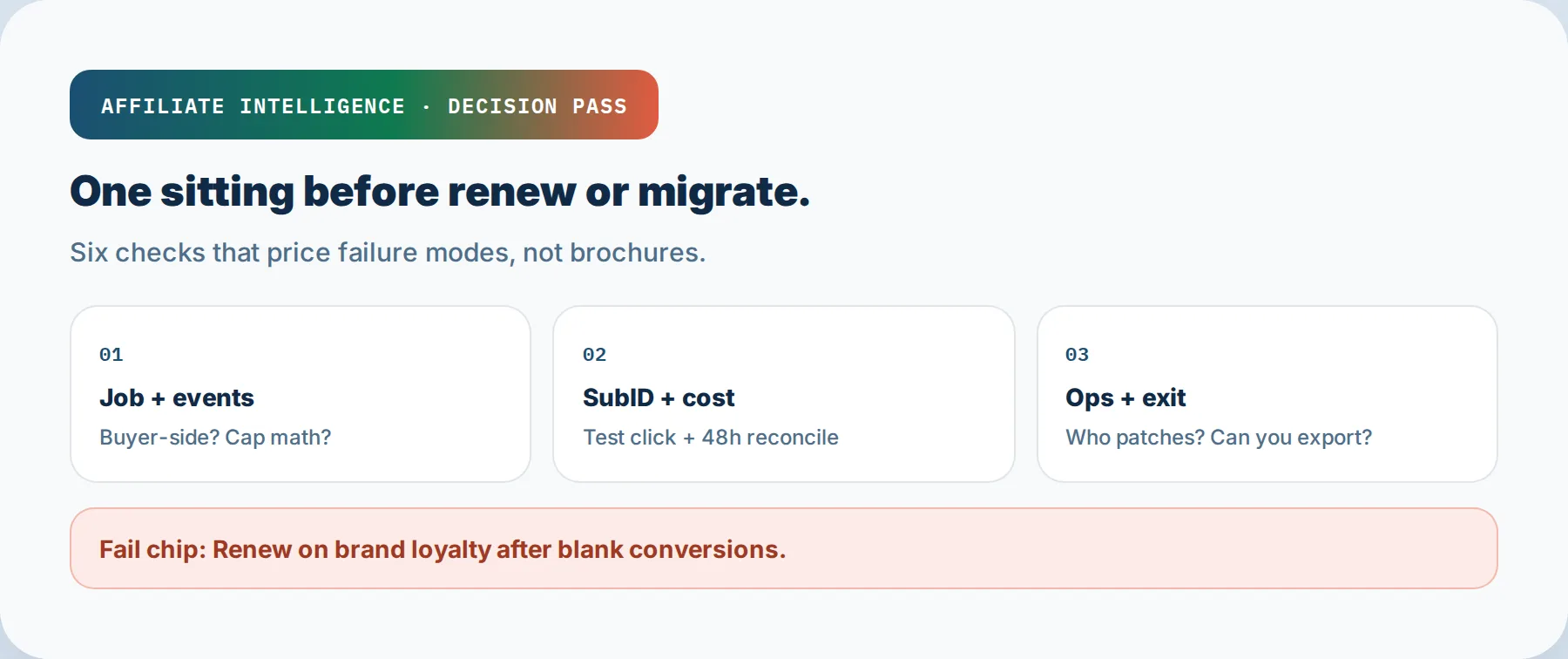
Run this pass before renewing or migrating.
- Buyer-side or network-side: are you buying traffic or managing affiliates?
- Event math: project monthly events and clicks, then compare cloud cap and overage total against self-host ops tax.
- S2S SubID test click: confirm one controlled click produces one correctly attributed conversion.
- Cost reconciliation: match tracker-reported spend to the traffic source for 48 hours.
- Host and support coverage: if self-hosted, name who patches, watches disk, and what support actually covers.
- Exit export: can you pull raw clicks and conversions if you leave?
The tracker is infrastructure. Treat it like float and clawback risk. Price the failure modes before the logo.