S2S Postback Tracking: The Failures Behind a Green Tick
The Failed Assumption
Operators often treat server-to-server attribution as a switch. Enable the postback URL, watch the dashboard tile turn green, and assume conversion proof is solved. That assumption is expensive.
If the blank column starts before the postback, fix the SubID tracking guide setup and naming first. This page maps green-tick failures after the echo is supposed to return.
A green tick means the endpoint answered. It does not mean tokens matched, SubIDs returned, or payouts will reconcile. TUNE is explicit: you receive a 200 OK HTTP response code if TUNE attempts to process the postback, even if the conversion is unsuccessful. The UI confirmation is a delivery receipt, not an attribution receipt. I am skeptical of any dashboard that conflates the two.
Consider the structural scenario. Your tracker shows a green S2S status. The raw postback log shows an incoming request, a 200 OK, and no matched click ID. The network never printed an error. The dashboard never stopped smiling. The conversion is already orphaned.
That gap between UI confirmation and payout truth is the entire subject. “We turned on S2S, so attribution is fixed” is the root failure. Production still breaks on wiring gaps, silent parameter swaps, sync disagreement, and filters that block empty subsource values. The green tick hides every one of them.
What Affiliate S2S Actually Is (Scope It)
For the definition and happy-path setup (pixel vs postback, click ID join key, first verify), start with the S2S tracking guide - then use this page when the tick lit but commissions are wrong.
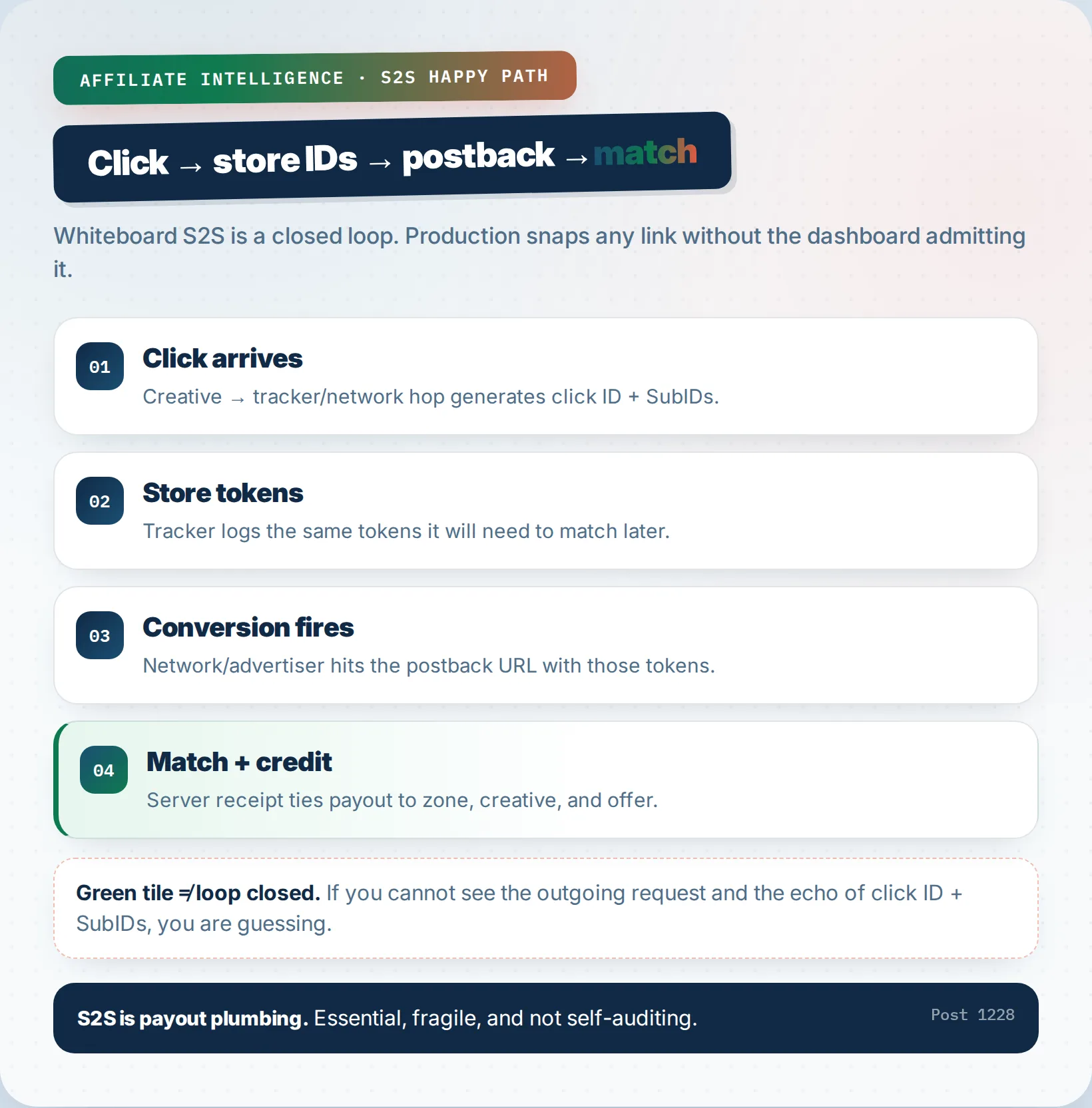
Affiliate S2S is narrow. A click arrives. Your tracker or network logs a click ID and SubIDs. After a conversion, the advertiser fires a postback carrying those same tokens server-to-server. The network matches the event back to the click. That loop gives you one thing a dashboard thumbnail never can: a server receipt tied to a payable action, with zone and creative labels intact.
The happy path is structural, not magical. Lander captures the ad click ID. That ID gets passed into the affiliate SubID slot. The network stores it. On conversion, the network fires a postback with the same ID. Your tracker matches it. Optional: a server event forwards the conversion to the ad platform. Break any hop in that chain and you still get a green tick - with an empty matched row underneath.
S2S moves the message off the browser. It does not invent missing tokens. This is not marketing server-side tagging. A Stape or server-side GTM container aimed at GA4 or Meta CAPI solves a different problem: moving analytics and conversion API events off the browser. Affiliate S2S carries payout-critical data, and confusing the two leaves you with a setup that looks modern while silently discarding the click ID the network actually needs.
That distinction matters. Safari ITP and Firefox ETP already remove 30 to 35 percent of trackable traffic by default, and desktop ad blocker penetration has passed 40 percent. Server-side postback holds above 98 percent accuracy regardless of browser, ad blocker, or consent state, while pixel tracking misses browser-blocked events. Resilience is not correctness. If your link never stored a SubID in the network’s expected slot, a postback cannot return one later.
The counterargument deserves its moment. Pixel-only tracking can be acceptable when an error costs you a reporting inaccuracy. Server-side is required where an error costs you a partner dispute. Most operators cannot tell in advance which errors become disputes, which is exactly why the default matters.
One more scope boundary. A server-fired network pixel is not the same as affiliate S2S. If the network fires a pixel from their server but the browser cookie never ties, the request logs page events without purchase conversions. That is a pixel with extra steps, not a server-side conversion loop. When the cookie never ties, the CAPI or postback path is the only route back. The full tracking spine lives in server-side tracking guide.
Facebook Conversion API is not a simple postback URL. Meta’s ClickID arrives as fbclid and must be formatted into the fbc parameter, and the full click-to-CAPI chain requires more than clickid passthrough. Partial middleware that fires only a conversion event without the complete chain leaves optimization broken while something looks server-side. Contrast that with the affiliate network postback: the network holds the click ID, the advertiser returns it, and the match is the whole job.
Failure Mode Map: Silence Points Behind a Green Tick
Before an operator trusts a postback to reflect reality, walk the silence points in order. Every one can show green in the UI while the attribution chain has already snapped.
Copied Destination URL Is Not the Affiliate Link
An operator builds a lander, opens the merchant checkout in the browser, copies the final destination URL after the redirect, and pastes it into the campaign as the affiliate link. The page loads. The user can buy. But the affiliate redirect never fires, so the click ID is never created, the cookie/postback handoff has nothing to store, and attribution is bypassed before tracking begins. It looks like a working link because the destination loads. It is not the affiliate link. Green UI elsewhere does not save this path break.
1. Postback Never Fires, Timeouts, Endpoint Blocked, HTTP Success Ignored
Not every conversion produces a postback. Advertiser endpoints time out under load. A firewall or IP allowlist silently drops the request. Or the tracker accepts an HTTP 200 and still fails to match the click ID because it was stripped earlier.
The 200 danger is real. TUNE returns 200 OK even for unsuccessful postbacks, so do not resubmit as you would for a 4xx or 5xx response. Everflow retries up to five times per failure, then auto-disables a postback after at least 10 consecutive failed attempts spanning more than 72 hours. A fast burst of failures inside a 72-hour window does not deactivate on its own; a slow drip of consecutive failures across the boundary does. “Last received” tile is not evidence. Inspect raw postback logs: outgoing request, response code, attempted transaction ID. If you cannot see all three, you are guessing.
A high-volume checkout endpoint that times out under load is structural failure. The network keeps a green status because some events still arrive; the missed ones never enter the log. Only a raw count of sent versus received reveals the gap.
2. Token and Macro Mismatch
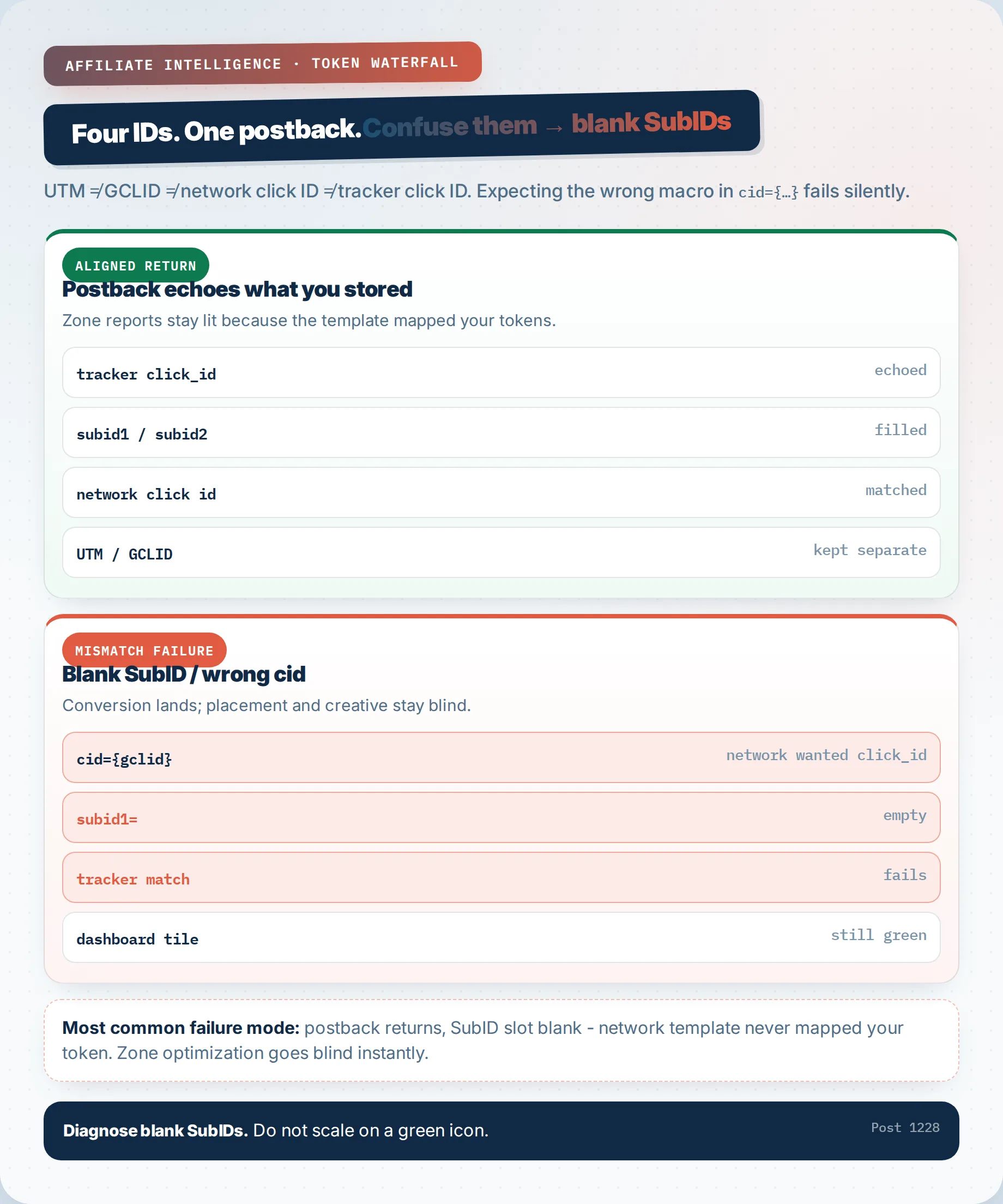
The most common production break is a macro name mismatch. Every platform uses different syntax for the same idea. CAKE expects #s1#. Everflow expects {sub1}. Affise has no clickid macro for affiliate postbacks at all - you pass {sub1} through {sub8}, not {clickid}.
Nine times out of ten, an operator sends {payout} when the platform expects {sale_amount}. It looks right and fails silently. If you write cid={gclid} when the network expects cid={click_id}, the postback arrives, the system returns a happy response, and nothing credits. Macro mismatch is a parameter mapping fix, not a postback fix. The waterfall underneath is unforgiving: UTM is not GCLID, GCLID is not the network click ID, the network click ID is not your tracker click ID. The Google Ads offline sibling covers the silent filters that make this worse. Wrong macro in the slot fails silently every time.
3. Blank SubID on Conversion
Even with the macro matched, the value can arrive empty. A blank SubID column means zone optimization goes blind: you can count a conversion but cannot tell which placement or creative produced it. Treat the blank column as an unread receipt, not a tracking failure.
In a postback verification pass, a blank SubID is a signal that the token mapping broke upstream. The postback can only return what the click chain stored. CAKE’s s1 SubID maxes at 50 characters, not 100 like s2 through s5. A long campaign label gets truncated, the network returns a partial or empty value, and last week’s report no longer reconciles. Do not chase the postback. Chase the payload field. The blank-SubID diagnostic walks the full sequence.
Subsource Filter Trap
Filtering bad subIDs or subsources can also block good traffic that passes empty or missing subsource values. A conversion that the filter discards before postback matching never reaches the server loop. The UI still shows a green delivery status because the filter ran silently earlier. If a rule is built to exclude “known bad subsource values,” empty strings may fall into the same bucket without anyone noticing. Before blaming the network, check whether the filter caught legitimate rows before the postback had a chance to match.
4. Pixel + S2S Double-Fire Without Dedupe
The reverse failure is over-reporting. If a browser pixel and a server postback both fire for the same conversion without a shared transaction ID, EPC inflates. Pixel tracking can underreport by up to 20 percent. Double-fire is the opposite error, and it looks fantastic in the dashboard right up until the network’s payout reconciliation comes back lower.
Set a dedupe key - usually a transaction ID or order ID returned in the postback - and confirm that firing the identical test event twice produces one credit. Or disable one method. A green tick hides over-reporting until reconciliation, and that is a finance-facing problem.
5. Off-Domain Checkout / No Thank-You Pixel
When checkout happens on a third-party payment page, you often cannot place a thank-you pixel. The only path back is a server-side postback or import from the processor. That works only if your click ID survives the handoff and the processor can fire a callback. A handoff often drops the parameter much earlier than the conversion deadline. The conversion does not vanish because the customer vanished. It vanishes because the ID did.
6. Sync Disagreement: Tracker vs Network vs Ad Platform
Different systems count conversions at different moments. Client-side analytics may count a pageview as a conversion. The advertiser fires the postback only after payment confirmation, hours later or the next day. Campaign-level and user-level counts diverge by design.
Google Ads offline conversions can take three hours or longer. GA4 conversions can lag up to 24 hours. Some affiliate platforms treat 48 hours as a conversion deadline. None of these are delays to panic over; they are different ledgers with different counting moments.
When real sales show in the network while Google or Facebook show zero, check the conversion import or postback-to-ads wiring before swapping offers or rebuilding the lander. Verify the network postback is forwarded to the ad platform as an offline or server conversion, check the mapping and timing, and distinguish import failure from postback failure. A clean network postback that never reaches the ad platform is not a tracking defect; it is an integration break. The payout truth is the server receipt, not the client-side event. If you feed a delayed or modeled number into optimization, you are reacting to estimates, not outcomes.
Last-Click Theft After a Clean Postback
Tracking can work perfectly and commission can still vanish. A user clicks your affiliate link, the postback returns a clean matched conversion, and the network shows credit. Then the user opens the merchant app or activates a coupon partner that changes last-click attribution after your click. The final touch steals the commission. The postback was not the defect; the credit moved. This is not a broken S2S loop. It is a reconciliation problem that looks like tracking failure because your dashboard showed a matched server receipt before the merchant ledger said otherwise.
Verify Before You Scale: The Postback Checklist
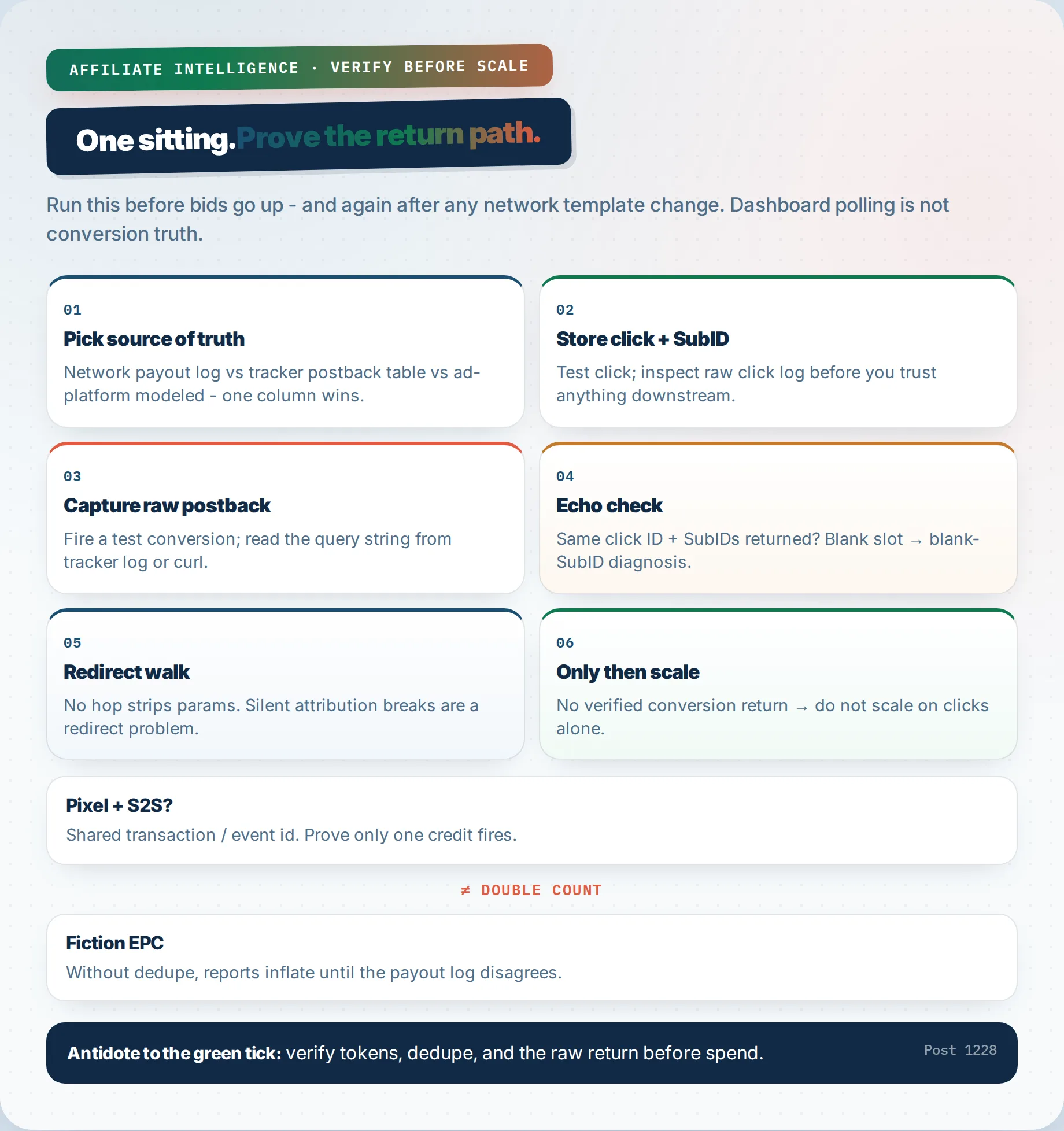
Click firing is not conversion attribution. An operator can watch a healthy click count and still have zero matched conversion postbacks. The only test that matters before scaling spend is the full path: click to lander to conversion to commission/reporting, including a test purchase where the offer allows it. A structure test is not theater; it separates a real server loop from a dashboard costume.
Verify Lander Domain, Not Offer Domain
Facebook domain verification and pixel/CAPI optimization attach to your owned bridge or lander domain, not the merchant offer domain. Operators who verify the offer domain while running through a lander get optimization and review failures that look like postback bugs. The ad account trusts the domain it sees in the click path. If that domain is not the one verified in Business Manager, the server event may never qualify for the expected optimization signal. That is a paid/scope failure, not an S2S postback defect.
Outgoing-Click Conversion Proxy
When a postback is unavailable, labeling outgoing clicks as a conversion proxy can be honest interim measurement. It is not payout truth, and it must not be presented as a matched server-side conversion or a clean postback. Keep the label explicit because the gap between a click leaving and a commission arriving is the same gap the postback exists to close.
- ☐ Run one controlled click-to-conversion test purchase where the offer allows it. Confirm the click ID and SubID survive from click through lander to commission or reporting.
- ☐ Inspect the raw postback log for the outgoing request, response code, and attempted transaction ID. A 200 OK alone is not evidence.
- ☐ Check the SubID column on the test conversion. A blank slot means token mapping broke upstream, not the postback.
- ☐ Verify every macro placeholder against platform documentation. CAKE expects #s1#; Everflow expects {sub1}; Affise has no clickid macro and needs {sub1}-{sub8}.
- ☐ Check the subsource filter does not discard good traffic that passes empty or missing subsource values before postback matching.
- ☐ If pixel and S2S both run, confirm a shared transaction ID or order ID deduplicates. Fire the same test event twice and expect one credit.
- ☐ Map the off-domain checkout callback path. Confirm the click ID survives the processor handoff and the callback returns to the tracker.
- ☐ Note sync delays: Google Ads offline conversions can take 3+ hours, GA4 up to 24 hours, and some affiliate platforms up to 48 hours. Reconcile daily against the payout ledger, not the browser event.
- ☐ Verify the destination platform actually recorded the GET/conversion, not just that the endpoint was sent.
S2S postback accuracy should run at 98 percent or better when correctly configured. I treat a consistent drop below that as a signal, not law, because baselines vary by network and offer type. But it is a signal that conversions are going untracked, and that will surface later as partner disputes. Closed-loop proof is the only thing that turns a green tick into a payable event.
Hybrid vs Graduate Tooling
Pixel-only tracking is fragile under privacy. S2S without verified token return is theater with a different costume. A DIY click logger that appends parameters but cannot receive or match postback callbacks is not production S2S. It is a click counter. That fork is a build-versus-buy question, and the honest math lives in the custom click tracking versus paid tracker cost analysis.
A hybrid bridge keeps operators sane in the messy middle. Use server-side postbacks for networks that support them. Fall back to pixels for the rest. Keep a manual reconciliation rhythm. The proxy is honest when postback access is limited: an outgoing-click conversion labeled as a proxy metric, not payout truth. Check the subsource filter trap before blaming a network - bad-subID filters can also block good traffic with missing subsource.
Do not pretend hybrid is permanent architecture. At some volume, manual reconciliation costs more than a proper tracker. The metric that matters is whether the tool returns your SubIDs cleanly on postback and lets you verify the whole loop. The tracker platform comparison covers that decision without a scoreboard. Setup pitfalls live in the paid traffic tracking platforms piece.
Graduation triggers are structural, not aspirational. Event caps and overage fees. Multi-currency latency. Automation rules a spreadsheet cannot run safely. When postback reliability becomes payout-critical, you graduate tooling because the job demands it, not because a comparison chart crowned a winner.
A green tick means the endpoint answered, not that tokens matched or payouts will reconcile.