Pinterest Affiliate Marketing: Vanity Metrics Won’t Pay Rent. Here’s What Does
Here’s what most Pinterest advice won’t say: beautiful boards and high follower counts are not the same as a functioning monetization system. The difference between pins that generate traffic and pins that generate attributed revenue is a pipe you own, a program that fits the traffic, and measurement that separates vanity from cash.
The Failed Assumption: Pretty Boards Do Not Equal Income
If you are still building your first affiliate pipe, the start-without-the-course guide maps the week-one sequence: one niche, one offer, one surface, one tracked link.
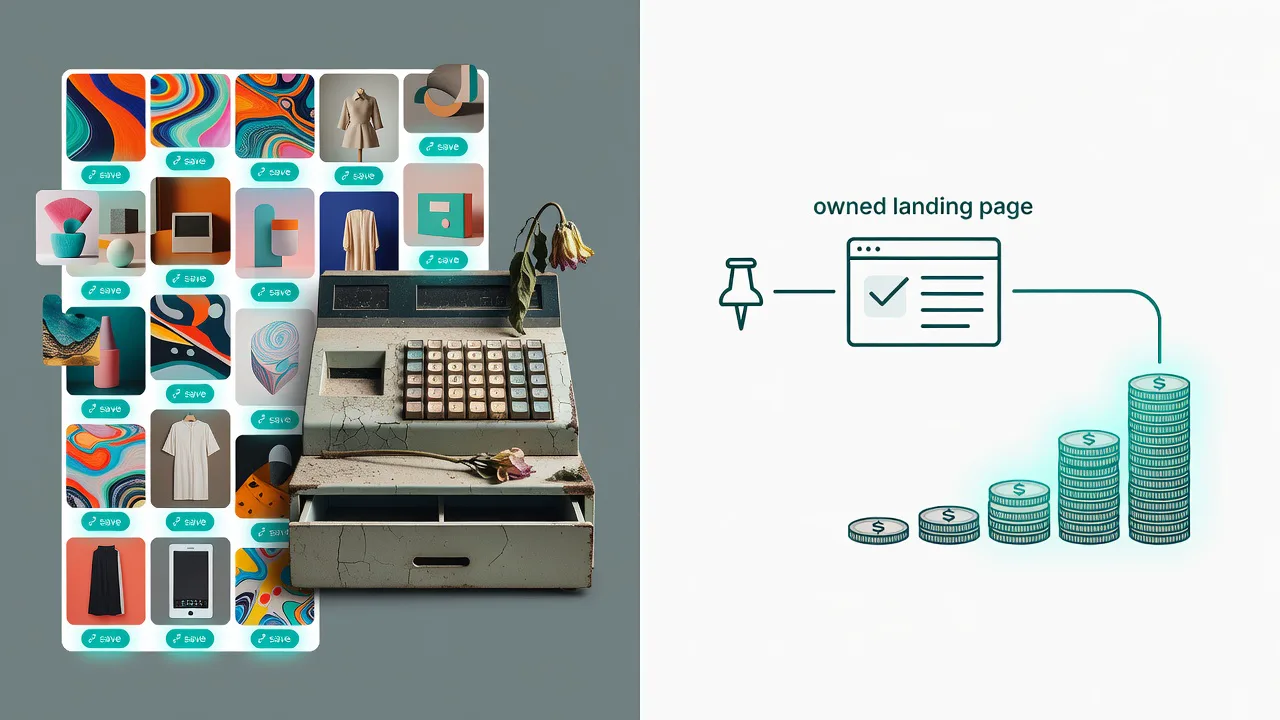
The core of pinterest affiliate marketing is building a conversion system, not just growing a visual archive. Operators often mistake board aesthetics for a pipeline. You can have a finished board – trending fonts, cohesive color palette, thousands of saves – and still earn nothing. That’s because a board is not a monetization system. The actual system is: pin -> owned destination -> Qualifying Link -> attributed sale. Without every link in that chain, you’re running an unpaid design portfolio.
If your boards look finished but outbound clicks stay flat, you are optimizing aesthetics for an unpaid audience.
That’s not a failure of Pinterest; it’s a category error. Pinterest is a search-and-save engine, not a checkout counter. It can build distribution, but it won’t close the sale. The sale lives on your destination, under your measurement, inside a program whose placement rules you’ve verified. Until you own that transition, every vanity metric – followers, impressions, saves – is a proxy for nothing.
Before you scale pin volume, fix the pipe. And before you trust a “without a website” shortcut, understand that your link-in-bio is an asset single point of failure (SPOF). For the domain resilience playbook, see the domain SPOF guide. This piece owns the Pinterest channel map.
Metrics That Matter (and Vanity That Does Not)
The metrics that pay rent are outbound clicks, landing conversions, and attributed sales. Follower count is noise. “Gorgeous pin” is a compliment, not a KPI.
Saves can be aspirational without transactional intent. A user saves your “10 Best Coffee Makers” pin because they want to revisit it someday, not because they’re buying a machine this hour. That’s wishlist behavior. Treating saves as a sales proxy will mislead your board optimization. Value/inspiration pins can drive distribution; conversion pins need clearer commercial intent. Don’t build a rigid board taxonomy – just separate signal from ambient engagement.
Here’s a structural scenario: your impressions climb, your saves are healthy, but outbound clicks barely move. Your creative and SEO are working, but the monetization pipe is broken. Maybe the destination is a naked Amazon product page that cold traffic ignores. Maybe the link doesn’t disclose an affiliate relationship and triggers user distrust. Or maybe the program’s cookie window is too short for research traffic. Diagnose the pipe, not the pin design.
Pinterest Analytics distinguishes impressions from outbound clicks; use that. (As of current platform documentation, see Pinterest Analytics.) Judge your boards by whether people click through and whether those clicks convert downstream.

The Pipe Map: Pin to Owned Landing to Merchant
The naive pipeline – pin -> Amazon product page with your affiliate tag – is a leaky bucket. It fails for three reasons: platform low-value signals (tracker-heavy URLs look spammy to Pinterest), merchant placement rules (Amazon Associates may restrict direct social posts), and cold traffic that won’t convert on a product page alone.
Duplicating the same destination URL across many pins can collapse reach; Pinterest’s algorithm flags repetitive link patterns. (For how duplicate pins harm reach, see Pinterest’s community guidance, but the pattern is consistent: unique destinations matter.)
Why Naked Affiliate Destinations Fail
A tracker-heavy URL with query parameters pasted directly on a pin – especially at high promo frequency – signals low-value to automated filters. It also dumps cold visitors onto a product detail page where bounce rates are high. If the same affiliate URL appears across dozens of pins, distribution may throttle. The fix is not a redirect trick; it’s replacing the naked destination with an owned bridge.
Owned Bridge Anatomy
Instead of linking to the merchant, send pin traffic to a short value page on your own domain: a tip list, a curated shortlist, a quick comparison, a “why I recommend this” blurb. Then place the Qualifying Link (affiliate link) as the next step. This warms the visitor, provides context, and keeps the pin’s destination as your domain – not a third-party storefront.
Email capture is optional but valuable: an email list turns one-time pin traffic into a repeatable asset. The bridge page is the conversion handoff; fix it before scaling pin volume.
Compliance, Not Evasion
When operators ask for “pattern-breaking redirects,” I point them to the cloaked landing pages vs redirect hygiene and Amazon cloaking compliance articles.
An owned bridge is not a cloaked merchant hop. The moment you try to obscure the final destination to evade platform spam detection, you’re in gray territory that can cost accounts. Stick to straightforward owned landings, clear disclosures, and legitimate program placement.

Amazon (and Program) Fit for Pinterest Traffic
Amazon Associates + Pinterest as a direct social surface is a common pairing that often generates more risk than revenue. Operators often encounter placement friction or commission risk when sending social-first traffic directly to Amazon, not because Pinterest banned affiliate links, but because Amazon’s placement rules aren’t automatically compatible with social-first traffic patterns. (Amazon’s Associates Program Policies need review; the Operating Agreement governs placement surfaces.)
Placement Rules Beat Brochure Folklore
Do not assume Pinterest is interchangeable with Instagram, YouTube, or Twitch under Amazon’s Associates Operating Agreement. The current agreement specifies allowed site types and may classify offsite social platforms differently.
Before you paste an Amazon affiliate link onto a pin, verify that you’re in compliance with both Amazon and Pinterest policies. (For destination-rule depth, see the Amazon cloaking compliance article.) If a placement isn’t explicitly allowed, treat it as disallowed until confirmed.
Cookie Window and Research Traffic
Amazon’s standard cookie window is short (verify current Associates terms). Pinterest users often browse, save, and purchase days or weeks later. A cold pin-to-product hop might get no attributed sale because the user left the session without buying. Warm the visitor on an owned page, and consider affiliate programs with longer cookie windows if your content serves research-heavy purchases. (The Walmart affiliate program DD offers a retail contrast.) Always check current program terms for exact duration.
Fit Tests Beyond Amazon
If Amazon’s cookie and placement friction make the math unworkable, test creator-commerce programs or merchant-direct affiliate programs with longer windows. A soft tease: YouTube and TikTok have their own pipe dynamics, but for now, focus on whether Pinterest’s traffic can drive attributed sales given the specific offer’s economics. (For rate survival, see Program Economics.)

Without a Website – Temporary Options and SPOF Risk
“Pinterest affiliate marketing without a website” is a popular demand signal. Yes, you can start with a link-in-bio landing page or a single board linking to a tool like Beacons or a Notion page. Treat it as a fragile, temporary asset, not a strategy.
If that single page goes down, gets flagged, or the provider changes terms, every pin redirecting to it breaks at once. That’s an asset SPOF. (For domain concentration risks, read the Domain SPOF playbook.) The moment you have meaningful pin traffic, build a site you control. Temporary options are not substitutes for owning the pipe.

Disclosure, Creative, and Account Hygiene
Affiliate pins must carry clear, conspicuous disclosure. For ordinary commission links, Pinterest does not require its Paid Partnership brand-tag tool (that path is for formal creator-brand sponsorships where the brand approves a tag and can run paid media behind the pin). Use a clear affiliate disclosure phrase in the pin description instead – “#ad” or “#affiliate” language that states the commercial relationship. Pair that with the FTC Endorsement Guides. (For platform rules, review Pinterest Advertising Guidelines and the official FTC Endorsement Guides. For a broader audit, see the compliance audit checklist.)
Creative hygiene: do not scrape Amazon product images as your default pin visual. Amazon’s image rules restrict usage unless done via the Product Advertising API, and even then, compliance is fiddly. Prefer original photography, collages, or lifestyle images that convey the product in context. Scraped catalog shots signal low effort and can get content flagged.
Cadence matters. Consistency beats binge volume. Posting 15 affiliate-heavy pins in a day from a new account looks like spam.
Steady, daily pinning with a mix of affiliate and non-affiliate content avoids filters. Avoid identical destination URLs on every pin; vary your bridge pages or at least rotate. And don’t put merchant links on every pin from a brand-new account. (Pinterest’s guidelines say no specific limit, but the pattern of repetitive affiliate activity can trigger flags.)
Measurement: Boards vs Sales
Boards are not financial ledgers. Saves and impressions without attributed sales remain vanity metrics, no matter how aesthetically pleasing the pin. To turn a board into a measurable asset, you must tag destinations so each pin can be judged by the revenue it generates. Without that mapping, your reporting is a scrapbook, not a P&L.
UTM Plus SubID on Destinations
Tag every pin’s destination URL with UTM parameters (for analytics) and SubID or network click IDs (for payout attribution). Without a SubID on the affiliate link, you’ll see a commission in the network dashboard with no idea which board, pin, or creative earned it.
(For SubID implementation, see the SubID complete guide and email click-zone hybrid. For broader tracking hygiene, soft-link to tracking best practices.) Make your tracking survive the redirect chain. Network click IDs also count.
Judge Boards by Attributed Sales
If two boards look similar but only one generates attributed sales, the ledger decides. A/B test board content, pin styles, and bridge pages using your SubID segments. Saves are not the KPI. Impressions are not the KPI. Outbound clicks are a leading indicator, but attributed revenue is the truth.
Dark Social Blind Spots
Saves and private forwards create Direct or dark-social attribution gaps. A user saves your pin, later opens Pinterest, clicks from their saved board, and buys. That click may appear as Direct / None in analytics. Without SubID, you lose the story. For handling dark-social tracking, see the dark social guide. Accept some blind spots, but tag what you can.
Worth-It Judgment: Scale, Fix, or Walk Away
Income screenshots and “roadmap” courses are marketing until your own ledger matches. If you need long cookies, unrestricted naked links, or full-time livelihood from one aesthetic channel, Pinterest may be the wrong primary pipe – or the wrong program pairing. The decision is: can you get a profitable, measurable pin-to-sale pipeline that meets your revenue ceiling? If the answer is no after fixing the pipe, walk away this week and allocate effort elsewhere.
If you’re getting some attributed conversions but the volume is too low, scale content and pin frequency while maintaining tracking. If conversions are zero despite decent outbound clicks, fix the bridge landing, switch programs, or test different product types. If your account keeps getting flagged, audit your pin patterns and compliance.
YouTube has its own vanity trap: views are not commissions. When you are ready for a second channel map, use the YouTube affiliate funnel playbook. Do not spread thin: master one channel’s monetization before adding another.
One-Sitting Pinterest DD Checklist
Use this checklist before scaling pin volume. If you can’t check each item, fix the gap first.
- Define success metrics as outbound clicks + attributed sales, not followers or saves.
- Map pin -> owned landing -> merchant; no naked affiliate destinations as primary pipe.
- Verify current Amazon Associates Operating Agreement / program placement rules; do not assume Pinterest is an allowed surface.
- Price cookie window vs. research traffic behavior; longer cookies may be necessary.
- Include clear affiliate disclosure on pins (FTC-compliant); soft-link compliance audit.
- Use original or lifestyle creative, not scraped merchant catalog images.
- Avoid duplicate destination URLs across many pins; vary landing pages.
- Maintain consistent daily pinning cadence; no binge-and-pause spam bursts.
- Append UTM + SubID (or network click ID) to every destination URL; soft-link SubID guide.
- Have a plan for “without a website” SPOF; soft-link Domain SPOF.
- Set up a remonetize plan for when one program closes or changes terms.
- Soft-link cloaked landing compliance and Amazon cloaking for when bridge advice drifts toward evasion.
- Soft-tease dark social tracking at dark social guide.
If your next channel question is TikTok rather than pins, treat Shop in-app and classic bio click-out as different pipes in TikTok Shop affiliate vs classic affiliate links - same vanity trap family, different eligibility and tracking rules.
Operators who scale pin volume before this checklist are volunteering unpaid traffic. Fix the pipe, then scale.