Bridge Page Meta Ads: Affiliate Tracking Reality Check
Reality Check: Bridge + CAPI Does Not Close the Purchase Loop
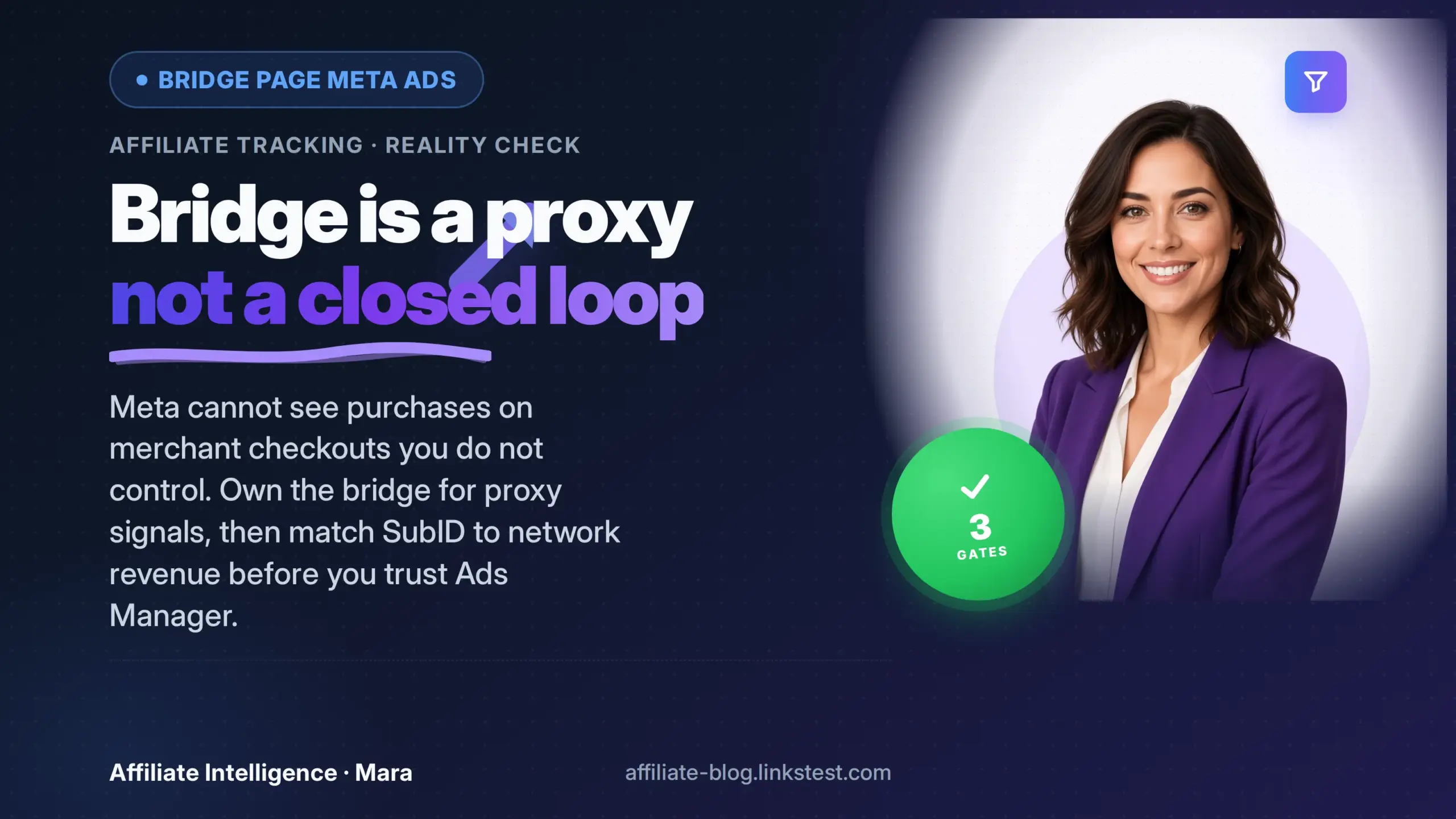
Operators often treat a bridge page plus Conversions API as the fix that closes the purchase loop. It doesn’t. Meta still learns from proxy events - page loads, button taps, outbound clicks - not from merchant checkouts. The structural constraint is blunt: you cannot pixel a checkout page you do not control. Without that final purchase signal, Meta knows someone clicked, never that someone bought. CAPI strengthens the proxies you already send; it never moves the Purchase event onto the merchant page. Name that false assumption before touching any setup.
Prerequisites
Before you touch a campaign, open two ledgers and keep them separate: Meta Ads Manager and your affiliate network’s revenue ledger. You need the network’s exact SubID parameter name - Impact uses subId1 with 255 characters, CJ uses sid with 64, Awin uses clickref with 50, and ShareASale uses afftrack with 255. Using the wrong name means the network silently drops the value.
You also need an owned bridge page, or the ability to create one; a clean browser profile with no extensions that strip parameters; and enough spend to generate a meaningful outbound sample. Before I trust a setup, I confirm which ledger owns truth. Meta reports platform-facing events; the network ledger reports money movements. They will not reconcile. Have both open and plan one controlled test click with a known ASCII label before going further.
Checkpoint: You can name your network’s payout parameter, paste a seeded test value into a live link, and open both dashboards side by side.
Step 1: The Checkout You Cannot Pixel
You own the bridge. You do not own the merchant checkout. Name that ownership boundary before any tooling.
Name the Purchasing Blind Spot
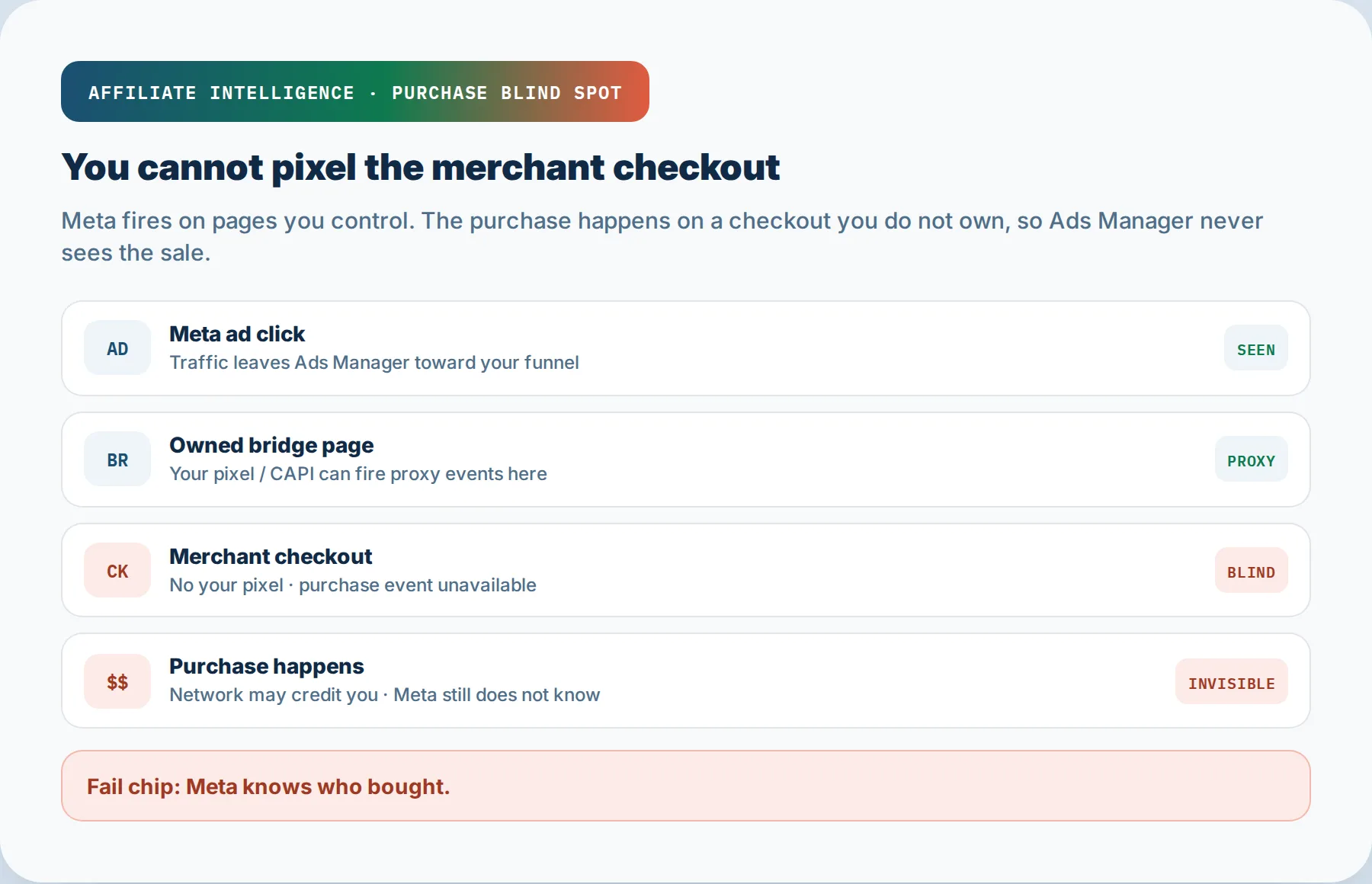
Walk the chain. Ad loads. User clicks. They may stop on your bridge, then advance to the merchant page. At checkout, your pixel is absent because the page isn’t yours. Purchase completes. Meta receives no purchase event. The optional bridge does not change that end state.
A bridge page you control can fire events before the handoff, but the transaction itself lives on another domain where your tracking has no rights. This is not a setup mistake - it’s ownership. Any tool that claims to close this loop is overstating what a proxy can do. The fail chip is “Meta knows who bought.” It doesn’t. The purchase stays invisible.
Checkpoint: Write a dated sentence in your own words: “Meta sees the click, never the sale.” Then mark one campaign where you currently treat a bridge event as proof of revenue for review.
Step 2: What a Bridge Page Actually Buys You
A bridge page is proxy infrastructure, not a closed loop. Build the instrumentable middle, and know what it cannot see.
Proxy Infrastructure, Not a Closed Loop
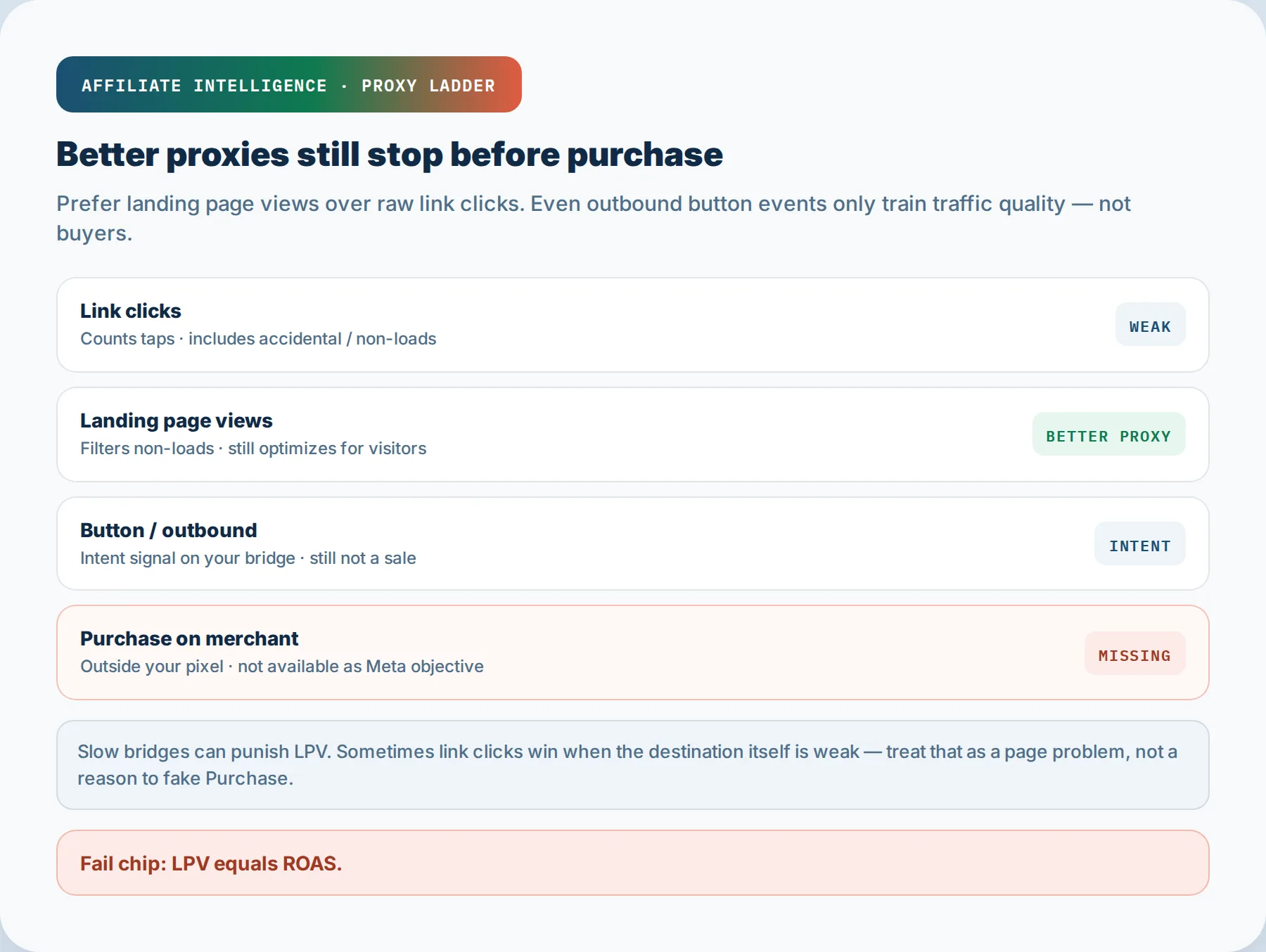
The closed-loop myth says a bridge page plus CAPI finally gives you purchase truth. It doesn’t. What the bridge gives you is a controlled page where your pixel and server can fire events: page load, time on page, button tap, outbound affiliate click. Those are proxy signals - they correlate with interest, not with money. A merchant checkout is still downstream, and Meta still never learns a sale happened.
The page can pre-sell, capture click IDs, and pass SubIDs forward. That’s real infrastructure. The fail chip is “LPV equals ROAS.” A landing page view is a loaded page, not a closed transaction. Treat the bridge as scaffolding you own before a handoff you don’t.
Prefer Landing Page Views Over Link Clicks
Link clicks count every outbound tap, including duplicates, accidental taps, and users who bail before the page renders. Landing page views require the destination to load, so they filter the noisiest, lowest-intent traffic. That matters when every signal is already weak.
I recommend LPV as the default proxy optimization event. Starting July 2025, Meta’s landing page view optimization became available even for advertisers with pixel sharing challenges (Meta Business Help Center), so the no-pixel excuse mostly died. There is a nuance: a slow bridge page or a broken pixel can make link clicks look temporarily stronger, because clicks fire before the page fails. If LPV trails link clicks by a wide margin, page speed or pixel health is the first suspect, not the audience. Use LPV as the stronger filter, and treat a sudden LPV collapse as an infrastructure alert, not a creative verdict.
Checkpoint: You have a bridge page event strategy with LPV as the default proxy and a logged reason for any exception.
Step 3: SubID Revenue Matching Is the Real Optimization Loop
Meta’s algorithm can’t tell you which creative earned revenue. That matching job is manual, and it runs on SubIDs. I trust the network ledger before Ads Manager.
Lay the SubID Spine
The real creative loop is a spreadsheet, not the ads UI. Append a unique SubID - or map a click ID through a SubID slot - to every affiliate link you run. When the network pays, the SubID comes back in the payout rows, and you join it to the creative. The parameter name is not yours to choose. Impact wants subId1; CJ wants sid; Awin wants clickref; ShareASale wants afftrack. Hand-append the wrong name and the network discards the label silently. For the full naming conventions and length limits across networks, see tracking best practices UTMs SubIDs S2S.
Example URL:
https://network.com/click?offer=123&sub1=meta&sub2=spring-campaign&sub3=creative-a-v1
For a network that expects a different slot name, that same intent might look like:
https://network.com/click?offer=123&afftrack=meta-spring-campaign-creative-a-v1
Check live docs before deploying. Build with the network’s Link Builder if required, then click once and wait 24 to 48 hours for the report. A blank column is a sequence failure, not a verdict. When the column stays blank after one controlled click, open silent attribution breaks diagnose and fix. The full naming conventions and length limits live in the SubIDs advanced tracking and attribution guide before you scale.
Checkpoint: Every live creative has a unique SubID value mapped in your tracker or sheet, and one seeded test click confirmed the value survives into the network report.
Use SubID Discipline for Creative Tests
Creative testing without a clean purchase signal lives or dies on SubID discipline. Run each creative with its own SubID, then pull network EPC or revenue per creative weekly. Kill the losers manually. Judge on network EPC and revenue, not Meta’s results count. A pretty CTR with a flat EPC is a visibility win, not a money win.
Structured SubID schemas outperform a single generic identifier. One source reports a 34 percent higher ROI for publishers who pass structured SubID schemas versus one generic tag. The number is directional, not gospel, but the mechanism is sound: more dimensions, earlier statistical decisions. Compare EPC by creative. If creative_a_v1 returns $0.12 per click and creative_b_v1 returns $0.80, the decision writes itself in the ledger. Before last-click overlap distorts that comparison, open PPC attribution collision last-click overlap. Meta never runs that comparison for you.
Checkpoint: You have a weekly EPC-by-creative cut and a kill rule written before you look at the numbers.
Step 4: CAPI and Offline Uploads: Ceilings, Not Magic
CAPI strengthens the proxy signals you already send. Offline uploads try to retrofit purchase truth. Both hit structural ceilings. I’ll say it again - the checkout stays unpixeled.
What CAPI Can and Cannot Move
Conversions API fires from your server on your bridge page. It does not move the Purchase event onto the merchant checkout. What it can do is send those bridge events with more weight and less browser loss. Practitioner reporting suggests server-side events received 3-4x more algorithmic weight than client-side-only signals. That is a practitioner account, not an official spec, but it lines up with better event match quality in real setups.
Think of CAPI as getting more credit for the same proxy event, not a retraining of Meta’s brain. Wire CAPI on the bridge. Just don’t expect it to turn a page view into a purchase.
The Offline Match Ceiling
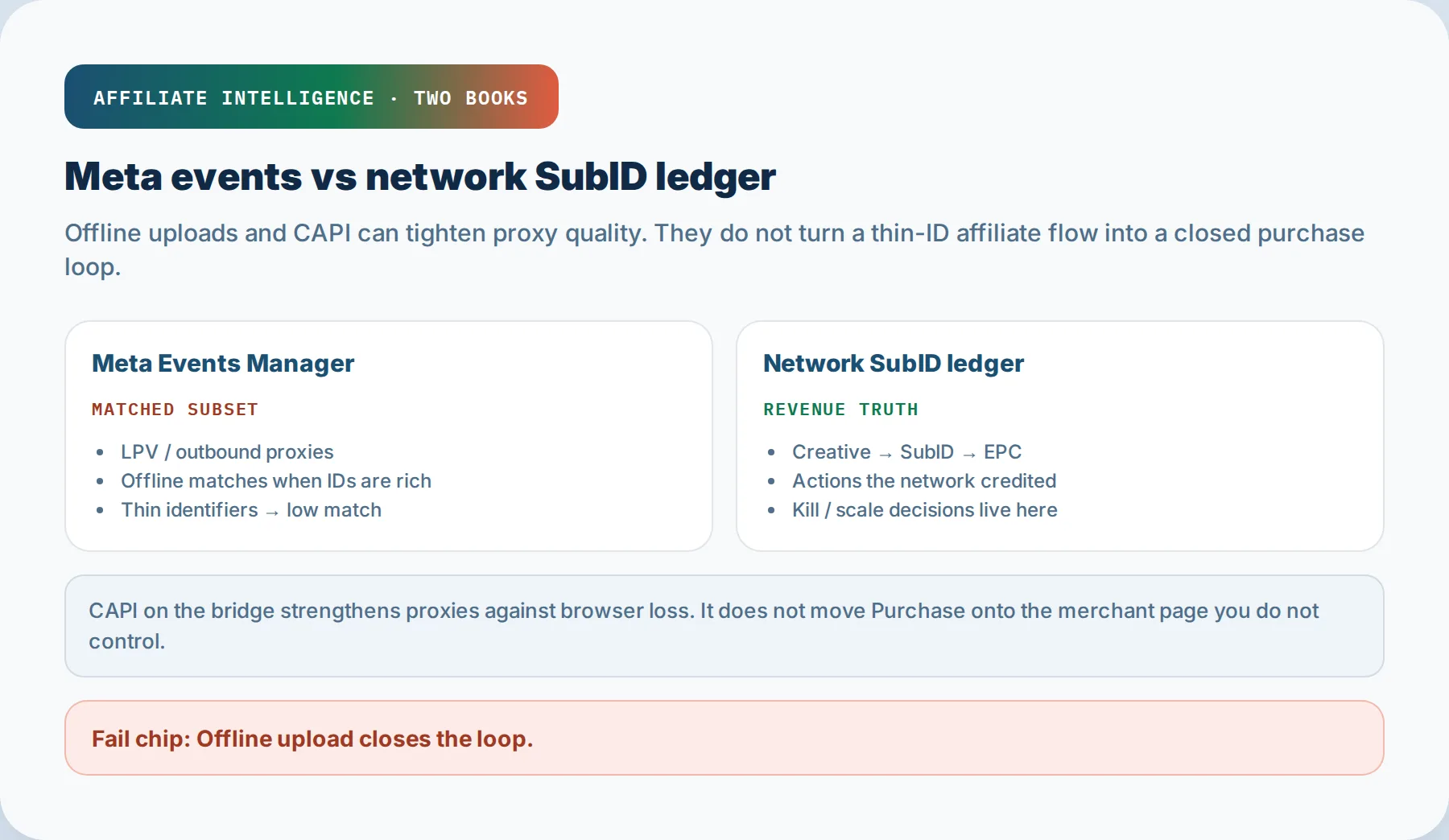
The two books stay separate. Meta Events Manager holds your bridge events; the network SubID ledger holds revenue. You can upload network conversion rows back to Meta as offline events, hoping Meta matches them to users it saw. The match ceiling is structural.
Offline matching depends on identifiers - hashed email, phone, name, click ID. Affiliate traffic is thin on those: no merchant email, no phone, often only a click ID that may not survive. Meta’s own guidance notes that insufficient customer fields lower match quality. When identifiers are thin, match rates fall hard. The server-to-server postback records the sale on the network side; Meta still only receives the matched subset you upload, and S2S postback failures behind a green tick is the audit path for that half. Do not read a single case like “4 of 40 matched” as a universal law - that is an illustrative reporting-gap pattern, not a fixed statistic. The honest statement is: offline uploads rarely restore Meta optimization for thin-ID affiliate traffic. You get a trickle of matched conversions, not a feedback loop. The fail chip: “Offline upload closes the loop.” It narrows the gap sometimes, never closes it.
Checkpoint: You accept that network actions and Meta’s matched subset will differ by design, and you stop chasing them to zero.
Step 5: Budget, Creative Tests, and Account Fragility
Thin budgets with no purchase signal fragment learning. High CTR with no conversions usually points at bridge alignment. Meta accounts are fragile; keep the setup honest and clean.
Consolidate When There Is No Purchase Signal
If Meta has no purchase event to optimize toward, every extra ad set fragments the same weak signal across more delivery pools. Fewer than 30-50 optimization events per week per ad set often means stability rarely arrives. At that volume, splitting into multiple ad sets hurts. Consolidate thin budgets into fewer ad sets and let the algorithm accumulate signal in one place.
Before you kill a test, check the outbound volume was meaningful: a few hundred clicks over a week won’t answer much, but a thousand clean outbound clicks with zero network conversions is a pattern, not noise. Pre-write your kill rules - max acceptable cost per acquisition, minimum outbound sample, and a cookie-lag window. Do not optimize creative while unit economics are red. The paid traffic tracking platforms setup pitfalls guide covers the arithmetic before you buy a single click.
Checkpoint: You have a consolidation threshold and a pre-written kill rule that includes outbound volume and cookie lag.
Audit Bridge Alignment and Respect Account Fragility
CTR without conversions is a diagnosis, not a traffic verdict. If the ad pulls clicks and the ledger stays flat, audit bridge alignment first - the page must echo the ad’s specific promise within the first viewport. A high CTR with a weak conversion rate points to a post-click gap, not a bad audience. When ad metrics improve but payouts don’t, open PPC commissions flat despite better ad metrics.
Tracker SaaS is optional - a tollbooth for convenience, not a requirement. If you run one, make sure it survives Meta review without cloaking-style footprints. No evasion, no ban circumvention. Account fragility is real: ad accounts get restricted over domain trust and false positives, and reviews typically complete within 48 hours, though restrictions can linger. Keep the bridge honest and the redirect chain short.
Checkpoint: You know which diagnostics to open next for flat payouts, silent breaks, attribution collision, and tracking best practices.
Step 6: Verification: The Two-Book Weekly Read
Verification is manual reconciliation between two ledgers. No single dashboard tells the truth. Pick the right source for each decision.
Read Two Ledgers Side by Side
Network actions and Meta’s matched subset differ by design, not error. Meta includes view-through and modeled conversions; the network ledger records actual paid actions attributed to your clicks. The gap is structural. Accept it and assign each decision to the right book.
For revenue truth and creative kills, read the SubID ledger. For in-platform optimization and proxy trend direction, read Ads Manager. When the two diverge - Meta looks green, the ledger looks red - the ledger wins. Reconcile weekly: are click IDs still appending on the bridge? Are SubIDs populating in the network report? Has the offline match rate dropped? Treat these as health checks, not weekly confessionals.
Checkpoint: You open both ledgers side by side weekly and write one kill-or-scale note from the network side, not the Ads Manager side.
Triage and Closing Scaffolding vs Building
The decision frame is simple. If the bridge page is green in Ads Manager while the SubID ledger is red, the campaign is losing. Kill or scale on network revenue, not proxy counts. Proxy signals train traffic quality; network revenue decides spend.
The bridge page is scaffolding - necessary, honest, incomplete. The building is the revenue loop you run by hand until a merchant grants you real checkout access, which almost never happens for third-party affiliates. Stop chasing a phantom closed loop. Wire the proxies, lay the SubID spine, respect the offline ceiling, consolidate thin signal, and make the weekly call from the ledger.
Troubleshooting Common Issues
- LPV rises but network EPC is flat. Proxy training improved page arrivals, not buyers. Re-audit bridge message match, compare EPC by SubID, and don’t scale on LPV alone.
- SubID column is blank. Likely the wrong parameter name or a stripped param in a redirect. Check live docs, rebuild the link, run one controlled click, trace every hop.
- CAPI shows green but no Purchase at merchant. Expected structural blind spot, not a fixable break. Keep CAPI for bridge events and accept no merchant Purchase.
- Learning limited persists. Signal is fragmented across too many ad sets, or no purchase event exists. Consolidate into fewer ad sets, optimize for LPV, and keep one primary event.
- Offline upload matches poorly. Thin identifiers. Where lawful, add more match keys. Otherwise accept the ceiling and judge on the SubID ledger.
- High CTR, zero conversions. Bridge alignment gap. Audit promise match above the fold, funnel continuity, and load speed before touching targeting.