Measure Customer LTV by Affiliate Partner Before You Touch the Rate Card
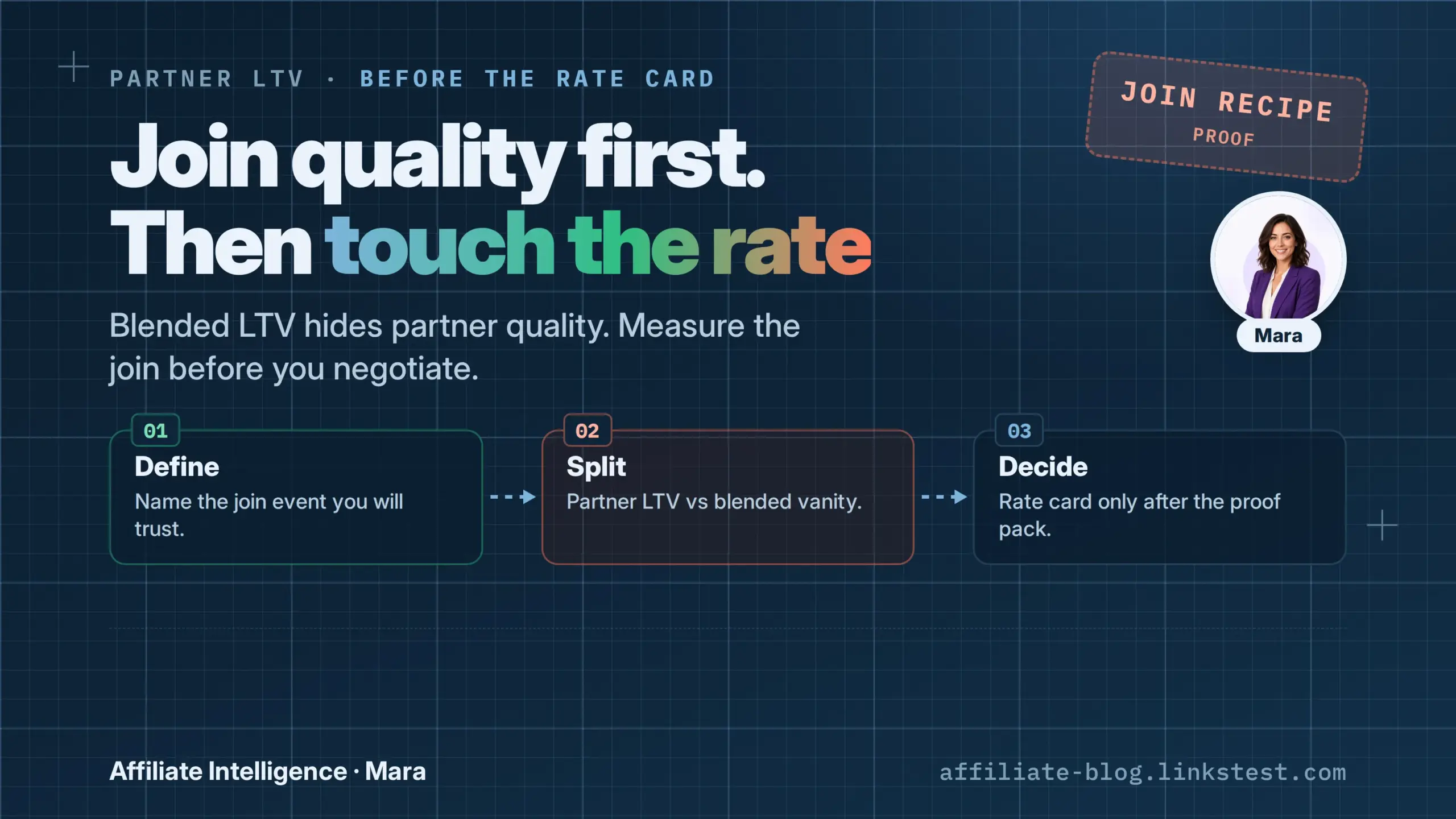
The rate card is the last thing you touch. Before it, a partner-level join. This is how you measure customer LTV by affiliate partner before touching a single rate. Blended LTV gives you a number; the join tells you whether that number is yours. Eight beats, one sheet, no new stack. This is the measurement gate between the rate you inherited and the rate you can actually defend.
Workbench Before Rate Edits
Goal: get the sheet ready before any join exists. You need six columns before you can measure customer LTV by affiliate partner. None of them require a warehouse. They require decisions.
affiliate_id— a stable publisher ID from the network export, not a campaign name that changes with every promotion.first_order_at— the acquisition date anchor. Every downstream retention month is counted from this timestamp.cohort_revenue_by_month— revenue per partner per month since first order, so the curve can be read across time instead of flattened into a single average.refund_window_days— this must mirror the published refund policy, not the friendlier number the growth team prefers.gross_profit_per_order— revenue minus COGS, per order. Revenue-only sorting flatters low-margin SKUs and cuts the wrong partner.ntf_flag— derived from the one-sentence NTF definition signed by the business.
The NTF definition is a sentence, not a vibe. New means first-ever purchase date, or first order in 24 months. Write it. Get finance, marketing, and the affiliate manager to sign it. If you cannot write it in one sentence, any partner LTV number is theater. The full case sits in the new-to-file rate as the early quality proxy.
Why it works: a join is only as good as the columns you anchor it to. An undefined “new customer” produces a number you cannot defend in a budget room.
Checkpoint: The sheet has one row per partner, all six columns filled, and the NTF sentence signed by all three functions.
The Join Gate Sits Before the Rate Card
The partner-level join is the measurement gate between the rate you inherited and the rate you can defend. Before that join exists, any rate card edit is a bet on a headline you have not verified at the customer level.
A network dashboard will tell you clicks, conversions, first-order revenue, and maybe EPC. It will not tell you whether a partner’s customers repurchase, whether they return at a different rate, or whether those first purchases are new-to-file demand or recycled checkout-layer capture. Those answers live in the join between affiliate source, orders, and customer retention.
Until the join exists, the rate card is frozen. That is not conservatism for its own sake. It is sequencing. If you raise or cut a rate before you know which partners compound at 90 days, you are pricing the average while the curves underneath are moving in opposite directions. Blended LTV and imported benchmarks are not substitutes for that join. They are averages; the join is evidence.
One sheet is the test: partner ID, 90-day gross profit per customer, NTF flag, refund flag, chargeback flag, and keep rate. If those columns are not populated, the rate card is not ready.
Why it works: measurement before structure prevents a rate change from becoming a louder version of the same error.
Checkpoint: The join-gate columns are on one sheet, and no rate change is authorized until that sheet exists.
Blended LTV Is a Subsidy Map
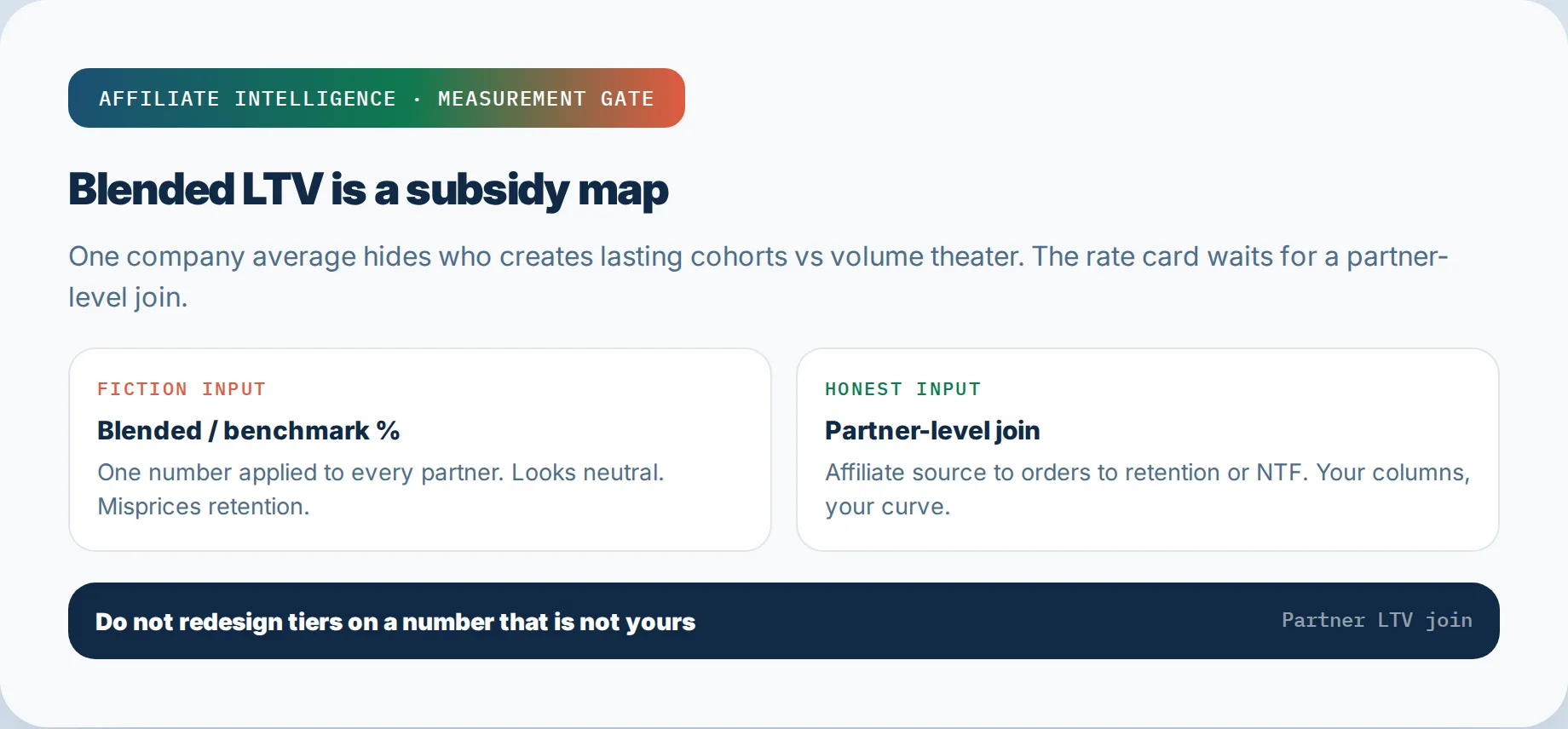
Blended LTV averages a content partner’s multi-quarter customer into a coupon partner’s one-and-done buyer. The average is real. It is also useless for pricing either partner. A flat model built on the blend overtaxes creation and subsidizes capture.
The structural failure is visible only when you look at cohort shape. Two partners can each send the same number of first orders. One cohort flattens after order one. The other repeats and compounds. Same order count, same first-order revenue, same blended LTV contribution. The blend sees one number. The join sees two curves heading in opposite directions. You cannot underwrite a rate card from an average that hides the direction.
Blended LTV is therefore not a neutral input. It is a subsidy map. It quietly transfers margin from partners who create demand that compounds to partners who capture demand that was already decided. The fix is not a better percentage on top of the blend. The fix is to stop designing on the blend at all. The economics of affordability are covered in the commission sustainability and margin yield guide.
Why this works: once you name blended LTV as a subsidy map, you stop trying to correct it with a rate tweak. The rate tweak is a louder version of the same model.
Checkpoint: You can state, from your own order data, which partner types the current flat model overpays and underpays before touching a single rate.
Partner-Level LTV Is Columns, Not a Dashboard Myth
Partner-level LTV is not a field your affiliate platform will hand you. It is three columns and a direction. Fintel Connect’s partner LTV guide names the gap directly: affiliate reporting often stops at the conversion event, while customer value continues to develop after onboarding.
affiliate_id— the anchor.cohort_gross_profit_90d— gross profit per customer at 90 days, by partner.ntf_flag— from the signed definition.
The direction is the fourth element. Sort partners by 90-day gross profit per customer and ask one question: does the curve flatten or compound? A partner whose curve compounds is worth a different rate than one whose curve is flat, even at identical first-order counts.
Why it works: the level tells you where partners rank; the direction tells you what you are underwriting. Dashboard metrics often reverse those two.
Checkpoint: You can name all three columns, and you can sort partners by 90-day gross profit per customer on one sheet.
Assumed LTV vs Retention Cohorts You Already Have
Many rate discussions start with an assumed LTV imported from a model. The better starting point is the retention cohort already sitting in your order history. A cohort retention curve is not a projection; it is observed behavior. It shows whether customers bought once or came back, and when.
To pull retention by partner, join the affiliate source to the first purchase date, then count repeat orders in each subsequent month by partner. That gives you a partner-level retention curve. It beats assumed LTV because it does not require a lifetime model to be correct before you make a pricing decision.
When full LTV lag is long, use NTF as the early quality proxy. A partner driving true first purchases may still look immature at day 90, but the NTF flag tells you whether the cohort is real acquisition or recycled demand. Adobe’s lifetime revenue cohort documentation makes the same move: filter the cohort chart by acquisition source to see whether one source’s customers are more loyal or more valuable than another’s. That filter is the join.
Why it works: observed retention beats assumed LTV, and NTF bridges the lag when the full lifetime curve is not mature enough to trust.
Checkpoint: At least one partner retention cohort is pulled from existing order history, and NTF is applied as the early proxy.
Siloed Export vs CRM Is Plumbing, Not a Skip
The gap between the affiliate export and the CRM or order system is plumbing. It is not a license to keep reporting at the conversion event. The affiliate platform closes the loop at the sale; the CRM holds the rest of the customer behavior. The join between them is the measurement.
This gap is why conversion-level reporting hides LTV. A partner can look efficient at click-to-order while producing weak downstream value. A different partner can look ordinary on first order while driving the cohort that compounds. If your reporting stops at conversion, you are pricing acquisition efficiency while ignoring customer quality.
A spreadsheet join is enough for one partner read. Export affiliate IDs and order IDs, map once, and sort by repeat behavior. It is less repeatable than a warehouse join, but it produces a real answer. The danger is partial mapping. An unmatched partner ID silently drops that partner from the cohort, and the missing row looks like low performance or no performance. Reconcile unmatched IDs before trusting any partner-level read.
Why it works: naming the gap as plumbing makes measurement tractable. The cost of the join is not a system problem; it is a decision to map the IDs.
Checkpoint: The affiliate export and CRM share at least one reconciled join across partner ID and order ID.
Build the CRM Join: Affiliate Source to Orders to Retention or NTF
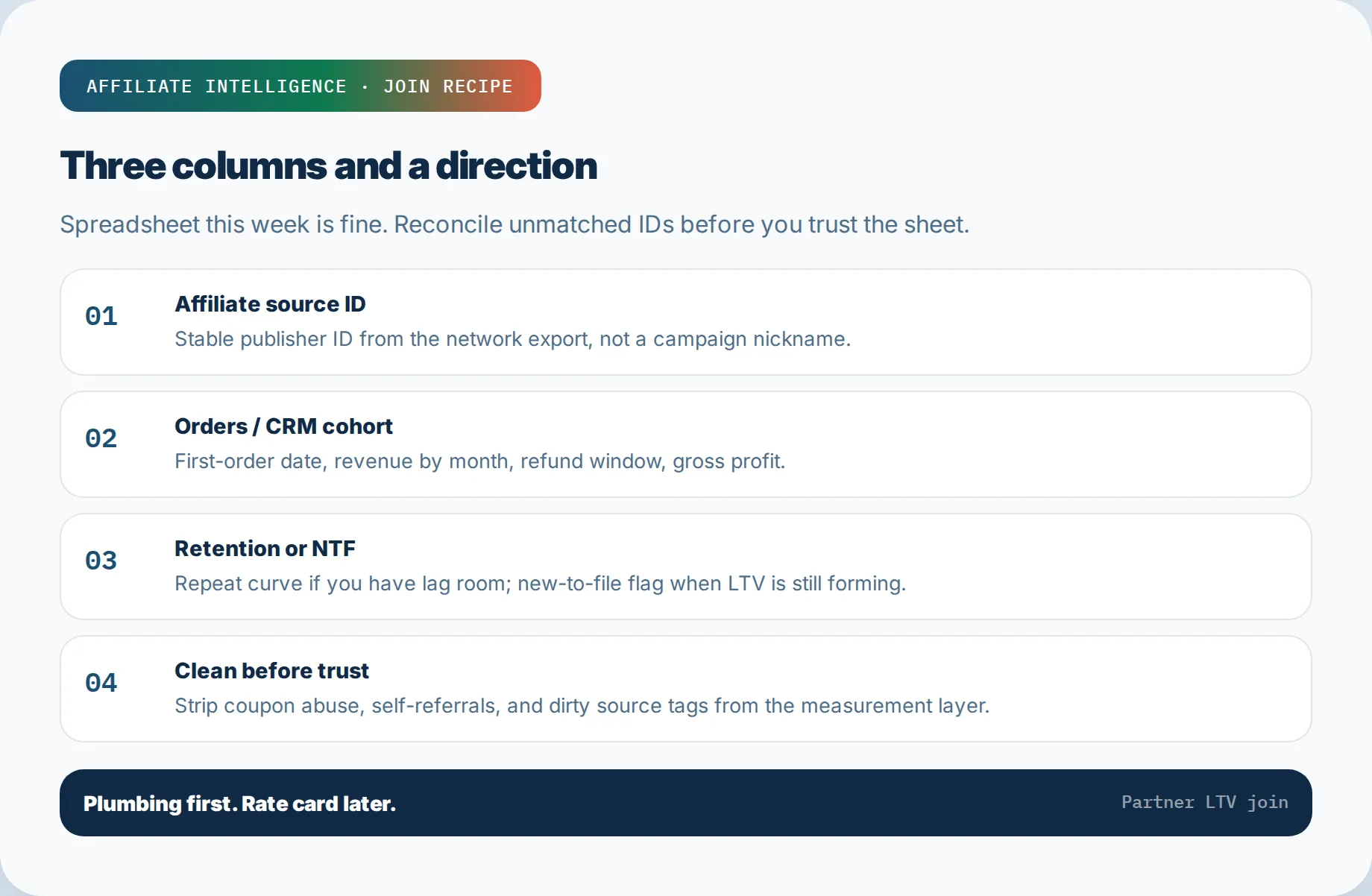
Goal: produce a reconciled join where every partner row carries NTF or retention. The raw material sits in your OMS and affiliate exports. Production systems already hold it. The join is affiliate source → orders → CRM.
SELECT
  a.affiliate_id,
  DATE_TRUNC('month', o.first_order_at) AS cohort_month,
  COUNT(DISTINCT o.customer_id) AS customers,
  SUM(o.revenue) AS cohort_revenue,
  SUM(o.gross_profit) AS cohort_gross_profit,
  SUM(CASE WHEN c.first_order_at = o.first_order_at THEN 1 ELSE 0 END) AS ntf_customers
FROM affiliate_attribution a
JOIN orders o ON a.order_id = o.order_id
JOIN customers c ON o.customer_id = c.customer_id
GROUP BY 1, 2;
If gross_profit is not in the warehouse, join margin per SKU from the product table. Do not sort on revenue alone.
Spreadsheet fallback: if SQL is not available this week, export partner IDs and order IDs, then map once. A vlookup or index-match in one sheet is a join. It is less repeatable; it is enough for one partner read. A spreadsheet join is still a real join. Partial mapping is worse than none — an unmatched affiliate_id silently drops that partner from the cohort. Reconcile unmatched IDs before paying anything on the join.
When full LTV lag is long, NTF is the early quality proxy. Use it to separate partners who create new demand from partners who recycle existing demand. The new-to-file rate KPI guide argues that a dashboard without an NTF column is incomplete because revenue rankings favor checkout-layer capture over real acquisition.
Why it works: the join surfaces the curve per partner — flat or compound. That shape, not first-order total, is what you underwrite.
Checkpoint: You can sort partners by 90- or 180-day cohort gross profit per customer, the NTF flag is applied, and unmatched IDs are reconciled.
Clean Before You Trust: Coupon Abuse, Self-Referrals, Dirty Tags
Cohort LTV is only as clean as its attribution. Three scrubs first.
Coupon cohorts. A coupon partner can look high-LTV while intercepting decided buyers who were already coming. Run the five signals in the coupon cohort cannibalization signal guide before trusting the curve.
Self-referral rings. Self-referred orders are fake LTV: the affiliate is the buyer. Self-referral is one of the most common affiliate fraud patterns, and an IP match between click and checkout catches a meaningful share of naive attempts. Hold commissions 30 - 60 days to let refund-window churn surface. The commission clawback and reversal guide covers the reversal taxonomy.
Dirty tags. Inconsistent UTM capitalization splits one partner into three rows. “Facebook” and “facebook” are different sources to the join. Normalize before sorting.
Why it works: a join built on dirty attribution ranks the wrong partners with conviction. Clean first, then trust.
Checkpoint: Partner rows with self-referral flags or leaked coupon codes are excluded or flagged before any LTV comparison.
Discount and Coupon Cohorts Break LTV
A discount or coupon cohort can look high-LTV because the front-end revenue arrives cleanly. The problem is intent. If a coupon partner intercepts shoppers who already decided to buy, the cohort may look profitable while adding little incremental demand.
The repair is classification, not a rate cut on vibes. Before you trust a coupon partner’s LTV, check whether the partner appears anywhere in the funnel other than the final click, whether the code is reused on content landings, and whether the new-to-file rate is materially different from the rest of the program. The five coupon partner cannibalization signals separate additive recovery from capture. Run those before letting a coupon cohort set the wider rate card.
Why it works: a coupon cohort is only as valuable as the demand it creates. The signal set separates creation from interception.
Checkpoint: Coupon partner rows are classified as additive or intercepting before their LTV is used in any pricing decision.
Downstream Columns That Break Blended Math
Blended math breaks downstream when you forget the columns that change partner-level value. Four columns matter.
Refund window. A partner at a 9% return rate is not the same LTV as a partner at 2%, even at identical first-order totals. Refund exposure is a partner-level risk column, not a program-level memo.
Keep rate. Paying commission on sticker revenue when returns eat the difference overstates both revenue and LTV. The keep rate versus sticker rate guide does the full arithmetic.
Chargebacks. A card lookback can run months after payout. Banked commission gets pulled retroactively. Track it by partner, not in aggregate.
Gross margin. Revenue LTV flatters a low-margin SKU. Gross profit LTV does not. A partner sending $100 orders at a 60% margin outearns a partner sending $150 orders at a 35% margin, before any refund difference. Sort by revenue and you cut the wrong one.
NTF belongs in the same downstream view. A partner with high first-order revenue but low new-to-file is recycling demand. That changes the rate more than a blended LTV delta.
Checkpoint: Every partner row carries refund, keep rate, chargeback, gross profit, and NTF columns before any LTV comparison.
Benchmarks Fail Without Margin, Payback, and Retention
An industry commission median is a number without your payback. It cannot tell you whether a rate clears your margin, your refund burden, or your cash cycle. A 20% payout is ruinous at 30% gross margin and trivial at 80%. The benchmark is someone else’s underwriting.
Before any external benchmark is trusted, three local numbers have to sit beside it: gross margin per order, payback period, and 90-day retention. Those three determine whether a commission is affordable on your unit economics. The commission sustainability and unit economics guide covers the yield-versus-sticker math in full. The short version: affordability comes from your own margin, not from a competitor deck.
Why it works: a benchmark can only ever be a comparison, never a law. Local unit economics make it a decision.
Checkpoint: You can reject any external benchmark that does not clear your local margin and payback, with the arithmetic written down.
Before You Cut a Low-LTV Partner, Check the Funnel
A low-LTV partner is not automatically a failed partner. Check the funnel first.
- Last-click overwrite. If a checkout extension overwrites a content cookie, the content partner’s LTV reads as zero because the attribution moved. Check whether low-LTV partners are the ones being overwritten.
- Cookie window truncation. If your attribution window is shorter than the buying cycle, the partner who started the journey loses credit. A 30-day cookie in a 60-day evaluation cycle produces false negatives.
- Landing page or offer mismatch. If a partner’s audience arrives to an offer that does not match the referral context, weak retention may be a mismatch, not a partner-quality problem.
- Conversion path breakage. Broken post-click tracking, missing UTM pass-through, or a checkout flow that drops the affiliate parameter can break the join before the customer ever repurchases.
- Post-click experience. If onboarding is weak, a cohort may underperform across every partner. That is a program-wide issue, not a single low-LTV partner.
- Coupon intercept. A coupon cohort with strong front-end numbers but flat retention is capture, not creation. The coupon partner cannibalization signals identify that pattern.
- NTF quality. If a partner drives true first purchases that never repeat, that is a value problem, but a different one from recycling existing demand.
Cutting on blended LTV cuts the partner you never measured. Check the funnel. Then decide.
Checkpoint: Every low-LTV partner is labeled funnel-failure, attribution-failure, or true quality-failure before any demotion or cut.
This-Week One-Partner Proof Pack
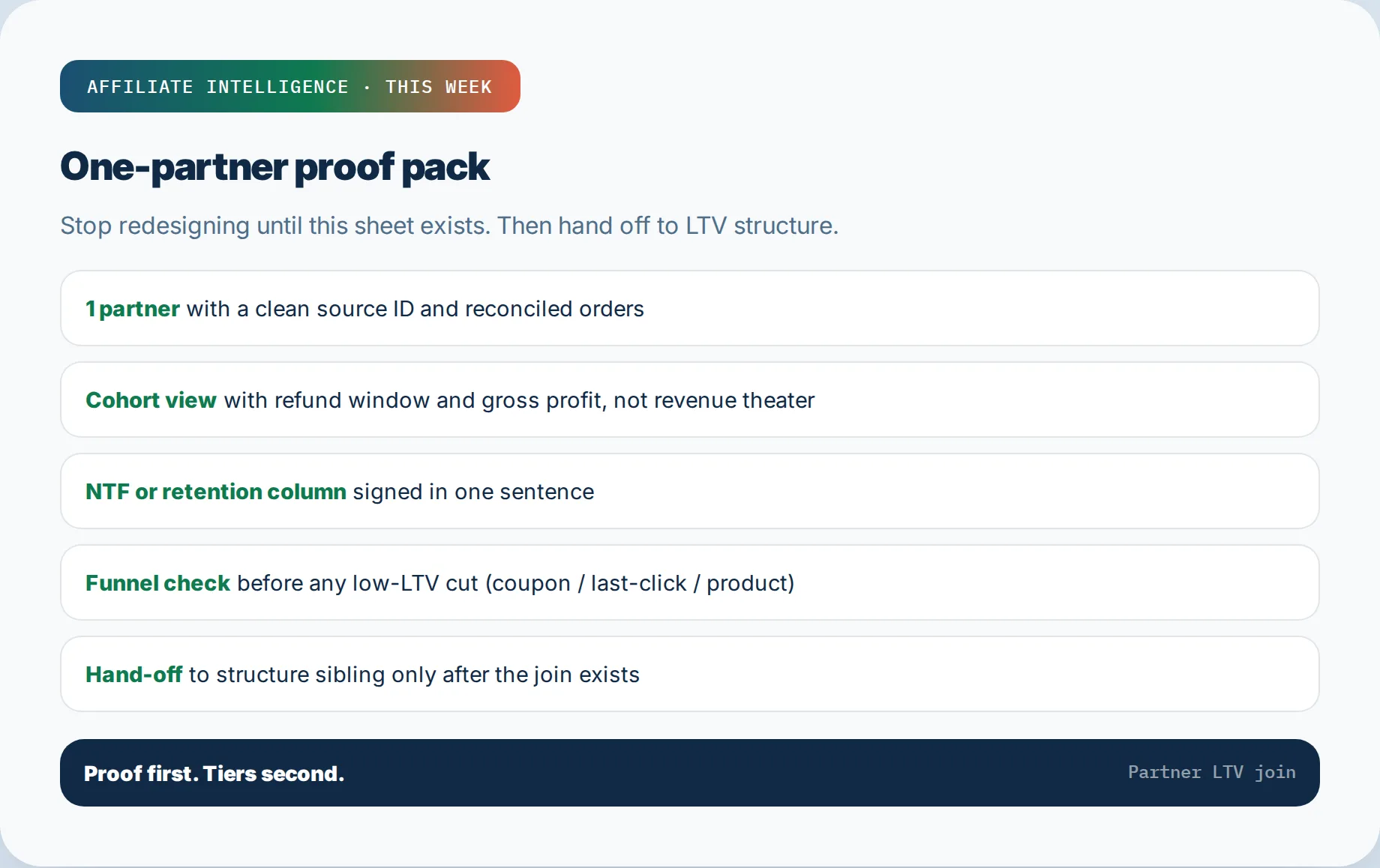
This week’s deliverable is not a redesigned commission schedule. It is a proof pack: one partner’s join, cleaned, sorted, with a temporary cap instead of a new tier chart.
Pick one partner. Run the join. Produce a one-page summary with the partner-level columns: 90-day gross profit per customer, NTF flag, refund flag, chargeback flag, keep rate, and retention direction. The point is to prove the join works on one row before scaling it to the whole program.
Thin data is normal at this stage. If you only have 90 days of cohort, do not invent permanent tiers. Use a temporary cap:
cap:
  type: temporary_cap
  value: 3_orders_or_90_days
  review: monthly
A cap converts an open-ended promise into a forecastable cost. You can raise later; a cut is governed and painful. Once the join exists and the table is clean, the redesign becomes a structure question, not a rate question. The pay for customer value structure after the join exists handles caps, taper, and gates. Do not rebuild tiers here.
The sequence does not need a vendor case study to hold: measurement first, structure second. Run the one-partner join, then hand off to the structure sibling only after the sheet exists.
Checkpoint: One partner’s proof pack exists, a temporary cap is in place, and no permanent tier changes have shipped.
Troubleshooting When the Join Won’t Cooperate
- No native network partner LTV. Your export will not hand you cohort LTV. Export affiliate IDs and order IDs, then join manually. This is an unblocking step, not a product gap.
- Partial ID mapping. Unmatched IDs silently drop partners. Reconcile before paying anything on the join. A missing
affiliate_idis a missing cohort row. - Coupon intercepts inflate capture. Apply coupon-cohort flags and exclude them from acquisition pricing. Check the five signals before trusting the curve.
- Self-referral rings. IP and fingerprint matching, plus a 30-60 day hold, catches most of the visible abuse. Instant payout is an open door.
- Dirty source tags split partners. Normalize UTM capitalization to one source per partner. “Facebook” and “facebook” are two rows until you fix them.
- No gross profit column. Join margin per SKU from the product table. Revenue-only sorting cuts the wrong partner.
- When to use a temporary cap. If the cohort is not mature enough for permanent tiers, cap at 3 orders or 90 days and review monthly. Do not ship a permanent structure on thin data.
- Hand-off to structure only after the join exists. The LTV-based commission structure guide is the next step, not a parallel workstream.
Next-Week Join Questions
- Which partner rows are still unmatched after the first reconciliation pass?
- Which cohorts flatten by day 90, and which ones compound?
- Which downstream column changed a partner’s rank from the revenue-only view?
- Which partner needs a temporary cap before any permanent structure is drafted?
- Which coupon partner needs the five-signal classification before its LTV is used in the rate card?
- Can you write the NTF sentence in one sentence and keep it signed?
- Does one partner’s proof pack now exist with the reconciled join and clean columns?